
NMLSRegulated
United States Crypto Asset Transfer License (MTL)




United States Crypto Asset Transfer License (MTL)

Singapore Crypto Asset Exchange License (CEX)

Ireland Crypto Asset Payment License (EMI)

Malta Crypto Asset Trading License (STP)
United Kingdom Virtual Asset Service Provider (VASP)
Australia Virtual Asset Service Provider (VASP)
Canada Crypto Asset Exchange Registration (MSB)

Start each round with 100 units, play at hotspot coins, set stop losses and gains. Move from 100 to 200, then 200 to 400, and 400 to 800. Remember to stop after three rounds! Crypto trading requires luck, and going all in each time, you may win nine times and lose once. If you make it through the three rounds with 100 units, you'll end up with 1100 units! At this point, I recommend a triple-strategy approach. Make two types of trades each day: ultra-short-term trades and strategic trades. Add trend-based trades if opportunities arise. Ultra-short-term trades are for quick in-out moves on a 15-minute timeframe. Pros: High returns. Cons: High risk. These trades are best done with major players like Bitcoin or Ethereum. The second type, strategic trades, involve contracts of around four hours with small positions, for example, ten times 15 units. Save the profits and regularly invest in Bitcoin each week. The third type, trend trades, are for medium-to-long term transactions. Go straight in when you're sure. Pros: You can score big if you choose the right spot and set a relative high-risk-to-reward ratio. In summary, from eight years of crypto trading experience: First, either hone your own skills or find a reliable mentor to learn from. Second, control your emotions. Don't chase the market and collect more information. Third, entry is important, but exit is paramount. We can study together on choosing the right entry timing.

GEMINI is trying their best, the exchange still need a little improvement...for future use.
Exchanges with reserves exceeding 88.51%
Exchanges with 24H outflows exceeding 80.64%
Exchanges with 24H trading volume exceeding 91.34%
| Currency/Name | Trade | Unit Price | Change | 24H Vol | +2%/-2% Market Depth | Liquidity |
|---|---|---|---|---|---|---|
| BTC/USDT | $78,954.31 | -- | $45,749.14 | $68.26K/$65.38K | 541 |
| ETH/USDT | $2,505.21 | 3.57% | $21,700.39 | $9.51K/$9.51K | 415 |
What Is Gemini?
Gemini is a New York-based cryptocurrency centralized exchange (CEX) regulated by the New York State Department of Financial Services, available in all 50 U.S. states and over 60 countries. The platform was built with a focus on security and compliance, although it offers fewer crypto assets than its competitors, notably over 80 cryptocurrencies and over 21 crypto-to-crypto trading pairs.
The platform is aimed at both beginners and advanced traders. In addition to an intuitive user interface, the project has a library of educational content for crypto newcomers. Customer accounts are well protected, the crypto exchange was one of the first to receive ‘SOC 1 Type 2’ and ‘SOC 2 Type 2’ certification. The exchange also offers insurance coverage against certain types of losses.
The core products are Gemini ActiveTrader (for skilled traders and investors), Gemini Exchange, Gemini Derivatives, Gemini Wallet, Gemini Mobile, Gemini Clearing, Gemini Dollar (GUSD) and Gemini Custody.
Who Are the Gemini Founders?
The company was co-founded by brothers Tyler and Cameron Winklevoss. They are identical twins, former Olympic rowers, investors and founders of Winklevoss Capital Management.
The brothers are co-founders of the social networking service — HarvardConnection (or ConnectU) and co-founders of the social media website — Guest of a Guest. They were also classmates of Mark Zuckerberg at Harvard. In 2004, they sued Zuckerberg and accused him of stealing their idea (implying the ConnectU project) to create the popular social network — Facebook. As a result, the twins won a $65 million settlement from the lawsuit.
When Did Gemini Launch?
Gemini Trust Company, LLC announced the launch of the Gemini exchange in early 2014, although it went live in October 2015.
Gemini Restricted Countries
The exchange is available in over 60 countries, including the United States, the United Kingdom, Canada, Australia, Hong Kong, Singapore, South Korea. The entire list of available countries can be found on their website.
What Coins Are Supported on Gemini?
With Gemini, traders and investors can buy, sell and store over 80 cryptocurrencies, including BTC, ETH, GUSD, XRP, ADA, AAVE, DAI, LINK, LTC, USDC and more.
How Much Are Gemini Fees?
Gemini offers a variety of fee schedules depending on the product & usage level. This includes: API fee, Mobile fee, Marketplace fee, app fee, custody fee, ActiveTrader™ fee, transfer fee and more.
To determine which fee schedule is right for you, find our products and their corresponding fee structures here: https://www.gemini.com/fees
Trading fees under Active Trader are charged under a maker-taker model, depending on the user’s 30-day trading volume. Maker fee ranges from 0.40% ($0 trading volume) to 0.03% (over $500M trading volume), and taker fee ranges from 0.20% ($0 trading volume) to 0.00% (over $500M trading volume).
Stablecoin pairs are charged 0.00%/0.01% in maker/taker fees.
Is It Possible To Use Leverage or Margin Trading on Gemini?
Leverage or margin trading is available. Gemini offers up to 100x leverage for BTC, ETH, and PEPE perpetuals through Gemini Crypto Derivatives product. Leverage is set at the account level and the default is up to 20x.
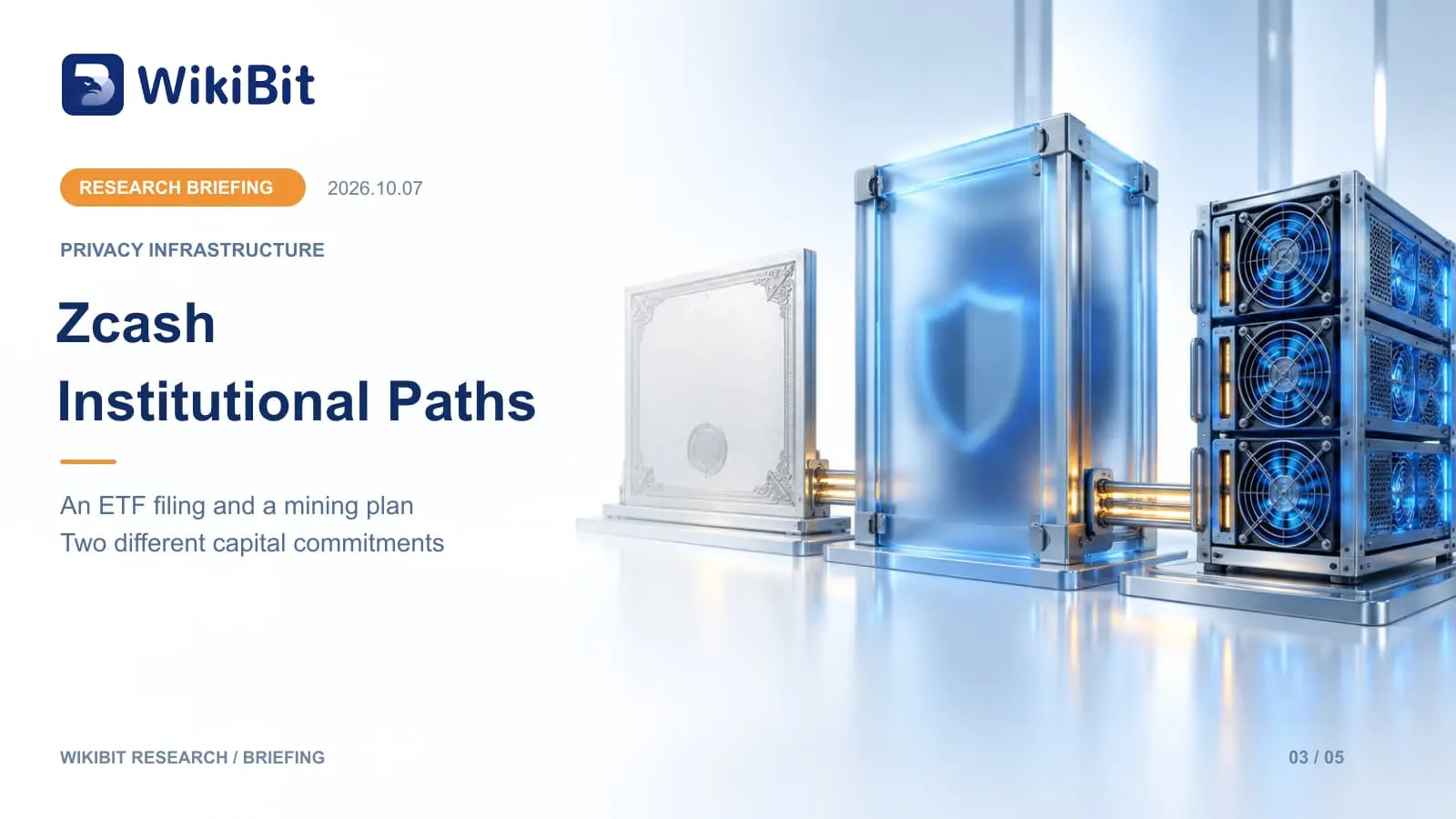
Zcash is being institutionalized in two very different markets at the same time. On October 6, Winklevoss Asset Services filed a preliminary S-1 registration statement for the Winklevoss Zcash ETF, which is expected to seek a Nasdaq listing under the ticker WINK. The proposed product would hold ZEC directly. Gemini Trust Company would custody the ZEC. The sponsor fee is proposed at 0.25% annually. Winklevoss Capital Fund has indicated non-binding interest in purchasing up to $100 million of shares. Separately, Fortitude Mining Holdings signed a letter of intent with Bitmain for priority access to next-generation Zcash mining equipment, with a non-binding purchase commitment of up to $100 million. One project packages ZEC for brokerage accounts. The other invests in the physical infrastructure that secures the network. Together, they make a stronger narrative than a price rally: institutional capital is beginning to build both the financial wrapper and the production layer around a privacy asset.WINK Is a Preliminary Filing, Not a Live ETF The SEC filing is explicit. The registration statement is preliminary. The shares cannot be sold until the registration becomes effective. The trust expects a Nasdaq listing under WINK, subject to the required process. The funds objective is straightforward: hold ZEC and provide exposure to its price, less expenses and liabilities. The filing still contains
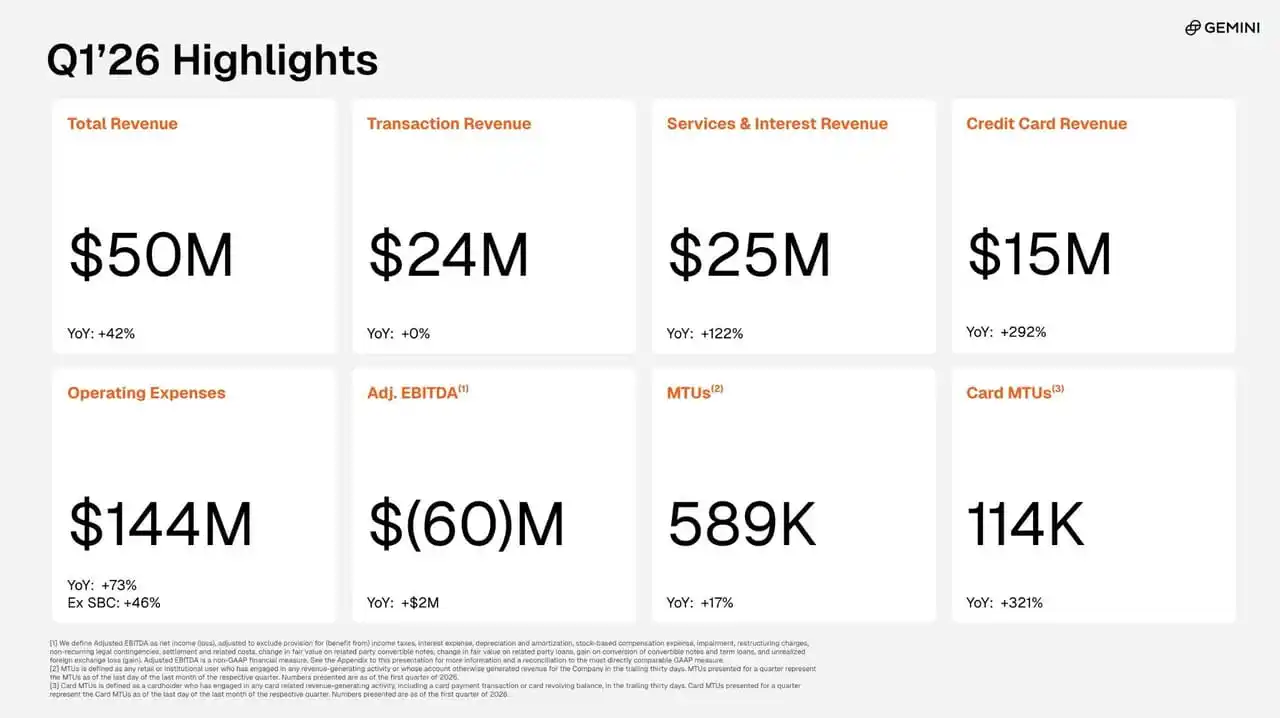
Crypto company Gemini reported a 42% year-over-year increase in revenue in Q1 2026 as it continued its growth from a pure crypto exchange to a financial services company. Total revenue for the Winklevoss twins company grew 42% year over year to $50.3 million in the first quarter, while transaction revenue remained stable at $24 million, the company reported Thursday. However, its crypto exchange revenue decreased 27% year-over-year to $17.2 million, “reflecting lower spot trading activity and a moderation in crypto market volumes,” while total trading volume declined to $6.3 billion from $13.5 billion in Q1 2025. The biggest increase was in credit card revenue, which surged nearly 300% to $14.7 million, driven by significant growth in the Gemini Credit Card user base, the company said. The expansion from crypto into broader financial services began in early 2021, when the company announced consumer finance products such as credit cards. Five years later, services and interest income, driven heavily by credit cards, made up almost half of total revenue, showing how pivotal the expansion has become. “As Gemini continues to evolve, we expect that the momentum we have built in diversifying our revenue will only accelerate,” said Gemini president Cameron Winklevoss. Geminis revenue increased, but so did operating
Crypto exchange Gemini has secured a Derivatives Clearing Organisation (DCO) license through its affiliate, Gemini Olympus, marking a major step in the companys push into regulated crypto derivatives and prediction markets in the United States. The approval was granted by the Commodity Futures Trading Commission, giving Gemini the authority to operate its own clearing infrastructure for derivatives products. The approval allows the company to clear and settle trades internally instead of relying on external clearing firms. It also expands Geminis regulatory footprint as competition intensifies among crypto exchanges seeking to establish regulated derivatives businesses in the US market. The company had previously secured a Designated Contract Market (DCM) license, which permits the listing and trading of derivatives products. With the addition of DCO status, Gemini can now handle clearing operations tied to those contracts. Gemini expands regulated derivatives infrastructure By operating its own clearinghouse, Gemini gains more direct control over how derivatives trades are processed and secured. According to regulatory filings tied to the approval, Gemini Olympus plans to support fully collateralised derivatives products, including futures, options, perpetual contracts, and event-based markets. The structure is also expected to support prediction market offerings connected to financial, economic, political, and sports-related outcomes. Gemini Titan, another affiliate linked to the companys derivatives infrastructure,