MASRegulated
Singapore Crypto Asset Payment License (EMI)





Singapore Crypto Asset Payment License (EMI)


I wonder why when I want to withdraw money, I have to pay taxes and fees first. In order to withdraw money, the purchase is a very high amount of money. I'm not sure to pay first.

I can't accept the trading fees of PAXOS. Opening the platform is a strong smell of routines. Even if you have excellent features, it is difficult to benefit from such a poor user experience.
itBit is the world’s first regulated digital asset platform, built for institutional investors as the most reliable, secure and efficient way to hold and trade crypto assets. itBit offers fiat to crypto trading, escrow, custody and OTC solutions for Bitcoin, Bitcoin Cash, Ethereum, Litecoin, Stellar Lumens and more.
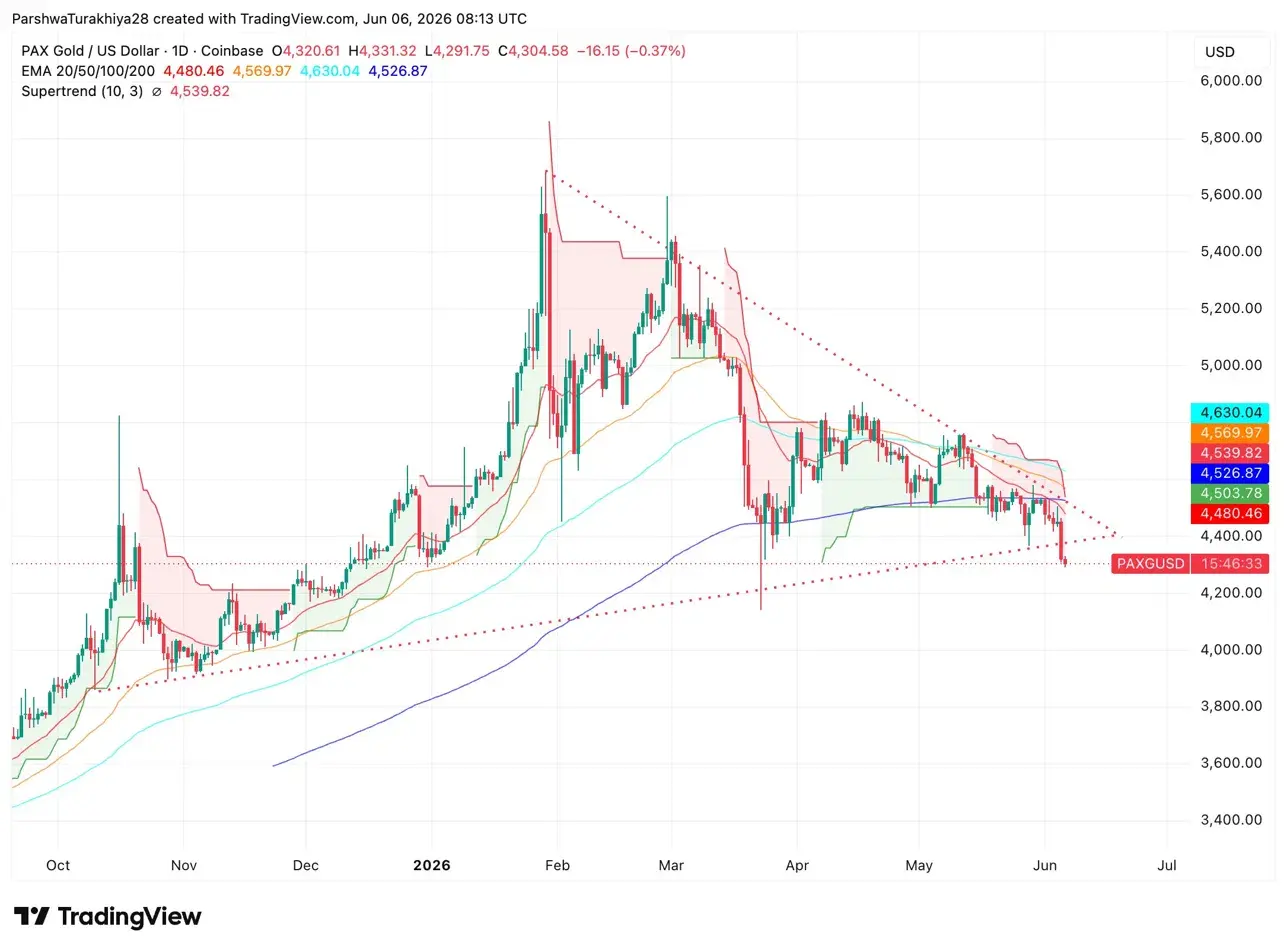
PAX Gold trades at $4,304 on June 6, down 0.37% and pressing into its lowest range since March as all four daily EMAs and the Supertrend sit overhead, while Paxos operates as the first and only SEC-registered blockchain clearing agency and Citigroup projects the tokenized asset market reaching $8.2 trillion by 2030. $PAXG Daily Chart: Descending Channel Tightens With Every EMA Acting as Resistance $PAXG/USD Daily Price Action (Source: TradingView) The daily chart shows $PAXG inside a clean descending channel that has been compressing price since the February high near $5,800. The channels dotted resistance trendline runs from that peak down through current levels, capping every recovery attempt at a lower high through March, April, and May. All four EMAs sit above current price and are pointing down. The 20 EMA at $4,480.46 is the nearest ceiling, followed by the 50 EMA at $4,569.97, the 100 EMA at $4,630.04, and the 200 EMA at $4,526.87. The Supertrend at $4,539.82 adds another layer of overhead resistance in the same cluster. The horizontal dotted support near $4,300 has held price twice through May and early June. A daily close below that level removes the last visible floor before the April lows near $4,200 and the broader
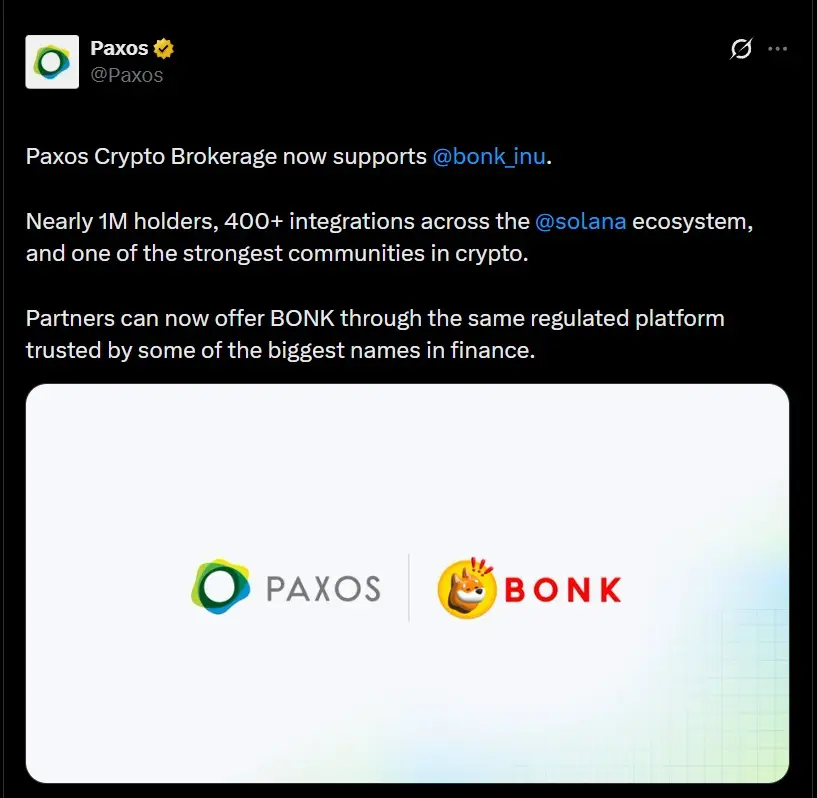
Paxos integrated $BONK into its crypto brokerage platform, allowing the memecoin to reach more than 500 million users worldwide.The integration enables platform partners to offer $BONK without additional compliance requirements or new technical implementation.$BONK has nearly one million holders, more than 400 integrations on Solana, and $130 million in BONKfun volume in March 2026 alone. Paxos, the federally regulated blockchain infrastructure companythat serves PayPal, Venmo, and Mastercard, announced a strategic partnershipwith $BONK through the tokens integration into its Crypto Brokerage platform. The agreement allows network partners to offer $BONK to their usersthrough the existing infrastructure, without having to meet additional compliance requirements or new technical implementations. The integration marks a historic moment for the Solana-based memecoin, which was born as a community airdropin December 2022, weeks after the collapse of FTX, when confidence in the crypto industry was at an all-time low. Far from fading with the pessimism of the moment, $BONK became a symbol of the Solana ecosystems resilience. $BONK Finds Its Way Into Traditional Finance Three years after its launch, the projects metrics speak for themselves. $BONK has accumulated nearly one million holders and more than 400 integrations within the Solana ecosystem.Its equity proxy, under the ticker BNKK, trades on NASDAQ. BONKfun,
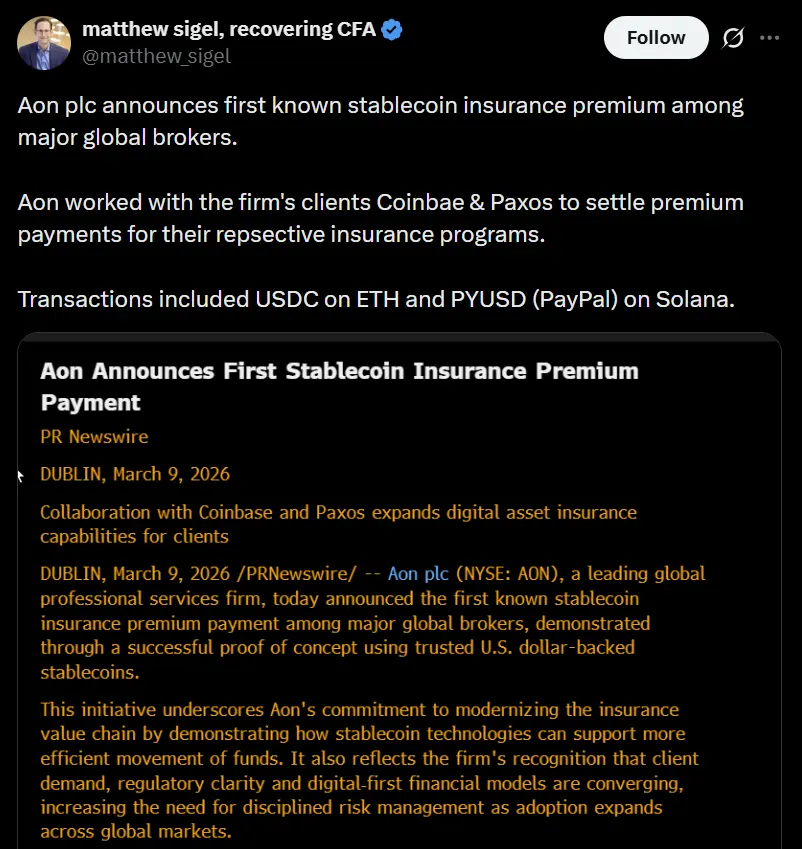
Aon, one of the worlds largest insurance brokers, is testing the use of stablecoins to pay insurance premiums, highlighting the growing role of digital dollars in traditional financial infrastructure following the passage of the GENIUS bill last year. In a Monday announcement, UK-based Aon said it completed a pilot that settled insurance premiums for clients, including Coinbase and Paxos, using $USDC ($USDC) on Ethereum and PayPal USD (PYUSD) on Solana. Tim Fletcher, CEO of Aon‘s financial services division, said the pilot reflects the company’s effort to explore stablecoins as a payment rail, predicting that tokenized assets will become more widely used in financial transactions. Aon said in August that its analysis showed 120 re-insurers wrote nearly $2 trillion of gross written premium in 2024. Source: Matthew Sigel, head of digital assets research at VanEck Instead of sending funds through traditional bank wires, the premiums were paid using stablecoins on blockchain networks. The pilot demonstrates how financial institutions are experimenting with blockchain settlement systems rather than relying solely on conventional payment infrastructure. The approach could have implications for the insurance industry, where premium payments typically move through banks, clearing systems and international wire transfers — processes that can take several days, particularly for cross-border transactions. Stablecoin