

















Global Market Cap
$0.00B
0.00%


| # | Exchange | Regulatory Status | Operating Period | Score |
|---|---|---|---|---|
| 6 |  | Domestic Regulation |  | |
| 7 |  | Domestic Regulation | | |
| 8 |  | Domestic Regulation | | |
| 9 |  | Domestic Regulation | | |
| 10 |  | Domestic Regulation | |

XT Exchange: Putting Idle Assets to Work Without Losing Sight of Their Next Use
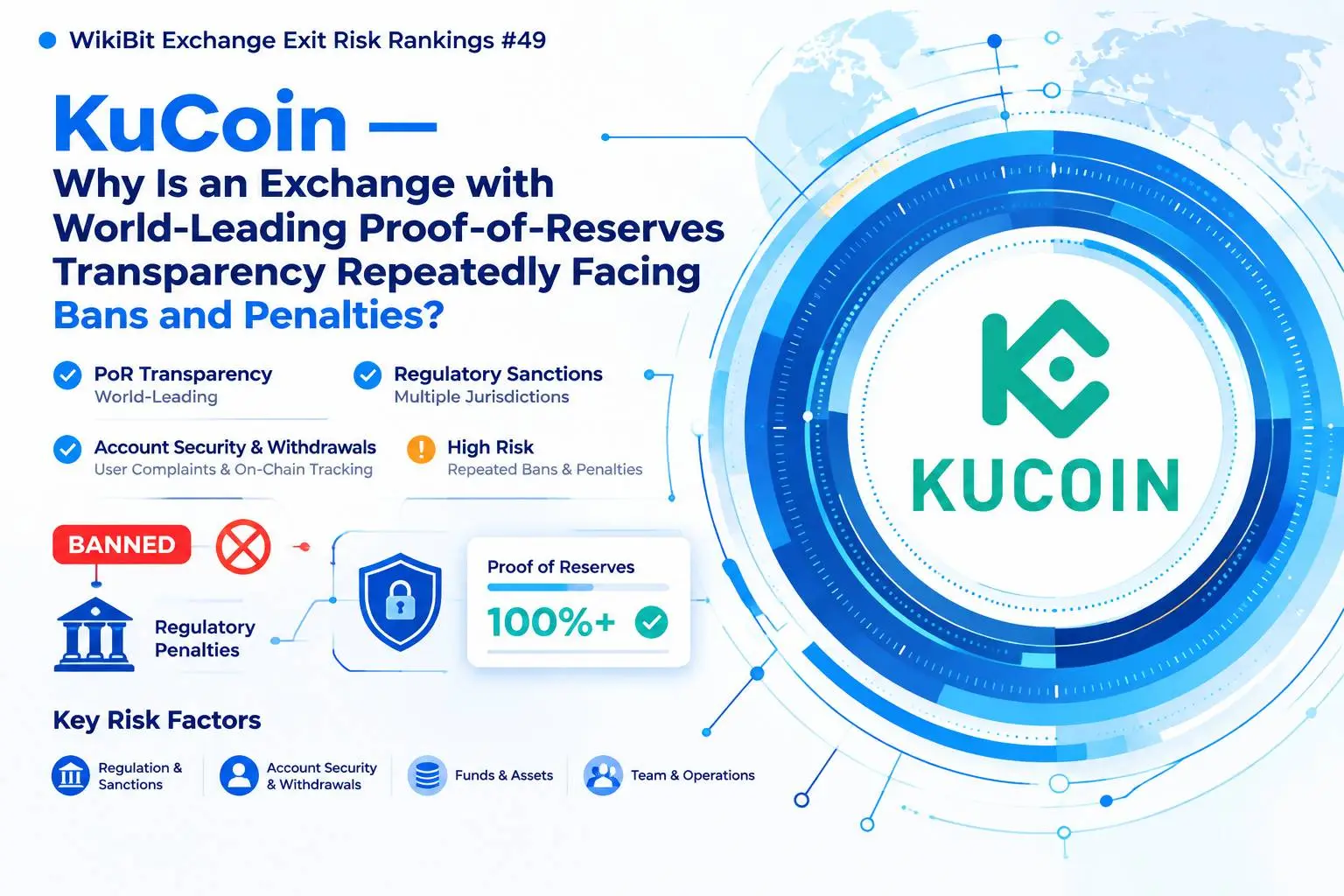
WikiBit Exchange Exit Risk Rankings #49: KuCoin — Why Is an Exchange with World-Leading Proof-of-Reserves Transparency Repeatedly Facing Bans and Penalties?

The Fed Holds Rates Steady in October, Yet Wall Street Heavyweights Sound the Alarm: Is a Financial Crisis Already on the Horizon?

Circle gives its Bitcoin-backed token one balance across Ethereum and Arc
Google Gemini AI Predicts a Huge Q4 Move for Hyperliquid

PHP flaw shows AI ‘vulnerability apocalypse’ is on schedule: Immunefi CEO

Bitcoin faces an inflation warning beneath steady US consumer sentiment

HOODs prediction markets to add $1.7B to revenue, exceed crypto by 2028: Bernstein

Strategy skips Bitcoin purchases, spends $205M on STRC buybacks

BTCPays API key fix is merged, but its latest release still predates the patch
XT Exchange: Putting Idle Assets to Work Without Losing Sight of Their Next Use
WikiBit Exchange Exit Risk Rankings #49: KuCoin — Why Is an Exchange with World-Leading Proof-of-Reserves Transparency Repeatedly Facing Bans and Penalties?














































**Title: Withdrawal Issues & Misleading Practices – Edgenex Capital**I am sharing my experience to warn others about my dealings with Edgenex Capital.I invested a total of **$10,000 (two accounts of $5,000 each)** on their platform, which is not MT4/MT5 but their own internal system.From the beginning, I was offered **high bonuses (300% / 1000 bonus)** and was told withdrawals would be processed quickly. However, this was not my experience.* Withdrawal requests were **consistently delayed** with various reasons* I had to **repeatedly follow up and push strongly** just to receive a **small partial withdrawal*** The process was stressful and lacked transparency* One of my accounts was **wiped out under questionable circumstances*** In another account, I had **closed trades in profit**, but my **capital and profits have still not been released**Communication from the account manager (named Kaif) included repeated promises of “next week withdrawal,” which were not fulfilled.
Hibt maliciously seizes assets! 4723U deposit doubled after profit then account frozen without reason, 7 days of review pretending to be dead, this is a scam platform! I am a Hibt user, UID: 20480**********43. Content: I recently legally deposited 4,723.19 USDT from Binance to the Hibt platform. All cash flows have blockchain certificates that can be verified, and the source is absolutely clean. Through personal trading profits, my account assets increased to over 10,000 USD. Unexpectedly, after seeing user profits, Hibt maliciously froze my account without warning, and even blocked the login permission, completely depriving me of the right to view my assets! This is clearly a common tactic of scam platforms. I have contacted customer service for over a week, but they have always used canned messages like 'under review' and 'please wait patiently' to evade, completely unable to provide specific review reasons and processing timelines. This behavior of using risk control as a pretext to illegally embezzle user principal and profits is essentially fraud, with no credibility at all.
Bitget TradFi system logic flaw leads to illegal seizure of user funds Complaint subject: Bitget Exchange (TradFi trading section) Amount involved: 1,500 USDT Core dispute: "Frontend confirms success, backend holds funds, liquidation takes the opportunity to intercept\" I. Event facts (timeline) 1. Liquidation and exit: On the trading day, I closed all orders under the TradFi account (precious metals trading). At this time, the account had zero positions, zero risk, and a balance of 2,160 USDT. 2. Asset isolation instruction: I immediately initiated a fund transfer of 1,500 USDT from the TradFi account to the spot account. 3. System feedback: After clicking confirm, the Bitget interface clearly displayed the \"Transfer Successful (Success)\" prompt. Based on this definite system feedback, I determined that the 1,500 USDT had entered a safe zone. 4. Trading again: 10 seconds after the transfer instruction was issued, I reopened positions using the remaining 660 USDT in the TradFi account. 5. Illegal seizure: Subsequently, market fluctuations caused the new position to trigger a forced liquidation. Shockingly, the Bitget system did not only settle the balance within the TradFi account, but instead took advantage of the lagging status of the previous transfer instruction showing \"Processing\" in the background, and forcibly intercepted and deducted the 1,500 USDT that had already been prompted as successful. II. Core rights arguments (Key Arguments) - Contract invalidation: The moment the system displayed \"Transfer Successful\", the funds had legally and logically left the TradFi risk pool. The delay in updating the Bitget backend ledger (showing \"Processing\") is a platform technical failure and should not be borne by the user. - Asset isolation principle: Spot account assets have absolute independence. When Bitget knew the user had issued an isolation instruction, it still used the \"in-transit funds\" as margin for liquidation, which is an illegal encroachment on user assets. - Customer service prevarication: I have provided evidence for over 4 days, but Bitget customer service has always delayed by citing \"verification" and refused to admit the asynchronous settlement bug between the TradFi section and the spot section. III. Demands (Demands) 1. Full refund: Immediately return the illegally deducted 1,500 USDT to my spot account. 2. Technical apology: Provide an explanation for the major bug where the transfer feedback of the TradFi system is out of sync with actual receipt, and fix this logic hole to prevent more users from being harmed.
My account has been frozen for over four months now, with no reason provided. Every time I ask Huobi why my account was frozen, they give no explanation. When I request to have my account unfrozen, I am only told to "wait patiently," with zero progress made. As of now, after more than four months, my account remains frozen and my assets are still inaccessible.
This is a super shady platform—be careful! They ban accounts for no reason at all! They froze thousands of my USDT. I deposited funds for contract trading and only made two trades, but I felt the slippage was way too severe. I wanted to withdraw my money. Then they just banned my account!!!! When I asked customer service, this was their response:
Opened a multi-coin contract position at once, then closed some of it. The funniest part was Bitcoin got closed after just 1 point.
Title: Ourbit froze 6000 USDT for 365 days On 15 July 2026 I deposited 6000 USDT (TRC20) to my Ourbit account。 Transaction on TronScan shows SUCCESS and CONFIRMED by over 200 blocks. I did ZERO trading. On 29 July 2026 Ourbit put my account under Risk Review and then showed Pending Final Risk Review 281 Days remaining, Total 365 Days. Now 80+ days passed, no progress. I submitted all documents. Support only gives template reply "wait patiently". No email, no reason given. I complained to BVI FSC. BVI FSC replied on 3 Oct 2026 that Ourbit Holdings Ltd is NOT licensed and was struck off/dissolved on 27 April 2026. I request Ourbit to clarify which legal entity is holding my funds and release my 6000 USDT immediately. This is not acceptable for a dissolved company to hold user funds for 365 days.
KCEX exchange is nothing but a betting scheme, there is no real trading. When users want to withdraw their coins, it freezes their accounts and then keeps holding users' assets, never unfreezing them. This is exactly how they make profits. It is basically a scam.
Platform: BitMart (币市) Issue: The platform announced an orderly shutdown. After submitting a normal withdrawal request for my account assets, it has been pending review for a long time. Customer service provided no effective handling, and the funds cannot be withdrawn. Withdrawal submission time: July 26, 2026, 11:22:56 Asset type and amount: 10.49 SOL Attachment: Account screenshot, withdrawal record screenshot
The platform has absconded, funds cannot be recovered, request platform assistance to handle and provide compensation. Now I cannot live normally, I have invested all my family's property.
The platform has absconded, the invested assets cannot be recovered, has been in upgrade all along, after the upgrade all assets were cleared to zero
I was scammed during the trading process. A fraudulent broker recommended this platform to me. The registration link was sent to me by the agent. I deposited USD 5,000 at 7:03 PM on July 28. They told me they would place manual trades on my behalf. However, at around 2:30 AM on July 29, they opened both long and short positions simultaneously, excessively traded to generate commissions, and continued doing so until my account was liquidated.
I was robbed by RBH, she disappeared with all the money I invested in her. First, she blocked me, preventing me from withdrawing or making trades. Then she sent messages asking me to deposit 25% of the amount I had in the broker, which was $3,550. They said that after depositing the 25%, access would be released after a few days. Then she disappeared completely, zero access, the broker evaporated.
Bitget blocked my account 23 days ago, 1000€ blocked and the service has been making me go in circles since the beginning
The Olink Wallet platform has collapsed, and assets cannot be withdrawn.
The platform started asking for 25% of the balance to release the use of withdrawal, The total loss was 1443.83 USD. then the platform disappeared without a trace and took down all its servers, and we are all here at a loss and I want my money back.
the company requested 25% of what was stuck, then went offline, I am waiting for your verification as shown in the print
Today, I have to step forward and make public an extremely absurd customer service experience that I encountered at Bitget, which severely violates the principles of financial fairness. I hope that through my real experience, all crypto traders on the internet, especially new friends who are preparing to participate in platform activities, can see the true face of this leading exchange when it cannot afford to lose. 1. Cause of the Incident: System Concealment and Coupon Recycling As a new user, I participated in Bitget's new customer activity and received a 50 USDT contract trading compensation experience voucher according to the rules. Subsequently, I used this voucher for normal trading, and after bearing the risk of market fluctuations, I successfully achieved a personal trading profit of 20 USDT. However, during the profit settlement and transfer, Bitget's underlying system, without any clear, strong pop-up warning or risk prompt, directly forcefully cleared and recycled the remaining 50 USDT activity experience voucher in my account in the background. Please note the actual state of my account assets at this time: 50 USDT activity coupon (platform performance principal) + 20 USDT (my personal trading profit earned by taking risks) = 70 USDT total assets. 2. Official Customer Service Divine Reply: After discovering that the system vulnerability led to the clearing of assets, I immediately submitted a ticket to the platform for a good-faith appeal. Since the system prompt indicated serious concealment and defects, the platform should have "returned the original\" 50 USDT experience voucher principal that was deducted. However, after a so-called \"final review\", the final conclusion given by Bitget's official supervisor shocked me (see attached image image.png). In the reply, the customer service wrote in black and white: \"If you use a 50 USDT experience voucher to open a position and incur a 20 USDT loss, the loss will be offset by the experience voucher according to the rules, and the user does not need to bear it with their own funds. In such cases, we will reissue a 50 USDT experience voucher. After the final review, we confirm that the current processing plan is the final decision (only reissue a 30 USDT experience voucher)...\" This passage directly shows Bitget's internal arrogance and black-box attitude towards users. May I ask the senior management of the platform, were your basic financial concepts and financial logic taught by a gym teacher? There are two serious logical paradoxes here: 1. The absurd double standard of \"deducting principal for profit, but fully compensating for loss": According to your logic, if I unfortunately lost 20U using this voucher, the platform would generously reissue the full 50U to me. But I, based on my own technical analysis and judgment, bearing the market risk that could lead to liquidation or zeroing at any time, worked hard to earn a 20U profit. Instead, the platform, with a big mouth, forcibly deducts my hard-earned 20U profit from the 50U activity principal that I should have enjoyed, and finally only gives me 30U as charity. Is this reasonable?
**Title: Withdrawal Issues & Misleading Practices – Edgenex Capital**I am sharing my experience to warn others about my dealings with Edgenex Capital.I invested a total of **$10,000 (two accounts of $5,000 each)** on their platform, which is not MT4/MT5 but their own internal system.From the beginning, I was offered **high bonuses (300% / 1000 bonus)** and was told withdrawals would be processed quickly. However, this was not my experience.* Withdrawal requests were **consistently delayed** with various reasons* I had to **repeatedly follow up and push strongly** just to receive a **small partial withdrawal*** The process was stressful and lacked transparency* One of my accounts was **wiped out under questionable circumstances*** In another account, I had **closed trades in profit**, but my **capital and profits have still not been released**Communication from the account manager (named Kaif) included repeated promises of “next week withdrawal,” which were not fulfilled.
Hibt maliciously seizes assets! 4723U deposit doubled after profit then account frozen without reason, 7 days of review pretending to be dead, this is a scam platform! I am a Hibt user, UID: 20480**********43. Content: I recently legally deposited 4,723.19 USDT from Binance to the Hibt platform. All cash flows have blockchain certificates that can be verified, and the source is absolutely clean. Through personal trading profits, my account assets increased to over 10,000 USD. Unexpectedly, after seeing user profits, Hibt maliciously froze my account without warning, and even blocked the login permission, completely depriving me of the right to view my assets! This is clearly a common tactic of scam platforms. I have contacted customer service for over a week, but they have always used canned messages like 'under review' and 'please wait patiently' to evade, completely unable to provide specific review reasons and processing timelines. This behavior of using risk control as a pretext to illegally embezzle user principal and profits is essentially fraud, with no credibility at all.
Bitget TradFi system logic flaw leads to illegal seizure of user funds Complaint subject: Bitget Exchange (TradFi trading section) Amount involved: 1,500 USDT Core dispute: "Frontend confirms success, backend holds funds, liquidation takes the opportunity to intercept\" I. Event facts (timeline) 1. Liquidation and exit: On the trading day, I closed all orders under the TradFi account (precious metals trading). At this time, the account had zero positions, zero risk, and a balance of 2,160 USDT. 2. Asset isolation instruction: I immediately initiated a fund transfer of 1,500 USDT from the TradFi account to the spot account. 3. System feedback: After clicking confirm, the Bitget interface clearly displayed the \"Transfer Successful (Success)\" prompt. Based on this definite system feedback, I determined that the 1,500 USDT had entered a safe zone. 4. Trading again: 10 seconds after the transfer instruction was issued, I reopened positions using the remaining 660 USDT in the TradFi account. 5. Illegal seizure: Subsequently, market fluctuations caused the new position to trigger a forced liquidation. Shockingly, the Bitget system did not only settle the balance within the TradFi account, but instead took advantage of the lagging status of the previous transfer instruction showing \"Processing\" in the background, and forcibly intercepted and deducted the 1,500 USDT that had already been prompted as successful. II. Core rights arguments (Key Arguments) - Contract invalidation: The moment the system displayed \"Transfer Successful\", the funds had legally and logically left the TradFi risk pool. The delay in updating the Bitget backend ledger (showing \"Processing\") is a platform technical failure and should not be borne by the user. - Asset isolation principle: Spot account assets have absolute independence. When Bitget knew the user had issued an isolation instruction, it still used the \"in-transit funds\" as margin for liquidation, which is an illegal encroachment on user assets. - Customer service prevarication: I have provided evidence for over 4 days, but Bitget customer service has always delayed by citing \"verification" and refused to admit the asynchronous settlement bug between the TradFi section and the spot section. III. Demands (Demands) 1. Full refund: Immediately return the illegally deducted 1,500 USDT to my spot account. 2. Technical apology: Provide an explanation for the major bug where the transfer feedback of the TradFi system is out of sync with actual receipt, and fix this logic hole to prevent more users from being harmed.
My account has been frozen for over four months now, with no reason provided. Every time I ask Huobi why my account was frozen, they give no explanation. When I request to have my account unfrozen, I am only told to "wait patiently," with zero progress made. As of now, after more than four months, my account remains frozen and my assets are still inaccessible.
This is a super shady platform—be careful! They ban accounts for no reason at all! They froze thousands of my USDT. I deposited funds for contract trading and only made two trades, but I felt the slippage was way too severe. I wanted to withdraw my money. Then they just banned my account!!!! When I asked customer service, this was their response:
Opened a multi-coin contract position at once, then closed some of it. The funniest part was Bitcoin got closed after just 1 point.
Title: Ourbit froze 6000 USDT for 365 days On 15 July 2026 I deposited 6000 USDT (TRC20) to my Ourbit account。 Transaction on TronScan shows SUCCESS and CONFIRMED by over 200 blocks. I did ZERO trading. On 29 July 2026 Ourbit put my account under Risk Review and then showed Pending Final Risk Review 281 Days remaining, Total 365 Days. Now 80+ days passed, no progress. I submitted all documents. Support only gives template reply "wait patiently". No email, no reason given. I complained to BVI FSC. BVI FSC replied on 3 Oct 2026 that Ourbit Holdings Ltd is NOT licensed and was struck off/dissolved on 27 April 2026. I request Ourbit to clarify which legal entity is holding my funds and release my 6000 USDT immediately. This is not acceptable for a dissolved company to hold user funds for 365 days.
KCEX exchange is nothing but a betting scheme, there is no real trading. When users want to withdraw their coins, it freezes their accounts and then keeps holding users' assets, never unfreezing them. This is exactly how they make profits. It is basically a scam.
Platform: BitMart (币市) Issue: The platform announced an orderly shutdown. After submitting a normal withdrawal request for my account assets, it has been pending review for a long time. Customer service provided no effective handling, and the funds cannot be withdrawn. Withdrawal submission time: July 26, 2026, 11:22:56 Asset type and amount: 10.49 SOL Attachment: Account screenshot, withdrawal record screenshot
The platform has absconded, funds cannot be recovered, request platform assistance to handle and provide compensation. Now I cannot live normally, I have invested all my family's property.
The platform has absconded, the invested assets cannot be recovered, has been in upgrade all along, after the upgrade all assets were cleared to zero
I was scammed during the trading process. A fraudulent broker recommended this platform to me. The registration link was sent to me by the agent. I deposited USD 5,000 at 7:03 PM on July 28. They told me they would place manual trades on my behalf. However, at around 2:30 AM on July 29, they opened both long and short positions simultaneously, excessively traded to generate commissions, and continued doing so until my account was liquidated.
| # | Ranking | Supported Currencies | 24h Vol | Average Liquidity | Trading Volume Trend (7 Days) |
|---|---|---|---|---|---|
| 1 | | 914 | $6,535,597,092 | 944 | |
| 2 | | 412 | $1,267,161,794 | 784 | |
| 3 | | 358 | $942,738,331 | 73 | |
| 4 | | 0 | $20,475,129 | -- | |
| 5 | | 652 | $1,406,806,305 | 766 | |
| 6 | | 830 | $1,588,924,989 | 709 | |
| 7 | | 930 | $753,478,176 | 760 | |
| 8 | | 1757 | $1,387,474,949 | 780 | |
| 9 | | 1025 | $1,357,283,845 | 653 | |
| 10 | | 0 | $112,962,841 | -- |
Please download WikiBit APP