NMLSRegulated
United States Crypto Asset Transfer License (MTL)





United States Crypto Asset Transfer License (MTL)

United Arab Emirates Crypto Asset Exchange License (CEX)
United Arab Emirates Crypto Asset Exchange License (CEX)

Japan Crypto Asset Exchange License (CEX)
Bahrain Crypto Asset Exchange License (CEX)
Italy Crypto Asset Trading License (STP)
Poland Crypto Asset Trading License (AGN)
Thailand Crypto Asset Exchange License (CEX)
Kazakhstan Crypto Asset Exchange License (CEX)
Salvador Crypto Asset Exchange License (CEX)
United Arab Emirates Crypto Asset Brokerage License (RTO)
Argentina Virtual Asset Service Provider (VASP)
Sweden Virtual Asset Service Provider (VASP)
Turkey Virtual Asset Service Provider (VASP)
Australia Virtual Asset Service Provider (VASP)
Exchanges with reserves exceeding 99.99%
Exchanges with 24H inflows exceeding 99.99%
Exchanges with 24H trading volume exceeding 99.99%
BNB
BNB
$754.05
1.51%
24H Vol
$1,595,443,284.54
Market Cap
$100,409,500,324.41
Issue Time
2017-07-25
Crowdfunding Price
$0.12
Circulation (pieces)
133,159,554.06
return on investment
+654,356.42%
Recently destroyed (pieces)
--
Total destroyed (pieces)
--
| Currency/Name | Trade | Unit Price | Change | 24H Vol | +2%/-2% Market Depth | Liquidity |
|---|---|---|---|---|---|---|
| USDC/USDT | $1.00 | 0.01% | $3,945,377,659.71 | $13.89M/$60.02M | 1,077 |
| BTC/USDT | $78,983.59 | 2.15% | $2,331,359,988.81 | $19.86M/$16.17M | 1,152 |
| ETH/USDT | $2,479.13 | 1.36% | $1,224,800,176.51 | $8.84M/$11.31M | 1,022 |
| XRP/USDT | $1.48 | 1.62% | $400,300,908.5 | $2.45M/$1.88M | 818 |
| SOL/USDT | $96.28 | 1.15% | $396,289,108.41 | $4.79M/$3.83M | 816 |
| ZEC/USDT | $817.97 | 7.00% | $250,004,287.16 | $1.04M/$736.81K | 825 |
| USD1/USDT | $0.99990484 | 0.01% | $215,155,785.36 | $15.12M/$31.81M | 1,048 |
| BNB/USDT | $704.62 | 0.78% | $131,908,250.07 | $4.80M/$4.91M | 928 |
| PYTH/USDT | $0.0494186 | 6.14% | $129,355,727.81 | $121.89K/$104.26K | 591 |
| DOGE/USDT | $0.08934954 | 3.84% | $106,688,580.27 | $1.56M/$865.18K | 760 |
What Is Binance TR?
Binance TR is a leading Turkey-based cryptocurrency exchange established in 2020 with the mission to increase the freedom of money. As the top exchange in Turkey by trade volume, Binance TR offers an extensive range of services and products, including Spot trading, Convert, Staking, Auto-Invest, Easy Buy/Sell, and the beginner-friendly Hizli Menu (Lite Menu on the app). The platform is known for its intuitive interface, low transaction fees, and rapid processing times.
With over 200 Turkish lira trading pairs and seamless 24/7 TRY deposit and withdrawal integration with seven major banks in Turkey—at zero fees—Binance TR makes it easy for Turkey based retail and institutional traders to enter the cryptocurrency ecosystem. The exchange also upholds high standards of security and privacy, having received its ISO 27001 and ISO 27701 certifications for information security governance and privacy information management, respectively.
When Did Binance TR Launch?
Binance TR was launched in September of 2020.
Where Is Binance TR Located?
Binance TR is a Turkey-based company operated by Binance Turkey Kripto Varlık Alım Satım Platformu A.Ş., registered in Istanbul, Turkey.
Binance TR Restricted Countries
Binance TR operates in compliance with local regulations, offering its services to residents of Turkey while also adhering to international AML/CTF standards.
What Coins Are Supported on Binance TR?
Binance TR is a fiat-to-crypto and crypto-to-crypto exchange that lists over 200 popular digital assets like BTC, ETH, AVAX, DOGE, USDT, XRP, SOL, ATOM, ADA, MANA, LTC, MATIC and others.
How Much Are Binance TR Fees?
Operating on a tiered model, standard fees of up to 0.1% apply for Maker positions and up to 0.15% for Taker positions on TRY trading pairs.
All TRY deposits, withdrawals, and crypto transfers between Binance.com and Binance TR are free.
Is It Possible To Use Leverage or Margin Trading on Binance TR?
In compliance with local regulatory requirements, Binance TR does not offer Leverage, Margin, or Futures Trading on its platform.
Introduction: An Exchange with a Seriously Split Personality When It Comes to Ratings In the first 23 editions, we dug into a series of exchanges ranging from HashKey to Zoomex. For the 24th edition, we are taking on one with an extreme “split personality” when it comes to its ratings — Hotcoin. On paper, Hotcoin looks pretty impressive: “Founded in 2017,” “9 years in operation,” “serving 8M+ users across 120+ countries,” “registered with Australia‘s AUSTRAC + U.S. FinCEN MSB,” “a member of Korea’s CODE-VASP alliance,” “regularly publishing PoR with reserve coverage above 100%,” “99.99% system availability throughout 2025,” and “eight years with zero security incidents.” Sounds like a stable, established major exchange, right? But on the other hand, TradersUnion gives it a 9.8/10 safety score and a Tier-1 rating, claiming that it is “regulated by top-tier financial authorities.” Meanwhile, CashbackForex and FXVerify both state that “the company currently appears to be unregulated by any government authority.” Its Trustpilot rating stands at 3.5/5, yet 63% of reviews are one-star, with users openly calling it a “scam.” There are also numerous complaints alleging that accounts were frozen after users made profits, profits were retroactively deducted, and withdrawals were suspended for six months. One exchange, with regulatory ratings swinging
In the span of just one day, Binance‘s bStocks added 78 new asset-chain deployments, significantly enhancing their market coverage. This surge brings total listings to 8,936, underscoring Binance’s competitive edge in the tokenized assets market. The new listings include tokenized stocks, funds, and stablecoins, which could reshape investor interest in this growing sector. For more insights, see the original report on Token Terminal. What Went Down The recent expansion of Binances bStocks marks a significant milestone in the tokenized stocks arena. With 78 new asset-chain listings, Binance is positioning itself as a leader in the rapidly evolving market for tokenized assets. This growth reflects a strategic advantage over competitors, indicating strong demand for tokenized offerings. As the broader crypto market continues to show mixed signals, this development could attract further interest from investors looking for innovative financial products. Key DetailsBinance‘s bStocks have added 78 new asset-chain deployments recently, pushing total listings to 8,936. This expansion includes various tokenized investments, enhancing Binance’s market presence. The growth is indicative of the increasing interest in tokenized assets and could further influence market dynamics. Investors may see this as a reason to explore tokenized offerings more actively. The competitive landscape is intensifying as Binance leads in asset-chain
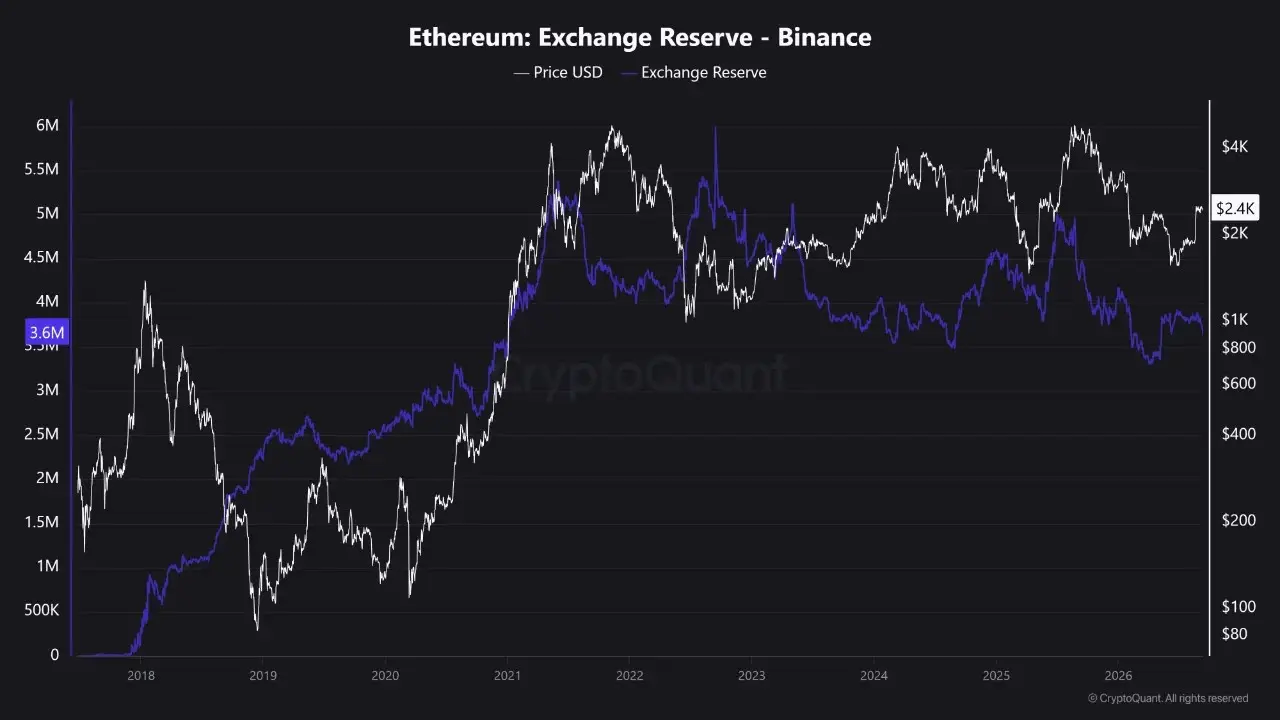
Ethereum has started consolidating near $2,470 after its August recovery, as falling exchange reserves reveal an increasingly tight liquidity supply structure. Reportedly, the supply structure shifted as fewer tokens remained readily available on Binance. According to CryptoQuant, the Binance $ETH reserves had fallen to approximately 3.74 million $ETH, marking their lowest level in three months. The decline reflected a broader reduction in exchange-held Ethereum. The total reserves across the major exchanges recently hit a multi-year low of approximately 14.88 million $ETH. The lower reserves limited the $ETH immediately available for trading, reducing potential selling pressure. However, falling reserves alone did not necessarily indicate stronger demand, but this supply shift coincided with record Ethereum staking participation. Roughly 43.1 million $ETH was staked, which represented 35.9% of circulating supply. The rising staking additionally limited the portion of $ETH readily available for trading as well. These developments together pointed toward an increasingly constrained liquid supply outlook. Source: CryptoQuantHow the tightening supply could reshape $ETH price direction The tightening liquid supply could become more significant and influential in case the spot demand strengthens. The fewer readily available tokens meant the bulls could face limited exchange-side supply pressure. Consequently, this imbalance could make Ethereum highly sensitive to sustained buying pressure. However, the supply tightening does not