Cursor urges credential resets after malicious Claude Code marketplace update

Code editor Cursor is urging developers who installed malicious Claude Code extension packages from its marketplace to clean affected machines and rotate accessible credentials and sessions from a trusted system. Removing the extension alone may leave persistent components running, the company warns.  The affected packages are Anthropic.claude-code versions 2.1.312 and 2.1.313 for macOS and Windows. Cursors security notice places their availability between about 2:27 a.m. and 1:35 p.m. PT on Oct. 29, 2026. Cursor says Anthropic did not develop the malicious versions and reports no evidence that other versions or the official distribution were affected.  Cursor clarified the affected versions and indicators on Oct. 30. Security researcher Phorion updated its malware analysis on Oct. 31 to include both versions, having initially identified only 2.1.313.  Related Company Anthropic AI safety and research company  Why uninstalling may leave access behind  According to Phorion, the payload attempts to add an attacker-controlled SSH key, enable the machines SSH remote-login service and establish a reverse tunnel. With SSH running, the planted key could let an attacker log in through that tunnel. Persistence mechanisms include a macOS LaunchAgent and, on Windows, an attempted scheduled task with a Startup-folder fallback.  Phorion says the injected code executes when Node loads the extension module, before

Within 1 weeksIndustry

Is Coinbase Safe After the $6 Billion Binance Hack?

Hackers took more than $8 billion from Binance, Bybit, and Bitget in 20 months. None of the attacks stole the master passwords, known as private keys. Each tricked the exchanges own systems into approving withdrawals.  The risk reaches beyond exchange users. Coinbase, which has disclosed no comparable theft, holds the Bitcoin behind most US spot Bitcoin exchange-traded funds ETFs. Its defenses now protect Wall Streets money too.  Sponsored  Sponsored  How Hackers Got Past 3 Exchanges  Binance lost about $6.3 billion on October 29. Co-CEO Richard Teng said the $6 billion Binance heist began with an engineers compromised laptop. Binance found no evidence of a key leak.  “To be clear: the attacker did not simply use one engineer‘s permissions, and this was not a single ’one-click action,” Teng stated.  Bybit lost nearly $1.5 billion in February 2025. Hackers planted code in Safe{Wallet}, an outside app Bybit used to approve transfers. Staff saw one destination while signing another. The FBI blamed North Korea.  Bitget lost about $387.5 million in September. Attackers entered through flaws in outside security products. Fake withdrawal orders then passed through Bitgets normal signing process.  Chart comparing the Binance, Bybit, and Bitget hacks by amount and attack method. Source: BeInCrypto  Sponsored  Sponsored  What Coinbase Does Differently  Coinbase uses multi-party computation (MPC), which

Within 1 weeksIndustry

Bitcoin redemption freeze puts $136 million Aave market under scrutiny

Aave has restricted new deposits and borrowing against $136 million in tokenized Bitcoin after Threshold Network suspended tBTC minting and redemptions.  Related Asset Bitcoin #1 BTC · $77,867.96 24-hour change: up 0.32% Loading price history… 24H Up 0.32% 7D Down 3.36% 30D Down 7.81%  The Oct. 31 intervention followed Thresholds decision to halt operations on its Bitcoin bridge while conducting undisclosed security maintenance, prompting decentralized lending protocols to limit their exposure to the asset.  In an Oct. 31 security update, Threshold said the token remained fully backed, with approximately 4,320 BTC held in bridge wallets against 4,185 tBTC in circulation.  “tBTC remains fully backed, and no funds have been lost,” the project stated, adding that investigators had found no unauthorized token minting.  Related Asset tBTC TBTC · $65,304.25 24-hour change: up 0.30%  The reserves exceed the circulating supply by about 135 BTC, reassuring holders about the assets backing the token even as they temporarily lose access to direct Bitcoin redemptions.  Threshold maintained that the situation was contained and that bridge functionality would return after remediation. However, it has not disclosed the specific security issue that prompted the suspension or provided a reopening date.  Existing tBTC remains transferable across Ethereum and layer-2 networks, although new Bitcoin deposits, token minting

Within 1 weeksIndustry

Oil, Inflation, and Fed Risk. Why MicroStrategy Still Wants More Bitcoin Now?

Oil ended October at $117.64 a barrel. US inflation is 3.7%, and two Federal Reserve officials wanted another rate hike last week. Yet Michael Saylor is signaling that Strategy (formerly MicroStrategy) could announce another Bitcoin purchase on Monday.  On Sunday, Saylor posted his Bitcoin-buying chart with the caption:  Sponsored  Sponsored  “We found room for even more orange.”  Why Buy Bitcoin When the Economy Looks Worse?  This is high-conviction accumulation: buying through uncertainty because you expect an asset to gain value over years.   It can also be contrarian investing. The danger is overconfidence when evidence changes.  Saylor‘s belief is clear. In Thursday’s earnings release, he declared:  “Were at the beginning of the next bitcoin bull market.”  Meanwhile, expensive oil is feeding inflation. Gasoline prices rose 34.2% over the year to September.  Sponsored  Sponsored  The Fed held rates at 3.75%–4% on October 28, although two officials favored an increase. Chair Kevin Warsh noted “a stable correlation between oil prices” and market interest rates this year, though he said that link had recently weakened.  Higher yields can make safer assets more attractive than Bitcoin. They can also complicate Strategys fundraising.  The Hidden Risk for MSTR Shareholders  MicroStrategy holds 848,517 BTC, worth about $66 billion on Sundays chart, against a $64 billion purchase cost. Its paper profit has narrowed.  October

Within 1 weeksIndustry

OneKey founder warns BlackRocks Bitcoin ETF could be a North Korean target

North Korean hackers could target BlackRocks $62 billion Bitcoin exchange-traded fund (ETF), crypto wallet maker OneKey founder Yishi Wang warned.  Related Asset Bitcoin #1 BTC · $77,960.70 24-hour change: up 0.61% Loading price history… 24H Up 0.61% 7D Down 3.07% 30D Down 8.51%  “I suspect IBIT is already on North Koreas shortlist,” Wang said, following the $6 billion Binance hack that US authorities attributed to North Koreas TraderTraitor operation.  The warning puts fresh attention on Coinbase, which serves as the primary Bitcoin custodian for BlackRocks iShares Bitcoin Trust (IBIT), the worlds largest spot Bitcoin ETF. CryptoSlates April 8 snapshot put funds naming Coinbase in a custody role at more than 80% of US Bitcoin ETF assets.  Coinbase has already made precautionary changes to its offline storage infrastructure following the Binance breach. In an Oct. 29 statement, Chief Security Officer Jeff Lunglhofer said the exchange was blocking transfers to compromised Binance wallets and had adjusted its cold storage systems out of an abundance of caution.  Related Company Coinbase A leading digital currency company  The company maintained that its infrastructure remained secure.  Why BlackRocks Bitcoin ETF could face significant risks  Wangs concern stems from the techniques North Korean attackers have used in previous cryptocurrency thefts, particularly the February 2025 Bybit

Within 1 weeksIndustry

Bitcoin‘s ’Uptober Goes Bust With Worst October Finish Since 2014

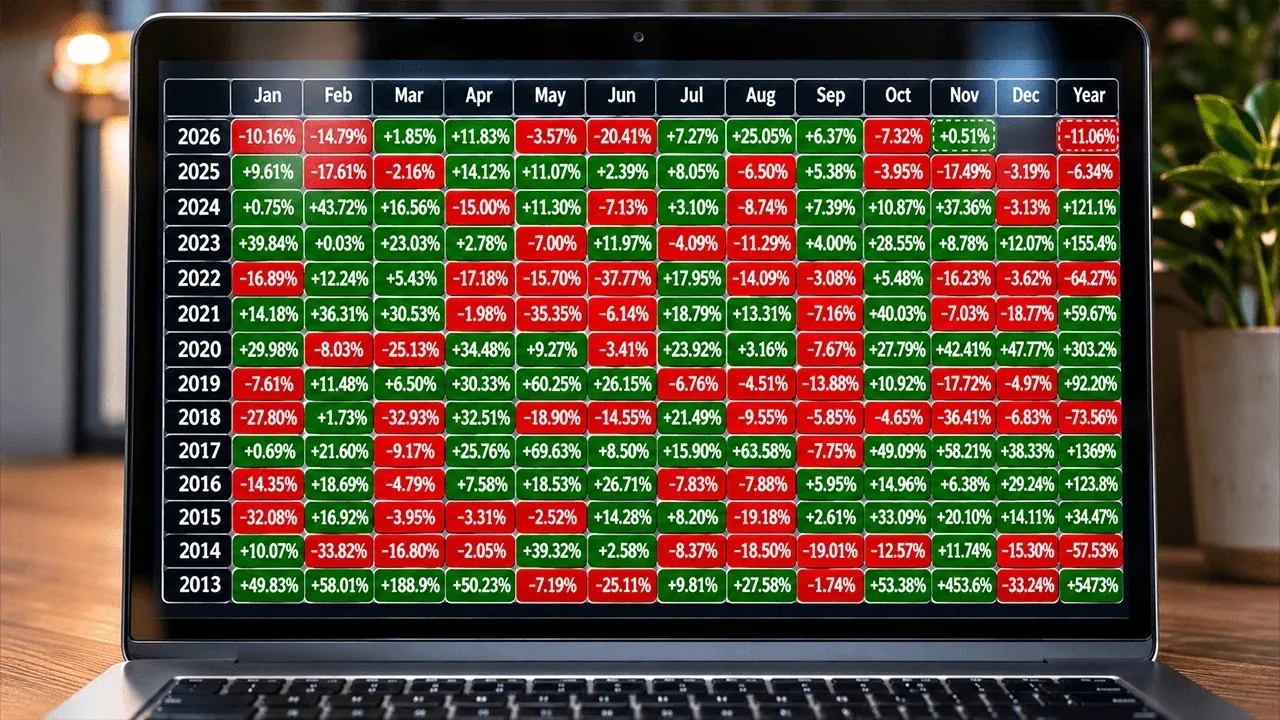
Bitcoin‘s celebrated “Uptober” tradition suffered another setback in 2026, with the leading crypto asset closing October down 7.32% against the greenback, its weakest performance for the month since 2014. Over the past seven days, BTC traded between $76,337 and $81,840 as the major $6.3 billion Binance hack rattled markets. The decline also marked bitcoin’s first consecutive October losses since 2011 and 2012, raising questions about Novembers prospects.  Key TakeawaysBitcoins price closed October down 7.32%, recording its weakest performance for the month since 2014.Binances $6.3 billion breach rattled markets as BTC traded between $76,337 and $81,840.Bitcoins price enters November facing a critical support test after consecutive October losses.  Bitcoins Uptober Tradition Takes a Beating as October Closes 7.32% Lower  Bitcoins famous “Uptober” rally never showed up for its 2026 appointment. Instead, the cryptocurrency closed October with a 7.32% decline, delivering its worst performance for the month in 12 years and fourth-worst October in recorded trading history.  The final week proved particularly punishing, with BTC changing hands between $76,337 and $81,840 as the $6.3 billion Binance hack jolted an already nervous market. The monthly result also cemented a rare historical distinction: two consecutive losing Octobers, something bitcoin‘s price hadn’t experienced since 2011 and 2012.  Uptober Gets Clobbered

Within 1 weeksIndustry

FBI and Secret Service join response to Binances $6.3B hack

Update (Oct. 30 at 9:04 pm UTC): This article has been updated to include FBI and US Secret Service statements reported by Reuters and Bloomberg, along with Binances latest recovery and withdrawal plans.  The US FBI and Secret Service have publicly acknowledged their involvement in the response to Binances $6.3 billion hack as efforts continue to trace and recover stolen cryptocurrency.  The FBI told Reuters Friday it was working with government and industry partners to assess the incidents scope and potential impacts and coordinate investigative steps.  Secret Service investigators were also “working around the clock” with private-sector partners to recover stolen funds, a spokesperson told Bloomberg on Friday.  The cryptocurrency exchange revealed its cooperation with law enforcement in a Friday X post, without specifying the agencies involved.  The exchange has separately reserved more than $6.34 billion in company funds to cover losses, including $5 billion already held in the affected cryptocurrencies. A spokesperson told Cointelegraph those tokens were in Binances custody, but declined to disclose wallet addresses, citing security concerns.  Blockchain intelligence firm TRM Labs attributed the attack to North Koreas TraderTraitor group.  Withdrawals remained suspended Friday. Binance said it aimed to begin reopening them in stages from Sunday, subject to security checks, with proof-of-reserves results also

Within 1 weeksIndustry

China Puts Crypto on Its Anti-Corruption Hit List

Chinas Communist Party has put crypto on the target list of its anti-corruption campaign. A resolution published Sunday orders investigators to chase graft that moves through virtual currency, blockchain and money sent abroad.  The order changes no law, since crypto trading is already banned on the mainland. The risk falls on officials, their families and fixers. Those are the people who park hidden wealth in digital coins or offshore accounts.  Investors in Chinese tech firms face a second change, with more Party oversight inside platform companies.  Sponsored  Sponsored  China is Targeting Crypto in a New Way  The resolution was adopted on October 29 at the Fifth Plenum, a closed-door meeting of the Partys top leaders. Its English translation, released by Xinhua, runs to about 14,000 words.  Crypto gets one sentence.  “We will also resolutely combat corruption committed via the internet, virtual currency, cross-border capital, and blockchain.”  The same passage names “white gloves,” middlemen who front for officials. It also targets “revolving door” deals, where officials join businesses after they retire.  Sponsored  Sponsored  Officials whose family wealth far exceeds their income will be examined. Businesses run by their spouses and children face regular checks.  Crypto is a Poor Place to Hide a Bribe  Blockchains are public ledgers. Every transfer stays on record, so coins can

Within 1 weeksIndustry

Ethereum validators pocket $30 million windfall as Binance hackers lose $119 million in rushed trades

Ethereum validators captured the bulk of nearly $30 million in payments generated during the trading frenzy surrounding Binances $6.3 billion hack.  Related Asset Ethereum #2 ETH · $2,265.75 24-hour change: up 0.82% Loading price history… 24H Up 0.82% 7D Down 2.81% 30D Down 17.16%  According to an Oct. 30 investigation by Bitquery, the attackers lost approximately $119 million by exchanging stolen cryptocurrency at unfavorable prices while racing to move funds beyond the reach of stablecoin issuers.  The hurried transactions created extraordinary arbitrage opportunities, allowing trading firms and automated bots to retain approximately $60 million in profits after costs.  Another $29.5 million flowed to Ethereum block builders and validators as traders competed to exploit price differences created by the attackers massive transactions.  Ethereum validators capture windfall from arbitrage frenzy  Bitquery found that Ethereum block builders received 10,251 ETH in tips between 20:30 UTC on Oct. 29 and 01:00 UTC on Oct. 30, compared with just 4.6 ETH during the equivalent period the previous night.  The more than 2,200-fold increase followed aggressive cryptocurrency swaps by the hackers, who were converting stolen stablecoins and other assets into ETH and TRX before their holdings could be frozen.  Related Asset TRON TRX · $0.31 24-hour change: down 2.05%  On Ethereum alone, the attackers paid

Within 1 weeksIndustry

Ripple news: 1 billion XRP unlocked as price holds near $1.25

Ripple has released 1 billion XRP from escrow on November 1 through two transactions worth roughly $624 million each, drawing attention on social media despite following the companys established monthly schedule.  According to blockchain trackers KKapon and XRP Live, each transaction released 500 million XRP into Ripple-controlled wallets. The transfers were completed at approximately 00:00:02 UTC, with the tokens moving out of existing escrow contracts.  Meanwhile, the November transactions involved two Ripple escrow wallets, commonly identified by trackers as Ripple 10 and Ripple 11.  Each received 500 million XRP, bringing the total released to 1 billion tokens. At the prices cited by the trackers, the combined value was approximately $1.25 billion.  In a separate alert, KKapon described the second release as part of Ripples scheduled monthly escrow arrangement.  The XRP Ledger records an escrow release through an EscrowFinish transaction, which allows previously locked tokens to reach their designated recipients once the programmed conditions have been met.  Ripple established the system in December 2017, initially placing 55 billion XRP into contracts designed to make a portion of its holdings available each month.  The company explained that unused tokens would return to new escrow contracts, extending the release schedule beyond the original 55-month arrangement.  As crypto.news previously explained in its

Within 1 weeksIndustry
1
...
2325
...
1000