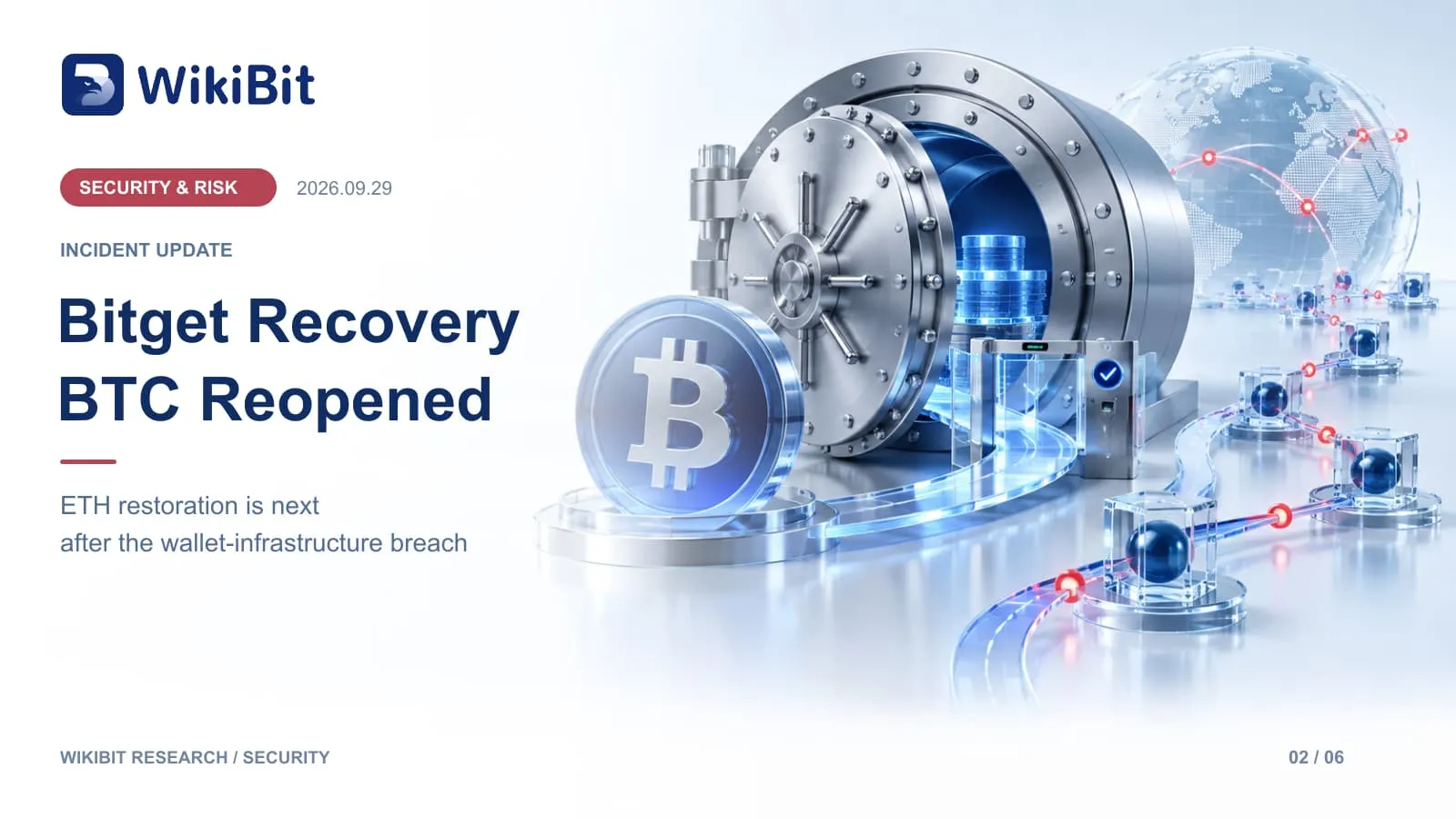
Bitget Hack Update: BTC Withdrawals Are Open; ETH Restoration Is Next After $388M Breach

Bitget has completed the first planned withdrawal-recovery milestone after the September 24 breach.  The exchange confirms that:  BTC withdrawals resumed at 08:00 UTC on September 28  and are open on:the Bitcoin network;BNB Smart Chain.  This materially improves the user-access picture compared with the full withdrawal freeze in place immediately after the incident.What is open now  BTC withdrawal support is confirmed operational on two networks.  Bitgets remaining schedule is:Sep. 29 08:00 UTC: ETH on Ethereum, BSC, Arbitrum, Base and Optimism;Sep. 30 08:00 UTC: USDT on Ethereum, BSC, Solana and Tron;Oct. 2 08:00 UTC: other supported tokens, fiat withdrawals and P2P.  At this reports cutoff, the ETH milestone remains in the future.The incident amount is now described as approximately $388M  Bitgets updated incident page uses approximately:  $388 million  as its current estimate.  The exchange says the incident involved 12 wallet addresses associated with hot or warm wallet infrastructure and activity across 11 blockchains.  Affected assets identified to date include:XRP;ETH;USDT;ZEC;ATOM;USDC;USD0;XAUt;BNB;AVAX;TRX;ALGO;TIA.  The estimate can still be adjusted as transaction classification and on-chain tracing continue.The current attack explanation is more specific  Bitget now says the attacker may have exploited a vulnerability in a:  third-party security product  to potentially obtain high-level internal credentials.  The attacker then appears to have:impersonated authorized activity;sent fraudulent withdrawal commands to the wallet system;bypassed existing risk controls;triggered abnormal transfers
Yesterday 09:49Industry Research

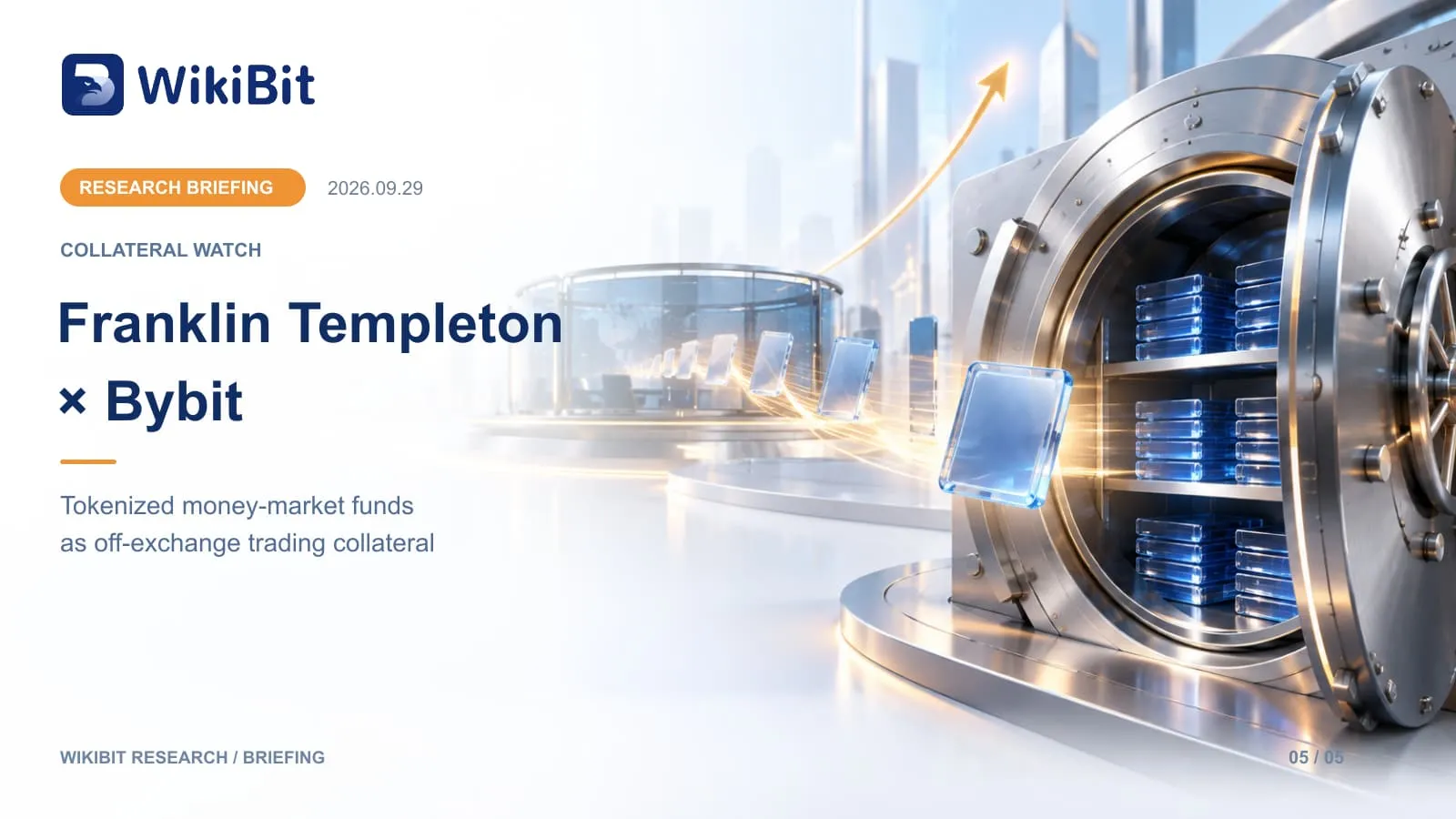
Franklin Templeton × Bybit: Tokenized Money-Market Funds Become Off-Exchange Trading Collateral

Tokenized money-market funds are moving from investment products into trading infrastructure.  Franklin Templeton expanded its off-exchange collateral program to Bybit on September 28, allowing eligible institutional users to pledge tokenized money-market fund shares and receive USDT or USDC trading credit.  The shares are issued through Franklin Templetons Benji Technology Platform.  The underlying assets remain in regulated off-exchange custody through ByCustody rather than being transferred into Bybits exchange wallets.  Their value is mirrored into the trading environment.  The investor can therefore continue earning money-market yield while using the asset to support crypto trading.  That architecture addresses one of institutional cryptos most persistent problems:  how do you use capital efficiently without putting all of it inside an exchange?The Collateral Stays Off the Exchange  Traditional exchange trading often requires users to deposit collateral directly onto the venue.  That creates counterparty exposure.  If the exchange fails, freezes withdrawals or suffers a security incident, the collateral can become trapped.  Off-exchange collateral changes that model.  The asset remains with a custody arrangement outside the trading venue, while the exchange recognizes its value and extends a credit line.  This separates two functions:  asset custody and trading liquidity.  That is especially attractive to institutions after repeated crypto exchange failures and hacks.Yield-Bearing Collateral Improves Capital Efficiency  Cash collateral often sits idle.  A tokenized money-market fund can

Yesterday 09:45Industry Research

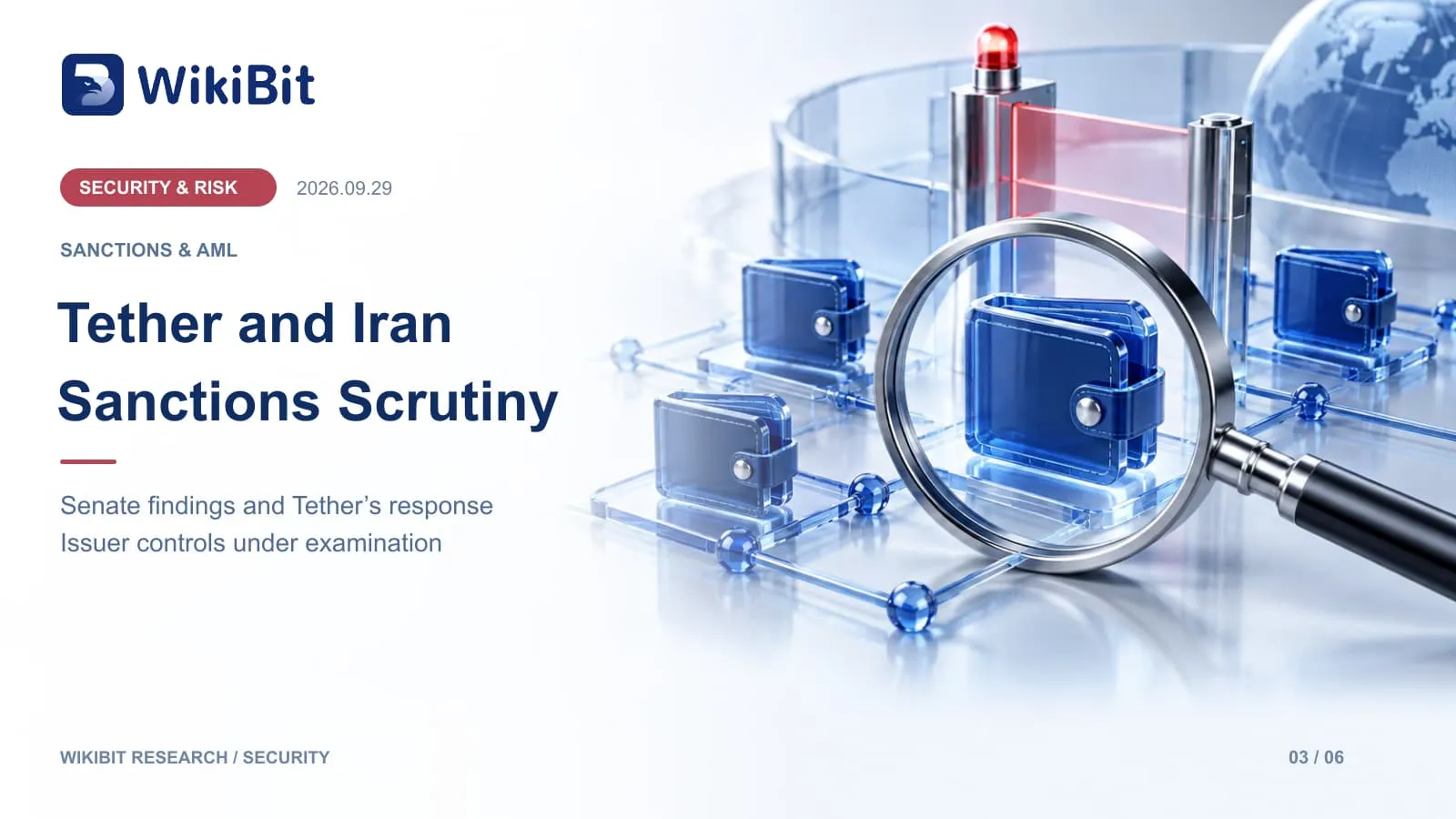
Tether, Iran and USDT: Stablecoins as Both Sanctions Rails and Enforcement Chokepoints

USDT is at the center of a new U.S. sanctions debate because it combines two characteristics that appear contradictory.  It is globally liquid and easy to move across crypto networks.  It is also issued by a company that can freeze specific token balances.  On September 28, Democratic staff of the U.S. Senate Permanent Subcommittee on Investigations released a report arguing that Tethers USDT has become deeply embedded in Iran-linked shadow-banking networks.  The report says investigators analyzed 846 cryptocurrency wallets that had been sanctioned, targeted for seizure or otherwise associated with Iran and its regional proxies. According to the report, 84% of those wallets had transacted exclusively or nearly exclusively in USDT.  Senator Richard Blumenthal called for Treasury and the Department of Justice to investigate Tethers sanctions and anti-money-laundering practices.  Tether pushed back the same day by emphasizing its cooperation with law enforcement. The company said actions involving USDT had frozen approximately $550 million across wallets U.S. authorities identified as connected to Irans central bank and sanctions networks during 2026.  These claims should not be collapsed into a simple conclusion that “Tether supports Iran” or “Tether stopped all illicit use.”  The more useful question is structural:  Why is the same stablecoin attractive to sanctioned actors and useful to enforcement agencies?Dollar

Yesterday 09:44Industry Research

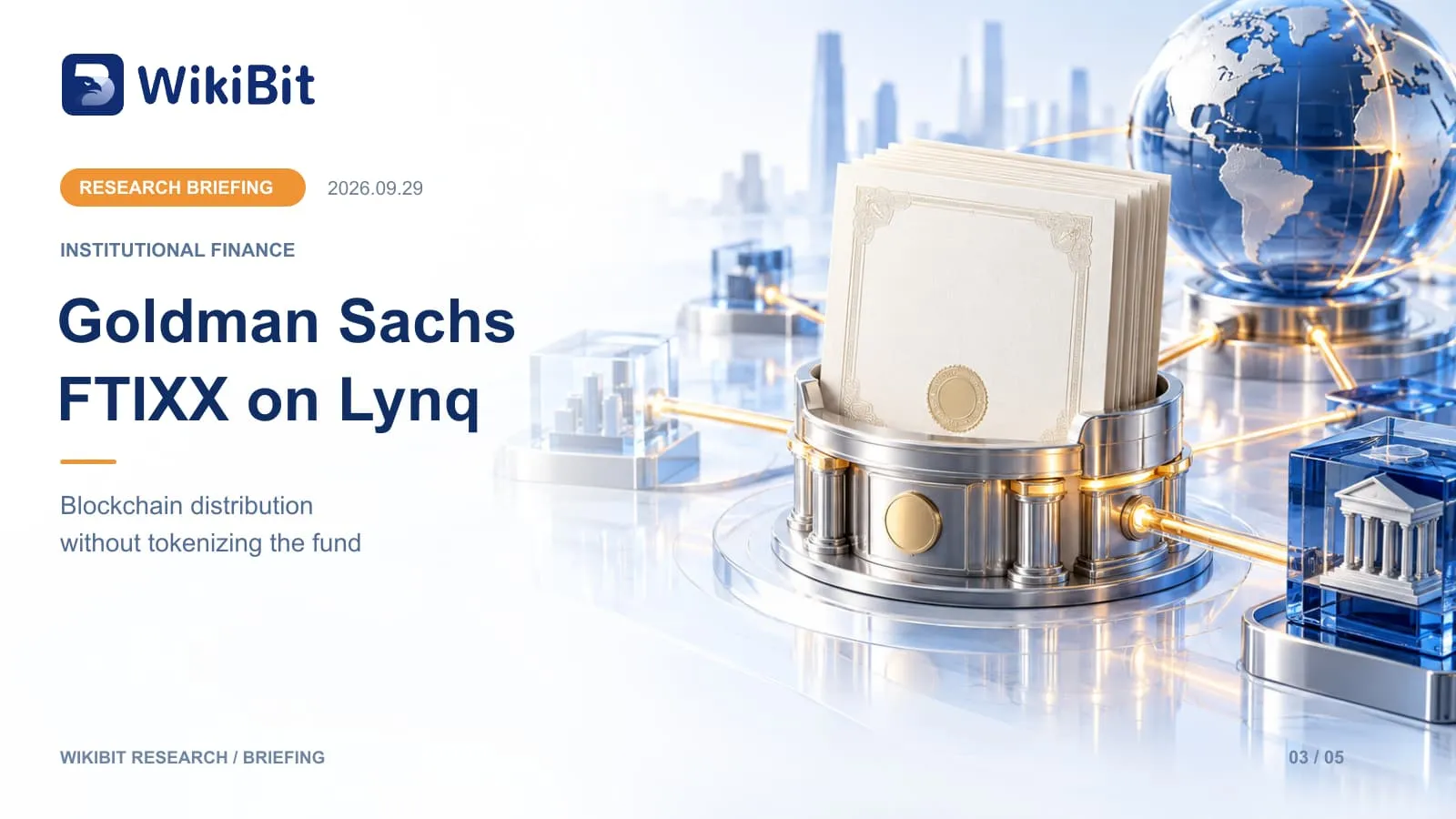
Goldman Sachs FTIXX on Lynq: Why Blockchain Distribution Does Not Require Tokenization

Goldman Sachs has found a different way to connect traditional asset management with crypto infrastructure.  Its roughly $100 billion Treasury money-market fund, FTIXX, is being made available to institutional digital-asset firms through Lynq, a settlement network built on a private, permissioned Avalanche Layer 1.  The important part is what Goldman did not do.  FTIXX is not being converted into a blockchain token.  It remains a conventional fund. Lynq becomes a new distribution and workflow layer around it, while trades are handled by SEC-registered broker-dealer tZERO Securities.  That makes the structure a useful counterexample to one of cryptos most common assumptions:  bringing an asset into blockchain-based financial infrastructure does not always require tokenizing the asset itself.Tokenization and Blockchain Distribution Are Different Things  A tokenized fund usually changes how the investors ownership interest is represented. The fund share or a mirror of that share exists on blockchain infrastructure.  The FTIXX-Lynq model is different.  The underlying fund remains inside conventional fund infrastructure.  Lynq gives institutional crypto firms a new place to access it, move capital around their workflow and park idle cash between trades.  That distinction matters because many institutions care more about workflow than token format.  If a trading firm can move cash efficiently, earn Treasury yield and redeploy it quickly, it may not

Yesterday 09:43Industry Research

Citi × Coinbase: Stablecoin Payments Become Invisible Banking Infrastructure

Stablecoins are becoming more useful by becoming less visible.  Citi and Coinbase expanded their payments partnership on September 28 with two connected products that blur the boundary between a bank account and a stablecoin wallet.  First, Coinbase is using Citis Virtual Account Wallet infrastructure to power Coinbase Virtual Accounts. Businesses can accept, hold and pay fiat through an account-like interface, while incoming fiat can be automatically converted into stablecoins underneath.  Second, Citis institutional clients can accept stablecoin payments through Spring by Citi. The merchant does not need to hold or manage the stablecoin. Coinbase handles the digital-asset payment rail and converts the stablecoin into fiat, while Citi settles the fiat as the bank of record.  This is more important than another merchant announcing “crypto payments.” It shows how stablecoins can enter mainstream finance without requiring the end user to behave like a crypto user.The User Interface Is Becoming Currency-Agnostic  Most businesses do not want to manage two treasury systems — one for fiat and another for stablecoins. They want money to arrive, move and settle.  The Citi-Coinbase model abstracts the asset type. A Coinbase customer can receive fiat into a virtual account and automatically convert it into stablecoins. A Citi merchant can receive a stablecoin payment

Yesterday 09:42Industry Research

Chainlink CCIP 2.0: Why Cross-Chain Security Is Becoming Configurable Infrastructure

Cross-chain infrastructure is moving away from a simple question — “which bridge is secure?” — toward a more complicated one: who gets to define the security model for each transfer?  Chainlink launched CCIP 2.0 on September 28 with a new architecture aimed at institutions, asset issuers and applications that want more control over how cross-chain transactions are verified, screened and finalized.  The most important new feature is the Cross-Chain Verifier, or CCV. CCIP already uses a default Committee Verifier made up of 16 independent node operators. CCIP 2.0 lets an issuer or application add another verification layer on top of that default network. An institution can operate its own CCV or select an independent third-party verifier, and a destination-chain transaction can be configured so that both the default verifier and additional CCV must sign before execution.  That changes the responsibility model for bridges.Cross-Chain Security Is Becoming Additive  Many bridge designs force users into one security assumption. The bridge has one validator set, signer group or message-verification system. If that layer fails, every application using the bridge inherits the failure.  CCIP 2.0 takes a layered approach: base verification + application-defined verification. The security improvement depends on genuine independence. Two verifiers hosted on the same infrastructure, operated

Yesterday 09:40Industry Research

Silver Price Forecast: XAG/USD drops to near $60.50 amid surging oil, Treasury yields

Silver price (XAG/USD) continues to lose ground after registering over 5% losses in the previous day, trading around $60.60 per troy ounce during Asian hours on Tuesday. Non-yielding Silver price declined as ongoing uncertainty surrounding US-Iran negotiations kept oil prices elevated. This persistent pressure on energy costs has heightened expectations that the Federal Reserve (Fed) will need to tighten monetary policy further to combat inflation.  The surge in oil prices resumed after Iranian officials expressed doubt about reaching an agreement prior to the upcoming US midterm elections in November. The standstill follows US President Donald Trump‘s recent rejection of Tehran’s latest proposal, which stalled diplomatic momentum.  Rising inflation concerns and expectations of additional rate increases pushed Treasury yields to fresh multi-year highs, creating headwinds for non-yielding assets like Silver. Following the central banks initial rate hike in three years earlier this month, money markets are currently pricing in roughly a 70% probability of another Federal Reserve rate increase in October.  Discover more  Blockchain news subscription  Blockchain development services  Crypto exchange reviews  OIS curve shows investors still pricing in multiple Fed hikes  Strategists at Rabobank highlight that positioning in US rates remains firmly tilted toward further tightening, with the bank noting that “the OIS curve suggests investors are still

Yesterday 09:24Industry

UN, Circle Foundation Partner to Speed Aid via Stablecoins

Key TakeawaysCircle Foundation announced 2 grants on September 25, 2026, to fund UNDP and WFP digital payment initiatives.Regulated USDC stablecoins are being integrated into 15 UN agencies via DHoTS to lower aid distribution costs.WFP will test stablecoin payment corridors across 2 to 3 countries over the next 3 years to establish benchmarks.  Accelerating UNDP Program Delivery  The Circle Foundation announced two new grant initiatives in partnership with the United Nations Development Program (UNDP) and the World Food Program (WFP) to modernize digital payments for international development and humanitarian relief.  The joint effort aims to explore how regulated payment stablecoins and digital financial infrastructure can lower costs, reduce delays, and improve financial resilience for communities receiving aid in crisis zones. Elisabeth Carpenter, Chief Strategic Engagement Officer at Circle and Founding Chair of the Circle Foundation, said that while the need for humanitarian aid is ever-growing, the resources for this are stretched thinner than ever.  “If we can help humanitarian and development institutions move value faster, more transparently, and at lower cost, we can ensure more of every aid dollar actually reaches the people who need it,” Carpenter said.  Discover more  investments  Digital Currencies  Currencies low-connectivity transfers in Haiti; community investments in Guatemala; and mobile wallet integration in The Gambia.  Robert

Yesterday 09:13Industry

Bitget Resumes Crypto Withdrawals After $388M Security Breach

After the security incident on September 24, Bitget has started to resume the crypto withdrawals, and the withdrawals of the BTC network and BSC network are resumed on September 28. The exchange stated that the process of restoring was made in a phased manner as part of other security reviews and remediations that took place on its withdrawal infrastructure, without impacting on user account balances.  Ad  Ad  Bitget Identifies Attack Path After $388M Crypto Hack Incident  Bitget said it also discovered that the attacker was able to gain access to internal credentials at a high level by exploiting a third-party security tool. Those credentials were then used to make withdrawals that were counterfeit and caused abnormal transfers that circumvented risk controls.  “Private keys were not compromised and cold wallets were not affected,” Bitget said. The crypto exchange also noted the flaw has been patched and the incident is contained.  Discover more  investments  Digital Currencies  Finance  The exchange estimated the total assets moved out of the bank are around $388 million. It explained that the amount is based on the latest amount that transactions were reconciled with to the original incident but not additional amounts that were not authorized after containment.  Mandiant and SlowMist are providing ongoing assistance with the forensic investigation.

Yesterday 08:57Industry

NEAR Price Forecast: NEAR Intents blocks more than $50M in attempted laundering linked to Bitget exploit

NEAR Intents, a cross-chain trading protocol, has blocked more than $50 million in attempted laundering flows linked to the recent Bitget exploit, while freezing $503,000 during the execution process.  The intervention was carried out through SHIELD, the protocols risk-intelligence system, which monitors transactions for links to hacks and other illicit activity, according to a Monday report.  Alex Shevchenko, co-founder and CEO of Auroro Labs, stated that SHIELD routinely processes more than $100 million in cross-chain volume each day and uses intelligence from know-your-transaction providers, independent researchers and industry partners to identify potentially illicit funds.  In the Bitget case, the system identified more than $50 million in attempted laundering flows and prevented the majority of the funds from moving through the protocol.  A further $503,000 was frozen during execution and remains restricted while Bitget pursues the appropriate legal and recovery processes. However, roughly $166,000 of the identified funds escaped through the protocol.  NEAR Intents also claimed to have waived any bounty offered by Bitget, allowing the exchange to retain more of the recovered funds.  “Crypto cannot simultaneously demand recognition of digital property rights and build infrastructure optimized for monetizing stolen property,” the team stated.  Bitget CEO Gracy Chen thanked NEAR Intents and SHIELD for identifying the attempted laundering

Yesterday 08:44Industry
1
...
1315
...
1000