MiCA CASP tracker makes EU crypto licences searchable

The MiCA Crypto Alliance launched its MiCA CASP Tracker on Aug. 5, turning public authorisation data from the European Securities and Markets Authority into a searchable directory for crypto users, businesses and compliance teams.  The tool allows users to check whether a company appears in ESMA‘s Markets in Crypto-Assets register and review the services it may legally provide. Each profile can show the firm’s name, Legal Entity Identifier, home country, national regulator, authorisation date and approved service categories.  MiCA tracker makes ESMA data easier to search  ESMA currently publishes its interim MiCA register through downloadable files. The latest version was dated July 31. The regulator says it republishes the data weekly after receiving updates from national competent authorities.  Moreso, the new tracker adds search and comparison functions. Users can filter records by company, country, regulator or authorised service. This can help a customer distinguish between a firm approved for custody and one permitted to operate a trading platform, exchange assets or execute client orders.  The MiCA Regulation defines ten regulated crypto services. They cover custody, trading platform operation, crypto-to-fiat exchange, crypto-to-crypto exchange, order execution, token placement, order transmission, advice, portfolio management and asset transfers.  A company‘s appearance in the register does not mean every product it

08-05Industry

Japan's FSA launches standalone crypto and stablecoin division

Japan has established a dedicated Cryptocurrency and Stablecoin Division within its Financial Services Agency, elevating digital asset oversight to an independent department as the country continues expanding its crypto regulatory framework.  Japanese publication NADA NEWS reported that the Financial Services Agency announced on Aug. 5 that it will create a new Cryptocurrency and Stablecoin Division, with the organizational restructuring taking effect on Aug. 7.  The new department will operate under the Asset Utilization and Insurance Supervision Bureau, replacing the previous structure in which cryptocurrency-related work was handled through the Cryptocurrency and Blockchain Innovation Office and the Cryptocurrency Monitoring Office under the Comprehensive Policy Bureaus Risk Analysis Division.  By establishing a standalone division instead of relying on office-level units, the regulator has formally elevated cryptocurrency supervision within its organizational structure.  Under the new division, the FSA will oversee three specialized offices. The Cryptocurrency Monitoring Office will continue supervising cryptocurrency exchange operators, while the newly organized Innovation Promotion Office and Digital Payment Planning Office will focus on financial innovation and digital payment policy.  The agency said the restructuring is intended to address new regulatory demands arising from financial digitalization while strengthening its ability to supervise financial institutions as technology continues evolving.  The restructuring follows Japans financial law overhaul  The

08-05Industry

"You stole, please return some." Coldcard hacker's wallet becomes a graffiti wall of pleas and hustles

SummaryA wallet tied to the Coldcard hacker has received several deposits since July 30, with some carrying written messages attached via Bitcoins OP_RETURN function.Messages range from genuine-sounding pleas for the money back to opportunistic pitches, including one offering to launder the stolen funds for a 10% cut.  “You stole, please return some.”  Thats one of several messages now sitting permanently on the Bitcoin blockchain, addressed to the wallet tied to the Coldcard hacker, which currently holds funds worth roughly $36 million. Each message arrives with a real, if tiny, payment attached.  The wallet in question is “bc1qq85v2c926eg6pgxhwp6q7lf6cnsz80qs3fcu9r.” It has been identified by blockchain researchers, including those at Galaxy Research, as one of the attacker-controlled addresses tied to the theft.  The address has taken in several deposits since the Coldcard theft began on July 30, with many of those transactions carrying written messages. Most are pleas to return the stolen money; others are performative, and at least one offers services to launder the stolen BTC.  This is as much a story about how the Bitcoin blockchain functions as it is about hack victims paying to convey their sentiments to the person who took their money.

08-05Industry

The worst chart for bitcoin bulls right now

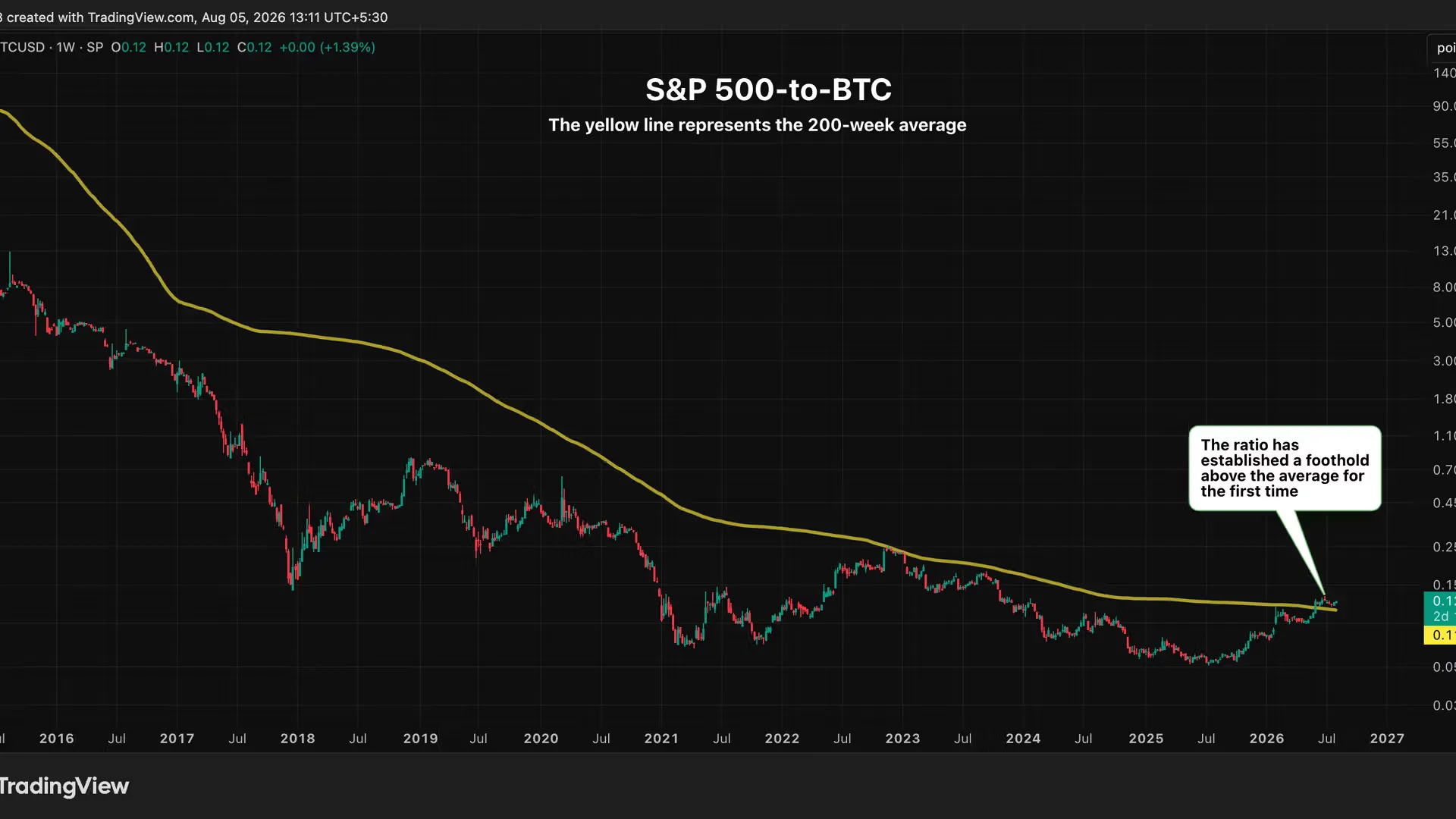
SummaryThe Ss capped every prior stock rally against BTC.The shift raises suggests that days of parabolic BTC gains may be behind us.  For years, bitcoin trounced stocks and most other assets, and supporters pointed to the outperformance as proof the largest cryptocurrency was also the best store of value. Now, one chart suggests that edge may be fading.  That chart is the St just topped the 200-week average, its established a firm foothold above it, clearly visible on the far right of the chart. The behavior is not isolated to the S&P 500, either. The Nasdaq/BTC ratio is showing the same first-ever crossover above the 200-week average.

08-05Industry

Ethereum researchers want to rein in staking; critics say it could backfire

A group of six Ethereum researchers and developers, including Ethereum Foundation‘s Justin Drake, has proposed changing the network’s issuance policy to cut validator rewards more sharply as the proportion of staked ETH rises.  The draft, called the Tapered Issuance Burn and currently being assigned the provisional number EIP-8363, would burn an increasing fraction of validators consensus rewards as the amount of staked ETH approaches a fixed threshold of 60.25 million ETH (around 50% of the current ETH supply), at which point the deduction hits 100%. The changes would phase in over 18 months.Tapered Issuance Burn Ethereum Improvement Proposal. Source: Github  The proposal has triggered backlash from developers, stakers and DeFi founders, who warn that the reward cuts could force out solo validators before larger institutions are affected, weaken institutional demand for ETH and disrupt DeFi markets built around staking yield.  One of the proposal‘s authors, Jérôme de Tychey, said the changes are needed to address the rising share of Ether being staked, which passed 33% in April. The authors argue continued staking growth could concentrate ETH in large custodians and liquid staking providers, while unchecked issuance erodes Ether’s role as a neutral, trustless store of value.  “Ever-growing issuance is a dilution tax on every

08-05Industry

Robinhood files $200M second venture fund focused on YC startups

Robinhood has filed to raise up to $200 million for its second publicly listed venture fund, offering retail investors access to seed-stage startups while introducing performance fees that were absent from its first fund.  SummaryRobinhood has filed to raise up to $200 million for its second public venture fund focused on seed stage startups.The new fund introduces a 2% management fee and a 20% performance fee, unlike Robinhoods first venture fund.RVII will invest mainly in companies linked to Y Combinator and is expected to begin trading on the NYSE on Aug. 13.The launch extends Robinhoods effort to expand beyond crypto trading and public markets into private company investing.  According to regulatory filings reviewed by multiple publications, Robinhood Ventures Fund II (RVII) plans to offer 7.6 million shares at $25 each, while Robinhood will separately sell another 400,000 shares. The fund is expected to begin trading on the New York Stock Exchange under the ticker RVII on Aug. 13, subject to regulatory approval.  Goldman Sachs is serving as the lead bookrunner for the RVII offering, while Citigroup, JPMorgan, UBS and Wells Fargo are acting as joint bookrunners. According to the filing, the subscription window is scheduled to close on Aug. 12, one day before

08-05Industry

Eliza Labs founder declares native token 'dead,' winds down foundation after Burwick Law settlement

Quick TakeShaw Walters, founder of Eliza Labs, announced that the associated token is “dead” and that the related foundation is winding down.Walters said the team used its remaining treasury and available funds to settle the class action lawsuit represented by Burwick Law.Walters said he will not support or launch another token linked to Eliza.  Shaw Walters, founder of Eliza Labs and the open-source ElizaOS AI agent framework, announced that the associated token is “dead” and that the related foundation is winding down.  In a lengthy post on social media platform X, Walters said Burwick Law had sued the project and that the team settled with a group of holders by transferring the remaining treasury and available funds.  In April, Burwick Law filed a federal class action lawsuit in the U.S. District Court for the Southern District of New York against Walters, Eliza Labs and other affiliates, accusing them of false advertising, deceptive acts and practices, negligent misrepresentation, and unjust enrichment.  The lawsuit claimed that the project falsely marketed itself as an autonomous, AI-managed venture fund governed by an independent agent when it was allegedly controlled by Walters and other insiders. It also accused the project of diluting holders during a token migration from ai16z

08-05Industry

Who should regulate prediction markets? Senators push Clarity Act changes

Senators have pushed to preserve state and tribal control over sports betting by seeking changes to the Clarity Act as Congress weighs federal crypto market legislation.  During a Senate Indian Affairs Committee roundtable on Tuesday, Indian Gaming Association Vice Chairman Tehassi Hill argued that prediction markets tied to sports and casino events should remain subject to state and tribal gaming laws instead of falling under the exclusive oversight of the U.S. Commodity Futures Trading Commission.  The discussion comes as the Senate works to advance the Clarity Act before lawmakers leave Washington for the August recess, with limited legislative time remaining before attention turns to the November elections.  Supporters of the proposal see the cryptocurrency market structure bill as a possible vehicle to clarify the limits of the CFTCs authority over prediction markets.  Senators seek Clarity Act changes over prediction markets  Speaking before the committee, Indian Gaming Association Vice Chairman Tehassi Hill urged Congress to amend the Clarity Act to explicitly prevent “sports and casino gambling through prediction markets” from bypassing existing gaming rules.  Hill said the legislation should make clear that state gaming laws and the Indian Gaming Regulatory Act, rather than federal commodities law, govern those markets. Tribal gaming groups have argued that expanding federal

08-05Industry

CLARITY or not, crypto isnt going back in the bottle: Bitwise

A failure to pass the CLARITY Act this week will put the bill in a “walking dead” state, but won‘t stop the crypto industry’s march forward, according to Bitwise chief investment officer Matt Hougan.  In a blog post on Wednesday, Hougan said while many, including himself, have called it the “make or break” week for the CLARITY Act, the reality is that the crypto industry has made too much progress to “go back in the bottle.”  “The reality is that Washington is always late to major technology shifts, and it has rarely mattered as much as people feared,” said Hougan.  His comments come as the Senate faces an Aug. 5 deadline to advance the landmark crypto market structure bill before its summer recess, with many concerned that failure to pass this week could see the bill pushed into the next year as lawmakers focus on the midterm elections in November.  Prospects for CLARITY this year fade  Market observers are increasingly pessimistic about the CLARITY Acts passage this year. In July, Galaxy Research lowered its probability of the CLARITY Act passing in 2026 to 30%, while Polymarket currently shows a 23% chance of it being signed into law this year, down from 82% in February.  On July

08-05Industry

AI credit bubble could fuel Bitcoin ‘crack-up boom’ past $1M: Hayes

BitMEX co-founder Arthur Hayes said the debt-fueled artificial intelligence infrastructure boom could end in a 2008-style credit crisis and predicted the resulting government liquidity response could drive Bitcoin (BTC) to $1 million or higher.  In a Tuesday blog post, Hayes said investors have mistakenly treated spending on data centers and power infrastructure as high-growth technology investment rather than leveraged real estate. He said he expects lenders to finance excessive construction before a slowdown in AI capital expenditure exposes weaker borrowers.  The thesis connects the trillion-dollar expansion of AI infrastructure to a potential new source of crypto-market liquidity. However, Hayes predicted crisis, government bailout and subsequent BTC rally remain speculative.  Hayes described the AI boom as a “credit story like 2008 and not an earnings story like 2000.” He said BTC could remain between $60,000 and $70,000, with possible downside to $50,000, before the credit cycle and resulting liquidity response drive a recovery. Hayes also forecast that Ether (ETH) would reach $5,000 by year-end and said Maelstrom intends to build a significant position while selling out-of-the-money ETH put options.  Hayes‘ latest outlook builds on his earlier views on AI’s competing effects on crypto liquidity. On May 13, he said US-China competition in AI would encourage

08-05Industry
1
...
384386
...
1000