Kast launches stablecoin-powered business platform after $80M raise

Stablecoin payments company Kast has launched a platform combining business accounts, payment cards, cross-border transfers and yield-bearing balances on stablecoin rails.  Kast said its KAST Business platform allows companies to receive funds through fiat virtual accounts provided by regulated partners, deposit supported stablecoins and crypto, issue virtual cards and make local payouts in more than 20 currencies. The company said it serves more than 170 countries, although availability varies by jurisdiction.  The platform offers up to 8% annual percentage yield on idle balances, which Kast says is generated through short-term US Treasurys and stablecoin yield, alongside up to 3% cashback on purchases.  Kast is a financial technology company rather than a bank, with regulated services provided through licensed partner institutions.  The launch comes after Kast raised $80 million at a reported $600 million valuation in March. The company said it would use the funding to develop products, secure licenses and expand across North America, Latin America and the Middle East.  Kast subsequently hired former US Securities and Exchange Commission adviser Stephanie Allen to lead policy communications as it prepared the business-platform rollout.  Kast claims more than 1 million users and aims to onboard between 1,000 and 5,000 active businesses by the end of 2026.


09-02Industry

Bitcoin Price Analysis: Warning Signs Emerge as BTCs Breakout Loses Momentum

Bitcoin continues to hover below $78K, but the absence of meaningful upside progress is becoming increasingly important. After the initial breakout impulse, repeated failures to challenge the $80K-$82K supply area suggest demand is losing strength, raising the probability of a deeper corrective move.  Bitcoin Price Analysis: The Daily Chart  The daily chart shows BTC transitioning from an impulsive breakout into a clear loss of momentum. Following the rapid advance from the mid-$60K region, Bitcoin has spent several sessions fluctuating between roughly $77K and $81K without establishing a fresh high.  This behavior is particularly notable because the price is consolidating directly beneath the major $80.5K-$82.5K resistance zone. The inability to absorb supply around this area, combined with repeated upper wicks, suggests buyers are struggling to maintain the strength seen during the initial rally.  Although the broader structure remains bullish following the breakout above the moving averages and previous resistance levels, the probability of a deeper pullback has increased. The $72K-$74.4K zone is the first major daily support area and represents a logical destination if selling pressure expands.  For the immediate bearish risk to diminish, BTC would need to regain momentum and establish acceptance above $80.5K-$82.5K. Until then, the prolonged hesitation beneath resistance favors caution.  BTC/USDT 4-Hour Chart  The

09-02Industry

Layer-1 chain to pause new transactions for 24 minutes to unlock a 10x speed boost

MultiversX has given node operators nine days to prepare for an upgrade designed to make its blockchain 10 times faster.  Related Asset MultiversX #153 EGLD · $4.24 24-hour change: up 8.98% Price history is not available. 24H Up 8.98% 7D Up 24.36% 30D Up 60.22%  The Supernova upgrade is scheduled to activate Sept. 10 during epoch 2233, cutting block times to 600 milliseconds from six seconds and forcing more than 5,000 nodes to migrate onto software capable of processing the new rules.  The upgrade goes beyond shorter block intervals. Supernova restructures MultiversXs consensus pipeline so validators can vote on a block while execution proceeds in parallel, removing transaction execution from the critical path that previously constrained block production.  The design is also intended to preserve deterministic finality while pushing intra-shard finality below 250 milliseconds and cutting cross-shard settlement from about 18 seconds to roughly 2.4 seconds.  Meanwhile, MultiversX is keeping its epoch length unchanged and maintaining backward compatibility for addresses, keys, and balances.  The countdown begins as MultiversXs EGLD token shows renewed momentum. Data from CryptoSlate showed that EGLD crossed $4 over the weekend for the first time since May, reaching about $4.05 before pulling back below the threshold.  Most MultiversX nodes are still on the old

09-02Industry

Bitcoin leads Ethereum and Solana in decentralization, ARK finds

ARK Invest and Glassnode published a joint study on Sept. 1 that found three entities could cross the measured block-production thresholds for both Bitcoin and Ethereum, while Solana required 19.  SummaryBitcoin reaches its 51% hash-rate threshold through three mining pools, according to the joint report.Ethereum requires three staking entities to exceed 33%, although pooled delegation complicates direct control assumptions.Solanas Nakamoto coefficient is 19, but nearly all measured infrastructure operates inside commercial data centers.Bitcoins infrastructure is comparatively dispersed, with 63% of measured nodes operating anonymously through Tor networks.Ethereum hosts roughly 49% of execution-layer nodes in clouds, including 20% through Amazon Web Services.  The 32-page report, titled The Decentralization Spectrum: Design Tradeoffs in Digital Assets, compares the networks across ownership, exit fluidity, verification costs, critical resilience, reconstruction costs and infrastructure distribution.  The findings do not mean three companies control Bitcoin or Ethereum. The metric counts mining pools and staking platforms as entities, even when the underlying hardware, stake or node operators belong to separate participants who may withdraw or redirect their resources.  Bitcoins three-pool threshold does not equal ownership  The report applied a 51% hash-rate threshold to Bitcoin. Foundry USA represented 27.27% of the measured hash rate, followed by AntPool at 17.06% and F2Pool at 16.96%. Together,

09-02Industry

Core DAO plans emergency hard fork after validators drew excess rewards

Core DAO is coordinating an emergency hard fork after validators claimed more CORE rewards than the blockchain intended to issue.  In an update, Core said the incident had been contained and that “malicious validators” could no longer draw excess rewards. It said the fork would be a forward upgrade and would not roll back the network or reverse any previously confirmed transactions.  This followed an earlier status update on Monday, in which Core said a small number of validators had accrued rewards significantly above the protocols intended issuance. It said the incident was limited to reward issuance and that user assets remained safe, adding that it would publish a technical postmortem.  Several exchanges restricted CORE transfers around the time of the incident. Coinbase paused sends and receives on the Core network, while Bithumb and Coinone suspended deposits and withdrawals, citing suspected or confirmed security concerns.  Bitget also suspended CORE deposits and withdrawals, citing wallet maintenance, while LBank suspended deposits because of what it described as the projects requirements.  Core has not disclosed how much CORE was issued, how long the activity continued, or whether any of the additional tokens entered circulation. It also has not explained the vulnerability that enabled the validators to obtain the

09-02Industry

These Wall Street Giants Are the Biggest Holders of Spot XRP ETFs

Investment advisors held $120.9 million of the reported XRP ETF exposure, far ahead of banks, brokerages, and hedge fund managers.  Goldman Sachs, Jane Street Group, and Millennium Management were the three largest reported holders of spot XRP ETFs in second-quarter 13F filings, according to Bloomberg Intelligence data shared by James Seyffart on August 31.  The filings show that institutional exposure has grown alongside a sharp increase in XRP ETF inflows, even as the Ripple token itself has pulled back from its August highs.  Advisors Dominate XRP ETF Holdings  Bloombergs compilation puts Goldman Sachs well ahead of other reported holders, with $87.4 million in ETF exposure representing 84 million XRP. Jane Street followed with just under 16 million XRP, worth $16.6 million, while Millennium Management held 15.5 million tokens valued at about $16.2 million.  Intesa Sanpaolo ranked fourth with $14.4 million in exposure, followed by Marex UK Holdings at $8.1 million. Citadel Advisors also appeared in the filing data, although its XRP exposure fell by $645,000. But SIG Holdings recorded a much larger reduction, with its reported XRP exposure down by roughly $4.6 million.  Across the identified holders, total exposure reached $183.5 million, representing about 176.4 million XRP. Bloomberg also grouped the holders by category and found

09-02Industry

Robinhoods tokenized-asset chain is growing fast, but not necessarily where investors think

Robinhood Chain revenue from applications totaled between $2.66 million and $2.82 million over a rolling 24-hour window early on Sept. 1, creating an eye-catching measure of network activity with no disclosed bridge to Robinhoods corporate accounts.  Related Company Robinhood American financial services company  DefiLlama tracks application revenue, chain revenue and chain fees as separate layers. Its dashboard showed $963,612 of chain revenue on $1.07 million of chain fees during the same period. Public records provide no formula that turns either revenue figure into a Robinhood GAAP revenue line.  The recipients also show where the app total went. DefiLlamas revenue table placed trading bot GMGN first at about $1.11 million and token launchpad Pons second at about $1 million. Uniswap led the corresponding protocol fee table.  What Robinhood Chain revenue means for the company  Robinhood has described its own monetization in transaction terms. During the companys second-quarter earnings call, CFO Shiv Verma said Robinhood earns a few basis points per transaction, with approximately half shared with Arbitrum. He emphasized transactions as the basis instead of transaction volume.  The company provided no precise rate, eligible transaction count, fee base or reconciliation to its financial statements. DefiLlama also defines the $963,612 chain figure as gas revenue remaining after Ethereum

09-02Industry

3 Reasons Why Shiba Inu (SHIB) May Plunge This Month

September has historically been predominantly weak month for the meme coin.  July and August have been quite successful for the self-proclaimed Dogecoin killer, with its price closing both months in the green.  Nonetheless, certain important elements suggest that September may not be as beneficial and could deliver a move south.  The Worrying Signals  The first concerning element on the list is Shiba Inus burn rate, which has declined by 6% on a monthly scale. Data shows that less than 600 million tokens have been sent to a null address throughout August, an amount whose USD equivalent is negligible.  The burning mechanism aims to reduce the overall supply of the meme coin and potentially make it more valuable, but little to no activity on that front poses a serious obstacle to that mission.  Next is Shibariums stalled activity. The layer-2 scaling solution was exploited last year, and since then, the number of processed daily transactions has dropped to mere hundreds or even thousands (at most).  Shibarium Transactions, Source: shibariumscan.io  The feature has been labeled numerous times as important for the overall advancement of Shiba Inus ecosystem and something that can positively impact its price.  Last but not least, we shall mention the seasonal element. September has been a predominantly poor

09-02Industry

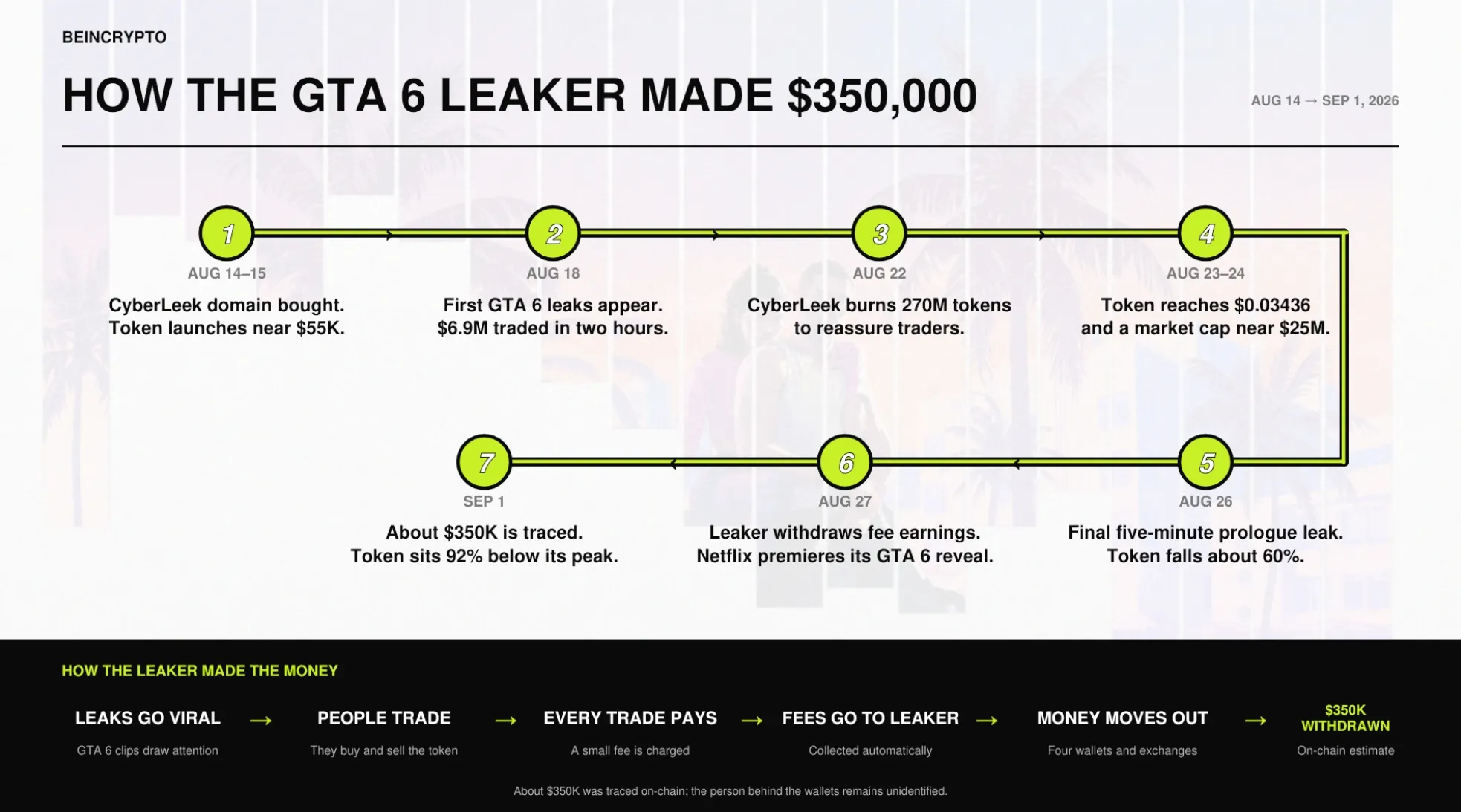
How the GTA 6 Leaker Profited $350,000 From CyberLeek

The anonymous leaker behind CyberLeek has reportedly pocketed roughly $350,000, according to on-chain analyst Conor Grogan. The funds allegedly came entirely from liquidity fees rather than direct sales.  The withdrawal coincided with a sharp price decline for the CYBERLEEK meme coin.  The Mastermind Strategy Behind CyberLeek  Grogan stated on September 1 that the person behind CyberLeek withdrew the funds through various OTC providers, a route that converts digital assets into conventional money without requiring large open-market token sales.  That structure differs meaningfully from a typical launch-and-dump scheme. Rather than offloading large CYBERLEEK holdings directly, the wallet tied to the project reportedly profited by collecting fees whenever other traders transacted in its liquidity pool.  Follow us on X to get the latest news as it happens.  The GTA 6 hacker, responsible for the Cyberleek coin, has cashed out about $350k, entirely from LP fees. They have washed funds through a variety of OTC providers  This is the first hacker that Ive ever seen make money solely on liquidity provision (versus dumping a token) https://t.co/5czgluVKBn pic.twitter.com/ABzjSjYAed  — Conor (@jconorgrogan) September 1, 2026  This mechanism depends entirely on sustained trading activity. The viral GTA VI leaks appeared to provide exactly that fuel, drawing in buyers and speculators with each new clip, even

09-02Industry

US Strikes Iran After Fresh Attacks Near Strait of Hormuz

The United States launched fresh strikes against Iranian targets Tuesday after attacks threatened commercial shipping near the Strait of Hormuz. U.S. Central Command said American forces targeted Islamic Revolutionary Guard Corps positions following recent threats. The escalation raises fresh concerns about shipping security and energy markets across the region.  Tensions Rise Around Vital Shipping Route  According to CNBC report, CENTCOM said the operation began around noon Eastern Time after Iran attempted attacks against commercial vessels. The command also cited threats against American personnel operating across the region.  President Donald Trump ordered the strikes after Iranian forces reportedly prepared sea mines for the waterway. Iranian missiles also targeted a U.S. facility in Jordan during the latest confrontation.  In the meantime, Washington is increasingly under pressure to stop the attacks without sparking a broader regional war. Tehran, however, may counter with further missile or sea operations.  Oil Markets Face Fresh Risks  The Strait of Hormuz remains crucial for global energy supplies and international trade. Before the conflict, about 20% of all global oil supplies passed through the waterway.  Other than to threaten tanker traffic, renewed fighting could also affect energy prices and transportation costs. Moreover, airlines and businesses across the Gulf face additional security concerns.  The U.S. Embassy in Qatar

09-02Industry
1
...
238240
...
1000