Nvidia Invests $3.5 Billion in MediaTek to Expand Beyond GPUs

In briefNvidia wrote MediaTek a $3.5 billion check for convertible bonds, its largest direct investment outside the US, covering about 90% of MediaTeks record $3.9 billion offshore bond offering.Alphabet bought in too without saying how much, and MediaTek shares hit their daily limit Tuesday, up 10% in Taipei trading.MediaTek is adopting Nvidias NVLink Fusion platform and expects its AI chip business to clear $2 billion in revenue this year.  Nvidia just wrote its biggest check outside the United States: $3.5 billion for MediaTeks convertible bonds in a deal announced Monday. The purchase covers roughly 90% of MediaTeks $3.9 billion offshore bond offering, which MediaTek called the largest of its kind in the islands capital-market history.  Googles parent company, Alphabet, also bought in, though neither company said how much Googles parent chipped in.  Myriad: How low will Nvidia go? Click to make your prediction.  The deal deepens a partnership that already touches PCs, data centers, and cars. MediaTek will adopt Nvidias NVLink Fusion platform, wiring custom-built chips straight into Nvidias rack-scale computing systems, according to the companies joint statement. Three areas get top billing: AI infrastructure, edge AI, and software-defined vehicles.  On the edge side, MediaTek and Nvidia keep building RTX Spark and DGX Spark chips
09-02Industry

Bitcoin price tumbles as US strikes rattle global markets

Bitcoin price has fallen below $77,000 as fresh U.S. military strikes on Iranian targets have pushed oil prices higher and triggered heavy selling across crypto and stock markets.  Bitcoin price falls below $77,000  The U.S. Central Command said American forces began striking Islamic Revolutionary Guard Corps targets in Iran at 12 p.m. ET on Tuesday, citing recent attempted attacks against commercial vessels in the Strait of Hormuz and U.S. military personnel stationed in the region.  Bitcoin (BTC) fell through $78,000 as reports of the operation emerged before extending its decline below $77,000. The cryptocurrency traded around $76,762 at the time of writing, after falling from an intraday high near $79,166.  Selling also reached Ethereum (ETH), which moved below $2,400 during the market decline. According to CoinGlass data cited in the original report, roughly $115 million in leveraged long positions across the crypto market were liquidated within one hour.  Liquidations occur when an exchange closes a leveraged position after the traders collateral can no longer cover mounting losses. A rapid price decline can therefore force the closure of long positions, adding more sell orders to an already weak market.  One day earlier, Bitcoin had held near $78,000 even as earlier exchanges between U.S. and Iranian forces pushed

09-02Industry

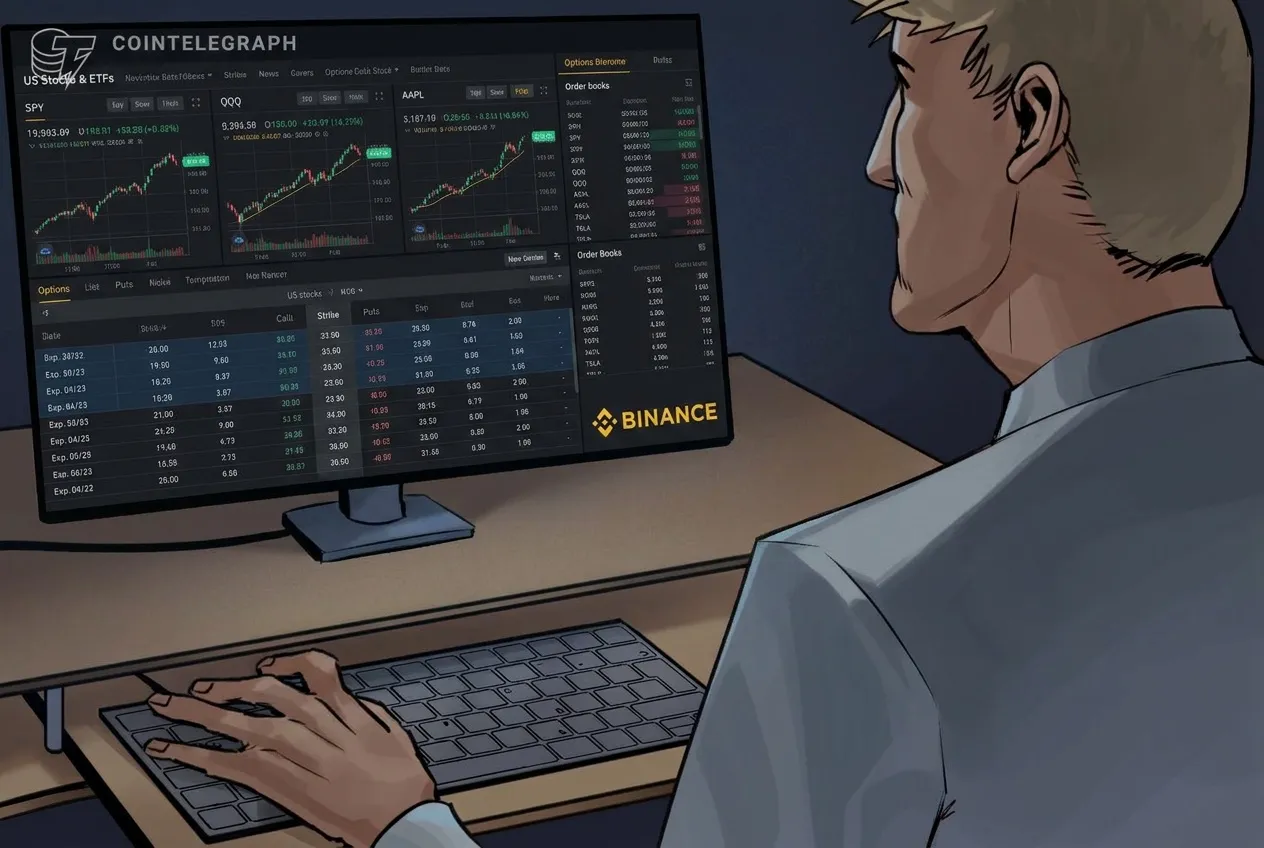
Binance expands TradFi push with options on 1,000 US stocks, ETFs

Binance is expanding further into traditional finance by launching options trading on more than 1,000 US stocks and exchange-traded funds for eligible users outside the United States.  The options will be offered through Binances Abu Dhabi-regulated broker-dealer, Nest Trading, with orders routed to US-registered Alpaca Securities for execution, clearing, settlement and custody.  The launch builds on Binances existing equities offering of more than 7,000 US stocks and ETFs and adds to a growing lineup of traditional financial products available through the platform.  Unlike equity-linked perpetual futures, the options are physically settled, meaning users who exercise them receive or deliver the underlying shares.  According to Binance, the expansion comes as trading in traditional financial products on the platform has accelerated, with TradFi perpetual futures volume reaching about $433 billion in August, roughly 15 times Januarys total.  Related: Binance says employees questioned in UAE cleared and released  Tokenized stock market surges as exchanges expand offerings  As crypto exchanges and traditional brokerages expand into tokenized equities, the onchain stock market has expanded sharply over the past year.  Tokenized stocks now have about $2.6 billion in distributed value, up from roughly $346 million at the same time last year, according to RWA.xyz data. Monthly transfer volume has also climbed 93% over the

09-02Industry

Large USDC Transfer Sparks Market Interest at Coinbase

A wallet nobody can yet identify just moved $221,226,193worth of USDC straight into Coinbase, and the size of that single transaction is enough to make traders sit up. This kind of large USDC transferdoesn‘t happen every day, and when it lands on one of the industry’s biggest exchanges, it tends to raise immediate questions about whos behind it and what comes next.  Key takeawaysCoinbase received a $221,226,193 USDC transferfrom an unidentified wallet, first flagged by the CryptoTwitter tracker @whale_alert.USDC is a dollar-pegged stablecoin held 1:1 and managed through the Circle Reserve Fund.The move comes as recorded USDC trading volume sits at essentially nothing, raising the odds that this single transfer could jolt activity back to life.Coinbases role as a major settlement point for crypto means large stablecoin inflows like this one often precede shifts in liquidity or institutional positioning.  Significant USDC Transfer to Coinbase  A transfer of this scale is rare enough to draw attention on its own, and the fact that the sending wallet remains unidentified only adds to the intrigue surrounding it.  Details of the $221 Million Transfer  The transaction, first spotted and reported by the blockchain-tracking account @whale_alert, sent $221,226,193in USDC into Coinbase from a wallet that hasn‘t been publicly tied to

09-02Industry

SEC proposes transfer agent overhaul for tokenized securities

The U.S. Securities and Exchange Commission has proposed its first major transfer-agent rule overhaul in more than four decades as blockchain recordkeeping, tokenized securities and automated systems enter regulated U.S. markets.  SummaryThe SEC proposal would update registration, recordkeeping, transfer processing, and asset-safeguarding requirements.Onchain transfer agents would face controls covering digital records, cybersecurity risks, and business continuity.New standards would govern restrictive legends, paying-agent services, and outside technology providers.Public comments will remain open for 60 days after Federal Register publication.  The SEC, in a proposed rule, said most of its transfer-agent requirements date from the late 1970s and early 1980s, when investors commonly held paper certificates and firms processed ownership changes manually.  Transfer agents maintain an issuers official ownership records, register securities transfers and monitor whether a company issues more securities than authorized. Many also process dividends, interest payments, fund redemptions, and other corporate actions.  Under the proposal, the commission would update rules covering transfer-agent registration, reporting, recordkeeping, processing times, and the protection of securities and client funds. The package also introduces requirements for restrictive legends, paying-agent activity, and the oversight of third-party service providers.  You might also like:  SEC and FDA sign 3-year market integrity pact  “Market participants are actively seeking to bring blockchain-native, or ‘onchain,’ transfer agents

09-02Industry

BofA, Citi, Goldman Sachs among 21 institutions planning stablecoin launch

A group of 21 major financial institutions plans to establish a new company to develop and issue stablecoins, offering another sign of traditional finances push into digital dollars as regulatory frameworks take shape.  The consortium, announced Tuesday, includes Bank of America, Goldman Sachs, Citi, Deutsche Bank, UBS, Santander, MUFG and Fidelity Investments. It plans to launch a US dollar-denominated stablecoin in the first half of 2027, subject to the companys formation and other conditions.  According to the announcement, the group ultimately plans to expand into stablecoins denominated in other G7 currencies, with a euro offering identified as its next priority.  The consortium said its stablecoin will target wholesale, institutional and retail markets, including use cases such as cross-border payments and digital asset settlement. The initiative is intended to comply with both the US GENIUS Act and the European Unions Markets in Crypto-Assets Regulation (MiCA), where applicable.  The venture builds on an initiative announced last October, when an initial group of 10 banks said they were exploring a 1:1 reserve-backed form of digital money available on public blockchains. The consortium has since more than doubled in size, bringing together financial institutions across North America, Europe, East Asia, the Middle East and Africa.  Related: Kast launches stablecoin-powered

09-02Industry

Heres what happened in crypto today

Today in crypto, Singapore is considering allowing jointly issued cross-border stablecoins into its regulatory regime. Thailands SEC seeks comments on rules requiring retail-accessible overseas crypto derivatives to trade on qualifying, centrally cleared exchanges, while Strive bought 1,800 Bitcoin for $143 million, becoming the fifth-largest publicly traded corporate holder.  Singapore weighs recognizing some foreign-issued stablecoins  The Monetary Authority of Singapore (MAS) is reconsidering its earlier restriction on stablecoins issued across multiple jurisdictions, proposing a route for some jointly issued tokens to qualify under its regulatory framework.  MAS opened a public consultation on Tuesday, covering legislative amendments to implement its stablecoin framework and additional policy proposals reflecting developments since 2023.  Under one proposal, stablecoins jointly issued by a Singapore issuer and a foreign issuer could be regulated under the framework and labeled “MAS-regulated stablecoins,” provided that the associated risks are sufficiently mitigated.  MAS is also considering recognizing a limited number of foreign-issued stablecoins regulated under comparable overseas frameworks, citing their potential use in cross-border wholesale transactions.  Thailand SEC proposes retail access to regulated overseas crypto derivatives  Thailands Securities and Exchange Commission (SEC) has proposed allowing intermediaries to facilitate retail access to certain digital asset derivatives traded overseas.  Under the proposal, eligible products would need to resemble crypto derivatives traded in

09-02Industry

S&P 500, Nasdaq Fall as Iran Strikes Send Brent Toward $95

U.S. stocks moved lower Tuesday as renewed fighting between the United States and Iran sent oil prices sharply higher, pushed Treasury yields toward multiyear highs and revived concerns that energy inflation could keep interest rates elevated.  The S&P 500 fell roughly 0.7%, while the Dow Jones Industrial Average lost about 0.9% and the technology-heavy Nasdaq Composite dropped around 1% during Tuesdays session.  The selloff followed another escalation in the Middle East, with U.S. and Iranian forces exchanging strikes and investors again focusing on the risk of disruption around the Strait of Hormuz.  Oil provided the clearest market reaction. Brent crude surged toward $95 per barrel, with the supplied FinancialJuice market update putting the settlement at $94.65, up $4.16, or 4.6%.  That rise is increasingly important for equities because higher energy prices can feed directly into inflation expectations just as investors are debating whether the Federal Reserve may have to keep policy tighter for longer.  Tech Stocks Take the Pressure as Yields Rise  The oil shock quickly spilled into the bond market.  The benchmark 10-year Treasury yield climbed to roughly 4.79%, near its highest level in about 19 months, as traders reassessed the inflation and interest-rate outlook.  Higher yields are especially difficult for richly valued growth and technology companies

09-02Industry

Optimism pushes network speeds to 200 ms, but standard data feeds are dropping key information

Optimism is targeting 200 ms subblocks on OP Mainnet, cutting the preconfirmation interval from 250 milliseconds in a rolling change targeted for Aug. 31. Subblocks, formerly called Flashblocks, are incremental updates the sequencer sends while it is still building a normal block, giving apps feedback before that block is sealed.  Related Company Optimism A low-cost and lightning-fast Ethereum L2 blockchain.  The 20% speedup carries a quiet compatibility risk. Optimisms migration notice says four fields will remain in each streamed payload but stop carrying usable data: state_root, block_hash and withdrawals_root will be all-zero values, while withdrawals will be an empty list.  Related Asset Optimism #123 OP · $0.10 24-hour change: up 7.78% Price history is not available. 24H Up 7.78% 7D Down 7.31% 30D Up 11.34%  The payload type remains ExecutionPayloadFlashblockDeltaV1, so software can continue parsing the stream without raising an error. Fields including receipts_root and logs_bloom will still contain real values. That combination makes the migration easy to miss in systems that treat successful decoding as proof that every field is meaningful.  Why 200 ms subblocks make the provider boundary matter  Subblocks are preconfirmations, not finalized blocks or state commitments. Optimisms technical explainer says direct stream consumers should treat the zeroed state root and block hash

09-02Industry

4 Major Countries Start Their Crypto Regulations This Week

Four governments moved on crypto regulation in the first week of September. Russia and Vietnam switched on new rules Tuesday. Pakistan set a filing deadline for Saturday. Singapore opened a consultation.  Russia‘s regulated and legal crypto market is now open, but it has a hard limit. Vietnam and Pakistan narrowed the scope of what firms can legally do. Singapore’s rules are still in draft form.  Sponsored  Sponsored  Russia Legalizes Trading But Keeps the Payments Ban  Federal Law 282-FZ came into force Tuesday, treating crypto as property. Licensed brokers and exchanges can now serve ordinary buyers.  HUGE: ???????? President Putin officially signed Russias version of the Crypto CLARITY Act into law, with the law taking effect today.  ???????? Pass the U.S. CLARITY Act! pic.twitter.com/198Z6tM0Jp  — Conor Kenny (@conorfkenny) September 1, 2026  While that is the opening, the leash is short because small investors must first pass a test. They can then buy up to 300,000 rubles per year through a single intermediary.  At the central banks rate, that is about $3,500. Spending crypto in Russian shops remains banned.  There is also a contrast. Big banks have to start offering digital rubles, and large retailers have to accept them. Exchanges have until July 2027 to finish registering. Sberbanks crypto collateral plan still needs

09-02Industry
1
...
239241
...
1000