Exchanges with 24H trading volume exceeding 99.01%
4 /100
$5,860,000
58.36% 






No Regulatory License
Be aware of the risks!
Exchanges with 24H trading volume exceeding 99.01%
ASTER
Aster
$0.70
3.00%
24H Vol
$89,311,168.24
Market Cap
$1,888,754,605.37
Issue Time
2025-04-25
Circulation (pieces)
2,704,529,094.81
Recently destroyed (pieces)
--
Total destroyed (pieces)
--
| Currency/Name | Trade | Unit Price | Change | 24H Vol | +2%/-2% Market Depth | Liquidity |
|---|---|---|---|---|---|---|
| ASTER/USDT | $0.68625033 | 2.09% | $12,551,689.81 | $94.38K/$121.10K | 558 |
| BTC/USDT | $79,062.66 | 2.18% | $5,894,765.3 | $112.39K/$174.33K | 610 |
| ETH/USDT | $2,481.05 | 1.45% | $2,402,888.44 | $88.68K/$108.21K | 560 |
| AIW3/USDT | $0.03423902 | 0.82% | $924,307.33 | $271.85/$67.45 | 89 |
| BNB/USDT | $704.15 | 0.66% | $328,161.12 | $46.26K/$62.15K | 534 |
| USDC/USDT | $0.99987134 | 0.01% | $162,429.02 | $419.88K/$411.28K | 649 |
| SENTIS/USDT | $0.21924372 | 0.62% | $111,292.23 | $4.64K/$545.25 | 220 |
| USD1/USDT | $0.99967135 | 0.06% | $83,175.92 | $55.08K/$55.89K | 525 |
| FORM/USDT | $0.25769261 | 4.14% | $80,320.69 | $717.20/$268.16 | 95 |
| TAG/USDT | $0.00081878 | 6.76% | $40,847.48 | $1.23K/$1.21K | 238 |
Aster is a decentralized perpetual exchange built for everyone. It offers MEV-free, one-click trading with up to 1001x leverage in Simple Mode, and full-featured, pro-grade tools in Pro Mode. Backed by YZi Labs, Aster is building the future of DeFi: fast, flexible, and community-first.
Retail investors real advantage is not getting information faster than institutions. It is the ability to avoid chasing every trend, identify opportunities before the market reaches a consensus, validate narratives with data, and control risk through disciplined position sizing. First, Understand This: What Is the Real Secret to Building Wealth in Crypto? Whenever a new crypto market cycle begins, a familiar pattern emerges. At first, only a small group of people pays attention to an emerging sector. Then, projects begin attracting capital, social media discussions increase, and prices start showing unusual movements. Eventually, mainstream media coverage intensifies, retail investors rush in, and even people who rarely follow crypto begin talking about it. By the final stage, stories about the “next 100x coin” are everywhere. The problem? By the time everyone knows about a hot trend, the easiest money may already have been made. What retail investors should learn is not how to predict which coin will rise tomorrow, but how to identify three distinct stages:Narrative Formation: A new demand trend emerges. Projects begin attracting attention, but the market has not fully priced in the opportunity.Capital Validation: Trading volume, user growth, capital flows, or real business metrics begin to improve, and the market gradually recognizes the opportunity.Sentiment
Mastercard is folding a newly launched stablecoin called Open USD into BVNK, the crypto infrastructure platform it bought earlier this year, in a move that marks one of the clearest signs yet of a broader Mastercard stablecoin integrationstrategy taking shape across its payments network. The plan gives banks and businesses a way to hold, move, and settle digital dollars through rails they already use for everyday fiat transactions, rather than treating crypto as a separate, walled-off system. Key takeawaysMastercard is integrating the Open USD stablecoininto its BVNK platform, the stablecoin infrastructure company it acquired earlier this year.Open USD, also called $OUSD, launched on September 30 across Ethereum, Solana, Base, and Tempo blockchains.Businesses can mint and redeem $OUSD 1:1 with the US dollar with no minting or redemption fees.Founding partners — Coinbase, Mastercard, Shopify, Stripe, and Visa — have committed more than $1 billion toward $OUSD liquidity.$OUSD is also reachable through Stripe and Visa, with Coinbase support going live on October 1. Mastercard Integrates Open USD Stablecoin Into BVNK Platform Through BVNK, Mastercard is giving banks and companies access to Open USD, enabling them to use the token together with fiat currencies and other stablecoins when handling payments, settlement, and liquidity management. According to
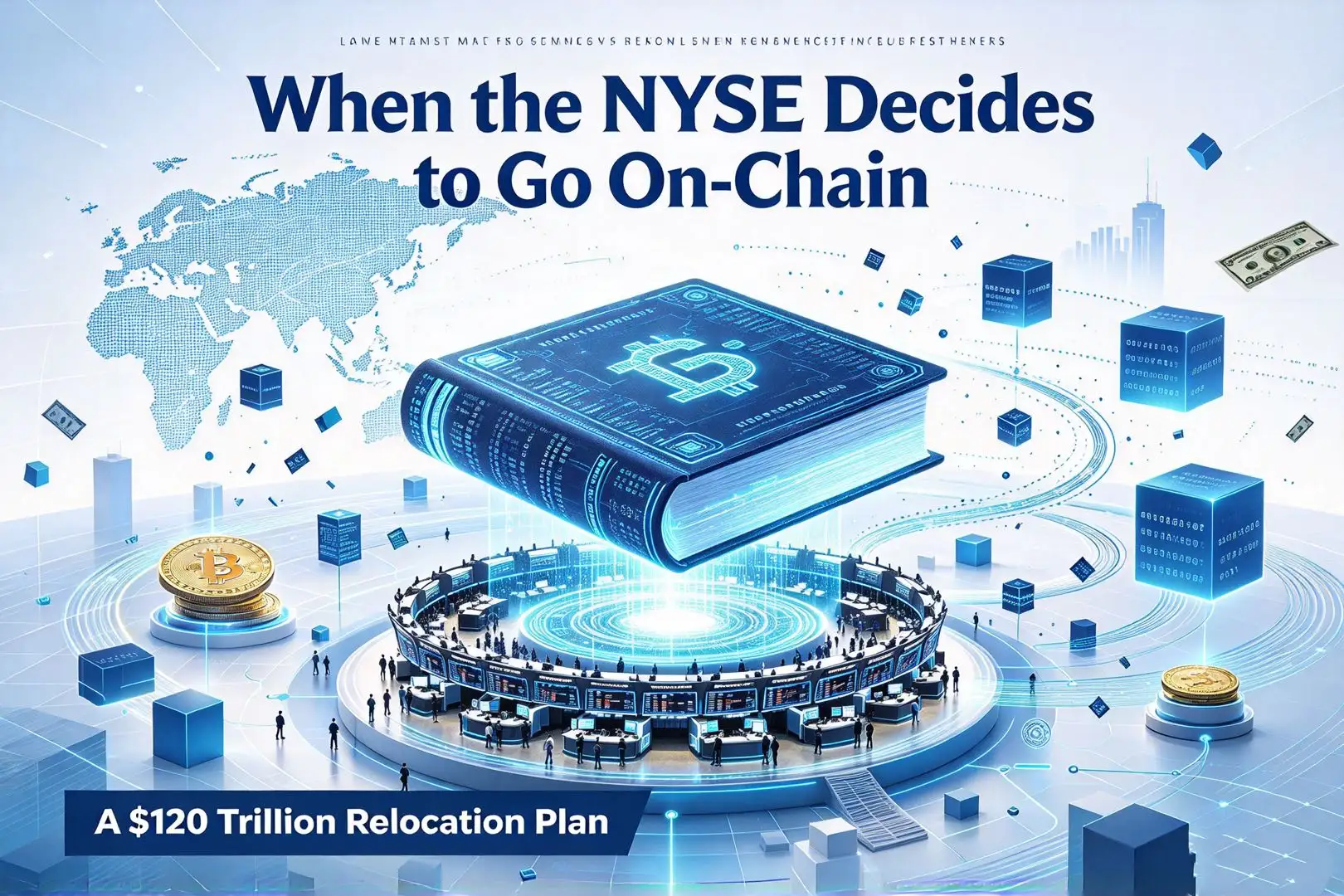
The chairman of the U.S. Securities and Exchange Commission just said something that could reshape the global financial system: “I would like to see the stock market run on blockchain.” This is not crypto-industry hype. The person who said it is Paul Atkins, Chairman of the U.S. Securities and Exchange Commission (SEC). In a live interview with CNBC, he made it clear that the entire financial system is moving toward the crypto era. Put simply: the gatekeeper of the worlds largest capital market is actively inviting blockchain in, rather than keeping it outside the door.What Does “Putting Stocks On-Chain” Actually Mean? The first thing many people think of is: “Turn Apple stock into a token.” But the reality is much more interesting. When you buy a U.S. stock, this is roughly what happens behind the scenes: your money starts at a bank, moves through a broker, is matched on an exchange, confirmed by a clearinghouse, and recorded by a custodian. Only then do you effectively “own” the stock. The entire process currently operates on a T+1 settlement cycle—sell today, and the transaction settles the next business day. The logic of on-chain stocks is much simpler: Stock = TokenBroker = WalletClearing = Smart ContractDollar = Stablecoin The SEC chairman