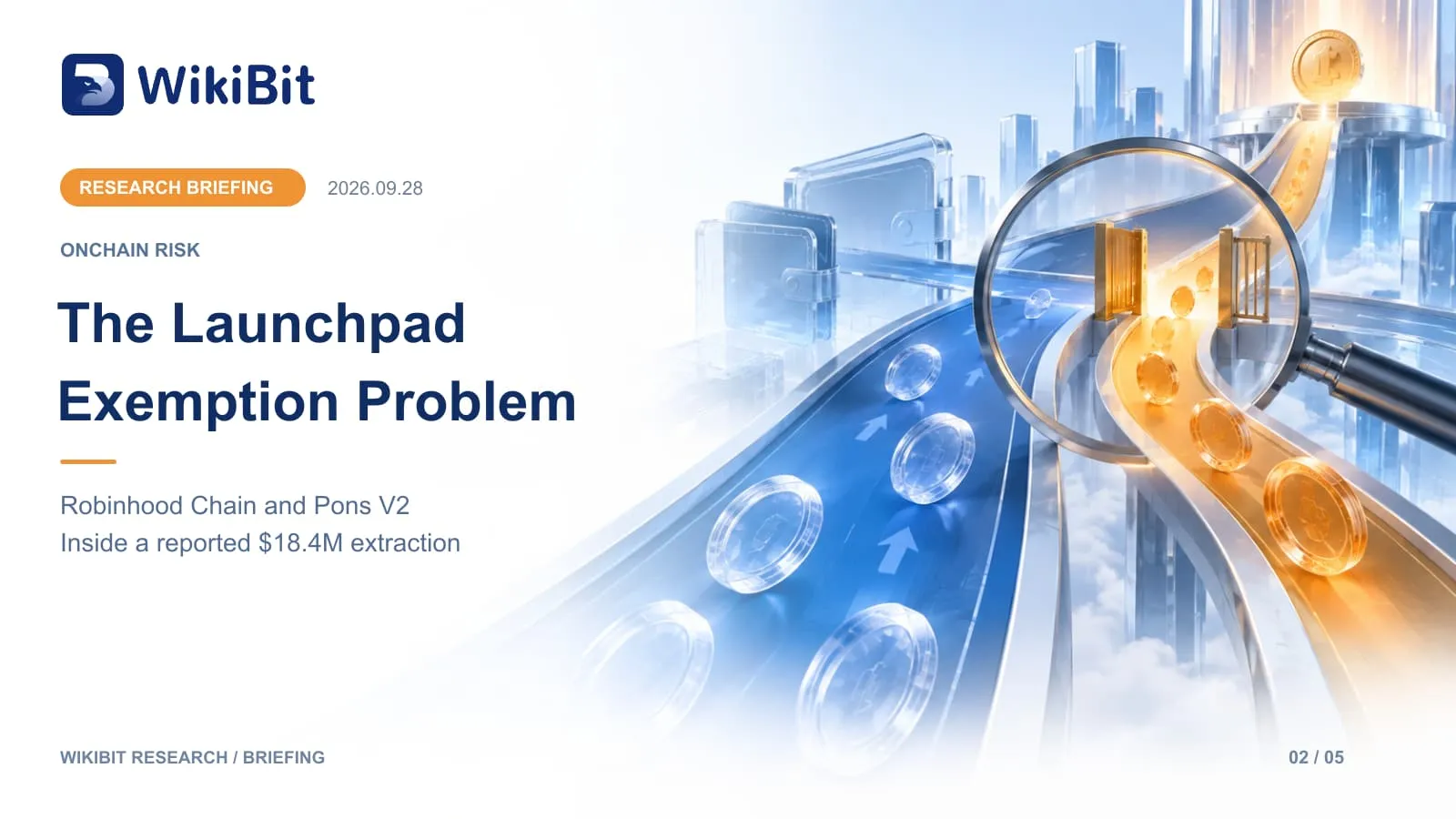
Robinhood Chain’s Reported $18.4M Extraction: The Risk Behind Launchpad Exemptions

Evidence at a glance: Wazzs $18.43 million estimate covers 53 launches. The Block reported checking launch mechanics for 10 tokens, not independently reproducing the full total. WikiBit has not performed a new transaction-level audit.  A September 27 report on Robinhood Chain token launches puts a specific design choice under scrutiny: who can bypass a launchpads opening protections. It has also become a case study in how a launchpad feature designed to help projects coordinate opening liquidity can be turned into an extraction mechanism. On September 27, pseudonymous onchain analyst Wazz published an investigation alleging that one coordinated operation extracted at least $18.43 million from 53 token launches on Robinhood Chain between July 10 and September 21.  The Block independently reviewed the onchain activity for 10 Pons V2 launches on Wazzs list and confirmed a recurring pattern:token creators exempted a specific set of wallets from the launchpads anti-sniping tax;those wallets bought most of the token supply within seconds of launch;the opening purchases pushed the token into a Uniswap pool;the same cluster then sold into public buyers.  The Block also traced a specific flow connecting proceeds from one launch, DRAFT, to wallets that later funded another token, DEED. However, The Block did not independently reproduce

Yesterday 14:01Industry Research

Ethereum’s Cryptographic World Computer: What the 2030 Vision Changes

Evidence at a glance: Based on Vitalik Buterin‘s September 27 essay and Ethereum’s published roadmap. Future architecture and delivery targets remain proposals, not mainnet guarantees.  Vitalik Buterin‘s latest Ethereum roadmap is not simply a proposal to make the chain faster. It is a proposal to change what Ethereum fundamentally is. In a September 27 essay titled “The cryptographic world computer,” Buterin argued that Ethereum is moving toward a system that combines a blockchain with zero-knowledge proofs, offchain computation, multi-party block construction and stronger privacy. Buterin’s essay  He wrote that Hegota — the fork planned for 2027 — is likely to be Ethereums last “normal” upgrade, meaning the last major fork whose technology would still look broadly familiar to a 2015 Ethereum developer. After that, the roadmap increasingly depends on:recursive STARKs;automated formal verification;highly optimized proof-of-stake;multi-party block construction;quantum-safe cryptography;privacy-preserving verification.  That is a much larger shift than another throughput upgrade. The central idea is that Ethereum should stop requiring every computer to repeat every computation. Instead, specialized systems can do work elsewhere and provide short cryptographic proofs that the work was done correctly. Ethereum then verifies the proof.Verification Is Becoming More Important Than Re-Execution  Traditional blockchains are deliberately repetitive. In the conventional fully validating model, nodes

Yesterday 13:59Industry Research

UK Cryptoasset Regulation: The 2026 Rules and 2027 Implementation

The United Kingdom has now created the legal foundation for a comprehensive cryptoasset financial-services regime, but the new framework is not yet fully in force.  The Financial Services and Markets Act 2000 (Cryptoassets) Regulations 2026 were made on February 4, 2026. They create new regulated activities covering areas such as operating cryptoasset trading platforms, dealing and arranging, safeguarding, staking and issuing qualifying stablecoins.  The main regime is scheduled to come into force on October 25, 2027.  Before then, firms face an important implementation period. The FCA will accept applications for the new cryptoasset permissions from 7:00am on September 30, 2026 until February 28, 2027.  At the same time, todays rules have not disappeared.  Cryptoasset firms can already face:anti-money-laundering registration requirements;financial-promotion rules;Travel Rule obligations;existing FSMA requirements where another regulated financial product or service is involved.  This creates one of the most important distinctions in UK crypto regulation:  FCA registration, lawful crypto advertising and future FSMA crypto authorisation are not the same thing.  A platform saying it is “FCA registered” may currently mean that the entity is registered under the Money Laundering Regulations for relevant cryptoasset activity.  That does not automatically mean the firm already holds the future permissions required to operate a regulated cryptoasset trading platform, safeguard qualifying cryptoassets, issue

Within 1 weeksIndustry Research

Singapore Payment Services Act: DPT Licensing and Asset Protection

Singapores crypto regulatory framework is best understood as an activity-based licensing system rather than a single “crypto licence.”  The Payment Services Act 2019 (PSA) regulates Digital Payment Token, or DPT, services alongside other payment activities. Its scope was materially expanded on April 4, 2024 to capture custody, token transfers and exchange-arrangement activities that previously could fall outside the perimeter.  Customer-asset safeguards followed in October 2024, requiring relevant DPT service providers to place customer assets into trust arrangements or return them within the prescribed timeframe, maintain proper records and separate safeguarding functions from trading and investment decisions.  A second framework then became important in 2025.  From June 30, 2025, Singapore introduced a separate Digital Token Service Provider regime under the Financial Services and Markets Act for specified Singapore-linked businesses that provide digital-token services only to customers outside Singapore. MAS has said the licensing bar for that model is high and that it will generally not issue such licences.  These two regimes should not be combined.  For a crypto platform operating from Singapore in 2026, the useful questions are:  Which legal entity provides the service?  Does it serve customers in Singapore, customers overseas, or both?  Which regulated activity does it perform?  Does its MAS permission actually include Digital Payment Token Service?  Those questions

Within 1 weeksIndustry Research

South Korea Virtual Asset User Protection Act: Safeguards and Market Abuse

South Koreas Virtual Asset User Protection Act has moved well beyond its launch phase.  The law took effect on July 19, 2024 and added a dedicated user-protection and market-conduct layer on top of the countrys earlier virtual asset service provider registration and anti-money-laundering framework.  Its core protections are concrete.  Customer cash deposits must be managed separately through banks. Virtual asset service providers must actually hold the types and quantities of crypto entrusted by users. At least 80% of the economic value of customer virtual assets must be maintained in cold storage. Providers also need insurance, mutual-aid arrangements or reserves for specified incidents such as hacking and system failures.  The law also created a much stronger market-abuse regime covering conduct such as insider dealing, price manipulation and fraudulent transactions.  By July 2026, those provisions were no longer theoretical. Korean financial authorities reported that they had completed investigations into more than 40 suspected unfair-trading cases since the law took effect and had referred or reported more than 30 cases to investigative authorities.  That enforcement record makes the 2026 question different from the one investors asked in 2024.  It is no longer:  Will South Korea enforce the User Protection Act?  It is:  How do the custody rules work in practice, what does the

Within 1 weeksIndustry Research

Japan Payment Services Act: Crypto Registration, Custody and 2026 Reform

Japan has one of the longest-running crypto exchange registration systems among major financial markets, but its regulatory structure is changing again in 2026.  The Payment Services Act (PSA) remains the current foundation for cryptoasset exchange registration, custody and customer-asset protection. Amendments adopted in 2025 took effect on June 1, 2026, introducing a new intermediary category and additional measures affecting customer assets and stablecoin-related services.  A second reform followed only weeks later.  On July 15, 2026, Japan enacted amendments to the Financial Instruments and Exchange Act (FIEA) and Payment Services Act that are designed to move much of the regulation of cryptoasset trading into the FIEA framework.  That later reform has passed, but it has not yet replaced the existing PSA regime as of September 2026.  The Financial Services Agencys implementation materials state that the cryptoasset regulatory changes are scheduled to take effect within one year from April 1, 2027. Until the relevant provisions commence, existing PSA registration and custody rules remain operational.  That creates a two-layer question for users and businesses:  What rules apply to the provider today?  and:  What will change when the 2026 FIEA reform takes effect?  Those questions need to be kept separate.Japans crypto framework is broader than the Payment Services Act  The PSA is central, but it

Within 1 weeksIndustry Research

Australia Digital Assets Framework Act: Platform Licensing and the 2027 Transition

Australias digital-asset regulatory framework changed materially in 2026, but the most important new platform rules are not yet fully operational.  The Corporations Amendment (Digital Assets Framework) Act 2026, Act No. 38 of 2026, received Royal Assent on April 8, 2026. It creates a new financial-services framework for digital asset platforms (DAPs) and tokenised custody platforms (TCPs) under the Corporations Act.  The reform is significant because it regulates the platform arrangement itself rather than simply trying to classify every crypto token as a traditional financial product.  But enactment should not be confused with commencement.  ASICs current implementation roadmap says the new DAP/TCP framework will commence in April 2027, followed by a licensing transition. At the same time, Australias existing financial-services laws already apply where a digital-asset product or service falls within existing financial-product definitions.  That creates two parallel questions for businesses in 2026:  What law applies to my product today?  and:  What additional DAP or TCP obligations will apply when the new framework commences?  For users, the same distinction matters when an exchange says it is “preparing for Australias new crypto licence.” Preparation for a future regime does not establish that every service it provides today is already properly authorised.The Act is law, but the new framework starts in 2027  The

Within 1 weeksIndustry Research

GENIUS Act Explained: US Stablecoin Rules and Implementation in 2026

The GENIUS Act is no longer only a policy framework waiting for an effective date.  The Guiding and Establishing National Innovation for U.S. Stablecoins Act, or GENIUS Act, became law on July 18, 2025 as Public Law 119–27.  Its principal effective date is now effectively fixed at January 18, 2027.  The statute originally used a two-part formula:18 months after enactment; or120 days after the primary federal payment stablecoin regulators issue final implementing regulations;  whichever occurs first.  The first date is January 18, 2027.  By late September 2026, the principal federal implementation packages remained in proposed-rule form. OCC had proposed its main framework, FDIC had proposed prudential and custody rules, and the federal banking agencies and FinCEN had proposed customer-identification requirements. No final implementing rule had been issued early enough for the 120-day mechanism to produce a date before January 18, 2027.  That makes the distinction between law enacted and regime effective much clearer than it was earlier in 2026.  For issuers, exchanges and users, however, one date is still not enough.  The Act also contains separate delayed restrictions, including a rule that, beginning three years after enactment — July 18, 2028 — digital asset service providers generally may not offer or sell payment stablecoins in the United States unless

Within 1 weeksIndustry Research

Brazil Virtual Assets Law: Central Bank Licensing, VASP Rules and FX Boundaries

Brazils crypto regulatory framework moved from broad legislation into detailed central-bank supervision in 2026.  The foundation remains Law 14,478 of 2022, which created a legal framework for virtual-asset services. But a current review can no longer stop there.  Decree 11,563 assigned the main authorization and supervisory role to the Banco Central do Brasil (BCB), while preserving the authority of the Comissão de Valores Mobiliários (CVM) over securities. Then, in November 2025, the BCB published Resolutions 519, 520 and 521, which became the operational core of the regime in 2026.  Those rules took effect primarily on February 2, 2026.  They address three different questions:who needs authorization and how the transition works;how virtual-asset service providers must operate;when virtual-asset transactions fall inside Brazils foreign-exchange and international-capital framework.  The result is much more specific than the phrase “crypto is regulated in Brazil.”  For users and businesses, the important questions are:  Which legal entity provides the service?  Is it authorized, in the authorization process or operating under a valid transition?  Is the product a virtual asset, a security, a derivative or a foreign-exchange service?  Which regulator and rule apply to that activity?  Those distinctions matter more than a generic “BCB regulated” label.Brazils framework now has several regulatory layers  Brazils virtual-asset regime can be understood through four main

Within 1 weeksIndustry Research

Dubai Virtual Assets Law and VARA: Licensing, Custody and Marketing Rules

Dubais virtual-asset regime is now mature enough that the phrase “VARA regulated” is no longer very informative on its own.  Law No. 4 of 2022 created the Virtual Assets Regulatory Authority, but the legal position of an exchange, custodian, broker or token issuer depends on much more than the existence of that law.  Users need to know:which legal entity provides the service;whether that entity appears in VARAs Public Register;whether it holds a full VASP licence or only In-Principle Approval;which activities the licence actually covers;whether the product is offered inside VARAs territorial perimeter;which version of the relevant rulebook applies.  Those distinctions became even more important in 2026.  VARA now publishes activity-specific permissions in its Public Register, including a separate designation for Exchange Services that include Exchange Traded Derivative Services. In March 2026, it also updated the Exchange Services Rulebook with detailed requirements for crypto derivatives covering areas such as client suitability, margin, leverage, segregation and insurance funds.  The practical lesson is simple:  A Dubai company registration, an In-Principle Approval or a licence for one virtual-asset activity should never be treated as permission for every crypto product offered under the same brand.VARA does not regulate the DIFC  The first boundary is geographic.  VARA regulates virtual assets and virtual-asset activities across

Within 1 weeksIndustry Research