GENIUS Act Explained: US Stablecoin Rules and Implementation in 2026

The GENIUS Act is no longer only a policy framework waiting for an effective date.  The Guiding and Establishing National Innovation for U.S. Stablecoins Act, or GENIUS Act, became law on July 18, 2025 as Public Law 119–27.  Its principal effective date is now effectively fixed at January 18, 2027.  The statute originally used a two-part formula:18 months after enactment; or120 days after the primary federal payment stablecoin regulators issue final implementing regulations;  whichever occurs first.  The first date is January 18, 2027.  By late September 2026, the principal federal implementation packages remained in proposed-rule form. OCC had proposed its main framework, FDIC had proposed prudential and custody rules, and the federal banking agencies and FinCEN had proposed customer-identification requirements. No final implementing rule had been issued early enough for the 120-day mechanism to produce a date before January 18, 2027.  That makes the distinction between law enacted and regime effective much clearer than it was earlier in 2026.  For issuers, exchanges and users, however, one date is still not enough.  The Act also contains separate delayed restrictions, including a rule that, beginning three years after enactment — July 18, 2028 — digital asset service providers generally may not offer or sell payment stablecoins in the United States unless
09-23Industry Research

Brazil Virtual Assets Law: Central Bank Licensing, VASP Rules and FX Boundaries

Brazils crypto regulatory framework moved from broad legislation into detailed central-bank supervision in 2026.  The foundation remains Law 14,478 of 2022, which created a legal framework for virtual-asset services. But a current review can no longer stop there.  Decree 11,563 assigned the main authorization and supervisory role to the Banco Central do Brasil (BCB), while preserving the authority of the Comissão de Valores Mobiliários (CVM) over securities. Then, in November 2025, the BCB published Resolutions 519, 520 and 521, which became the operational core of the regime in 2026.  Those rules took effect primarily on February 2, 2026.  They address three different questions:who needs authorization and how the transition works;how virtual-asset service providers must operate;when virtual-asset transactions fall inside Brazils foreign-exchange and international-capital framework.  The result is much more specific than the phrase “crypto is regulated in Brazil.”  For users and businesses, the important questions are:  Which legal entity provides the service?  Is it authorized, in the authorization process or operating under a valid transition?  Is the product a virtual asset, a security, a derivative or a foreign-exchange service?  Which regulator and rule apply to that activity?  Those distinctions matter more than a generic “BCB regulated” label.Brazils framework now has several regulatory layers  Brazils virtual-asset regime can be understood through four main

09-23Industry Research

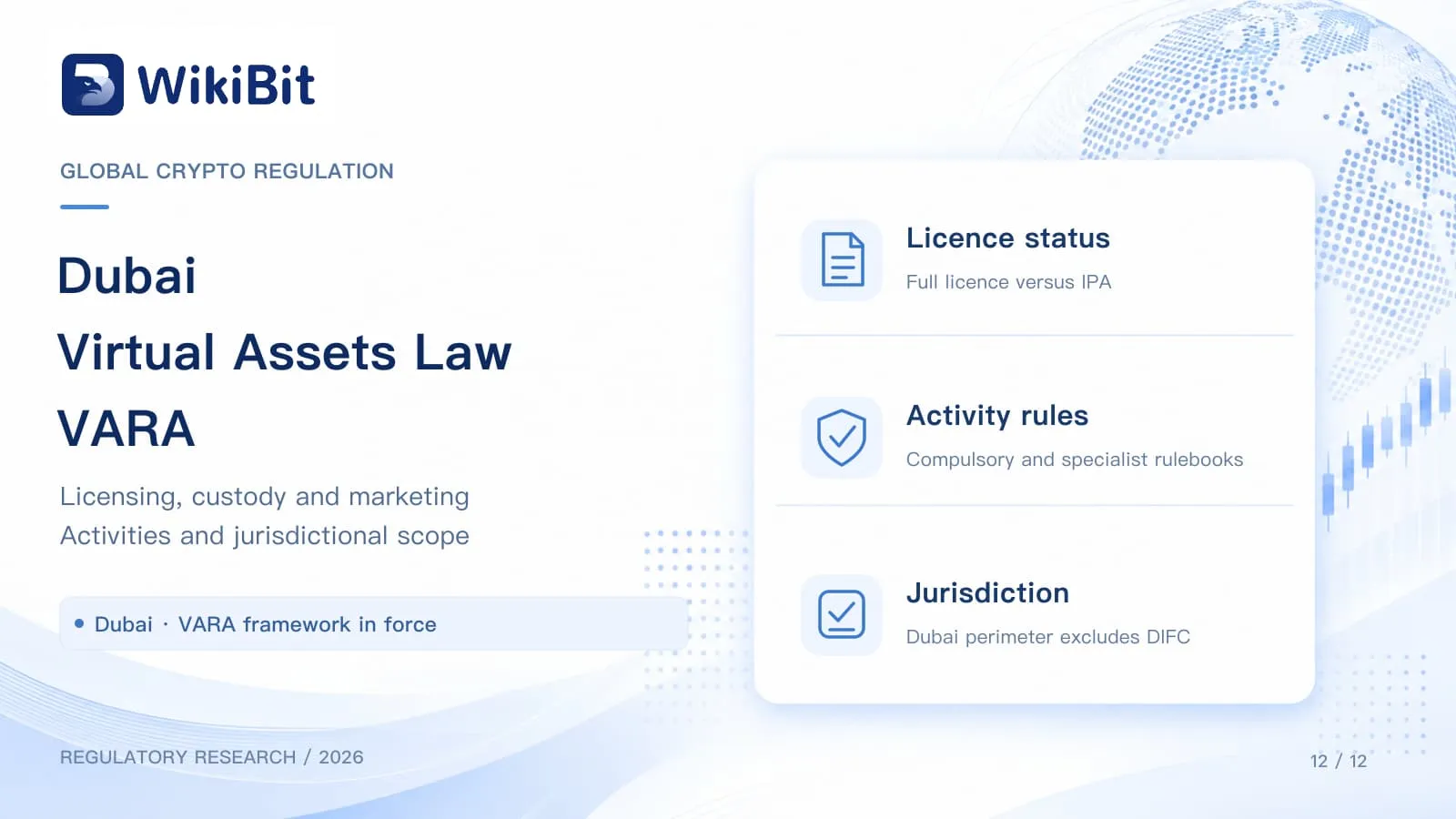
Dubai Virtual Assets Law and VARA: Licensing, Custody and Marketing Rules

Dubais virtual-asset regime is now mature enough that the phrase “VARA regulated” is no longer very informative on its own.  Law No. 4 of 2022 created the Virtual Assets Regulatory Authority, but the legal position of an exchange, custodian, broker or token issuer depends on much more than the existence of that law.  Users need to know:which legal entity provides the service;whether that entity appears in VARAs Public Register;whether it holds a full VASP licence or only In-Principle Approval;which activities the licence actually covers;whether the product is offered inside VARAs territorial perimeter;which version of the relevant rulebook applies.  Those distinctions became even more important in 2026.  VARA now publishes activity-specific permissions in its Public Register, including a separate designation for Exchange Services that include Exchange Traded Derivative Services. In March 2026, it also updated the Exchange Services Rulebook with detailed requirements for crypto derivatives covering areas such as client suitability, margin, leverage, segregation and insurance funds.  The practical lesson is simple:  A Dubai company registration, an In-Principle Approval or a licence for one virtual-asset activity should never be treated as permission for every crypto product offered under the same brand.VARA does not regulate the DIFC  The first boundary is geographic.  VARA regulates virtual assets and virtual-asset activities across

09-23Industry Research

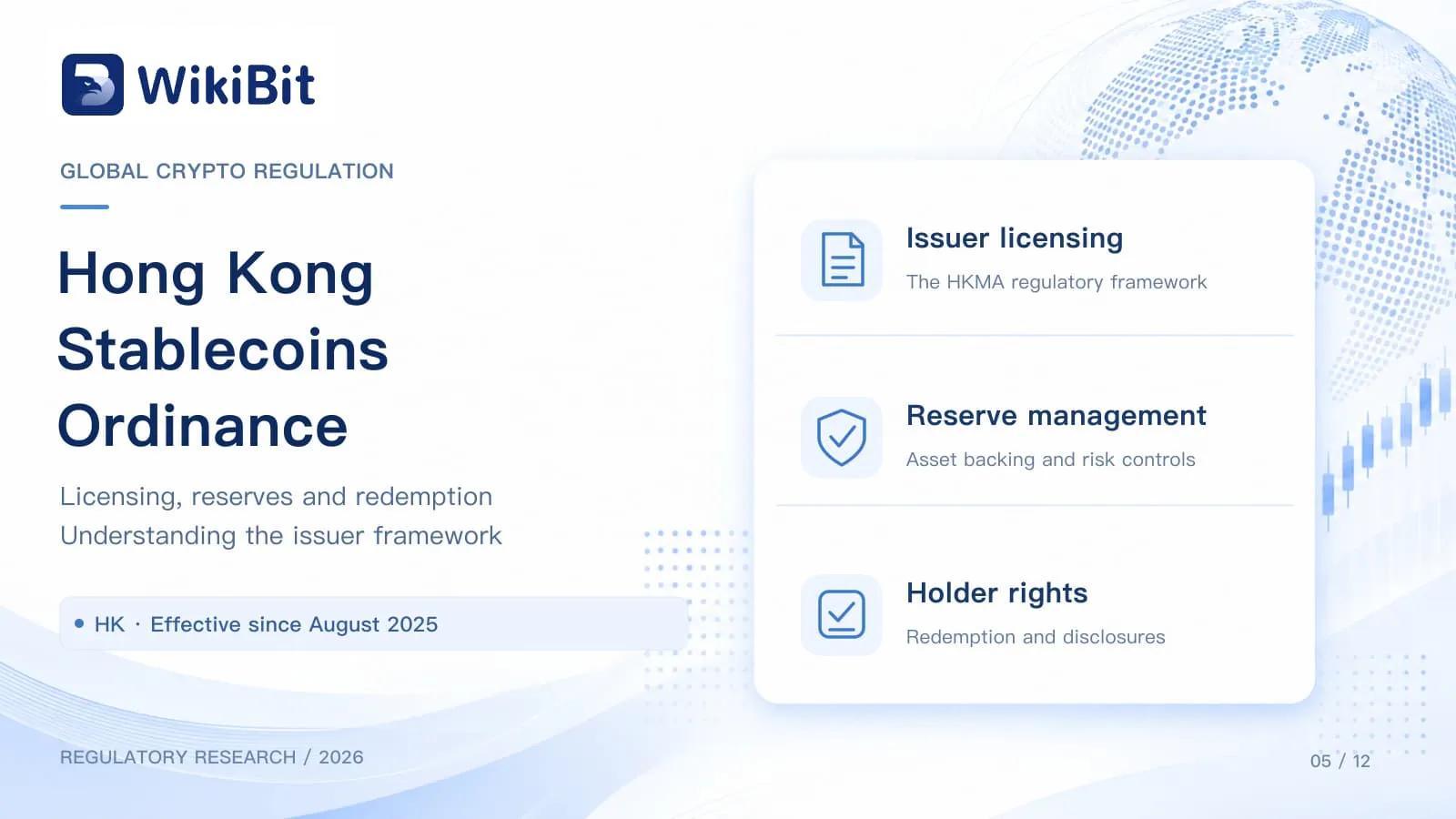
Hong Kong Stablecoins Ordinance: Licensing, Reserves and Redemption

Hong Kongs stablecoin regime is no longer a sandbox experiment or a proposal waiting to take effect.  The Stablecoins Ordinance (Cap. 656) came into operation on August 1, 2025, creating a licensing framework for regulated fiat-referenced stablecoin issuance. On April 10, 2026, the Hong Kong Monetary Authority granted the first two stablecoin issuer licences to Anchorpoint Financial Limited and The Hongkong and Shanghai Banking Corporation Limited (HSBC).  Both licensed issuers initially plan to issue Hong Kong dollar-referenced stablecoins.  That milestone makes Hong Kongs framework much easier to evaluate in 2026. The relevant questions are no longer only what applicants might need to do. There are now licensed issuers, ongoing HKMA supervision and separate Securities and Futures Commission rules governing how licensed platforms and intermediaries may provide services in regulated stablecoins.  For users, the most useful way to understand the regime is to separate four layers:  Issuer → Reserve assets → Redemption → Distribution  A licence at one layer does not automatically authorise every business at the next.  A stablecoin issuer licence does not make every exchange licensed. An exchange licence does not authorise the exchange to issue its own stablecoin. And the fact that a regulated stablecoin can be traded through an intermediary does not mean every

09-20Industry Research

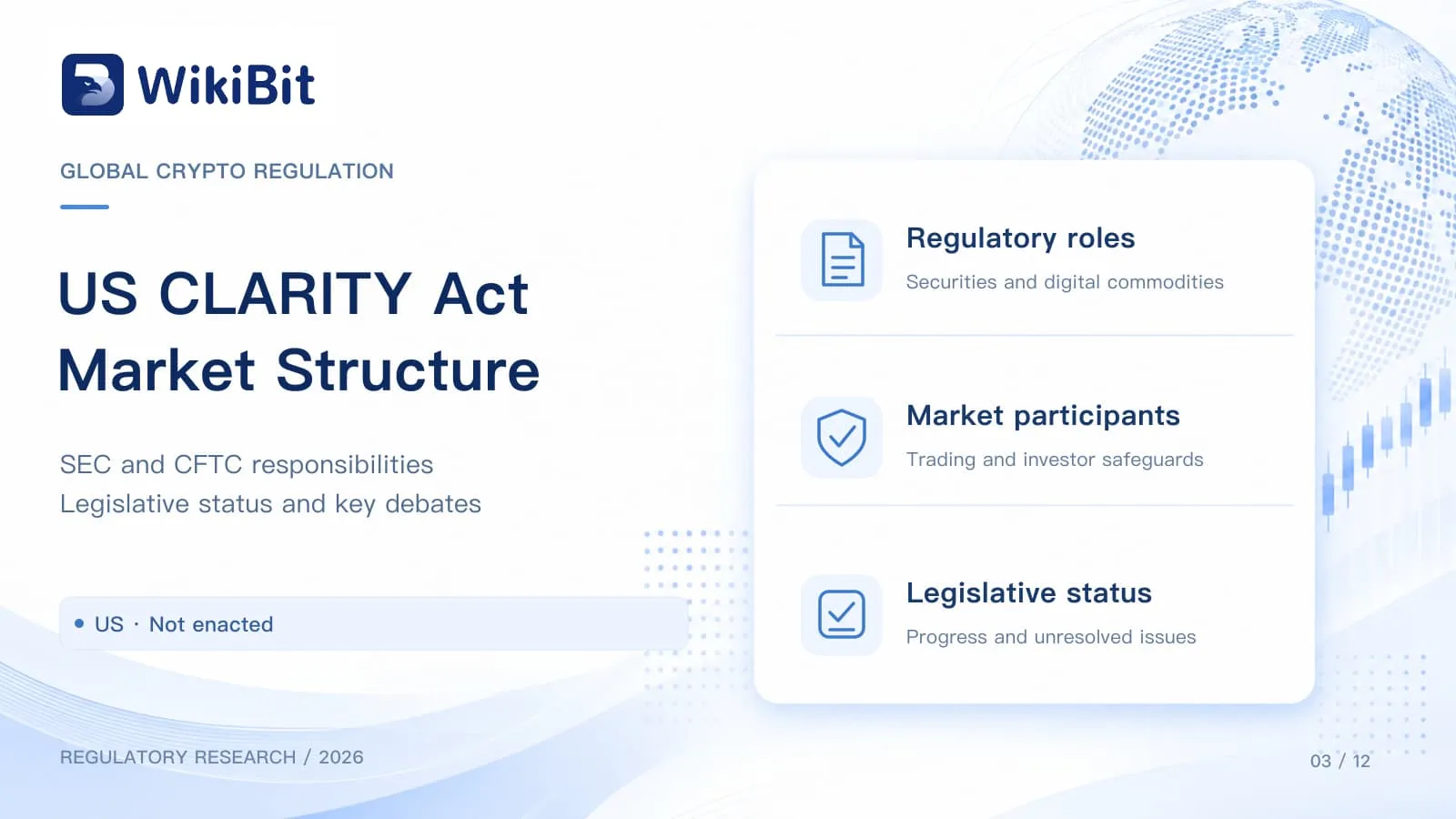
CLARITY Act Explained: Crypto Market Structure and Its 2026 Status

As of September 2026, the CLARITY Act remains one of the most important unfinished pieces of U.S. crypto legislation.  The House passed H.R. 3633, the Digital Asset Market Clarity Act of 2025, on July 17, 2025. The Senate then developed its own market-structure approach through both the Banking Committee and Agriculture Committee. In May 2026, the Senate Banking Committee advanced H.R. 3633 by a 15–9 vote.  But the legislation has not become law.  On September 15, 2026, a Senate procedural motion to advance the CLARITY Act fell short. That means the proposal remains part of an active legislative debate rather than the current federal rulebook.  This distinction matters because market-structure legislation can sound more settled than it really is. Headlines about committee votes, revised drafts or bipartisan negotiations do not create new legal permissions by themselves.  The useful question in September 2026 is therefore not simply:  What does the CLARITY Act regulate?  It is:  Which provisions are proposals, which version contains them, where is the legislation in Congress, and what law applies today?  That approach is especially important because several congressional texts have shaped the debate. The House-passed CLARITY Act, Senate Banking Committee text and Senate Agriculture Committees digital-commodity proposal overlap in important areas but are not interchangeable.Where the

09-20Industry Research

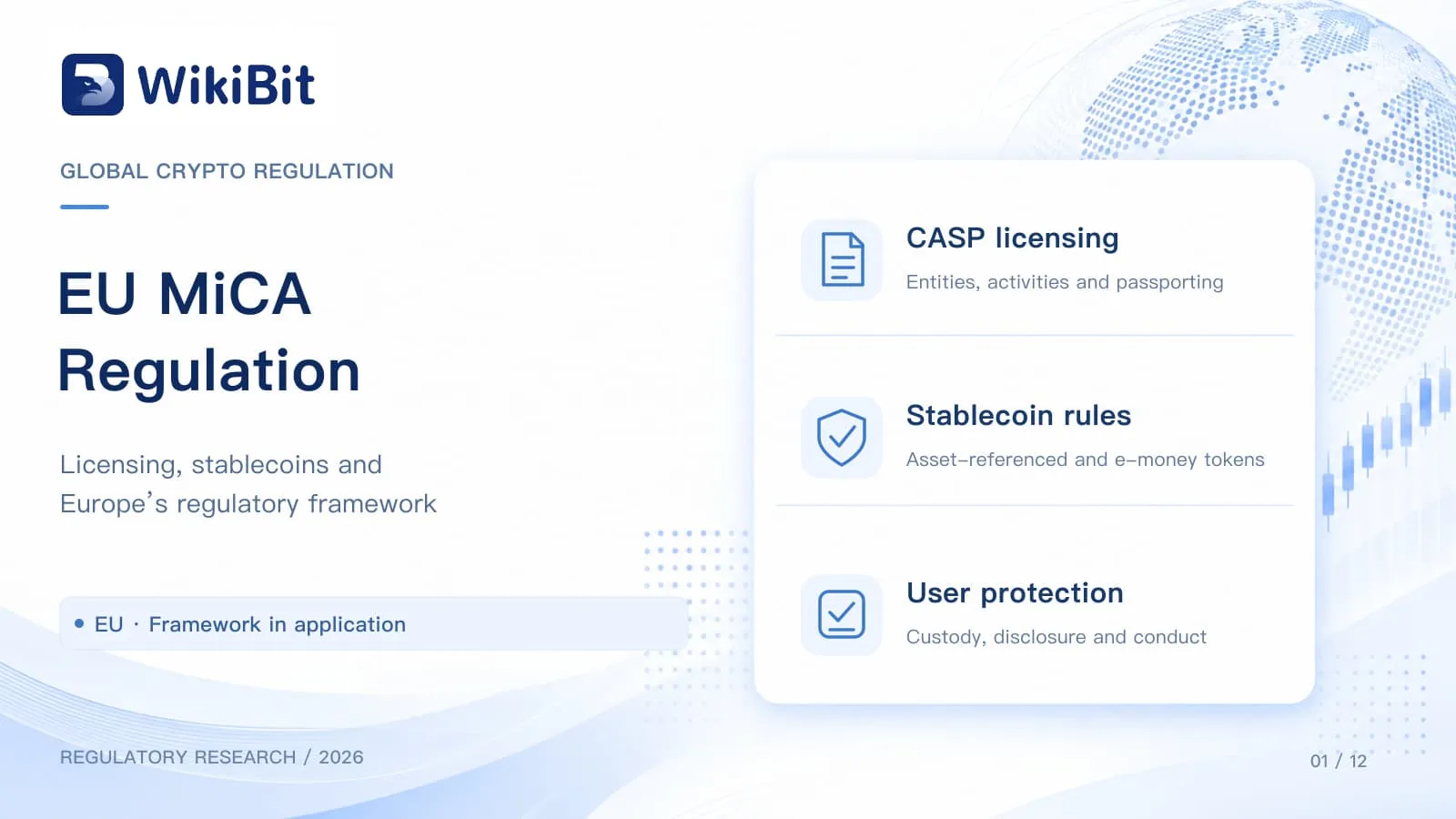
EU MiCA Regulation Explained: Crypto Rules, Stablecoins and Exchange Licensing in 2026

The Markets in Crypto-Assets Regulation, better known as MiCA, has moved into a very different phase in 2026.  For several years, the regulation was discussed mainly in terms of implementation dates, licence applications and transitional arrangements. That period is largely over.  The stablecoin provisions have applied since June 30, 2024. Most of the remaining regulation has applied since December 30, 2024. And on July 1, 2026, the longest possible transitional period for crypto-asset service providers came to an end.  For exchanges, custodians and other crypto businesses serving EU customers, the central question is therefore no longer:  Is this company preparing for MiCA?  It is:  Which legal entity serves the customer, is that entity authorised under MiCA, and which services is it authorised to provide?  That distinction is more important than the licence badge shown in an exchange footer.  A global crypto brand may operate through one MiCA-authorised European company, a separate UK entity, Middle Eastern entities and offshore companies. MiCA protections attach to the authorised legal entity and the services covered by its authorisation — not automatically to every company using the same brand.  For users, this makes MiCA more practical than it may initially appear. Regulatory claims can increasingly be verified against official registers rather than accepted as

09-20Industry Research

BTCC Review 2026: Futures Fees, Reserves and Risks

BTCC is one of the oldest names still active in crypto trading, tracing its history to 2011. But the platform users see in 2026 is very different from the early China-based Bitcoin exchange associated with the original brand.  Todays BTCC is primarily a derivatives platform. It offers USDT- and coin-margined perpetual futures, spot trading, copy trading, Earn products and an expanding TradFi section covering stocks, indices, commodities, metals and forex through USDT-settled contracts.  Its 2026 strategy has been particularly aggressive on cost.  BTCC permanently cut standard crypto futures fees in June and removed execution fees entirely from more than 30 TradFi futures instruments. At the same time, it has continued publishing monthly Proof of Reserves reports with customer-level Merkle verification.  The reserve numbers have also changed since earlier versions of this review. BTCC reported a 140% total reserve ratio for its August 15, 2026 snapshot, up from 129% in July and 132% in February. Its live PoR page has since advanced to a September 15 report date.  Those are meaningful disclosures.  But BTCCs strongest products are still leveraged derivatives. A 0.048% taker fee does not make a highly leveraged position low-risk, and a 140% PoR snapshot does not turn futures collateral into an insured deposit.  The useful

09-20Industry Research

Zoomex Review 2026: Fees, Leverage, KYC and Safety

Zoomex is built primarily for active crypto traders rather than investors looking for a simple place to buy Bitcoin and leave it untouched.  The platform combines ordinary spot markets with perpetual futures, copy trading, automated strategies and a wallet-connected DEX. Its most aggressive product is a separate 1000x Futures section, where users can select leverage as high as 1,000 times their input capital.  That feature makes Zoomexs central trade-off unusually clear.  Its standard trading fees are competitive. Spot costs 0.1% for both makers and takers, while standard USDT perpetual contracts charge 0.02% maker and 0.06% taker. But on a highly leveraged position, trading commission quickly becomes a secondary issue. Funding, liquidation mechanics, position size and regional eligibility matter much more.  Zoomex has also improved the amount of security and reserve information it publishes. Its current transparency page states that customer assets are backed 1:1 and displays a 100% reserve-coverage figure, while Hacken publishes multiple penetration tests covering Zoomex systems.  Those disclosures are useful, but they need to be read carefully. Zoomexs public reserve page does not provide the same clearly exposed customer-level Merkle liability verification used by some exchanges, and a penetration test answers a different question from whether customer liabilities are fully covered.  For a

09-20Industry Research

Hotcoin Review 2026: Reserves, Fast Listings and Trading Risks

Hotcoin is a centralized crypto exchange built around breadth and speed. Its platform combines spot trading, perpetual futures, copy trading, P2P, Earn products, Web3 features and an increasingly large selection of tokenized traditional-market assets.  That rapid product cycle is one of Hotcoins main attractions. It is also one of the main reasons users need to monitor the platform more actively than they might on an exchange focused on a smaller set of established markets.  New tokens can appear quickly. Futures contracts can be introduced or removed. Blockchain deposits and withdrawals can be suspended for maintenance. Smaller assets can be delisted with a fixed withdrawal deadline. Tokenized stocks may launch with temporary zero-fee campaigns that expire only days later.  The other major issue is custody transparency.  Hotcoin publicized approximately $137.45 million in exchange assets as of June 15, 2026, based on wallet data displayed by CoinMarketCap. But reserve values move with asset prices, deposits, withdrawals and changes in disclosed wallets. At the time of this review in September 2026, CoinMarketCap was displaying roughly $56.7 million in total assets attributed to Hotcoin, substantially below the June snapshot.  That change should not automatically be interpreted as customer withdrawals, a reserve deficit or financial distress. CoinMarketCap itself notes that

09-20Industry Research

KCEX Review 2026: Zero Fees, Restrictions and Risks

KCEX has one of the simplest fee pitches among centralized crypto exchanges in 2026: spot trading costs 0% for both makers and takers, while standard USDT-margined perpetual futures charge 0% maker and 0.01% taker.  There is no VIP ladder to climb before reaching those headline rates, and KCEX now describes its zero-fee spot structure as standard pricing rather than merely a limited campaign.  For an active trader generating substantial turnover, that difference can be meaningful.  But fees are not the hardest part of evaluating KCEX.  Its current User Agreement excludes residents of a long list of countries, including the United States, Canada, Singapore, Indonesia, mainland China and Hong Kong. KCEX simultaneously publishes a U.S. FinCEN MSB registration for a subsidiary, which can easily be misunderstood as authorization to serve American traders even though its own terms explicitly reject U.S. registrations and transactions.  Reserve transparency is another important limitation. Unlike exchanges that publish customer-verifiable Merkle-tree proof of reserves, KCEX does not currently surface an equivalent public verification system. CoinMarketCaps KCEX exchange page currently labels its reserve data as unavailable.  KCEX does have independently inspectable security evidence. Hacken conducted penetration tests covering its Web/API infrastructure, Android app and iOS app in 2025, with most identified issues subsequently fixed.  The

09-20Industry Research
1
...
12141516