Introduction: An Exchange Whose Offshore Compliance Narrative Is Falling Apart
In the first 56 editions of this series, we investigated a range of exchanges, from HashKey to BloFin. For Edition #57, we're turning our attention to an exchange with a distinctly offshore profile: BTSE (btse.com).
On paper, BTSE has an impressive background. Founded in 2018 by traditional finance traders and technology professionals, the exchange was acquired by Talos Global, with Henry Liu taking over as CEO in 2022. It passed a Hacken Proof of Reserves (PoR) audit on April 9, 2026, and published an asset transparency report. BTSE claims that more than 99% of its assets are held in cold wallets and that it maintains an insurance fund. According to CoinPaprika's adjusted data, its 24-hour trading volume stands at approximately $430 million, ranking it 24th among 136 centralized exchanges.
But the other side of the story is considerably less reassuring.
On July 24, 2025, the Seychelles Financial Services Authority (FSA) formally rejected the VASP license application submitted by BTSE Holdings Limited and instructed the company to “immediately cease all operations or relocate its services outside the jurisdiction.”
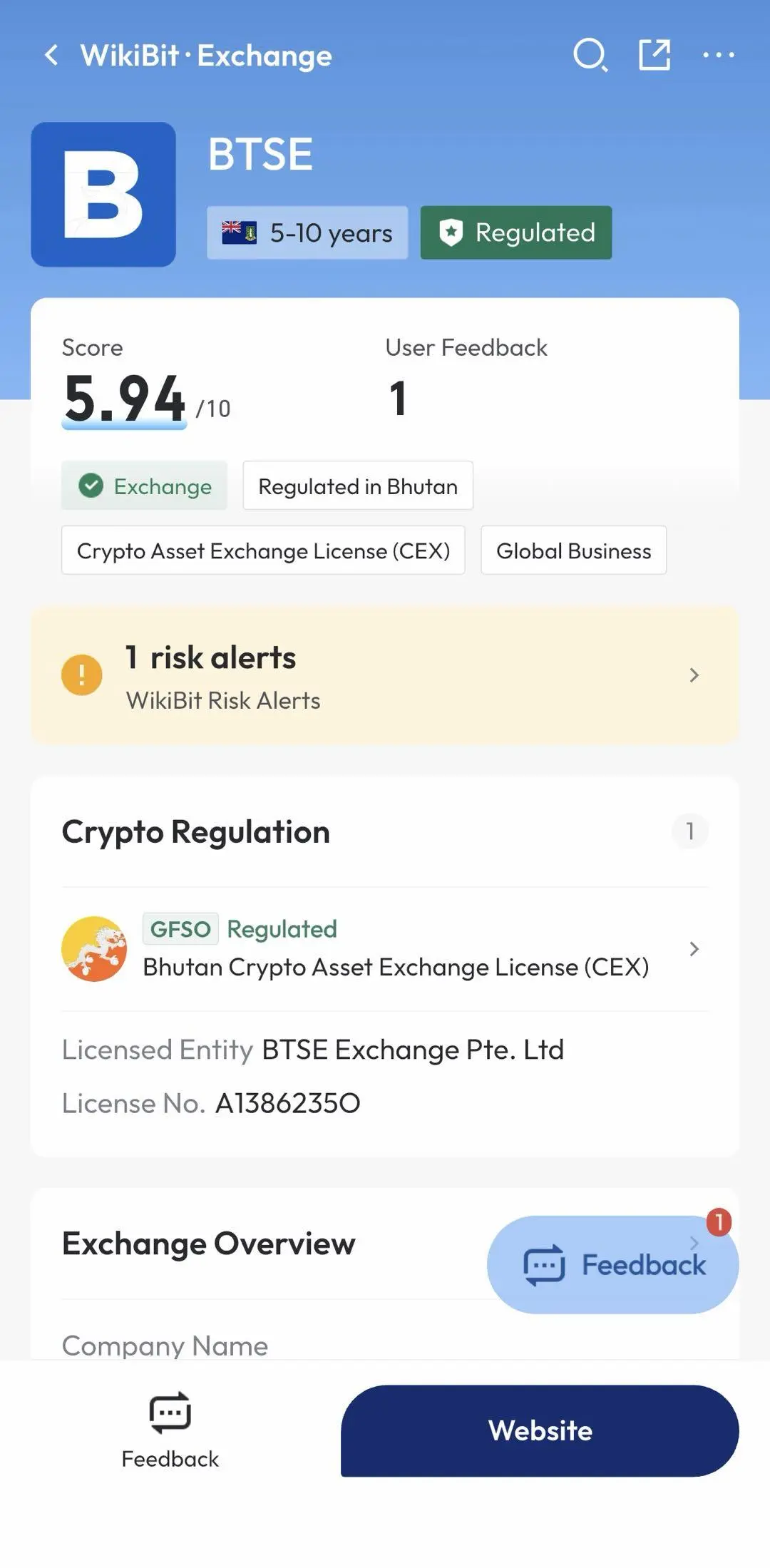
WikiBit gives BTSE a score of just 5.94/10, explicitly flagging its regulatory environment as relatively loose based on currently available information.
On Trustpilot, BTSE has a rating of 2/5, classified as “Poor.” User complaints frequently involve unexplained 24-hour deposit restrictions, withdrawal difficulties, and customer support responses that appear to rely heavily on standardized templates.
FX110 has also documented complaints involving requests to deposit 200–3,000 USDT to “activate” withdrawal channels. One user described the experience bluntly: “Once you deposit your USDT, forget about withdrawing it.”
Why would an exchange that has passed a Hacken PoR audit and claims to store 99% of its assets in cold wallets have its offshore license application rejected, while some users are reportedly being asked to make additional deposits to activate withdrawals?
Let's examine the evidence layer by layer.
1. Regulatory Compliance: Seychelles Rejected the Application, Exposing Cracks in BTSE's Offshore Compliance Narrative
BTSE is a textbook example of the offshore regulatory narrative examined in this series.
According to publicly available records from the Seychelles Financial Services Authority (FSA), the VASP application submitted by BTSE Holdings Limited on December 31, 2024, was formally rejected on July 24, 2025.
The FSA also instructed the company to “immediately cease all operations or relocate its services outside the jurisdiction.”
Records from OffshoreAlert confirm that BTSE was among the exchanges, alongside KuCoin, that were effectively shut down in Seychelles following the introduction of the country's VASP legislation.
TradersUnion's assessment also explicitly notes that BTSE does not hold Tier-1 regulatory authorization, meaning investor protection and transparency may fall below the standards offered by leading financial jurisdictions.
BTSE's Response: “That Was a Different Entity”
BTSE's official response to the Seychelles FSA notice was that the notice concerned BTSE Holdings Limited, a former Seychelles-registered International Business Company (IBC).
According to BTSE, this entity is a “separate legal entity” from the one currently operating the BTSE platform, and the two entities do not share directors, governance structures, or operational functions.
BTSE further emphasized that the FSA had “not identified any financial misconduct, fraud, AML/CFT violations, or harm to any users,” and that “no enforcement action has been taken against any BTSE entity.”
From a legal and corporate-structure perspective, BTSE's explanation has a certain logic. If the operating business genuinely migrated to a new legal entity, reportedly in Costa Rica, then the FSA's notice would apply to the former entity rather than the new operating company.
However, from a user-protection perspective, the central questions remain unanswered:
Which jurisdiction regulates the new operating entity?
What licenses does that entity actually hold?
Which regulatory framework governs its operations?
What legal protections are available to customers if withdrawals are frozen or disputes arise?
Changing the legal entity does not automatically resolve regulatory concerns. Users need to know exactly which company holds their assets and which regulator, if any, is responsible for overseeing it.
Indonesia's OJK: A Genuine Compliance Achievement, but Not a Substitute for Global Licensing
BTSE's regulatory record is not entirely negative.
On December 19, 2025, Indonesia's Financial Services Authority (OJK) published a whitelist of digital financial asset and crypto-asset trading platforms that included the following entry:
| Item | Details |
| Platform | BTSE Indonesia |
| Operating company | PT Aset Kripto Internasional |
| Registration number | S-20/D.07/2025 |
| Official website | btse.id |
This indicates that BTSE Indonesia, through its local operating entity, obtained authorization to operate within Indonesia's regulatory framework.
This is a meaningful positive development. It demonstrates that the BTSE group is not entirely avoiding regulatory oversight and is making efforts to enter regulated markets through locally established entities.
However, an important distinction must be made: the OJK authorization applies to BTSE Indonesia, operated by PT Aset Kripto Internasional. It does not automatically mean that the global platform at btse.com is licensed in Indonesia, nor does it mean that all global customers enjoy the protection of Indonesian regulations.
Indonesian users should use the locally authorized platform and review the corresponding account agreements. The BTSE Indonesia authorization should not be treated as a regulatory passport for the global platform.
Risk Rating: HIGH (Regulatory Compliance)
2. Account Security and Withdrawals: No Major Hacking History, but Withdrawal Complaints Are Piling Up
Since its establishment in 2018, no major publicly documented incidents involving a BTSE hot-wallet hack, private-key leak, or misappropriation of customer funds have been identified through the sources reviewed.
This is a relatively clean security record compared with several other exchanges featured in this series.
However, the number and nature of negative user complaints remain concerning.
Case 1: February 2026 — Incorrect Refund Information Left a User Unable to Recover Funds for Two Months
On February 21, 2026, a Danish user posted a one-star review on Trustpilot, claiming that BTSE had rejected a transaction and subsequently provided incorrect information when processing the refund.
As a result, the funds failed to reach the user's account.
The user stated that the issue remained unresolved for more than two months. Despite repeatedly contacting customer support, they received essentially identical template responses and remained unable to access their money.
The significance of this complaint is not that it proves BTSE misappropriated customer funds. Rather, it highlights a specific operational risk:
When a transaction is rejected and funds need to be returned, are the platform's payment processing, information verification, and customer-support escalation procedures sufficiently reliable?
Fiat deposits and withdrawals often involve banks, intermediary payment processors, and beneficiary information. Even without malicious intent, processing errors can leave customer funds inaccessible for extended periods.
Case 2: February 2025 — Transfer from Another Exchange Triggered KYC Restrictions
On February 14, 2025, a Finnish user complained on Trustpilot that their account had been asked to provide additional identity and proof-of-address documents after transferring assets from the Iranian trading platform Wallex to BTSE.
The user claimed to have submitted identification documents, a selfie, and a utility bill, but their account was still not functioning normally two days later.
This type of complaint requires careful interpretation.
BTSE explicitly lists Iran as a restricted jurisdiction and conducts sanctions screening on user identities, sources of funds, and on-chain wallet addresses.
If funds originate from a restricted jurisdiction, involve high-risk counterparties, or are connected to sanctioned addresses, additional compliance checks are not unexpected.
However, from a user-experience perspective, the platform should clearly communicate:
Which documents or information are still missing?
What stage has the review reached?
Is there an estimated timeframe for completion?
Users should not be left with nothing more than a generic “Please wait for the review” response.
Case 3: December 2024 — User Claimed Their Account Was Frozen During Withdrawal and Original Asset Records Became Inaccessible
Another Trustpilot user posted a complaint on December 7, 2024, claiming that their account and assets had been frozen when they attempted to withdraw funds on November 5, 2024.
The user later stated that their account status had changed, but their original asset balances and transaction records were no longer accessible through the platform. They also mentioned an account balance of approximately $28,000.
This complaint should not be presented as proof that “BTSE stole $28,000.”
However, it highlights an important lesson for exchange users: whenever a withdrawal dispute arises, screenshots of account balances, transaction histories, deposit transaction hashes, and customer-support ticket records can become critical evidence.
Trustpilot Rating: 2/5 — 24-Hour Deposit Restrictions Without Notifications
BTSE currently holds a Trustpilot rating of 2/5, classified as “Poor.”
Several recurring complaints appear in user reviews:
“24 hour locks on deposits with no notifications whatsoever.”
“Submit a customer service request and you'll type on the entire order information and you get blocked.”
“I honestly have never experienced customer service this bad. It has been more than two months and I still cannot access my own money because of BTSE.”
“Unable to access my own money for two months,” “template customer service responses,” and “24-hour restrictions without notification” are not simply complaints about poor withdrawal experiences.
They point to a broader issue: the reliability and accessibility of customer funds.
For a centralized exchange, users must be able to access their assets under clearly communicated rules. Unexplained restrictions and ineffective support mechanisms can undermine that fundamental expectation.
“Mandatory KYC”: A Gap Between Marketing Claims and Actual Withdrawal Requirements
Another Trustpilot complaint reveals a different potential problem.
According to one user, BTSE advertised that spot trading, deposits, and withdrawals did not require KYC, subject to a daily limit of $100,000.
However, when the user attempted to withdraw, the platform suddenly demanded identity verification.
The user reportedly attempted to withdraw just 0.0006 BNB to cover gas fees, but the funds were withheld and a KYC request was issued.
Citing BTSE's Terms of Service, specifically Section 4.1, and information from its support center, the user argued that KYC was only required during registration or for fiat/crypto transactions such as credit-card purchases, rather than ordinary cryptocurrency deposits and withdrawals.
BTSE customer support reportedly responded:
“Sorry we didn't communicate this in advance, but you still need to complete KYC, otherwise we will not process your withdrawal.”
The underlying issue here is not that exchanges should never require KYC.
Exchanges have legitimate AML, sanctions-screening, and risk-management obligations. They may also need to request additional verification when suspicious activity is detected.
The problem is the lack of transparency around when and why these requirements apply.
“The platform advertises that KYC is unnecessary, but suddenly demands it at the moment of withdrawal.”
This is a transparency and customer-communication failure, not necessarily a failure of the security measures themselves.
Users may accept KYC requirements. What they cannot reasonably accept is having the rules effectively changed unilaterally at the very moment they try to withdraw their own funds.
Risk Rating: EXTREMELY HIGH (Account Security and Withdrawals)
3. Proof of Reserves Transparency: The Hacken Audit Is Real, but It Doesn't Explain Why Withdrawals Get Stuck
BTSE's investment in Proof of Reserves (PoR) transparency is genuine. It is not simply a low-cost marketing sticker.
According to BTSE's official blog, the exchange completed a Proof of Reserves audit conducted by Hacken on April 9, 2026. Hacken is one of the leading independent blockchain security firms in the cryptocurrency industry.
In addition to this audit, BTSE regularly publishes “Asset Transparency Reports,” providing users with ongoing visibility into its on-chain reserve holdings.
BTSE's PoR system uses a Merkle Tree mechanism. Individual user account balances are aggregated into a Merkle Root, allowing users to verify whether their balances are included in the root without exposing other users' information.
An independent auditor then cross-checks the Merkle Root against publicly verifiable on-chain wallet addresses to confirm that the exchange's total asset holdings cover its total customer liabilities.
TradersUnion also confirms that BTSE keeps more than 99% of its assets in cold wallets and maintains an insurance fund.
The Problem: BTSE Says It Has Reserves, but Doesn't Disclose How Much
No asset-by-asset reserve ratios.
Consider publicly available industry comparisons. MEXC's April 2026 Hacken report, for example, disclosed verifiable figures, including a BTC reserve ratio of 295%, total reserves of 12,695.71 BTC, 69,430.24 ETH, and 1.88 billion USDT.
BTSE, by contrast, provides only the conclusion that its reserves meet a “≥1:1” ratio, without disclosing specific reserve ratios, snapshot totals, or the precise methodology used to calculate customer liabilities.
Key Figures Come from BTSE's Own B2B Website
Details such as the 1:1 reserve ratio, Merkle Tree verification, and April 9 audit date were initially published on BTSE Enterprise Solutions' content pages.
This is closer to self-disclosure than comprehensive third-party reporting.
An independent audit is valuable, but users should be able to access the underlying audit report and independently verify its scope, methodology, and findings.
On-Chain Footprint Does Not Match the Exchange's Reported Scale
Third-party on-chain aggregator CoinBoss lists BTSE's identified holdings as just 20.0020 BTC, worth approximately $1.31 million, accounting for 100% of the assets identified in its coverage.
An important qualification is necessary: incomplete wallet labeling can significantly underestimate an exchange's actual holdings. Therefore, this figure does not prove that BTSE has a reserve shortfall.
However, it does highlight something important: BTSE has not proactively established itself as an exchange whose overall reserves can be independently verified through comprehensive public on-chain disclosures.
BTSE has achieved “being audited,” but has not fully achieved “being independently verifiable by anyone.”
By industry standards, this puts BTSE around the middle of the pack. It is not a transparency benchmark, but neither is it a complete black box.
Risk Rating: MEDIUM (Proof of Reserves Transparency)
4. Financial Strength: Funding History and Institutional Business, but No Fully Verifiable Public Financial Statements
According to CoinPaprika, BTSE's adjusted 24-hour trading volume is approximately $430 million, ranking it 24th among 136 centralized exchanges.
The platform lists around 200 assets and has a credibility score of 32%. BTC accounts for 64.7% of its trading volume, while ETH accounts for 19.1%.
CoinGecko reports BTSE's 24-hour trading volume at approximately $84.58 million, with a Trust Score of 8/10.
CoinMarketCap reports spot trading volume of approximately $80.81 million per day.
The significant differences between these platforms' reported figures reflect disagreements in the visibility and verifiability of BTSE's trading activity across third-party data providers.
Overall, BTSE is not an empty shell. It has real trading volume, real users, and real products.
However, it remains considerably smaller than first-tier platforms such as Binance, OKX, and Bybit. For large-volume traders, order book depth and slippage are important factors that deserve careful evaluation.
A $22 Million Series A Round and a $400 Million Valuation
On March 11, 2021, BTSE officially announced that it had completed its Series A funding round on January 31, 2021, raising approximately $22 million at a post-money valuation of $400 million.
At the time, co-founder and CEO Jonathan Leong stated that the funding would support BTSE's development into a comprehensive digital financial services platform.
This indicates that BTSE was not simply a small project relying entirely on trading fees. It secured institutional and family office backing at an early stage of its development.
However, one important distinction must be made: a $400 million valuation in 2021 does not mean the company's net assets are still worth $400 million in 2026.
A valuation represents a market price established during a funding transaction. It is not equivalent to cash reserves, nor does it represent funds available to protect customer assets.
Enterprise-Level Business Provides an Additional Source of Value
In addition to providing retail trading services, BTSE operates enterprise-level technology businesses.
This is a relatively meaningful advantage because it gives the company business activities beyond its retail exchange operations.
However, the existence of B2B operations does not automatically guarantee that the group has sufficient financial resources to cover customer liabilities.
Lack of Public Financial Statements Is a Major Weakness
BTSE is not a publicly listed company. In this investigation, we could not identify sufficiently comprehensive public audited financial statements to independently verify its consolidated balance sheet, cash reserves, net assets, operating cash flow, and total customer custody liabilities.
As a result, two important questions remain unanswered:
How much proprietary capital does the BTSE group currently have?
Are customer assets held by the exchange fully segregated from the group's operational funds?
BTSE has a funding history, enterprise-level operations, and a certain degree of market presence. However, its overall financial strength cannot be fully verified through comprehensive public audited financial statements.
This does not justify concluding that BTSE is undercapitalized. Equally, its historical funding valuation and reported trading volume alone are insufficient to establish that it has adequate solvency.
Risk Rating: MEDIUM-HIGH (Financial Strength)
BTSE has genuine trading activity and an established user base, but its overall market position remains in the lower-middle tier.
Against a backdrop of withdrawal complaints and regulatory uncertainty, an exchange of this size may have considerably less capacity to absorb a sudden wave of customer withdrawals than a first-tier platform.
5. Internal Operations and Management: Founders Are Identifiable, but Governance and Compliance Backgrounds Have Gaps
Founder: Jonathan Leong | Current CEO: Henry Liu
BTSE's founding team is publicly identifiable.
Jonathan Leong founded BTSE, which was established in 2018. Henry Liu has served as CEO since 2022.
In June 2023, BTSE Holdings was acquired by Talos Global.
Among the operating executives, COO Jeff Mei has a relatively well-documented professional background. He previously held management positions at Huobi (HTX) and ChainUp, bringing more than 15 years of management and global operations experience. Earlier in his career, he also worked at 500 Startups and Bank of America Merrill Lynch.
However, identifiable founders do not necessarily mean transparent corporate governance.
First: Post-Acquisition Governance Structure Remains Unclear
BTSE Holdings was acquired by Talos Global in June 2023. However, publicly available information does not clearly explain the post-acquisition corporate structure, decision-making authority, or allocation of regulatory responsibilities.
The Seychelles FSA notice concerned “BTSE Holdings Limited,” while BTSE maintains that its current operating entity is “a separate legal entity.”
Yet the registration jurisdiction, licensing status, and governance structure of this supposedly separate operating entity also remain unclear in publicly available information.
This creates a gap in corporate transparency.
Second: Gaps in the Compliance Background
COO Jeff Mei has previous experience at Huobi and ChainUp.
However, Huobi (now HTX) has itself faced regulatory pressure in multiple jurisdictions, while ChainUp primarily provides B2B infrastructure services rather than directly handling retail customer withdrawals and exchange compliance operations.
Whether the experience of an executive who previously worked at an exchange facing significant regulatory scrutiny can be effectively applied to an offshore platform seeking to establish a stronger compliance framework is a question worth monitoring.
This is not evidence of misconduct, but it is a relevant consideration when evaluating management and compliance capabilities.
Third: A Tension Between 242 Employees and the Frequency of Withdrawal Complaints
BTSE reportedly has a workforce of approximately 242 employees.
So why do users repeatedly complain about “template-only customer support” and being unable to access their funds for two months?
This does not necessarily mean the company is understaffed.
However, it may indicate that the design of its customer service and compliance review processes prioritizes risk control over resolving customer problems efficiently.
For an exchange handling customer funds, compliance controls are essential. But an effective operating model must also provide timely explanations, clear escalation channels, and practical solutions when legitimate users encounter problems.
Risk Rating: MEDIUM (Management and Corporate Governance)
6. Product Experience and Trading Depth: AutoTrader Is a Highlight, but Liquidity and Customer Support Are Weaknesses
Product Strengths: AutoTrader and Futures Trading Offer Differentiation
One of BTSE's most distinctive product features is AutoTrader, an automated trading tool offering multiple bot strategies for users who do not have the time to monitor markets constantly.
Its futures trading fees are relatively competitive, ranging from 0.01% to 0.05%. The platform supports leverage of up to 100x on BTC and ETH perpetual contracts.
BTSE supports more than 240 cryptocurrencies across spot trading, margin trading, and futures markets.
According to TradersUnion, BTSE is:
“Suitable for active traders seeking futures trading and basic passive income features.”
However, the assessment also notes that it may not be the ideal choice for users seeking the lowest spot trading costs, a wider selection of assets, or immediate customer support.
The Weaknesses Are Equally Clear
First: Limited liquidity depth.
One Trustpilot user described the platform's liquidity as:
“Extremely low liquidity.”
For an exchange in the middle tier of the market, insufficient order book depth can result in significantly higher slippage costs for large trades compared with first-tier platforms.
This is particularly important for high-frequency traders and users executing large orders.
Second: Customer Support Is Limited to Email.
TradersUnion explicitly points out that BTSE offers email support but no real-time live chat.
In situations where users may face problems such as being unable to access their funds for two months, relying exclusively on email means that every communication can involve delays ranging from several hours to several days.
When standardized responses are added to the equation, the effectiveness of customer support becomes even more questionable.
Third: A Clear Divide in the User Experience.
For traders using AutoTrader and futures products, BTSE offers a reasonably adequate range of features.
But for users who need to withdraw funds quickly or encounter account-related problems, the platform's operational support appears much weaker.
The result is a familiar but troubling pattern:
“Trading works smoothly, but when something goes wrong, there's nowhere to turn.”
This structural weakness is also evident in BTSE's user experience.
Risk Rating: MEDIUM (Product Experience and Trading Depth)
7. Comprehensive Exchange Exit Risk Assessment
| Assessment Dimension | Risk Level | Key Findings |
| Regulatory Compliance | HIGH | Seychelles FSA rejected its VASP application; no Tier-1 regulatory authorization; WikiFX rating of 1.72/10, classified as “Unregulated”; operating entity's legal and regulatory status remains unclear. |
| Account Security / Withdrawals | EXTREMELY HIGH | 24-hour deposit restrictions without notifications; users reporting being unable to access funds for two months; KYC requirements at withdrawal reportedly contradict marketing claims. |
| Proof of Reserves Transparency | MEDIUM | Hacken PoR audit (April 2026), asset transparency reports, and claimed 99% cold-wallet storage; however, PoR does not guarantee smooth withdrawals. |
| Financial Strength | MEDIUM-HIGH | Funding history and institutional business operations, but no comprehensive publicly verifiable audited financial statements. |
| Management and Operations | MEDIUM | Founder Jonathan Leong is identifiable, with Henry Liu as current CEO; COO has a Huobi/ChainUp background; post-acquisition governance structure lacks transparency. |
| Product Experience | MEDIUM | AutoTrader and competitive futures fees are highlights; however, liquidity is limited and customer support is email-only, with no live chat. |
| Community Feedback | HIGH | Trustpilot rating of 2/5; recurring complaints involve deposit restrictions, withdrawal difficulties, and standardized customer support responses. |
Overall Rating: HIGH RISK OF EXCHANGE FAILURE
The two core risk vectors are withdrawal integrity and regulatory compliance.
BTSE is not a completely unqualified exchange like UZX or Azbit. It has genuine trading volume, publicly identifiable founders, a Hacken-audited Proof of Reserves system, and practical products such as AutoTrader.
It is unlikely to simply disappear overnight with customers' funds.
However, not being likely to disappear overnight does not mean being low-risk.
BTSE's risks are concentrated in two major areas:
1. Structural Weaknesses in Its Offshore Regulatory Framework
The Seychelles FSA rejected its VASP application, while WikiFX classifies the platform as “Unregulated.”
BTSE can legally argue that its operating entity has migrated elsewhere. But the reality users must consider is that the platform they are using does not have a clearly identifiable regulatory home backed by substantive licensing.
This is fundamentally similar to the issues identified with BloFin, including the absence of a MiCA license and its appearance on the French AMF blacklist.
The problem is not simply that its licenses have limited regulatory value. It is that the platform lacks a clearly established legal and regulatory status in major jurisdictions.
2. Proof of Reserves Does Not Guarantee Withdrawal Integrity
BTSE's Hacken audit and asset transparency reports are genuine developments.
However, PoR answers the question, “Does the platform hold sufficient assets?” It does not answer, “Will users be able to withdraw their money without unnecessary restrictions?”
An exchange can simultaneously claim to hold 99% of its assets in cold wallets and face frequent customer withdrawal complaints.
These two things are not contradictory because they measure different dimensions of risk.
The fundamental distinction: asset solvency and withdrawal accessibility are not the same thing.
8. Recommendations for New and Existing Users
Advice for New Users
1. First, verify whether your jurisdiction is actually covered by BTSE's regulatory framework.
The Seychelles FSA has rejected its VASP application, while WikiFX classifies it as “Unregulated.”
If you are in the European Union, BTSE does not hold a MiCA license. If you are in mainland China, BTSE has suspended fiat deposits and withdrawals and tightened its USDT policies.
Do not assume that being able to register means you are protected by a recognized regulatory framework.
2. If you still want to try BTSE, complete a full withdrawal test before increasing your exposure.
The reported complaints involving deposits to “activate” withdrawal channels suggest that withdrawals should not simply be taken for granted.
Start with an amount you can afford to lose. Complete the entire process:
Deposit → Trade → Withdraw.
Confirm that withdrawals work normally and that KYC requirements are clearly communicated before considering a larger allocation.
3. Do not store funds that you may need to access immediately.
The reported 24-hour deposit restrictions and potential mandatory KYC requirements mean that funds held on BTSE may be subject to unpredictable delays and additional conditions.
Only keep funds on the platform that you can afford to lose and can afford to leave inaccessible for a period of time.
4. Use self-custody for substantial long-term holdings.
BTSE's claim that 99% of assets are stored in cold wallets is a statement made by the platform itself.
However, “the exchange says it uses cold wallets” and “you have direct control over your assets at all times” are two very different things.
For substantial long-term cryptocurrency holdings, consider using a hardware wallet under your own control.
Advice for Existing Users
1. Monitor developments involving the Seychelles FSA and BTSE's operating entity.
BTSE claims that its current operating entity is separate from the “BTSE Holdings Limited” mentioned in the Seychelles FSA notice.
If additional jurisdictions subsequently take action against BTSE's operating entity, or if further details about its relocated entity become publicly available, these developments could materially affect your assessment of the platform's legal status.
2. Understand your KYC obligations and keep supporting evidence.
If BTSE advertises that spot trading does not require KYC but subsequently demands verification when you attempt to withdraw, this raises questions about inconsistent rule enforcement and disclosure.
Keep screenshots of BTSE's Terms of Service, support-center explanations, and any relevant marketing claims. These records may be important if you need to file a complaint or appeal.
3. Email-only customer support means you need to maintain complete records.
Save screenshots and copies of every email exchange with customer support.
If you eventually need to escalate a dispute to a regulator or consumer-protection platform, these records may be your only documentary evidence of what happened and how the exchange responded.
Final Verdict: Who Is BTSE Suitable For?
Who might consider using BTSE?
Derivatives traders who value AutoTrader's automated strategies and competitive futures fees, can accept the absence of Tier-1 regulatory oversight, and are willing to independently verify withdrawal functionality using small amounts of capital.
Who should avoid BTSE?
Mainland Chinese users: Fiat deposits and withdrawals have been suspended, and USDT policies have been tightened.
Users who consider reliable withdrawals non-negotiable: Reports involving deposit activation requirements and 24-hour restrictions raise legitimate concerns.
Long-term holders of substantial assets: Unclear offshore regulatory arrangements and questions surrounding withdrawal integrity make BTSE a questionable choice for storing significant long-term holdings.
BTSE's current position can be summarized as follows:
It has some genuinely useful products, but its regulatory and withdrawal foundations are not sufficiently solid.
AutoTrader is not just a marketing gimmick. Its Hacken PoR audit is not an empty publicity exercise. Its reported workforce of 242 employees and daily trading volume of approximately $430 million also indicate that it is not an empty shell.
However, the Seychelles FSA rejection and WikiFX's 1.72/10 rating point in the same direction.
The long-term security of an exchange depends on more than whether it offers useful trading tools. It also depends on whether its regulatory status is legitimate and whether customers can reliably withdraw their assets.
On both of these critical dimensions, BTSE's performance falls considerably short of what its AutoTrader features and PoR audit might suggest.
Coming Next
WikiBit Exchange Exit Risk Rankings #58: YUBIT Exchange
Stay tuned for our next in-depth investigation!
Risk Disclaimer
This article represents an independent analytical opinion and does not constitute investment advice. Cryptocurrency investments involve substantial risks. Always conduct your own research and exercise caution before investing.
Information in this article is updated as of November 9, 2026. Readers are encouraged to cross-check and verify the latest information through multiple sources.
WikiBit is a regulatory and risk intelligence platform built specifically for cryptocurrency investors. It provides real-time access to global exchange regulatory licenses, credit ratings, risk alerts, industry news, and genuine user reviews, helping investors identify potential risks, stay away from problematic platforms, and make more informed trading decisions.
Before investing in crypto, check WikiBit first!
Download the WikiBit App now and add an extra layer of protection to your crypto assets:
https://wikibit.onelink.me/wgfF/1b1dn69b