Nigeria's central bank sets ₦15B capital rule for stablecoins, bans algorithmic tokens

The Central Bank of Nigeria (CBN) has introduced new stablecoin licensing rules requiring foreign-currency issuers to maintain at least ₦15 billion in capital while prohibiting algorithmic stablecoins across the country.  According to the CBNs new regulations, which took effect on November 5, 2026, companies issuing naira-backed stablecoins must maintain at least ₦10 billion in paid-up capital. The framework establishes separate licensing categories for local and foreign-currency stablecoins, with issuers required to obtain approval for each token before offering it to customers.  The requirements cover cryptocurrency businesses operating in Nigeria, companies targeting Nigerian customers from overseas, and services that could affect the countrys payments system or foreign exchange market.  Nigeria requires ₦15 billion capital for foreign stablecoin issuers  Under the regulations, foreign-currency stablecoins fall into the Class 2 category, while tokens tied to the Nigerian naira fall under Class 1.  Companies seeking to issue dollar-backed or other foreign-currency stablecoins must establish a Nigerian-incorporated entity and secure a Foreign Currency Issuer Licence from the CBN.  JUST IN: Nigerias central bank bans algorithmic stablecoins, sets ₦15B capital requirement  The new rules require foreign-currency stablecoin issuers to hold at least ₦15 billion in paid-up capital, while naira-backed issuers face a ₦10 billion minimum and all approved… pic.twitter.com/aDfbBfUtnk  — crypto.news (@cryptodotnews) November 6,

11-06Industry

Bitcoin holds $75K as AI regulation fears see KOSPI halted after 8% crash

Bitcoin (BTC) held above $75,000 on Friday as a sell-off in US technology stocks spread to Asian markets.  Key points:Bitcoin steadied after falling as much as 6.6% on Thursday to $75.109 on Bitstamp.South Korea‘s KOSPI triggered a trading halt after falling more than 8% shortly after Friday’s open. The government announced a three-month waiver of margin-loan collateral requirements for brokerages from Monday.Analysis cited fears of tighter US regulation of AI following Democrats election gains. The Philadelphia Semiconductor Index fell 12.2% on Thursday.  South Korea eases collateral rules as KOSPI falls 6%  Data from TradingView showed BTC/USD trading near its 50-week simple moving average (SMA), at $75,733.BTC/USD one-day chart with 50-week SMA. Source: Cointelegraph/TradingView  The pair fell as much as 6.6% on Thursday as US stock markets saw sustained selling throughout the Wall Street trading session. The S&P 500 and tech-heavy Nasdaq Composite closed down 4.4% and 5.5%, respectively.Nasdaq Composite Index one-day chart. Source: Cointelegraph/TradingView  On Friday, Asian stocks extended the sell-off. South Koreas KOSPI Composite Index fell more than 8% shortly after the open, triggering a circuit breaker that halted trading for 20 minutes. The index then pared losses to close 6% lower at 5,059.69 points, its lowest close since March 31.KOSPI one-day chart. Source:

11-06Industry

NYSE-backed crypto venture faces 90% stock rejection as $92 liquidity problem threatens tokenization dream

More than 90% of the stocks targeted by OKX and NYSE-backed tokenization venture now face objections from their issuers.  Related Company OKX Hong Kong s latest regulatory notice with its original October proposal shows that companies have objected to 57 of the 63 stock tickers initially earmarked for trading.  The objections, which have grown to 67 companies overall, include Apple, Nvidia, Microsoft, Amazon, Tesla, and Meta, threatening to strip the proposed blockchain-based marketplace of many of Wall Streets most widely traded names before its launch.  Related Company Apple American multinational technology company  The setback comes just weeks after the US Securities and Exchange Commission (SEC) introduced a regulatory exemption designed to accelerate tokenized stock trading, allowing qualifying platforms to offer blockchain-based shares through automated trading pools.  Related Company Nvidia American multinational technology company  OKXICE, a joint venture equally owned by crypto exchange OKXs US holding company and Intercontinental Exchange, the parent of the New York Stock Exchange, plans to let investors trade tokenized versions of US stocks around the clock using stablecoins.  Related Company Microsoft American multinational technology company  However, the growing corporate resistance has left the venture facing questions about which securities it can offer and whether investors will have sufficient liquidity to trade them.  Wall Street giants

11-06Industry

BTCC Copy Trading Surpasses 680,000 Users, With Cumulative Copy Trading Earnings Exceeding $530 Million

BTCC, the worlds longest-serving cryptocurrency exchange, announced that its Copy Trading feature has surpassed 680,000 users, with cumulative copy trading earnings of more than $530 million and over 236 million successful copy trades.  First launched in 2023 on BTCC, the copy trading feature lets users automatically replicate the positions of experienced traders. It now supports more than 140 trading pairs, including TradFi pairs such as TSLA, AAPL, META and MSTR, so copy traders can follow lead traders across both cryptocurrency and traditional markets on a single platform.  The addition of TradFi pairs follows strong momentum in multi-asset trading on BTCC. TradFi volume climbed sixfold quarter-on-quarter to $16.3 billion in Q3 2026, and the platforms user base reached 12.6 million.  BTCC Copy Trading by the numbers:Total copy traders: 680,000+Total copy trading earnings: $530,000,000+Successful copy trades: 236,000,000+Supported trading pairs: 140+  “Copy trading is where our 0-Barrier Trading vision becomes practical for everyday traders,” said Alex Hung, Head of Operations at BTCC. “More people want exposure to crypto and traditional markets in one place, and copy trading lets them learn from experienced traders along the way. We will keep widening access to global markets while keeping security and trust at the core of everything we build.”  BTCC introduced

11-06Industry

Binance hackers had 8 weeks of access before $6.3B exploit, Security Alliance estimates

Non-profit cybersecurity organization Security Alliance (SEAL) estimates that the North Korea-linked TraderTraitor gained access to Binances systems about eight weeks before the $6.3 billion exploit on Oct. 29.  The hacking group gained access to Binances systems sometime in September, wrote SEAL in a Thursday report, adding that threat actors can navigate these systems with a “high degree of stealth over prolonged periods of time” after initial intrusion.  SEAL identified at least four “front companies” associated with TraderTraitors fake recruitment campaigns in 2026, including citalab.net, citalab.com, bitfit.io and oddium.io.  The cybersecurity organizations analysis pointed to similar multi-stage intrusion patterns in other high-profile crypto hacks. It estimated that attackers had about six weeks of access before the $388 million Bitget hack, six weeks of access to LayerZero before the vulnerability that led to the $293 million Kelp DAO exploit and about three weeks before conducting the $24 million AFX exploit.  Cointelegraph contacted Binance for comment on the estimates but did not receive a response by publication. Binance attributed the $6.3 billion hack to a fake job interview that enabled hackers to compromise an employee device and steal credentials to breach the exchanges wallet infrastructure.  Binance traced the attack campaign back to June, when a separate employees device

11-06Industry

Binances $6.3B hack leaves questions over hot wallet safeguards

Binances $6.3 billion security incident has left unanswered questions about how the exchange managed its hot wallets and limited the amount attackers could access.  Binance co-CEO Richard Teng said on Oct. 30 that the attack affected the exchanges own hot wallet. Most customer assets were held in offline cold storage and moved to hot wallets only when users requested withdrawals.  Wallet balances offer only a partial picture of an exchanges exposure to an attack. Public blockchain records can show funds moving but cannot establish the internal controls governing those transfers, CertiK analyst Jonathan Riss told Cointelegraph.  In its initial report Tuesday, Binance said attackers accessed an internal wallet-signing service to move funds outside its normal withdrawal process. Binance said some technical details would remain confidential to prevent further attacks.  The exchange did not respond to Cointelegraphs questions about its wallet balances and safeguards.  Rivals including Coinbase, Gate and Upbit have disclosed their cold-storage ratios following the attack.  What blockchain records can reveal  Riss said the $6.3 billion figure represented the cumulative value of assets affected across 10 blockchains. On Ethereum, attackers repeatedly drained a hot wallet as new deposits arrived.  When attackers can obtain valid signatures, their potential access depends on what the signing system allows them to

11-06Industry

Is the Musk-CZ Feud Back? Their Crash-Day Posts Leave Little Doubt

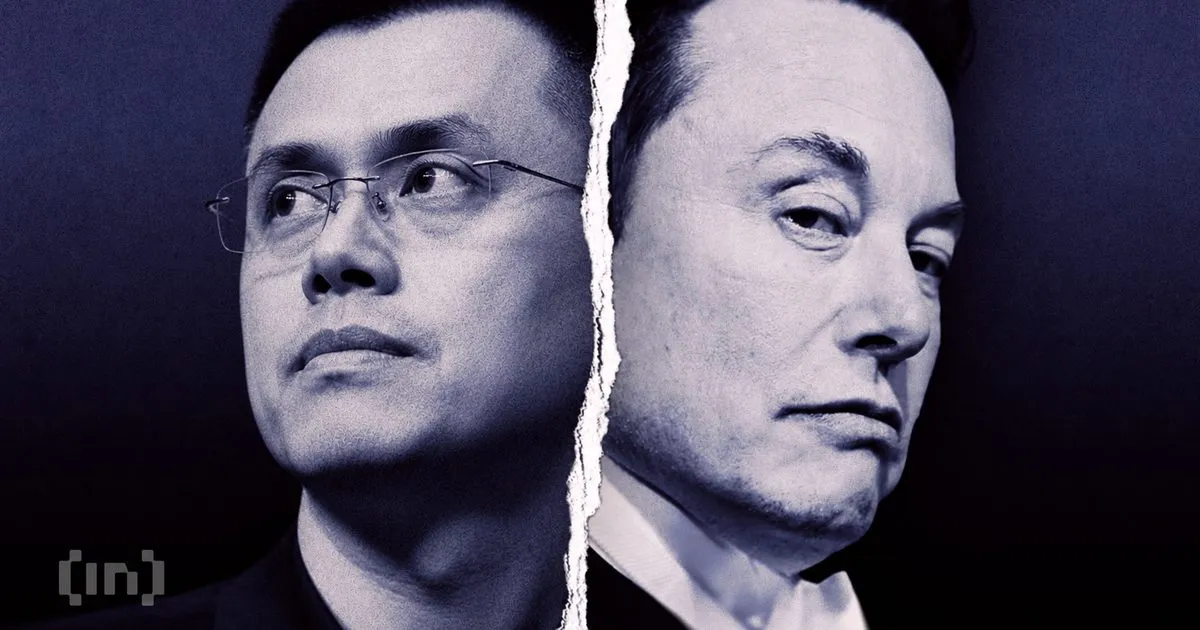
Binance founder Changpeng “CZ” Zhao and Tesla CEO Elon Musk revived their recent spat on Friday, trading memes as a stock selloff spilled into a crypto market crash. The exchange started under a post by Dogecoin co-creator Billy Markus, who had just woken up in Japan and asked how the market was doing.  The jokes landed on traders who were nursing real losses, as Bitcoin (BTC) slid alongside stocks. Holders of leveraged long bets, which use borrowed money to wager on rising prices, carried the most risk.  Sponsored  Sponsored  How Did Musk and CZ React to the Crypto Market Crash?  Musk replied to the Dogecoin co-creator first. His post showed a blurry, red-tinted image of CZ himself, a nod to the red candles on price charts.  The jab revived an earlier spat between the two. After North Korea-linked hackers took about $6.3 billion from Binance on October 29, Musk posted laughing emojis under a security warning from CZ.  At the time, CZ called it a bad time to troll and asked Musk for “a little support.”  This time, the Binance founder played along with a cartoon of a figure crouching on the ground, an arrow stuck in its bleeding leg.  Binance co-founder and co-CEO Yi He joined in about

11-06Industry

Russia proposes adding crypto assets to anti-money laundering system

Russia‘s Investigative Committee has proposed integrating cryptocurrency assets into the country’s anti-money laundering infrastructure to help authorities trace digital transactions and investigate financial crimes.  According to a Nov. 6 TASS report, the proposal was presented during the 20th session of the Open-ended Intergovernmental Working Group on Asset Recovery in Vienna, where Anna Starzhinskaya, a department head at the Russian Investigative Committees Main Investigative Directorate, represented the agency.  The working group operates under the Conference of States Parties to the United Nations Convention against Corruption and focuses on international cooperation in identifying, recovering, and returning assets linked to criminal activity.  During the meeting, the committee explained that Russian investigators already have access to specialized resources maintained by Rosfinmonitoring, the countrys financial intelligence agency, which help them examine cryptocurrency transactions and gather evidence in criminal investigations.  “Investigative authorities‘ access to Rosfinmonitoring’s specialized resources makes it possible to track cryptocurrency transactions and obtain significant information to prove criminal activity,” the committee said in a statement translated from Russian.  The agency subsequently proposed formally incorporating crypto assets into the anti-money laundering infrastructure, although the announcement did not set out a specific implementation timetable.  Russian investigators report $486 million in seized assets  Alongside the cryptocurrency proposal, Starzhinskaya presented figures on Russias efforts

11-06Industry

U.S. Stocks Lost the Equivalent of 1.2 Crypto Markets Overnight: Is the AI Bubble Starting to Burst?

November 5 was an ordinary Thursday, but Wall Street experienced a textbook case of a major shift in market sentiment. U.S. stocks lost $3.2 trillion in market value overnight—more than the entire crypto market capitalization of $2.5 trillion. In other words, the market wiped out the equivalent of 1.2 entire crypto markets in a single night.  The sell-off was triggered by a sharp collapse in AI-related stocks, setting off a chain reaction across the broader market. Nvidia plunged 9.3% in a single session, wiping out $446.6 billion in market capitalization—approximately RMB 2.98 trillion, roughly equivalent to the market value of Agricultural Bank of China disappearing in one day. AMD fell 17.3%, SanDisk dropped 22%, while Micron and Western Digital each lost more than 17%. Combined, the so-called “Magnificent Seven” lost approximately $1.04 trillion in market value.  The Philadelphia Semiconductor Index crashed 12.25%, dragging down the tech-heavy Nasdaq Composite by 5.52% and the Nasdaq 100 by 6.36%. Both recorded their worst single-day performances since the consecutive market circuit breakers of March 2020.  The U.S. stock market rout quickly spread across global markets, and Bitcoin was no exception. Within a short period, BTC plunged from $81,000 to $75,000. The entire crypto market lost approximately $140

11-06Deep Dive

Kaia asks stakers to migrate KAIA ahead of permissionless network upgrade

Kaia has asked users staking KAIA through its existing Public Delegation system to prepare for a mandatory migration to new staking contracts, with withdrawal requests set to open on November 17 ahead of its permissionless network upgrade.  According to a November 6 announcement, the transition will involve deploying new staking contracts and carrying out a network hard fork, requiring existing stakers to manually move their tokens because their current positions will not transfer automatically.  The migration will affect users who have deposited KAIA through the networks existing Public Delegation service, with the process requiring them to request a withdrawal, wait seven days, withdraw their tokens and deposit them into the replacement contract.  Kaia said withdrawal requests will open on November 17 through a dedicated Migration menu on Kaia Portal, while withdrawals and re-deposits are scheduled to begin from November 26.  Kaia staking migration requires users to move their tokens manually  Under the new arrangement, users will be able to connect their wallets to Kaia Portal and view their existing staking positions alongside their migration status.  The dedicated interface will guide users through each stage and direct them to the replacement staking contract operated by the same Governance Council, or GC, to which they currently delegate their

11-06Industry
1
...
5254
...
1000