Roundhill Memory ETF attracts $200M in retail cash in record time amid AI trade surge

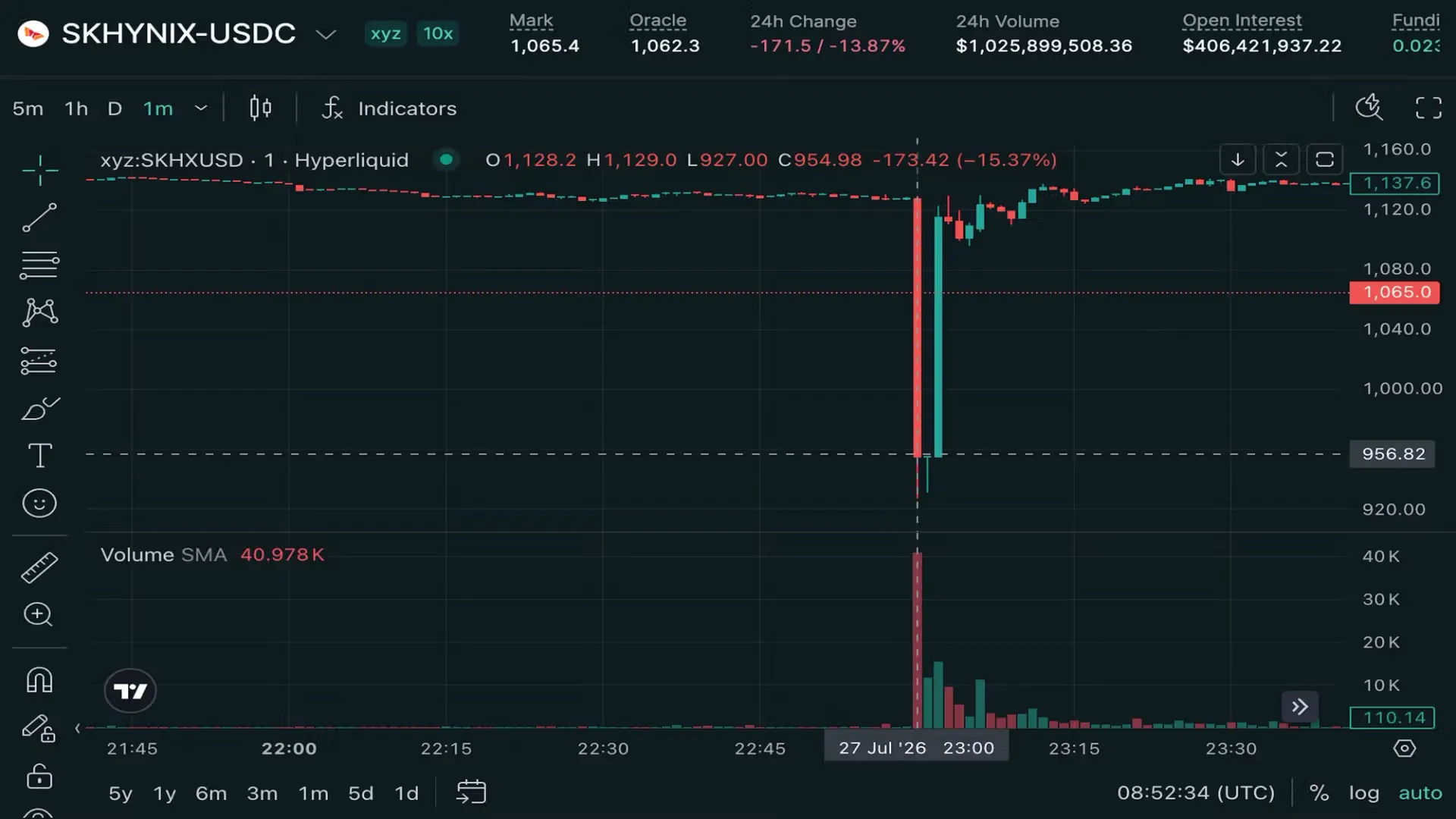
A fund built around memory chips has become the hottest thematic ETF launch in five years, pulling in over $200 million in cumulative retail net buying in just 27 trading days. The Roundhill Memory ETF, trading under the ticker DRAM, launched on April 2, 2025, and has returned roughly 88% since inception.  High-bandwidth memory, or HBM, is the component that feeds data to GPUs fast enough to keep them busy. DRAMs investment thesis is built around this bottleneck. As AI server buildouts accelerate globally, demand for high-bandwidth memory and traditional DRAM chips is expected to surge in what some in the industry are calling a “memory super cycle.” The fund offers concentrated exposure to the companies manufacturing these components, rather than spreading bets across the broader semiconductor universe.  The top holdings tell the story clearly. SK Hynix commands roughly 27.4% of the fund‘s weight, making it by far the largest position. Micron Technology, Samsung Electronics, and SanDisk round out the portfolio’s core.  Crossing $200 million in retail net buying within 27 trading days makes DRAM the fastest thematic ETF to hit that milestone since 2020. The fund has grown to approximately $6 billion in assets under management, putting it among the most successful

05-17Industry

Virtuals Protocol introduces EconomyOS for managing AI agents inboxes and commerce functions

Heres a question nobody was asking five years ago: does your AI agent need its own email inbox? Virtuals Protocol thinks so, and it just shipped one.  The project has rolled out a new managed-agent capability within its EconomyOS stack, giving onchain AI agents a dedicated inbox that can autonomously process one-time passwords, verification links, receipts, and other transactional communications. In English: AI agents can now sign up for services, verify their own accounts, and manage purchase confirmations, all without a human hovering over the keyboard.  What EconomyOS actually does  Think of EconomyOS as the operating system that lets an AI agent function like a small business. It bundles together onchain identity, non-custodial wallets, virtual payment cards, and now email management into a single framework.  The problem it solves is straightforward. Most of the internet still runs on Web2 rails. You need an email to sign up for things. You need to click verification links. You need to receive receipts. If an AI agent can‘t do any of that, it’s functionally locked out of most commerce.  By giving agents their own inboxes, Virtuals bridges a gap between the onchain world where these agents live and the off-chain world where most economic activity still happens. The

05-17Industry

Corporate Ethereum reserves reach $16B as companies stockpile 7.3M ETH

Public companies now hold roughly 7.3 million ETH on their balance sheets, a war chest valued at nearly $16 billion at current prices. That‘s not a rounding error. It’s a signal that corporate treasurers are treating Ethereum less like a speculative bet and more like a productive asset.  Here‘s the thing: while Bitcoin’s corporate treasury narrative has dominated headlines for years, thanks largely to Michael Saylors relentless accumulation, Ethereum has been quietly experiencing an even sharper surge in institutional adoption. The difference is what ETH lets you do with it once you own it.  Why companies are choosing ETH over a savings account  The core appeal isn‘t just price appreciation. It’s yield. Ethereum‘s proof-of-stake network lets holders lock up their ETH and earn staking rewards, a feature that Bitcoin simply doesn’t offer. With over 27 million ETH, worth approximately $50 billion, currently staked on the network, the mechanism is far from niche.  Beyond vanilla staking, companies are also exploring interest generated through decentralized finance products built on Ethereum. The network accounts for over two-thirds of all DeFi total value locked, with roughly $71 billion in deposits secured across its ecosystem. Most of the decentralized lending, borrowing, and trading infrastructure runs on Ethereum, and that

05-17Industry

Solana Eyes $117 Breakout — If Bulls Can Crush This Key Resistance

The Solana price has struggled to shake off its early-year woes despite a slightly improved general market climate in recent weeks. After falling from a nearly $150 valuation in the first quarter of 2026, the altcoin has been stuck within a consolidation range between $75 and $100 over the past few months.  The upper boundary of this consolidation zone proved formidable after the Solana price failed to fully capitalize on the injection of bullish momentum (triggered by news of the CLARITY Act passing the US Senate banking committee). A popular market analyst on the social media platform X has identified this specific resistance level and what lies on the other side for Solana.  A Break Above $98 Could Mean A Sustained Rally For SOL Price  In a recent post on the X platform, crypto pundit Ali Martinez pinpointed $98 as the level to break for the Solana price to reach its upside potential. According to the analyst, the cryptocurrency could embark on an approximately 30% rally if it sustains a break above this overhead resistance.  Martinez highlighted that the SOL token has been trading within a “well-defined” horizontal channel, with the lower and upper boundaries at $78 and $98, respectively. As a result of

05-17Industry

Rising yields threaten to derail tech and AI stock rally

Theres a tug-of-war happening in financial markets right now. On one side: surging Treasury yields fueled by stubborn inflation data. On the other: an AI stock rally that refuses to quit despite macro headwinds.  The US 10-year Treasury yield has climbed to roughly 4.45-4.5%, its highest level since mid-2025, following hotter-than-expected inflation data and a broader global bond market selloff. That kind of move tends to be kryptonite for high-growth tech stocks, whose valuations depend heavily on discounting future earnings.  The AI trade is drowning out everything else  Here‘s a number that should make you pause: nine of the top ten returning US stocks since the end of 2024 are AI-related. That’s not a diversified rally. Thats a one-theme market wearing different jerseys.  Semiconductors, the picks-and-shovels play of the AI boom, sit at the center of the trade. Companies building chips, running data centers, and supplying the infrastructure for large language models have attracted enormous inflows. NVIDIAs upcoming earnings report is being treated as something close to an economic indicator unto itself, with expectations that strong results could provide another leg up for the entire AI complex.  The bull case is grounded in real fundamentals. These companies are posting genuine revenue growth. Capital expenditure commitments

05-17Industry

Justin Sun-Led Liberland Micronation Awards Ethereum Founder Vitalik Buterin Its Top Honor

Liberland gave Ethereum co-founder Vitalik Buterin its highest award during ETH Prague 2026.The award recognized Buterins work in blockchain technology and his interest in new forms of digital governance.Liberland, founded in 2015 on disputed land between Croatia and Serbia, remains unrecognized by any sovereign nation.  Liberland, the self-declared micronation that elected Tron founder Justin Sun as prime minister in 2024, awarded Ethereum co-founder Vitalik Buterin its highest state honor this week during ETHPrague 2026 in Prague.  Liberland President Vít Jedlička presented Buterin with the “First Class Order of Merit of the Star of Liberland” during a side event at the Ethereum-focused conference.  “Liberland celebrates a shared vision by honoring Vitalik Buterin—using technology to expand human freedom and to experiment with new, more responsive forms of governance for the digital age,” the Liberland Ministry of Foreign Affairs said.  In a video posted on YouTube, Buterin thanked the Liberland community and congratulated the project on its progress.  “I look forward to seeing what kinds of synergies we can have between our communities, and whether or not any of the things that have been built can be useful for people there, or if there are any other things that can happen at some point in the future,” he

05-17Industry

Bhutan Official Speaks Up On Claims of Selling $1 Billion In Bitcoin

Bhutans Bitcoin movements have come into the spotlight again. The scrutiny comes due to the recent indications of a potential sale of nearly $1 billion worth of Bitcoin. For context, these transactions were flagged by the blockchain analytics firm, Arkham Intelligence, since July 2025.  Bhutan Officials Open Up On Selling Bitcoin  Over the last year, wallets associated with Druk Holding and Investments (DHI), the government-owned wealth fund of Bhutan, have been moving massive amounts of Bitcoin. DHI then dumped this reserve to exchanges and trading companies, according to on-chain reports.  In October 2024, Arkham reported that the wallets had almost 13,000 BTC in their holdings. However, this has fallen to approximately 3,100 BTC, which is worth about $252 million as of Fridays BTC price.  Another finding from the data indicated that, between 2026 alone, approximately $207 million worth of Bitcoin was removed from wallets. If the current rate of transfers continues, Bhutan could exhaust its remaining BTC reserves by October, according to Arkham Intelligence.  Bhutanese government officials, however, stated that they did not sell Bitcoin. “I don‘t recall the last time we sold any BTC,” said DHI’s Chief Executive Ujjwal Deep Dahal, per a CoinDesk report.  When contacted about the activity being monitored on the wallet,

05-17Industry

UAE asserts OPEC exit was sovereign strategic decision, not political move

The UAE is walking away from OPEC and the broader OPEC+ alliance, and it wants the world to know this isn‘t about geopolitics. It’s about business.  Energy Minister Suhail Mohamed Al Mazrouei has framed the withdrawal, effective May 1, as a sovereign strategic decision designed to give the country more flexibility over its own oil production. In practical terms, the UAE is tired of having its output capped by group quotas when it has the capacity, and the ambition, to produce significantly more.  What the UAE actually wants  UAE officials have linked the exit to internal strategic reviews that concluded OPEC quotas were actively constraining domestic industrial growth. The countrys “Make it in the Emirates” manufacturing strategy, which aims to build out a robust domestic industrial base, apparently requires more energy autonomy than OPEC membership allows.  Al Mazrouei has been careful to position this as a forward-looking economic play rather than a reaction to any specific diplomatic friction.  What OPEC loses  The UAE was OPECs third-largest producer. Its departure is not a rounding error.  Analysts estimate OPEC will lose around 15% of its total production capacity with the UAE out of the picture. That‘s a significant hit to the group’s ability to function as a credible market

05-17Industry

Barclays Says Prediction Markets are Retail’s New Trading Toy

Prediction markets have surged since the 2024 election, becoming retails latest high-risk trade.Kalshi and Polymarket topped $24 billion in notional volume by April, up from under $5 billion.Barclays says prediction markets are rising fast but remain far below the $57 trillion 0DTE market.  Prediction markets are moving from niche internet corners into retail trading‘s main arena, with Barclays calling them “retail’s shiny new toy.” The phrase reflects a rapid volume surge since the 2024 U.S. presidential election.  The appeal is simple. Traders buy contracts linked to real-world outcomes, from elections and sports to economic data and climate events. Instead of tracking a companys earnings, they trade a yes-or-no result.  Retail Traders Move Beyond Stocks and Crypto  Barclays analysts said monthly notional volume on prediction platforms has climbed sharply since last fall. The rise has placed prediction markets near leveraged exchange-traded products in retail activity.  That comparison matters, as leveraged ETPs are already high-risk tools. They use debt and derivatives to amplify daily moves in stocks, indexes, or other assets. The same retail appetite has appeared in other markets.  Five years ago, small traders helped drive the GameStop meme stock surge. They later pushed crypto deeper into mainstream investing.  More recently, retail traders became major users of zero-day-to-expiration

05-17Industry

Bitcoin ETF flows reverse as US funds shed $1B amid inflation fears

US-listed Bitcoin ETF flows have suffered their most severe weekly capital flight since the end of January, with investors pulling exactly $1 billion from the products.  The primary catalyst for the sudden institutional risk aversion appears to be the shifting US economic backdrop.  CryptoSlates data show that rising inflation concerns, alongside steep ETF outflows, led Bitcoins price to fall around 3% over the past week to $78,074 as of press time.  US Bitcoin ETF flows register largest weekly outflow in 5 months  Data compiled by SoSoValue indicates that the $1 billion ETF outflow snapped a six-week streak of consecutive positive inflows. During this reporting period, the US-listed funds had absorbed approximately $3.4 billion in net flows.  However, the net withdrawal over the past seven days totaled roughly 14,000 Bitcoin, marking a distinct pause in the recovery of institutional demand that had been building steadily since early April.  US Bitcoin ETFs Flows (Source: Ecoinometrics)  Despite the severity of the weekly outflows, Ecoinometrics, a Bitcoin-focused analytical platform, characterized the number as a period of tactical hesitation near a critical macroeconomic decision point, rather than a wholesale unwind of institutional positioning.  According to the firm, the broader structural recovery pattern for digital assets remains largely intact, as net flows into US

05-17Exchange
1
...
442444
...
1000