Hyperliquid Strategies expands stock-sale facility to $2.5B for HYPE treasury

According to a Form 8-K filed with the SEC on September 1, Hyperliquid Strategies Inc. (HSI), the Nasdaq-listed company building a treasury around $HYPE, has doubled its stock-sale program, which is used to fund its strategy, thereby increasing its equity financing commitment to $2.5 billion from $1 billion.  The move demonstrates how corporate treasuries have become an increasingly important source of demand for tokens in the cryptocurrency market.  $HYPE is not an equity, but Coinbase Institutional considers its economic model as “equity-like” since the fees collected by the protocol will help cover the costs for systematic token buybacks. By providing HSI with access to as much as $2.5 billion in equity financing, the company is now able to accumulate $HYPE if it draws and deploys the facility.  Selling up to $2.5 billion in stock to feed a $HYPE hoard  The change came through Amendment No. 1 to the ChEF Purchase Agreement, the committed equity facility HSI signed with Chardan Capital Markets in October 2025. The structure allows the company to sell newly issued shares over time and use the proceeds for its treasury strategy.  The original agreement capped gross proceeds at $1 billion. The September 1 amendment raises that ceiling to $2.5 billion.  The Amendment increases

09-02Exchange

Bitcoin leads Ethereum and Solana in decentralization, ARK finds

ARK Invest and Glassnode published a joint study on Sept. 1 that found three entities could cross the measured block-production thresholds for both Bitcoin and Ethereum, while Solana required 19.  SummaryBitcoin reaches its 51% hash-rate threshold through three mining pools, according to the joint report.Ethereum requires three staking entities to exceed 33%, although pooled delegation complicates direct control assumptions.Solanas Nakamoto coefficient is 19, but nearly all measured infrastructure operates inside commercial data centers.Bitcoins infrastructure is comparatively dispersed, with 63% of measured nodes operating anonymously through Tor networks.Ethereum hosts roughly 49% of execution-layer nodes in clouds, including 20% through Amazon Web Services.  The 32-page report, titled The Decentralization Spectrum: Design Tradeoffs in Digital Assets, compares the networks across ownership, exit fluidity, verification costs, critical resilience, reconstruction costs and infrastructure distribution.  The findings do not mean three companies control Bitcoin or Ethereum. The metric counts mining pools and staking platforms as entities, even when the underlying hardware, stake or node operators belong to separate participants who may withdraw or redirect their resources.  Bitcoins three-pool threshold does not equal ownership  The report applied a 51% hash-rate threshold to Bitcoin. Foundry USA represented 27.27% of the measured hash rate, followed by AntPool at 17.06% and F2Pool at 16.96%. Together,

09-02Industry

Core DAO plans emergency hard fork after validators drew excess rewards

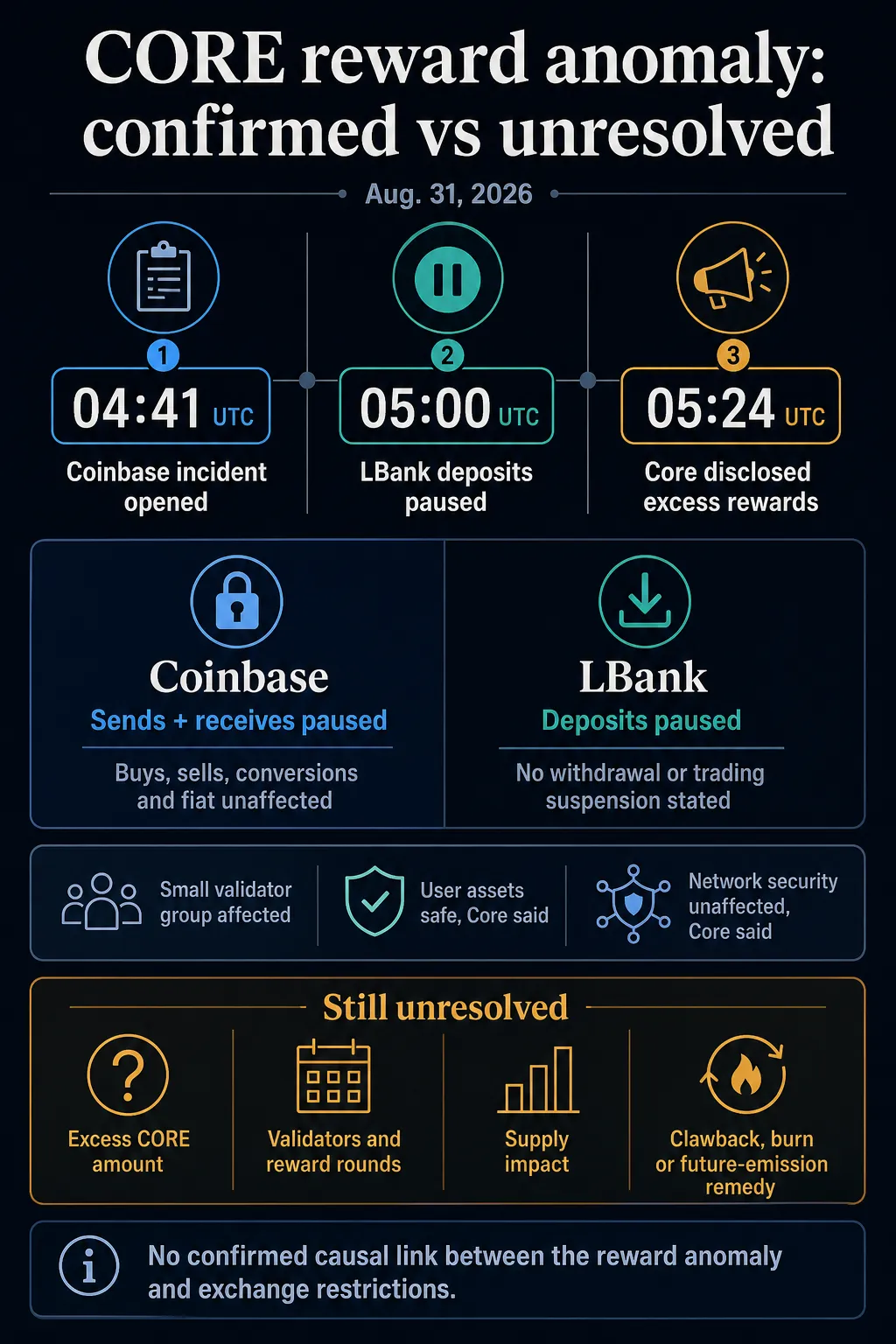
Core DAO is coordinating an emergency hard fork after validators claimed more CORE rewards than the blockchain intended to issue.  In an update, Core said the incident had been contained and that “malicious validators” could no longer draw excess rewards. It said the fork would be a forward upgrade and would not roll back the network or reverse any previously confirmed transactions.  This followed an earlier status update on Monday, in which Core said a small number of validators had accrued rewards significantly above the protocols intended issuance. It said the incident was limited to reward issuance and that user assets remained safe, adding that it would publish a technical postmortem.  Several exchanges restricted CORE transfers around the time of the incident. Coinbase paused sends and receives on the Core network, while Bithumb and Coinone suspended deposits and withdrawals, citing suspected or confirmed security concerns.  Bitget also suspended CORE deposits and withdrawals, citing wallet maintenance, while LBank suspended deposits because of what it described as the projects requirements.  Core has not disclosed how much CORE was issued, how long the activity continued, or whether any of the additional tokens entered circulation. It also has not explained the vulnerability that enabled the validators to obtain the

09-02Industry

These Wall Street Giants Are the Biggest Holders of Spot XRP ETFs

Investment advisors held $120.9 million of the reported XRP ETF exposure, far ahead of banks, brokerages, and hedge fund managers.  Goldman Sachs, Jane Street Group, and Millennium Management were the three largest reported holders of spot XRP ETFs in second-quarter 13F filings, according to Bloomberg Intelligence data shared by James Seyffart on August 31.  The filings show that institutional exposure has grown alongside a sharp increase in XRP ETF inflows, even as the Ripple token itself has pulled back from its August highs.  Advisors Dominate XRP ETF Holdings  Bloombergs compilation puts Goldman Sachs well ahead of other reported holders, with $87.4 million in ETF exposure representing 84 million XRP. Jane Street followed with just under 16 million XRP, worth $16.6 million, while Millennium Management held 15.5 million tokens valued at about $16.2 million.  Intesa Sanpaolo ranked fourth with $14.4 million in exposure, followed by Marex UK Holdings at $8.1 million. Citadel Advisors also appeared in the filing data, although its XRP exposure fell by $645,000. But SIG Holdings recorded a much larger reduction, with its reported XRP exposure down by roughly $4.6 million.  Across the identified holders, total exposure reached $183.5 million, representing about 176.4 million XRP. Bloomberg also grouped the holders by category and found

09-02Industry

Robinhoods tokenized-asset chain is growing fast, but not necessarily where investors think

Robinhood Chain revenue from applications totaled between $2.66 million and $2.82 million over a rolling 24-hour window early on Sept. 1, creating an eye-catching measure of network activity with no disclosed bridge to Robinhoods corporate accounts.  Related Company Robinhood American financial services company  DefiLlama tracks application revenue, chain revenue and chain fees as separate layers. Its dashboard showed $963,612 of chain revenue on $1.07 million of chain fees during the same period. Public records provide no formula that turns either revenue figure into a Robinhood GAAP revenue line.  The recipients also show where the app total went. DefiLlamas revenue table placed trading bot GMGN first at about $1.11 million and token launchpad Pons second at about $1 million. Uniswap led the corresponding protocol fee table.  What Robinhood Chain revenue means for the company  Robinhood has described its own monetization in transaction terms. During the companys second-quarter earnings call, CFO Shiv Verma said Robinhood earns a few basis points per transaction, with approximately half shared with Arbitrum. He emphasized transactions as the basis instead of transaction volume.  The company provided no precise rate, eligible transaction count, fee base or reconciliation to its financial statements. DefiLlama also defines the $963,612 chain figure as gas revenue remaining after Ethereum

09-02Industry

WikiBit Exchange Exit Risk Ranking – Issue 13: BiFinance: An Exchange Officially “Hammered” by Hong Kong’s SFC—What Is There Left to Defend?

Introduction: An “Official Certification” from the Regulator Is More Fatal Than Any Negative Review  In the previous 12 issues, we dug into HashKey (the compliance top student), HTX (a sanctions hotspot), UZX (a DAO penny stock), Phemex (the Morgan Stanley elite), Tapbit (the MSB sticker king), Coincheck (Japan‘s “immortal phoenix”), Deepcoin (the new outfit in El Salvador), Upbit (South Korea’s national exchange), Azbit (officially slapped down by the Seychelles FSA), FameEX (the three-country regulatory sticker collector), Bitvavo (Europe‘s compliance king), and CoinUp (personally “hammered” by He Yi)—and along the way, we’ve seen our fair share of regulatory problems.  But todays subject takes things to a whole new level: BiFinance.  Its résumé looks pretty impressive:  “Top 50 globally on CMC,” “$3.1 billion in 24-hour trading volume,” “Completed Series A and Series B financing,” “Strategic investment from listed companies such as Donghao Asia and Dingyi Group,” “U.S. MSB registration,” and “A leader in the RWA sector.”  Sounds like the standard résumé of a “star project,” right?  But on the other side of the story:  On July 31, 2026, Hong Kongs Securities and Futures Commission (SFC) placed BiFinance on its Alert List of Suspicious Virtual Asset Trading Platforms. The official designation states that BiFinance “is not licensed by the SFC

09-02Deep Dive

A validator reward failure on Core DAO triggers exchange transfer blocks and leaves token issuance in question

Core DAO validator rewards exceeded the protocols intended levels for a small group of validators, the project said, creating an unresolved supply question for the CORE token as two exchanges restricted transfers.  Core DAO said it had identified the root cause and was working on mitigations. It said user assets were safe. It described the incident as limited to reward issuance and said network security and custody were unaffected. Core did not disclose the amount of excess CORE, the validators or reward rounds involved, or the technical cause. It promised a postmortem after the issue is contained.  Related ReadingDeFi Technologies to stake $100 million in BTC on Core Chain  The missing amount is central because Core DAO validator rewards normally include newly minted tokens. The disclosure leaves unresolved whether the anomaly accelerated rewards already scheduled for later distribution or added issuance outside the projects planned path.  Coinbase opened its Core DAO incident at 04:41 UTC on Aug. 31, before Cores 05:24 UTC public statement. At 17:38 UTC, the exchanges status feed still listed the incident as investigating, with CORE sends and receives paused. Coinbase said buys, sells, conversions and fiat transactions were unaffected. Its public status page remained the venues official channel for further

09-02Exchange

3 Reasons Why Shiba Inu (SHIB) May Plunge This Month

September has historically been predominantly weak month for the meme coin.  July and August have been quite successful for the self-proclaimed Dogecoin killer, with its price closing both months in the green.  Nonetheless, certain important elements suggest that September may not be as beneficial and could deliver a move south.  The Worrying Signals  The first concerning element on the list is Shiba Inus burn rate, which has declined by 6% on a monthly scale. Data shows that less than 600 million tokens have been sent to a null address throughout August, an amount whose USD equivalent is negligible.  The burning mechanism aims to reduce the overall supply of the meme coin and potentially make it more valuable, but little to no activity on that front poses a serious obstacle to that mission.  Next is Shibariums stalled activity. The layer-2 scaling solution was exploited last year, and since then, the number of processed daily transactions has dropped to mere hundreds or even thousands (at most).  Shibarium Transactions, Source: shibariumscan.io  The feature has been labeled numerous times as important for the overall advancement of Shiba Inus ecosystem and something that can positively impact its price.  Last but not least, we shall mention the seasonal element. September has been a predominantly poor

09-02Industry

How the GTA 6 Leaker Profited $350,000 From CyberLeek

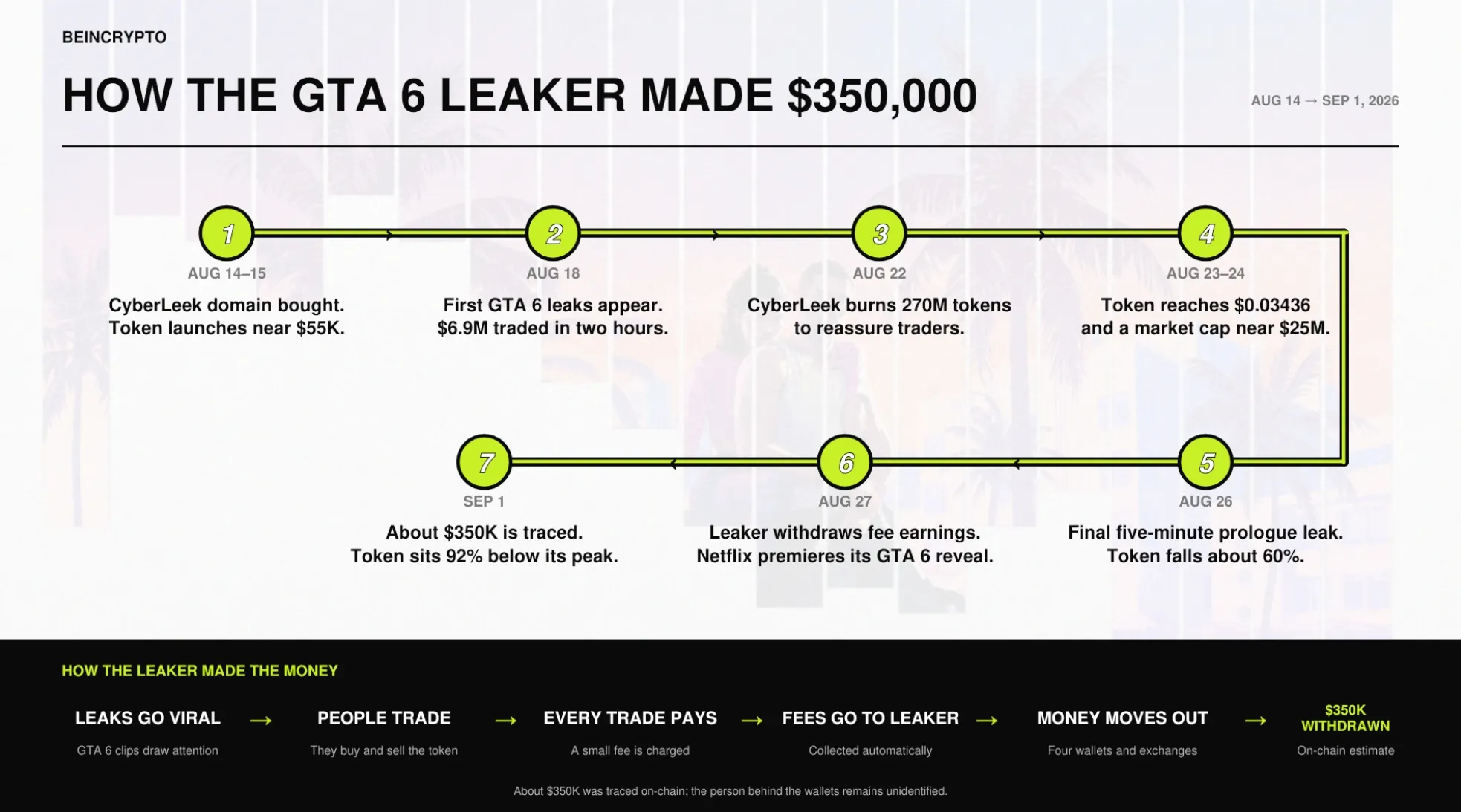
The anonymous leaker behind CyberLeek has reportedly pocketed roughly $350,000, according to on-chain analyst Conor Grogan. The funds allegedly came entirely from liquidity fees rather than direct sales.  The withdrawal coincided with a sharp price decline for the CYBERLEEK meme coin.  The Mastermind Strategy Behind CyberLeek  Grogan stated on September 1 that the person behind CyberLeek withdrew the funds through various OTC providers, a route that converts digital assets into conventional money without requiring large open-market token sales.  That structure differs meaningfully from a typical launch-and-dump scheme. Rather than offloading large CYBERLEEK holdings directly, the wallet tied to the project reportedly profited by collecting fees whenever other traders transacted in its liquidity pool.  Follow us on X to get the latest news as it happens.  The GTA 6 hacker, responsible for the Cyberleek coin, has cashed out about $350k, entirely from LP fees. They have washed funds through a variety of OTC providers  This is the first hacker that Ive ever seen make money solely on liquidity provision (versus dumping a token) https://t.co/5czgluVKBn pic.twitter.com/ABzjSjYAed  — Conor (@jconorgrogan) September 1, 2026  This mechanism depends entirely on sustained trading activity. The viral GTA VI leaks appeared to provide exactly that fuel, drawing in buyers and speculators with each new clip, even

09-02Industry

US Strikes Iran After Fresh Attacks Near Strait of Hormuz

The United States launched fresh strikes against Iranian targets Tuesday after attacks threatened commercial shipping near the Strait of Hormuz. U.S. Central Command said American forces targeted Islamic Revolutionary Guard Corps positions following recent threats. The escalation raises fresh concerns about shipping security and energy markets across the region.  Tensions Rise Around Vital Shipping Route  According to CNBC report, CENTCOM said the operation began around noon Eastern Time after Iran attempted attacks against commercial vessels. The command also cited threats against American personnel operating across the region.  President Donald Trump ordered the strikes after Iranian forces reportedly prepared sea mines for the waterway. Iranian missiles also targeted a U.S. facility in Jordan during the latest confrontation.  In the meantime, Washington is increasingly under pressure to stop the attacks without sparking a broader regional war. Tehran, however, may counter with further missile or sea operations.  Oil Markets Face Fresh Risks  The Strait of Hormuz remains crucial for global energy supplies and international trade. Before the conflict, about 20% of all global oil supplies passed through the waterway.  Other than to threaten tanker traffic, renewed fighting could also affect energy prices and transportation costs. Moreover, airlines and businesses across the Gulf face additional security concerns.  The U.S. Embassy in Qatar

09-02Industry
1
...
254256
...
1000