Bitcoin 'Anti-Spam' Fork Sputters to a Halt After Mining Just Two Blocks

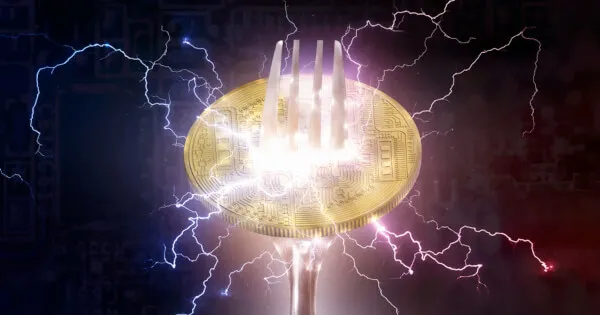
In briefSupporters of BIP-110 split off into a minority Bitcoin chain on Saturday at block 961,632, but it mined only two blocks in about eight hours before stalling, falling dozens of blocks behind the main network.The fork inherited Bitcoins difficulty setting with barely any hashpower—about 2.53% of recent blocks signaled support, far below the 55% activation threshold,BIP-110 sought to temporarily block non-financial data like Ordinals inscriptions from transactions, a move critics including Michael Saylor call a dangerous precedent.  The long-simmering fight over a controversial Bitcoin network proposal finally produced a chain split over the weekend, but the breakaway Bitcoin fork sputtered almost immediately, grinding out just two blocks in roughly eight hours before stalling out.  The fork came as a result of a Bitcoin Improvement Proposal known as BIP-110, whose supporters claimed would protect the network from unwanted spam and the legal liability that comes from hosting non-financial data on the network. Its detractors, the majority of the Bitcoin community, viewed it as an attempt at censorship.  The fork triggered Saturday at block 961,632, when Bitcoin nodes running BIP-110 software began rejecting any block that failed to signal support for the proposal. A block mined by AntPool without that signal was accepted by

Within 1 weeksIndustry

World Liberty received $100 million from businessman investigated for money laundering: NYT

Quick TakeGuren “Bobby” Zhou, the businessman behind Aqua 1s $100 million purchase of World Liberty Financial tokens, was arrested in Britain in 2021 on suspicion of money laundering, The New York Times reported.Zhou has not been charged. British officials told the Times that the investigation remained active as of late July.The source of the $100 million remains unclear. World Liberty said it followed all applicable laws and regulations.  Guren “Bobby” Zhou, the businessman behind Aqua 1s $100 million purchase of World Liberty Financial (WLFI) governance tokens, was arrested in Britain in 2021 on suspicion of money laundering and remains connected to an active investigation, The New York Times reported Sunday.  Zhou has not been charged. A British court record filed last November accused him of participating with five other people in a money laundering operation dating to 2019, according to the Times. Two of his longtime employees were charged in the case last September, and one defendant has pleaded guilty. A trial for the charged defendants is scheduled for 2028.  Reuters first identified Zhou as the person behind Aqua 1, the Times noted. The Block reported in June 2025 that the little-known UAE-based fund had purchased $100 million of WLFI, making it one

Within 1 weeksIndustry

Is Clarity's delay a blessing in disguise?: State of Crypto

But the other staffer said the fact that Republicans are also now coming out with concerns about the bill, even as Democrats like Alsobrooks and Ruben Gallego continue negotiating, suggests that the blame cannot be laid at either major party.  Senator Thom Tillis told Politico that “the odds drop precipitously” on Friday, citing the election as well, alongside the lengthy break.  But two of the people who spoke to CoinDesk said the bill has a legitimate shot at passage, especially given the August deadline was more of what the crypto industry hoped for than a hard-and-fast rule.  As has been the case, what that shot looks like will depend on what the Senate can negotiate in the next five weeks.  This weekWere taking a breather, maybe.  If you‘ve got thoughts or questions on what I should discuss next week or any other feedback you’d like to share, feel free to email me at nik@coindesk.com or find me on Bluesky .  You can also join the group conversation on Telegram.  See yall next week!

Within 1 weeksIndustry

Brazil to tighten crypto fraud controls with new 24-hour wait on transfers to self-custody wallets

Quick TakeBrazils central bank will require crypto firms to wait 24 hours after customers fund their accounts to transfer more than $10,000 to self-custody wallets or foreign crypto firms.Providers must also hold smaller transfers flagged by their risk controls, though they may release any held transfer early following a documented review.The rule takes effect on Jan. 1, 2027, and covers cryptocurrencies including stablecoins.  Brazils central bank, starting in the new year, will require crypto firms to wait 24 hours after customers fund their accounts to process transfers to self-custody wallets or offshore crypto firms, according to a resolution published Friday.  Under the resolution, the requirement applies when a single transaction or the sum of a customers daily transactions exceeds $10,000. Smaller transactions that are flagged by providers must also be held, although any held transaction can be released following a documented review by the crypto firm.  Providers must consider the risk profile of the customer, the transaction or service, the counterparty to the transfer, and the jurisdiction where the recipient is based.  The central bank described the hold as an exclusively precautionary measure designed to give providers time to assess fraud risk without permanently freezing customer assets. After 24 hours, the provider must either

Within 1 weeksIndustry

Bitcoin BIP-110 split widens as fork freezes at 2 blocks

Bitcoins BIP-110 split widened further on Aug. 9, with the enforcing branch still unable to produce a third block hours after mandatory signaling began.  The latest BIP-110 Monitor snapshot showed the minority chain stuck at block 961,633 while Bitcoins dominant, non-enforcing chain had reached 961,744. That increased the gap to 111 blocks from 88 earlier Sunday.  The stall offers the clearest test yet of how much mining support BIP-110 has attracted. Only 51 of the 2,016 blocks in the previous difficulty period signaled for the proposal, equal to 2.53%. Since the mandatory window started at block 961,632, the monitor had recorded zero signaling blocks among the first 113 blocks on the dominant chain.  Bitcoin worked exactly as designed. BIP-110 was free to fork, and the network was free not to follow. The result was decisive: about 99.85% of Bitcoins hashpower stayed with Bitcoin. The BIP-110 branch mined only two blocks and is already more than 80 blocks behind.  — Michael Saylor (@saylor) August 9, 2026  Bitcoin BIP-110 branch remains frozen after two blocks  BIP-110 enforcing nodes began rejecting non-signaling blocks at height 961,632 on Aug. 8. Roughnecks then produced an alternative block at that height and followed it with block 961,633. OCEANs BIP-110 block record confirms

Within 1 weeksIndustry

Trump weighs Iran war exit without nuclear deal: WSJ

President Donald Trump has privately told senior aides he could end the U.S.-Iran war without securing a nuclear agreement if Tehran fully reopens the Strait of Hormuz, the Wall Street Journal reported on Aug. 9, citing U.S. officials.  The report comes as Iran raises the price for reopening the waterway, tying compensation, sanctions relief and wider security demands to any durable arrangement.  The White House has not publicly confirmed that Trump has changed his nuclear objective. Its latest published Iran remarks, from July 28, instead repeated that Iran cannot obtain a nuclear weapon and said military options remain available if diplomacy fails. The reported willingness to “walk away without a nuclear deal” therefore remains a private policy consideration, not an announced shift in U.S. strategy.  BREAKING: President Trump has been floating the idea privately to senior aides that hes willing to “walk away” from the Iran War without a nuclear deal should Iran fully reopen the Strait of Hormuz, per WSJ.  Details include:  1. This objective reportedly became “more difficult”…  — The Kobeissi Letter (@KobeissiLetter) August 9, 2026  Irans latest demands complicate the Hormuz exit path  The Journal reported that Iran is seeking billions of dollars in U.S. payments, the withdrawal of American forces from the region and

Within 1 weeksIndustry

Strategy teases next Bitcoin move after 1,030 BTC transfer

Michael Saylor put Strategys Bitcoin activity back under scrutiny on Sunday, Aug. 9, with a two word X post: “Doing ₿usiness.”  SummaryStrategy sold 1,638 BTC for $104.73 million between July 27 and August 2, filings show.Saylors Sunday “Doing ₿usiness” post did not specify whether Strategy bought, sold, or moved Bitcoin.Lookonchain linked a 1,030 BTC transfer to Strategy, but no company filing confirms any sale.Strategys holdings remain 842,138 BTC acquired for $63.51 billion at an average cost of $75,419.STRC closed Friday near $94.60, still below the $100 stated amount Strategy management currently targets.  The company‘s executive chairman offered no details about whether the message referred to buying Bitcoin, selling more BTC, raising capital or another treasury transaction. As of Sunday, Strategy’s public Bitcoin ledger still showed 842,138 BTC, meaning no additional disposal after its Aug. 3 filing had been confirmed.  Doing ₿usiness. pic.twitter.com/PtekVgHXDp  — Michael Saylor (@saylor) August 9, 2026  You might also like:  Strategy offers $250 yearly for employee Trump Accounts  The timing has fueled speculation because Strategy confirmed a $104.73 million Bitcoin sale last Monday and a wallet linked to the company moved another 1,030 BTC two days later. Yet the second movement remains just that: an onchain transfer. Neither Strategy nor a later U.S. Securities

Within 1 weeksIndustry

Bitcoin investors pour $853 million into spot ETFs. BlackRocks IBIT claims the bulk

SummaryThe U.S.-listed ETFs pulled in $853 million in investor money in the week ended Aug. 7.That marks the highest weekly inflow since April.  Bitcoin exchange-traded funds (ETFs) pulled in $853.54 million in net inflows for the week ended Aug. 7, the largest weekly total since mid-April, according to data from SoSoValue.  BlackRocks IBIT accounted for the bulk of the activity, attracting $693 million on its own.  This surge in inflows offers a tentative sign that institutions are dipping back in after the heavy selling earlier this year.  Recent bitcoin price action has looked more constructive. Negative headlines, including a multi-million-dollar Coldcard hack and rising government bond yields, have failed to dent the spot market. Bitcoin held steady at around $64,000 early this week and traded at around $65,100 as of this writing.  Fridays unexpectedly weak U.S. jobs report for July has cooled bets on further Federal Reserve rate hikes for now, potentially clearing the path for continued institutional buying in ETFs.  What next?  The latest spike in inflows represents only one week of data. On a year-to-date basis, the ETFs remain roughly $4.5 billion in the red due to net outflows. This helps explain the heavy selling pressure seen during the first six months of the year,

Within 1 weeksIndustry

Bitcoin BIP-110 enters mandatory phase at 2.53% support

Bitcoins contentious BIP-110 test has moved from signaling into an actual chain split, and the first hours show miners overwhelmingly continuing to build on the existing Bitcoin chain.  The proposal entered mandatory signaling at block 961,632 on Aug. 8 after only 51 of the previous 2,016 blocks, or 2.53%, signaled support. Nodes enforcing BIP-110 then began rejecting blocks without version bit 4.  The latest available BIP-110 monitoring data on Aug. 9 showed the enforcing branch stalled at block 961,633 after producing only two blocks. Bitcoins non-enforcing chain had already reached 961,731, putting it 98 blocks ahead. The tracker also showed no BIP-110 signaling among the first 100 blocks of the new difficulty period on the dominant chain.  With only 2.6% miner signaling, BIP-110 has failed to earn broad miner support. At block 961,632, its nodes will reject non-signaling blocks. BIP-110 will then stall or fork into irrelevance while Bitcoin continues normally. Bitcoin is working as designed.  — Michael Saylor (@saylor) August 8, 2026  Bitcoin BIP-110 split widens after miner support stays low  The split began because BIP-110 applies different validity rules during its mandatory signaling window. According to the official BIP-110 specification, enforcing nodes must reject any block between heights 961,632 and 963,647 that fails to

Within 1 weeksIndustry

IMF warns local stablecoins could speed dollar adoption

Domestic stablecoins designed to strengthen the role of national currencies could have an unintended effect: making it easier for users to move into digital dollars.  SummaryIMF says local stablecoins could accelerate dollar-token adoption by making onchain currency conversion easier globally.Nearly 99% of stablecoins remain dollar-denominated, reinforcing network effects that local tokens struggle to match.South Africa shows limited dollar-stablecoin use while rand-linked tokens have attracted weaker demand so far.IMF recommends regulating onramps, offramps and onchain exchanges when stablecoins expand access to foreign currency.BIS found stablecoin inflows broadly similar across economies with and without cross-border usage restrictions imposed.  International Monetary Fund First Deputy Managing Director Dan Katz raised the concern on Aug. 7 during a speech at the University of Cape Town, as regulators weigh how stablecoins could reshape payments and foreign currency demand in emerging markets.  Katz said local currency and dollar stablecoins operating on the same blockchain infrastructure can make foreign exchange conversion easier. Users can potentially swap between them through decentralized exchanges, liquidity pools or peer to peer transactions instead of relying exclusively on banks and conventional currency dealers. In that environment, local tokens “might even accelerate the adoption of FX stablecoins,” he said. The IMF has not presented that outcome as

Within 1 weeksIndustry
1
...
3335
...
1000