WikiBit Exchange Exit Risk Ranking #26: Biconomy — The “Compliant Exchange” on Canada’s Blacklist, as the “High-Risk Exchange Club” Continues to Expand!

Introduction: A “Self-Proclaimed” Compliant Exchange  In the first 25 editions, we investigated a series of exchanges ranging from HashKey to CoinEx. For the 26th edition, we are taking a closer look at one of the most confusing cases in terms of identity — Biconomy.com.  First, lets clear up one thing: there are two “Biconomy” projects in the crypto industry.  One is Biconomy.io, a Web3 cross-chain infrastructure protocol. It has a publicly identified team, legitimate financing, investment from Coinbase Ventures, and backing from Polygons COO. It has nothing to do with exchange operations.  The other is Biconomy.com, which describes itself as a “global cryptocurrency exchange,” was established in 2019, and operates through the biconomy.com domain.  The subject of todays investigation is the latter.  On paper, its profile sounds impressive: “registered with the Securities Commission Malaysia,” “US MSB + Canadian FINTRAC MSB registrations,” “serving more than 1 million traders worldwide,” “independent third-party custody,” and “support for Malaysian Ringgit (MYR) deposits and withdrawals.”  Sounds like the typical setup of a “regulated Southeast Asian crypto exchange,” right?  But there is another side to the story.  On April 5, 2024, the Alberta Securities Commission (ASC) in Canada officially placed it on its investor alert list, citing the provision of financial services by an “unregistered/unlicensed
09-16Deep Dive

Will the Fed Lead Global Central Banks in Raising Rates—and Will Bitcoin Start With a 6 Again?

The Feds sixth rate-setting meeting of the year is now underway!  The final rate decision will be announced at 2:00 a.m. Beijing time on Thursday, followed by a press conference with Fed Chair Waller at 2:30 a.m.  According to the latest CME FedWatch pricing, the probability of a 25-basis-point rate hike has surged to 92.3%, making it almost a done deal!  Meanwhile, just before the meeting, U.S. President Donald Trump once again called for lower rates, saying: “The United States should have the lowest interest rates in the world.”  Waller is now sitting in a position where there is no safe answer:  Hike rates, and Trump will explode.Keep rates unchanged, and the market will explode.  With a 92.3% probability already priced in, leaving rates unchanged could actually become the “surprise.”  This is not only one of the toughest decisions Waller has faced since taking office—it could also become Bitcoins most important pricing moment of 2026 so far.  BTC is still moving back and forth between roughly $76,500 and $82,000. The consolidation has lasted nearly a month. And the longer the market stays trapped in a narrow range, the greater the probability of a violent breakout or breakdown. As the old saying goes: “The longer the consolidation, the bigger

09-15Deep Dive

WikiBit Exchange Exit Risk Ranking #25: CoinEx — A Bitmain-Linked Tech Veteran. Can It Survive a Sanctions Investigation?

Introduction: A Veteran Exchange with Strong Technical Foundations but Serious Compliance Weaknesses  In the first 24 editions, we investigated a wide range of exchanges, from HashKey to Hotcoin. For the 25th edition, we are taking a closer look at an exchange with a striking mismatch between technical capabilities and compliance risks: CoinEx.  CoinExs credentials are impressive when it comes to technology: founded in 2017, backed by Bitmain, built by the original ViaBTC mining-pool team, with founder Haipo Yang reportedly writing the entire ViaBTC codebase himself. The exchange claims to serve more than 10 million users across 200+ countries, support more than 1,300 cryptocurrencies, publish monthly Merkle Tree-based Proof of Reserves with reserve ratios consistently above 100%, and fully compensate users after a 2023 hack.  Sounds like the profile of a technically solid, user-focused veteran exchange, right?  But on the other side of the balance sheet is a major compliance red flag.  A major Wall Street Journal investigation in June 2026 reported that TRM Labs had traced more than $3.84 billion in transactions linked to sanctioned Iranian entities processed by CoinEx since 2019. Fund flows between CoinEx and Nobitex, Irans largest cryptocurrency exchange, reportedly reached $27 billion, while some funds were also found to overlap with

09-15Deep Dive

Trump’s Rare Compromise! The 60-Vote Survival Threshold: Can the CLARITY Act Survive Its “Hell-Level” Gauntlet?

If U.S. crypto regulation were a massive multiplayer online role-playing game, September 15 would be the day when every crypto player faces an extremely critical “pre-Boss battle.”  The protagonist of this battle is the CLARITY Act (Digital Asset Market Clarity Act), a bill that has the entire crypto industry on edge.  At 2:15 p.m. ET on September 15 (Tuesday) — 2:15 a.m. Beijing Time on September 16 — the U.S. Senate will hold a procedural vote. This is not the final showdown for the bill, but rather a life-or-death battle for the “entry ticket” to the next stage.  The voting result will usually be announced fairly quickly after the vote, although formal confirmation may take several hours.  So, where does the drama stand right now? Lets strip away the dry legal language and look at this crypto “Game of Thrones” from the simplest possible perspective.Act One: A Shocking Twist! Trumps “Compromise”  Just before the vote, the plot reached a dramatic climax.  Trump, who had previously opposed the ethics provisions, suddenly “voluntarily agreed” to some of the strictest ethical restrictions ever proposed — including requirements for relevant individuals to sell “substantial” crypto interests or place them into blind trusts, while even allowing state attorneys general to participate

09-14Deep Dive

WikiBit Exchange Exit Risk Ranking #24 Hotcoin: Compliance, User Withdrawals, Team, and More — A Minefield of Hidden Risks!

Introduction: An Exchange with a Seriously Split Personality When It Comes to Ratings  In the first 23 editions, we dug into a series of exchanges ranging from HashKey to Zoomex. For the 24th edition, we are taking on one with an extreme “split personality” when it comes to its ratings — Hotcoin.  On paper, Hotcoin looks pretty impressive: “Founded in 2017,” “9 years in operation,” “serving 8M+ users across 120+ countries,” “registered with Australia‘s AUSTRAC + U.S. FinCEN MSB,” “a member of Korea’s CODE-VASP alliance,” “regularly publishing PoR with reserve coverage above 100%,” “99.99% system availability throughout 2025,” and “eight years with zero security incidents.”  Sounds like a stable, established major exchange, right?  But on the other hand, TradersUnion gives it a 9.8/10 safety score and a Tier-1 rating, claiming that it is “regulated by top-tier financial authorities.” Meanwhile, CashbackForex and FXVerify both state that “the company currently appears to be unregulated by any government authority.”  Its Trustpilot rating stands at 3.5/5, yet 63% of reviews are one-star, with users openly calling it a “scam.” There are also numerous complaints alleging that accounts were frozen after users made profits, profits were retroactively deducted, and withdrawals were suspended for six months.  One exchange, with regulatory ratings swinging

09-14Deep Dive

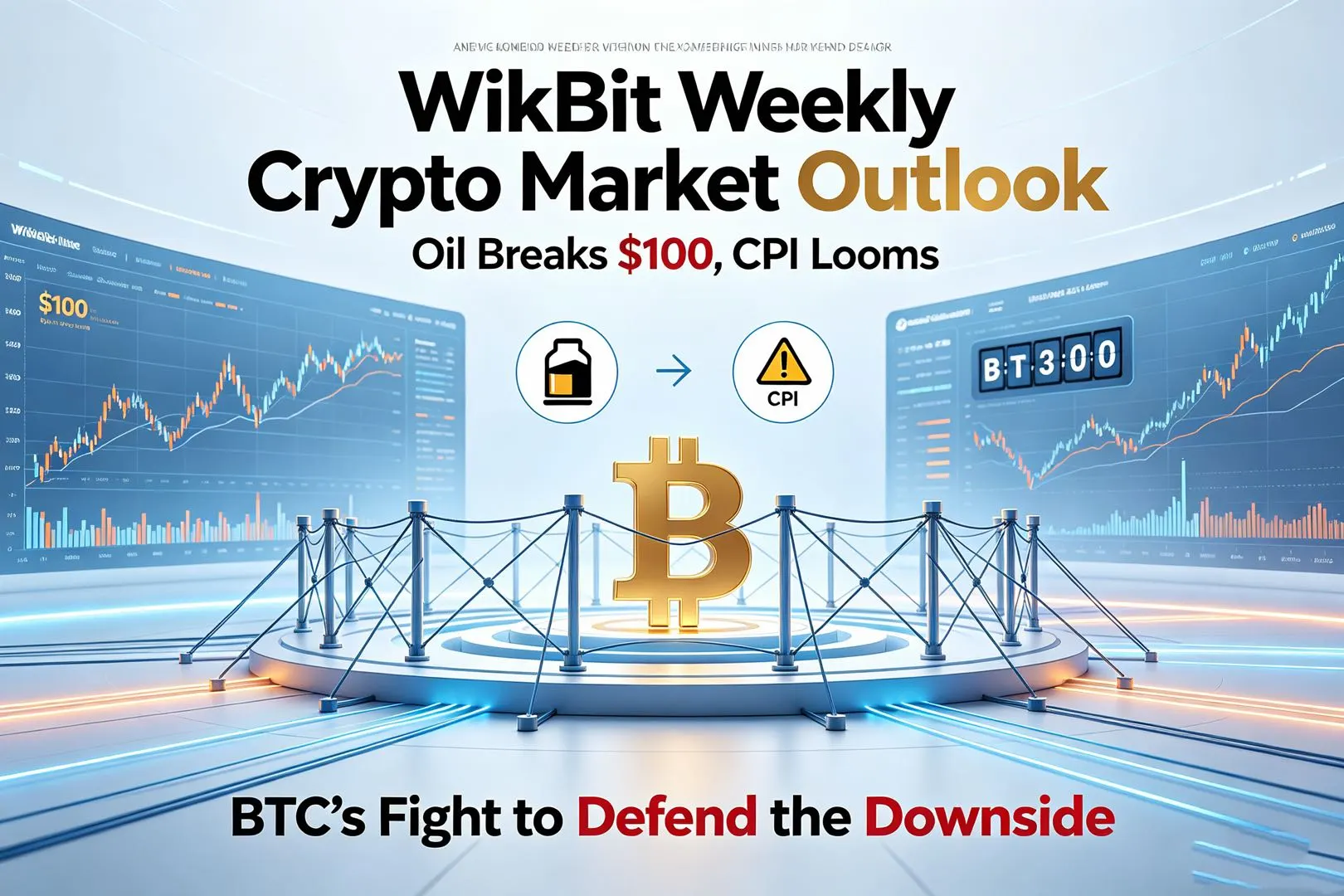
WikiBit Weekly Crypto Market Outlook: Oil Breaks $100, CPI Looms — BTC’s Fight to Defend the Downside

This Week‘s Plot: BTC’s Three-Week Winning Streak Ends  From September 7 to 11, BTC fell about 4% for the week and is now trading around $77,197, briefly dropping below $77,000. ETH has been relatively resilient, currently around $2,468, down roughly 2% for the week. There are three main culprits:PPI came in hotter than expected: U.S. August PPI rose 5.4% year over year, while energy prices jumped 4.2% month over month and diesel prices surged 24.1%. After the data was released, BTC plunged from above $79,000, while the 10-year U.S. Treasury yield approached 4.95%.The Middle East added fuel to the fire: The U.S.-Iran conflict escalated, pushing oil above $100, with Brent crude briefly approaching $109. Gold surged toward $5,000, but instead of flowing into BTC, safe-haven capital was scared away by renewed inflation expectations.Leveraged longs were liquidated: The entire crypto market saw approximately $452 million in liquidations over the past 24 hours, with long positions accounting for 76.76%.Bulls vs. Bears: On-Chain Data Warm, Macro Signals Cold  The on-chain temperature is cooling. Glassnode data shows the 7-day seller risk ratio for BTC has fallen to around 7 basis points per day, less than half the August high of 16 bps. The share of profit-taking

09-11Deep Dive

WikiBit Exchange Exit Risk Ranking #23 — Zoomex: F1 Sponsorship, Martínez Endorsement, 150x Leverage — Why Did France’s AMF Put It on the Blacklist?

Introduction: The “Sports Marketing Addict” — Zoomex‘s Two Faces  In the previous 22 editions, we dug into a series of exchanges ranging from HashKey to MGBX. For Episode 23, we’re taking a look at a “sports marketing addict” — Zoomex.  On paper, Zoomex has quite an impressive résumé: “Founded in 2021,” “more than 3 million users across 35+ countries,” “official partnership with the Haas F1 Team,” “Argentine goalkeeper Emiliano Martínez as a brand ambassador,” “Canada MSB + U.S. MSB + U.S. NFA + Australian AUSTRAC registrations,” “Hacken security audit certification,” “1:1 reserve policy with 95% of assets stored offline in cold wallets,” “590+ perpetual contracts,” and the “HackenProof bug bounty program.”  Sounds like a two-engine model of sports marketing + compliance and security, right?  But theres another side to the story.  Frances AMF added Zoomex to its blacklist in June 2024, officially warning that it was “offering crypto services without authorization.”  In April 2026, the Philippines SEC also included Zoomex on its warning list of unlicensed operators.  Its Trustpilot rating is only 2.2/5, with users calling it a “Ponzi” and warning others: “DO NOT PUT YOUR MONEY THERE.”  WikiBit concluded that “the platform currently has no valid crypto regulation,” while users have reported issues such as “accounts being

09-11Deep Dive

US CPI to Be Released at 8:30 PM Tonight: Could “Black Friday” Return? U.S. Stocks, BTC and Global Markets May Face a Broad Sell-Off

At 8:30 PM Beijing Time tonight, the U.S. August CPI data will be released.  Overall, the probability of the data being negative for financial markets is currently above 90%. The market is facing a potentially dangerous combination of Friday + bearish economic data + a high probability of further rate hikes, creating a triple-risk window that could trigger another “Black Friday.”  Yesterdays PPI report was, objectively speaking, not that bad. The overall data was bearish for markets, but only mildly so. Yet global markets still sold off across the board: U.S. stocks, crypto, A-shares, and the German, British, and French stock markets all declined.  Bitcoin plunged from $78,000 to $76,400, coming within striking distance of the previously mentioned $76,200 critical support level. This shows that market fear is already building. At this point, even the slightest piece of negative news can trigger another sell-off.  More importantly, after the release of the U.S. August PPI data, the CME-implied probability of a Fed rate hike jumped to 72.4%, surging by roughly 10 percentage points.  Historical data since 2015 shows that whenever the market-priced probability of a rate hike or cut has exceeded 69%, the Federal Reserve has ultimately delivered the corresponding rate move at its meetings.  And that

09-11Deep Dive

Robinhood Chain Deep Dive: TradeFi + Crypto — Can It Replicate and Surpass the SOL and BSC Wealth Stories?

The next major wealth-creation narrative in the public-chain space may have officially shifted from SOL and BSC to Robinhood Chain.  Veteran crypto traders know that every crypto bull market tends to produce a blockchain that creates extraordinary wealth. Solana previously rode high-performance infrastructure and the Meme narrative, while BSC leveraged low fees and retail-user traffic, creating countless 100x and even 1,000x wealth stories.  Robinhood Chain, officially launched in July 2026, enters the market with the massive user base of a traditional brokerage and a new TradeFi + Crypto combination. It brings U.S. equities and real-world assets, DeFi, and Meme culture together on a single blockchain, seemingly following the path taken by SOL and BSC while attempting to break through the ceiling of traditional public-chain models and trigger a new wave of wealth creation.  From its launch on July 1 to today, just two months in, the chain has delivered numbers that have left the entire crypto market stunned:  Daily revenue has surpassed $4 million — roughly twice that of Hyperliquid and five to six times that of Tron and Solana. Daily fee revenue even briefly reached an all-time high of $6 million.  TVL has surpassed $1 billion, daily DEX trading volume is approaching $1 billion,

09-10Deep Dive

WikiBit Exchange Exit Risk List #22: MGBX — An Investigation into “Compliance Packaging” and “Users Losing Contact”

Introduction: An Exchange That Seems to “Not Exist”  In the first 21 editions of this series, we investigated a range of crypto exchanges, from HashKey to WEEX. For Edition #22, we have something particularly “surreal”: MGBX.  On paper, its résumé looks pretty impressive:  “Founded in 2019,” “operating for seven years,” “more than 500,000 registered users,” “average monthly trading volume consistently above $20 billion over the past six months,” “Canada MSB + U.S. FinCEN MSB + Polish VASP registration,” “hot and cold wallet separation + multi-signature security,” and “Echo Points + AI-powered copy trading.”  Sounds like an “up-and-coming compliant exchange,” right?  But there is another side to the story.  MGBX cannot be found on CoinGeckos exchange rankings. In November 2025, approximately 96,000 user login and withdrawal passwords were reportedly exposed, an incident described by security organizations as an “exchange extinction-level event.” Its team page lists the CEO as “Jane Doe” — one of the most famous anonymous placeholders in the English-speaking world, essentially the equivalent of “John Doe” or “Zhang San” in Chinese.  Meanwhile, users have complained that after depositing $28,000, they were asked to pay a $5,000 “unlock fee” before they could withdraw their funds.  An exchange whose CEO is literally listed as “Jane Doe” — would you

09-10Deep Dive
1
...
810
...
748