WikiBit Exchange Collapse Risk Rankings #42: Bitstamp by Robinhood — “End-of-Life Care” for the World’s Oldest Exchange: Your Money Is in Luxembourg, but Your App Is at Robinhood
Introduction: An Old-School Exchange That Has Been “Adopted” In our first 41 installments, we investigated a series of exchanges, from HashKey to Bithumb. For Episode 42, were taking a look at one of the most unusual cases yet: Bitstamp by Robinhood. When it comes to industry experience, Bitstamp‘s résumé is arguably second to none in the crypto world: founded in 2011, it is one of the longest-operating cryptocurrency exchanges in the world. It holds a MiCA Crypto-Asset Service Provider (CASP) license issued by Luxembourg’s CSSF, a Major Payment Institution license from Singapores MAS, dual VASP and SIBA registrations in the British Virgin Islands (BVI), more than 50 active licenses and registrations worldwide, 4–5 million users, 95% of assets held in cold storage with 1:1 custody, and annual audits by a Big Four accounting firm. Sounds like “the most compliant established exchange in crypto, bar none,” right? But theres another side to the story. Bitstamp has a Trustpilot rating of just 1.3/5, with users describing their experiences as “Bad” and complaining about “accounts frozen for a year” and customer support that “simply doesnt exist.” In June 2025, the Grenoble Court of Appeal in France ruled that Bitstamp Europe was civilly liable to a user for operating in
Token2049 Was Huge, But What Really Matters for the Q4 Crypto Market? Four Wealth Opportunities Have Emerged!
This is a highlight summary of the Weekly Beat X Space AMA organized by WikiBit. On October 9, the Weekly Beat X Space focused on several major topics: Q4 market outlook, AI and crypto, stablecoin adoption, regulation, and leverage trading. The guests included Cube CEO Madison, Core Chain founder Liviu, Orion Finance community manager, Elytron Chains Desky, and other industry builders. If there is one sentence to summarize this AMA: The excitement around Token2049 does not equal a bull market. The real Q4 market depends on three things: whether liquidity is expanding, whether people are actually using crypto, and whether regulations can make institutional capital comfortable entering the market.1. Q4 Market Outlook: Watch the Tide Before the Waves The first question from the host was: After Token2049, market sentiment seems to have improved, but macro pressure has not disappeared. Bond yields are rising, rate hike concerns are returning — which indicators matter most now? The guests reached almost the same conclusion: Macro liquidity matters the most. Core Chains Liviu gave a very vivid analogy:Macro liquidity = the tideETF inflows = the wavesOn-chain activity = how many people are actually in the water The current challenge is that: The tide is moving out. The U.S. 10-year Treasury yield once moved above 5%.
Bitcoin Barely Holds $80K! Is the Rally Still Alive—or Is This the Final Bull Trap? The Full Bull vs. Bear Battle Playbook After October’s Roller-Coaster Ride
Over the past ten days, starting with Chinas National Day holiday, crypto traders have been on a wild roller-coaster ride. Bitcoin first surged through $86,000, fueling bullish expectations, only to be slapped back down toward the $80,000 abyss. Some traders made a fortune overnight, while others suffered devastating liquidations. The market now resembles a giant powder keg, with bulls and bears locked in an intense tug-of-war around the $83,000–$84,000 battleground. So, where is the market heading next? Up or down? Is the bull market still alive? Today, well look beyond the candlestick charts to uncover the capital battles unfolding beneath the surface—and lay out a practical, cost-effective trading playbook for crypto futures traders.Act I: Ten Days of Fire and Ice October 1–4 | The Prelude to Euphoria U.S. nonfarm payrolls came in surprisingly weak, prompting market cheers that the Federal Reserve might hold off on further rate hikes. Bitcoin seized the opportunity and surged toward $87,000, while Ethereum climbed above $2,700. October 5–8 | A Cold Shower The Feds meeting minutes delivered a series of hawkish signals. Bitcoin ETF flows suddenly reversed into outflows, while rising tensions in the Middle East and rumors of U.S. government Bitcoin sales added to the pressure. More than $1 billion in
WikiBit Exchange Exit Risk Ranking Episode 41: Bithumb — The Darkest Moment for South Korea’s “Perpetual No.2” Exchange, and the “Ghost Ledger” Behind the Accidental Transfer of 620,000 BTC
Introduction: A “Self-Destructing” Second-Largest Korean Exchange In the first 40 episodes, we dug into a series of exchanges ranging from HashKey to XT.com. Today, in Episode 41, were looking at a “self-destructing player” — Bithumb. On paper, Bithumb‘s resume in the Korean market looks like a textbook example of a “top-tier compliant platform”: founded in 2014, South Korea’s second-largest crypto exchange, approximately 22.3% market share, a VASP-licensed exchange approved by the Financial Intelligence Unit (FIU), a real-name banking partnership with KB Kookmin Bank, and even a previous plan for an IPO. Sounds like the perfect profile of a leading regulated Korean exchange, right? But on the other side of the story: On February 6, 2026, Bithumb accidentally distributed 620,000 BTC to 695 users due to an employee operational error — a mistake involving more than $40 billion worth of Bitcoin, about 15 times the amount of BTC actually held by the platform. Bithumb CEO Lee Jae-won admitted during a parliamentary hearing that the companys “internal control system had serious deficiencies.” The FIU accused Bithumb of approximately 6.65 million regulatory violations, imposed a fine of 36.8 billion Korean won (around $27 million), and issued a six-month “partial business suspension” sanction. In the first half of 2026, Bithumb recorded
WikiBit Exchange Exit Risk Rankings #40: XT.com — The “Social Exchange” with 12 Million Users, a CAD 2 Million Canadian Penalty, and Users Told to Pay “Tax” to Withdraw
Introduction: The Two Faces of an Exchange Awards Regular In our first 39 installments, we investigated a range of exchanges, from HashKey to Tokocrypto. For Episode 40, we turn to a platform with an impressive trophy cabinet and a growing list of legal and regulatory troubles: XT.com. XT.coms marketing credentials are certainly impressive. Founded in 2018, the exchange claims 12 million registered users worldwide, coverage across more than 200 countries and regions, support for over 1,300 tokens and 1,300+ trading pairs, and approximately $3.4 billion in daily trading volume. Headquartered in Dubai, it promotes itself as a socially integrated trading platform. In 2024, it received multiple industry awards, including recognition as a “Best Cryptocurrency Exchange.” It also regularly publishes Merkle tree proof-of-reserves reports, claiming reserve ratios of over 120% for BTC, ETH, and USDT. On paper, does this sound like the perfect image of a global social trading exchange? But there is another side to the story. In 2023, Quebecs financial markets regulator, the Autorité des marchés financiers (AMF), ruled that XT.com had violated securities laws. In March 2025, the Ontario Securities Commission (OSC) followed up with a CAD 2 million administrative penalty and a comprehensive ban on XT.com conducting securities-related activities in Ontario. In 2026,
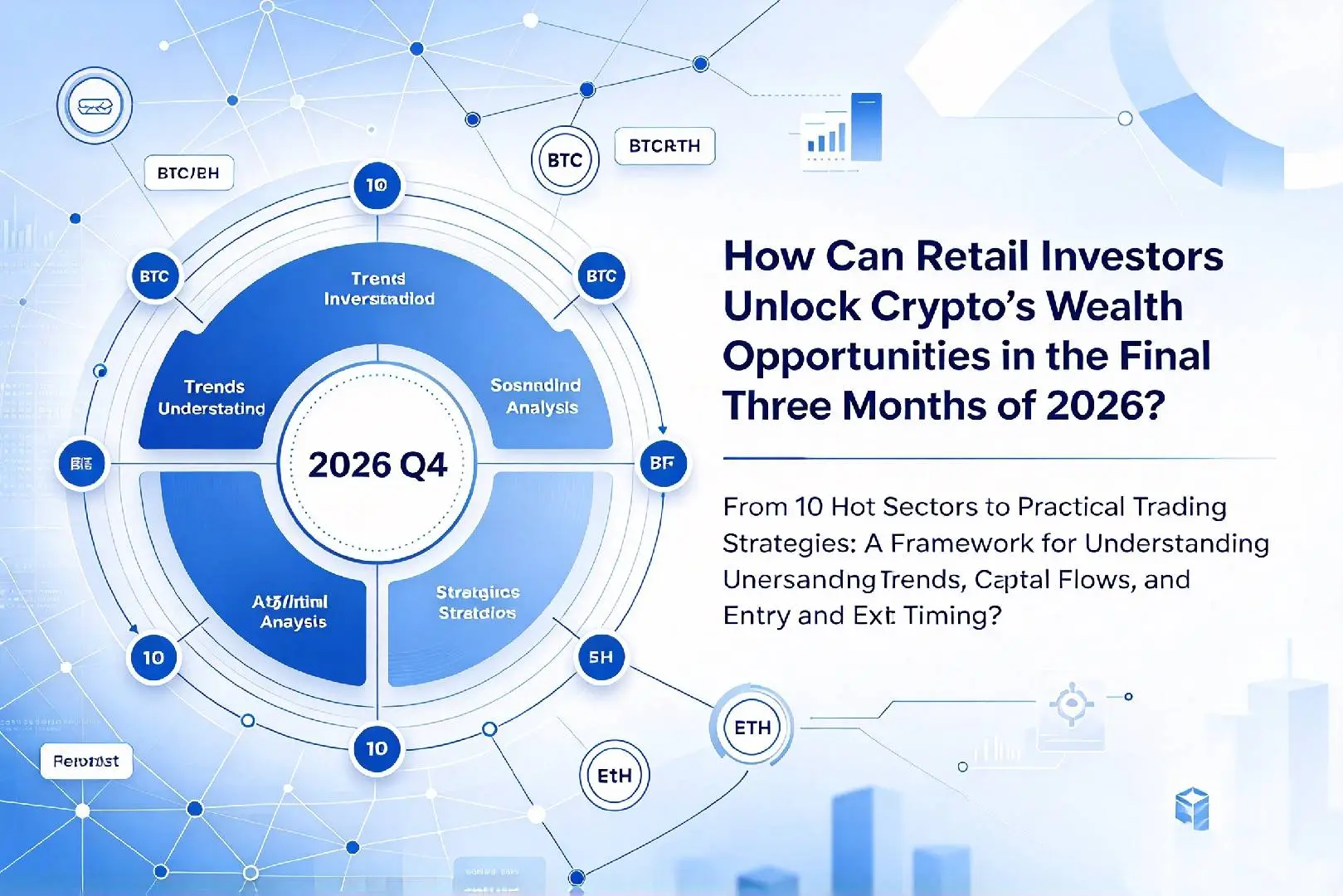
How Can Retail Investors Unlock Crypto’s Wealth Opportunities in the Final Three Months of 2026? From 10 Hot Sectors to Practical Trading Strategies: A Framework for Understanding Trends, Capital Flows, and Entry and Exit Timing
Retail investors real advantage is not getting information faster than institutions. It is the ability to avoid chasing every trend, identify opportunities before the market reaches a consensus, validate narratives with data, and control risk through disciplined position sizing. First, Understand This: What Is the Real Secret to Building Wealth in Crypto? Whenever a new crypto market cycle begins, a familiar pattern emerges. At first, only a small group of people pays attention to an emerging sector. Then, projects begin attracting capital, social media discussions increase, and prices start showing unusual movements. Eventually, mainstream media coverage intensifies, retail investors rush in, and even people who rarely follow crypto begin talking about it. By the final stage, stories about the “next 100x coin” are everywhere. The problem? By the time everyone knows about a hot trend, the easiest money may already have been made. What retail investors should learn is not how to predict which coin will rise tomorrow, but how to identify three distinct stages:Narrative Formation: A new demand trend emerges. Projects begin attracting attention, but the market has not fully priced in the opportunity.Capital Validation: Trading volume, user growth, capital flows, or real business metrics begin to improve, and the market gradually recognizes the opportunity.Sentiment
WikiBit Exchange Exit Risk Rankings #39: Tokocrypto — Binance’s “Golden Child” and Indonesia’s Compliance Benchmark, So Why Can Withdrawals Take Three Days?
Introduction: An Exchange Born with a Silver Spoon In our first 38 installments, we investigated a range of exchanges, from HashKey to Websea. For Episode 39, we turn our attention to a platform that appears to have one of the most legitimate pedigrees in the industry: Tokocrypto. Its credentials look impressive on paper: founded in 2018; Indonesia‘s first crypto exchange registered with Bappebti; awarded a full PFAK license in 2024; placed under the direct supervision of Indonesia’s Financial Services Authority (OJK) starting in January 2025; fully acquired by Binance in 2022; more than 5 million users; dual ISO 27017 and ISO 27001 certifications; Proof of Reserves using Merkle trees and zk-SNARKs; and user assets totaling $345 million. Sounds like a gold-standard example of regulatory compliance in Southeast Asia, right? But there is another side to the story. Tokocrypto has a Trustpilot rating of just 1.9 out of 5, with users repeatedly complaining about slow withdrawals and unresponsive customer support. Gridinsoft gives the website a trust score of only 35 out of 100 and flags it as a “suspicious website.” Multiple Chinese-language anti-fraud articles have accused Tokocrypto of being involved in a futures-trading Ponzi scheme scam. Academic research also indicates that 46.2% of sentiment toward
When the NYSE Decides to Go On-Chain: A $120 Trillion Relocation Plan
The chairman of the U.S. Securities and Exchange Commission just said something that could reshape the global financial system: “I would like to see the stock market run on blockchain.” This is not crypto-industry hype. The person who said it is Paul Atkins, Chairman of the U.S. Securities and Exchange Commission (SEC). In a live interview with CNBC, he made it clear that the entire financial system is moving toward the crypto era. Put simply: the gatekeeper of the worlds largest capital market is actively inviting blockchain in, rather than keeping it outside the door.What Does “Putting Stocks On-Chain” Actually Mean? The first thing many people think of is: “Turn Apple stock into a token.” But the reality is much more interesting. When you buy a U.S. stock, this is roughly what happens behind the scenes: your money starts at a bank, moves through a broker, is matched on an exchange, confirmed by a clearinghouse, and recorded by a custodian. Only then do you effectively “own” the stock. The entire process currently operates on a T+1 settlement cycle—sell today, and the transaction settles the next business day. The logic of on-chain stocks is much simpler: Stock = TokenBroker = WalletClearing = Smart ContractDollar = Stablecoin The SEC chairman

WikiBit Exchange Exit-Risk Ranking #37 — bitFlyer: Japan’s “King of Licenses,” So Why Do Users Say “Customer Service Doesn’t Exist”?
Introduction: The Two Faces of a “Compliance Ceiling” In the first 36 editions, we dug into a series of exchanges ranging from HashKey to GXT. For #37, were looking at one of the most “serious” names on the list: bitFlyer. Its résumé is arguably one of the most heavyweight in the entire crypto industry: founded in 2014; Japan FSA crypto exchange license No. 00003; the world‘s first crypto exchange to hold licenses simultaneously in the United States (48 states, including New York), Japan, and the EU; an EU MiCA license obtained in June 2026; Japan’s No. 1 Bitcoin trading volume for 10 consecutive years; total customer assets exceeding ¥1.4 trillion; no user-asset losses caused by hacking since its establishment; and EY ShinNihon LLC serving as its accounting auditor. Sounds like “the most compliant crypto exchange in the industry,” right? But there is another side to the story: a Trustpilot rating of just 1.9/5, with users saying that “customer service simply doesnt exist”; multiple complaints alleging that accounts were frozen without explanation and funds were withheld, including one user who claimed to have lost $2,230; co-founder Yuzo Kano publicly seeking a return to the CEO position and saying he wanted to “resolve management conflicts”; and,
WikiBit Exchange Exit Risk Ranking #38: Websea: Withdrawals Suspended for 4 Days, Hot Wallet Balance Nearly Zero — The “Worry-Free Derivatives Platform” Exposed
Introduction: A “Worry-Free” Exchange Where Users Have the Most to Worry About In the first 37 editions, we examined a series of exchanges ranging from HashKey to GXT. For the 38th edition, we turn to an exchange with an especially ambitious slogan but a much less reassuring reality: Websea. On paper, Websea has an impressive résumé: “founded in 2023,” “more than 1.5 million registered users worldwide,” “$4 billion in average daily trading volume,” an “ASIC regulatory authorization,” U.S. FinCEN MSB and Canadian FINTRAC MSB registrations, a strategic investment from Hony Capital, principal-protected copy trading, contract insurance, the Yongying Fund, and positioning as a “new-generation worry-free derivatives trading platform.” Sounds like a rising compliance star, right? But there is another side to the story. On April 27, 2026, Websea suddenly suspended withdrawals, shut down its C2C channel, and users began panic-selling, sending the platform tokens USDT price to roughly half its previous level. Then, starting September 25, 2026, withdrawals were reportedly suspended again for more than four days, with no official explanation from the platform. On-chain data showed that the platforms hot wallet balance had fallen to just 0.024 ETH and 0.24 USDC. WikiBit gives Websea a 5.98/10 score and flags it as having no valid regulatory status. FX110