$5.6 Billion Stolen: Both Are World No. 1—Will Binance Repeat Mt. Gox’s Fate?
At 4 a.m. today, Binance had $5.6 billion stolen, making it the largest exchange theft in history. So the question is: Will it become the second Mt. Gox? How will the market move next? Is it time to bottom-fish? Let me give the conclusion first: Binance will not repeat Mt. Goxs fate. But “not repeating Mt. Gox” does not mean “your money is necessarily safe.” These two things must be viewed separately.1. What Exactly Did Binance Lose, and What Did It Not Lose? As soon as the news of the Binance theft broke, the first name that came to many people‘s minds was not the hacker, but Mt. Gox. Because it was also an exchange theft, also the world’s largest, and also triggered user panic. Mt. Gox lost 850,000 BTC back then; the exchange went bankrupt, creditors waited ten years, and in the end they only received about 23.6% of their original claims as compensation. So people ask: Is Binance going to go down the same road? No. But the reason is not that Binance is more moral or luckier, but that between the two eras lies an entire set of structural firewalls. First, one point that is especially easy to be misled by: the

WikiBit Exchange Exit Risk Rankings #51: Bitget — 131% Reserve Ratio, a $387.5 Million Theft, and ZachXBT’s Claim That Its CEO Is Just a “Figurehead”
Introduction: The Regulatory Cracks Behind a Data-Driven Success Story In our first 50 installments, we investigated a series of exchanges ranging from HashKey to Gate. For Episode 51, we turn to a platform whose compliance narrative appears particularly contradictory: Bitget. On paper, Bitget performs impressively across several key metrics. It has more than 125 million users worldwide, held a 6.4% market share at the end of 2025, and ranked sixth globally. It has published 47 consecutive Proof of Reserves (PoR) reports, reports an overall reserve ratio of 131%, responds to 81% of negative Trustpilot reviews, and holds a 4.6-star rating on both the Apple App Store and Google Play. From almost any angle, it looks like a major exchange that takes its operations seriously. But there is another side to the story. In November 2023, France‘s financial markets regulator, the Autorité des marchés financiers (AMF), placed Bitget on its blacklist, confirming that it was operating without authorization. Although its blacklist status was removed on July 9, 2026, Bitget also exited the French market around the same time. As of October 2026, Bitget is still absent from the European Securities and Markets Authority’s (ESMA) register of MiCA-authorized Crypto-Asset Service Providers (CASPs), and the MiCA transitional
WikiBit Tokenized U.S. Stocks Series #4: The SEC’s Five-Year Window Isn’t a Countdown—It’s a Trial Period
Imagine this: You buy a tokenized version of Apple stock on a blockchain and transfer it to a friend seconds later. While you sleep, blockchain transactions continue around the clock, and smart contracts settle trades automatically. Sounds great, right? But questions immediately arise. If Apple trades at $200 on Nasdaq while its tokenized version sells for $206 on-chain, which price should you trust? If Apple pays a dividend, are token holders entitled to receive it? If the platform goes bankrupt, do you actually own Apple shares, or just a contractual claim against the platform? And if market manipulation, a hack, or a liquidity run occurs, who is responsible? These are the real questions the SEC must answer. The five-year period is not a countdown to the full-scale opening of the market. It is a financial experiment with defined boundaries: innovation gets a chance, but that does not justify handing the entire securities market over to a new model that has yet to prove itself.1.A Stock Is More Than a String of Code: Four Major Challenges Tokenization Must Address Blockchain technology can make transaction records easier to track, automate asset transfers, and potentially reduce intermediaries. But the securities market is much more than a
WikiBit Exchange Exit Risk Rankings #50: Gate — “Licenses Everywhere, Warnings Everywhere.” A User Says It “Stole $1.7 Million,” Yet Its Reserve Ratio Stands at 118%
Introduction: An Exchange Surrounded by Both Licenses and Warnings In our first 49 installments, we examined a range of exchanges, from HashKey to KuCoin. For Episode 50, we turn to one of the most complicated compliance stories in the industry: Gate (Gate.io). On paper, Gate has an impressive track record. Originally launched as Bter.com in 2013, it now claims more than 63 million users worldwide and lists over 5,500 crypto assets. Its 24-hour spot trading volume has ranked as high as second globally. The platform reports total reserves of $8.688 billion, a reserve ratio of 118.49%, and multiple regulatory registrations and licenses, including Maltas MiCA authorization, Dubais VARA license, Cypruss CySEC license, and Australias AUSTRAC registration. But there is another side to the story. In 2025, the Cayman Islands Monetary Authority (CIMA) issued a public notice explicitly stating that Gate.io and Gate Global Corp had “never been licensed or authorized to conduct business in or from within the Cayman Islands”—the jurisdiction Gate has long identified as its place of registration. Taiwans Financial Supervisory Commission (FSC) has stated that Gate had not completed the required anti-money laundering registration and was therefore prohibited from providing virtual asset services locally. In July 2026, a longtime Gate user
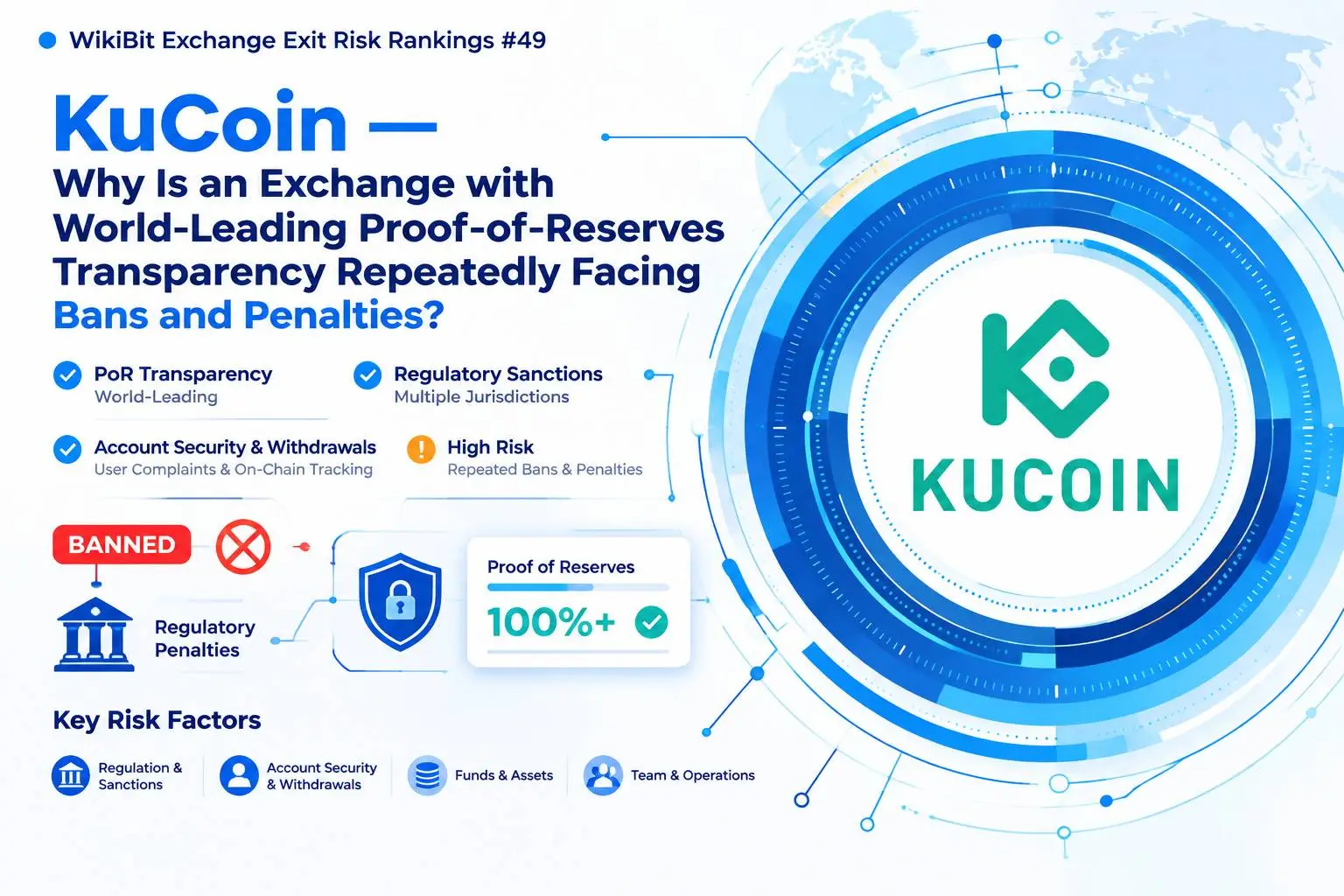
WikiBit Exchange Exit Risk Rankings #49: KuCoin — Why Is an Exchange with World-Leading Proof-of-Reserves Transparency Repeatedly Facing Bans and Penalties?
Introduction: An “A-Student” Report Card on Regulatory Compliance In the first 48 installments, we investigated a range of exchanges, from HashKey to MEXC. For Episode 49, we turn to one of the most strikingly contradictory cases: KuCoin. In terms of transparency, KuCoin has delivered one of the most impressive performances in the crypto industry. Founded in 2017, it received a Proof-of-Reserves (PoR) transparency score of 96.7 out of 100 from CryptoQuant in 2025, ranking first globally. It has published Merkle tree-based Proof-of-Reserves reports for more than 39 consecutive months, undergone third-party verification by Hacken, and held a 6.69% share of the global spot market in Q1 2026, placing it among the worlds top three exchanges. But there is another side to the story. On October 13, 2026, South Koreas Financial Intelligence Unit (FIU) officially blocked access to KuCoins website, extending restrictions beyond its app to the web platform. The UKs Financial Conduct Authority (FCA) listed KuCoin as an unauthorized firm. In January 2025, KuCoin pleaded guilty to charges brought by the U.S. Department of Justice (DOJ), agreeing to pay more than $297 million in penalties and admitting to receiving billions of dollars in suspicious funds between 2017 and 2024. The Commodity Futures Trading Commission
The Fed Holds Rates Steady in October, Yet Wall Street Heavyweights Sound the Alarm: Is a Financial Crisis Already on the Horizon?
Bitcoin is stuck around $80,000, ETH around $2,300, and SOL near $100. They seem unable to break higher or move lower—like sprinters waiting for the starting gun. And this week is certainly packed with potential market-moving events: October 29, 2:00 a.m. Beijing time (Thursday): Federal Reserve interest rate decision October 29, 8:30 p.m.: U.S. PCE inflation data October 29, 9:15 p.m.: European Central Bank interest rate decision October 30, 11:00 a.m. (Friday): Bank of Japan interest rate decision Each starting gun could send markets sprinting in either direction, triggering a sharp rally or a sudden sell-off. The biggest event is the Feds decision on October 29. The prevailing expectation is that it will leave rates unchanged, maintaining the federal funds rate at 3.75%–4.00%. On the surface, that sounds like a chance for markets to catch their breath. Yet almost simultaneously, another group of voices is raising the alarm: the probability of a global financial crisis over the next six months to two years may be increasing. This creates an apparent contradiction: If central banks are standing pat, why are financial heavyweights growing more nervous? The answer lies in a simple observation: The Feds pause does not mean the risks have disappeared. It may simply mean the central bank is
Wall Street Is Moving Finance On-Chain: Who Will Be the Biggest Winners, and What Should Retail Investors Watch Out For?
Traditional finance is entering the crypto world through ETFs, tokenization, and on-chain services. But institutional adoption does not automatically mean ordinary users will benefit. The real questions are: As Wall Street moves on-chain, who gains access to new opportunities, and who is simply being swept along by the hype? This article is based on the transcript of an X Space livestream organized by WikiBit on the theme “Wall Street Goes On-Chain.” The discussion focused on a straightforward question: As Wall Street moves onto the blockchain, who stands to benefit the most in the crypto world? The host opened by highlighting a central contradiction. On one hand, traditional finance is accelerating its entry into crypto, with ETFs, tokenized assets, and on-chain services emerging at a rapid pace. On the other, markets remain caught between inflation, interest rates, global risk sentiment, and concerns over user protection. Institutional activity is growing, but confidence has not automatically translated into demand. This raises two key questions:Who actually benefits from Wall Streets entry into crypto?For ordinary crypto users, what constitutes meaningful adoption? The livestream featured three guests from different backgrounds: MEJ from Gold House, a representative from RBC Group, and Akai, Community Manager at Bazaars. The diversity of the panel highlighted
WikiBit Crypto Weekly Market Outlook #8 (Fourth Week of October 2026): Tightening Expectations Weigh on Markets — Defense and Patience Amid Divergence
Bitcoin‘s short-term outlook is bearish, while its medium-term outlook remains neutral to cautiously bullish. However, next week’s FOMC meeting and Bank of Japan (BOJ) policy meeting are key catalysts that could determine the markets next major move. Before these events unfold, the optimal strategy is to reduce leverage and trade within a defined range rather than bet on a decisive breakout in either direction.1. Weekly Market Review (October 19–23): An Early Rally Followed by a Pullback, with Short-Term Bearish Signals This week, the market showed a structural divergence: BTC staged intermittent recoveries, while ETH continued to experience persistent capital outflows. Bitcoin (BTC) rebounded from lows near $81,000 at the beginning of the week, briefly recovering to $84,800 before encountering resistance at $85,000. It subsequently retreated to around $81,800 as of October 23. On the 4-hour chart, BTC fell back below MA5 and MA10. On the daily chart, MA5 ($82,462), MA10 ($82,143), and MA20 ($82,937) formed a bearish configuration, creating overhead pressure. The failure to break above $85,000 was the most significant bearish signal of the week. Ethereum (ETH) significantly underperformed BTC. Its price fluctuated within the $2,310–$2,530 range, repeatedly failing to sustain moves above $2,500–$2,550. As of October 23, ETH was trading at
WikiBit Exchange Exit Risk Rankings #48: MEXC (MXC) — Zero Trading Fees, 500x Leverage, and 3,000+ Tokens, but Are Compliance and Risk Controls Ticking Time Bombs Beneath the Surface?
Introduction: An Exchange That Trades Anonymity for Security and Product Power for Trust In our first 47 installments, we examined a series of exchanges, from HashKey to Bitfinex. In Issue #48, were taking a closer look at one of the most unusual players in the entire crypto industry: MEXC, also known as MXC or “Macha.” When it comes to product offerings, MEXC has become something of a benchmark in the crypto world: founded in 2018, with more than 40 million users worldwide, over 3,000 listed tokens, zero maker fees, leverage of up to 500x, and a reputation for being one of the fastest exchanges to list new tokens. It frequently opens centralized exchange (CEX) trading for projects just hours after they launch on decentralized exchanges (DEXs). Sounds like a degen traders paradise, doesnt it? But theres another side to the story. The UKs Financial Conduct Authority (FCA) has issued a warning. The Netherlands Authority for the Financial Markets (AFM) has flagged the platform as non-compliant. Seychelles Financial Services Authority (FSA) has initiated enforcement action. Dubais Virtual Assets Regulatory Authority (VARA) has imposed a fine. Japans Financial Services Agency (FSA) has issued warnings. South Koreas Financial Services Commission (FSC) has taken steps that resulted in the
Bitcoin Has Traded Sideways for a Month: The Real Risk Isn’t a Fed Rate Pause, but Disappointment in Market Expectations
This article is based on WikiBits livestream on October 22. The key takeaway in one sentence: The Federal Reserve holding rates steady does not mean rate cuts, let alone a return to monetary easing. With BTC trading sideways for a month, this is not the time to blindly bet on a rally. It is time to wait for confirmation from both capital flows and price action before deciding which direction the market is heading.1. First, Let‘s Correct a Common Misconception: Why Can Holding Rates Steady Actually Be Bearish? When people hear that the Fed will not raise interest rates next week, their first reaction is often: Isn’t that bullish? Liquidity pressures should ease, so Bitcoin ought to rise. In theory, there is some truth to that. The higher interest rates are, the more attractive low-risk assets such as cash and short-term Treasury bills become. Bitcoin pays no interest and is highly volatile, making a high-interest-rate environment unfavorable for its valuation. As a result, a rate pause may lead some investors to wonder whether the worst is finally over. But financial markets do not trade solely on whether rates are raised or held steady today. They trade on how the future interest-rate outlook compares