Immutable and Polygon Labs launch Inevitable Games Fund with hopes of raising $100M

King River Capital, Immutable and Polygon Labs have partnered to launch the Inevitable Games Fund (IGF), which aims to bring additional resources into the Web3 gaming space.  The fund wants to be ecosystem agnostic and act as a resource to encourage innovation in the on-chain gaming sector. Its investment process is led by King River Capital, with the assistance of Immutable and Polygon Labs.  Only “professional and sophisticated investors” will be able to contribute to the fund, which has a cap size of $100 million. According to Brendan Ma, head of investments at Immutable, the funds first close has reached $30 million, and it has received commitments from investors including Alpha Wave Ventures, Merit Circle and several family offices.  A handful of investment opportunities have already been identified by the fund, including decentralized Web3 gaming IP Pixelmon, open-world player versus player arms game Metalcore and role-playing game Guild of Guardians.  Co-founder and managing partner at King River Capital Zeb Rice said that video game spending exceeds global revenue from movies, streaming services and the music industry combined.  “Just as mobile gaming went from virtually zero in 2008 to 79% of gamers playing mobile today, we believe a similar shift has only just begun [with] Web3
2024-03-21Deep Dive

Exploring a New Concept in the Industry—Parallel EVM, Overview of Four Projects

Former Polygon co-founder JD once stated on social media that he anticipates every L2 in 2024 will rebrand themselves and label themselves as “Parallel EVM”.  Paradigms CTO Georgios also believes that 2024 will be the “Year of Parallel EVM” and mentioned that exploration and design of related technologies are also underway internally at Paradigm.The Definition and Implementation of Parallel EVM  The Parallel EVM (Ethereum Virtual Machine) is a concept aimed at improving the performance and efficiency of the existing EVM. Currently, the EVM has a crucial feature in its design to maintain network consistency and security:  Transactions are executed sequentially. Sequential execution ensures that transactions and smart contracts are executed in a deterministic order, making it easier to manage and predict the state of the blockchain. This design choice prioritizes security and reduces potential complexities and vulnerabilities associated with parallel execution. However, under high loads, it may lead to network congestion and delays.  Parallel EVM allows different independent transactions or smart contracts to execute simultaneously, greatly improving the processing speed and system throughput of the EVM.  General methods for parallel EVM processing include:  Partitioning or sharding: Transactions are partitioned or grouped, allowing them to execute in parallel. This means that different transactions can be executed simultaneously

2024-03-21Deep Dive

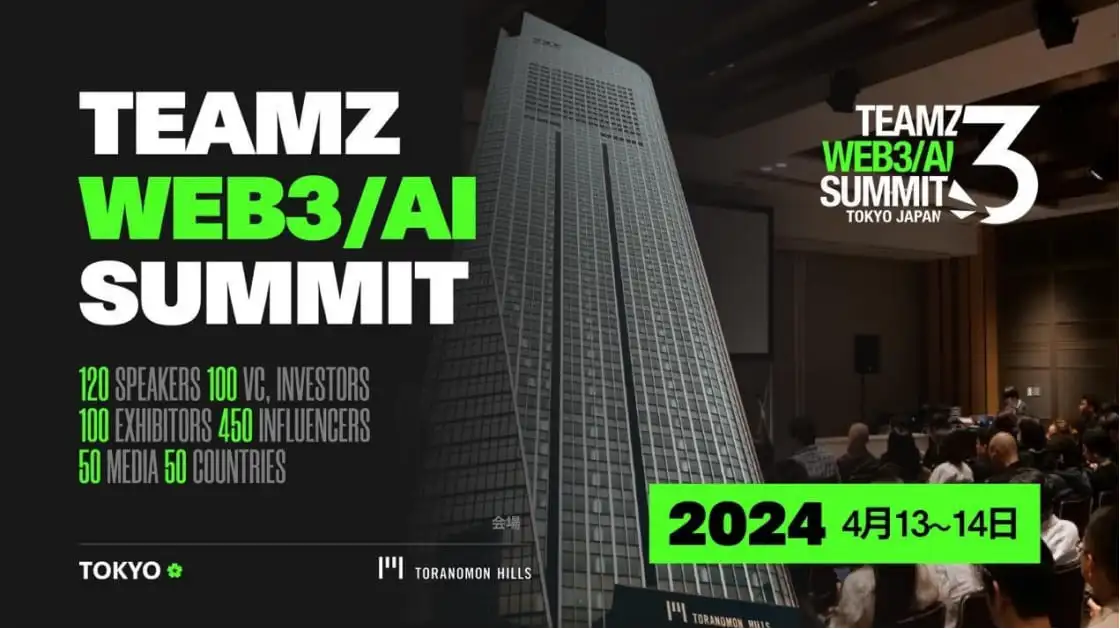
The TEAMZ WEB3/AI SUMMIT 2024, happening on April 13th and 14th, 2024

After the phenomenal success of last years event, the TEAMZ WEB3/AI SUMMIT 2024 is set for April 13th and 14th, taking place on the fifth floor of Toranomon Hills in Minato-ku, Tokyo. This summit is a pivotal convergence for leaders, experts, academics, investors, and developers in the Web3 and AI sectors, providing an unmatched opportunity for attendees to exchange the latest insights and delve into industry innovations.  Since 2017, TEAMZ Inc. has been at the forefront of hosting significant Web3 summits in Japan. Despite having to pause our events due to natural disasters after several successful editions, weve faced and overcome many challenges. We were delighted to successfully host our fifth summit on May 17th and 18th, 2023. This event stood out, drawing nearly 4,000 enthusiastic attendees and numerous industry leaders in Web3 and AI. It was an event of great significance, encouraging important dialogues and collaborations.  This year, from April 13th to 14th, the TEAMZ WEB3/AI SUMMIT 2024 aims to be even more spectacular than previous editions. Building on last years momentum, we expect this summit to be a grand assembly with over 5,000 participants. Attendees from across the world will gather to explore the latest industry trends and future possibilities.  CO-HOST

2024-03-21Deep Dive

Lazarus Group, a North Korean Hacker Collective, Stole $3 Billion in Cryptocurrency Over 6 Years

According to a report released by the cybersecurity firm Recorded Future, the Lazarus Group, an organization associated with North Korea, has stolen $3 billion in cryptocurrency over the past six years. The report states that in 2022 alone, the Lazarus Group looted $1.7 billion in cryptocurrency, likely providing funds for North Korean projects. Chainalysis, a blockchain data analysis company, indicates that $1.1 billion of this was stolen from DeFi platforms. A report released by the U.S. Department of Homeland Security in September highlighted Lazarus exploitation of DeFi protocols as part of its Analysis Exchange Program (AEP). The Lazarus Group specializes in fund theft. In 2016, they breached the Bangladesh Central Bank, stealing $81 million. In 2018, they attacked the Japanese cryptocurrency exchange Coincheck, making off with $530 million, and targeted the Central Bank of Malaysia, stealing $390 million.Process  Since 2017, North Korea has targeted the cryptocurrency industry as a key focus for cyberattacks, resulting in the theft of over $3 billion worth of cryptocurrency. Prior to this, North Korea had hijacked the SWIFT network, enabling them to siphon funds between financial institutions. Such activities have drawn close attention from international bodies, prompting financial institutions to invest in enhancing their own network

2024-03-20Deep Dive

Solana Meme Slerf Notches $3.2B in Volume After Developer Loses All Presale Funds

Slerf, a sloth-themed meme coin on the Solana network, raised $10 million in a so-called presale and quickly gained popularity even though the developer mistakenly burned the liquidity provider and tokens.  The launch of SLERF comes as developers are raising millions of dollars in presales, contributing to a surge in the price Solanas SOL token, which crossed the $200 mark for the first time since November 2021.  “This is not a joke I really f****d up and im really sorry. Was a simple mindless misclick when I was in the process of burning the the lp,” the developer said  One of the newest tokens emerging from the Solana meme coin presale narrative has chalked up multiple exchange listings, a $3.2 billion trading volume and thousands of unique holders in a few hours after going live – despite a major fumble.  Slerf, a sloth-themed meme coin on the Solana network, raised $10 million in a presale on Monday. The token is among several that have emerged as presales – or fundraising sales before the official introduction – in the past few days following the success of Book of Meme (BOME) earlier this month.  However, the developer behind the project ended up losing all received funds after

2024-03-19Deep Dive

Digital Asset Fund Flows | March 18th 2024

Digital asset investment products saw record weekly inflows totalling US$2.9bn, beating the prior weeks all-time record of US$2.7bn.  This weeks inflows have pushed year-to-date inflows to US$13.2bn, smashing the full 2021 inflows of US$10.6bn.  Smart contracting suffered last week, with Ethereum, Solana and Polygon seeing outflows totalling US$14m and US$2.7m and US$6.8m respectively.  Digital asset investment products saw record weekly inflows totalling US$2.9bn, beating the prior weeks all-time record of US$2.7bn. This weeks inflows have pushed year-to-date inflows to US$13.2bn, smashing the full 2021 inflows of US$10.6bn. Trading volumes totalled US$43bn for the week, the same as the prior week record and comprising a larger 47% of overall global bitcoin volumes. During the week global ETPs broke the US$100bn mark for the first time, although the price correction at the end of the week saw it settle at US$97bn.  Regionally, the US saw US$2.95bn inflows, with minor inflows into Australia, Brazil and Hong Kong of US$5m, US$24m and US$15m respectively. While Canada, Germany, Sweden and Switzerland saw a combination of US$78m in outflows last week. This year has not got off to a good start, having now seen US$685m in outflows so far.  Bitcoin saw US$2.86bn of inflows last week and now comprise 97% of

2024-03-19Deep Dive

February Web3 Security Incident Recap: Total Losses Amounted to $404 Million

According to the SlowMist Blockchain Security Incident Database, in February 2024, there were a total of 28 security incidents, resulting in approximately $404 million in losses. Reasons for these incidents included contract vulnerabilities, DDoS attacks, flash loan attacks, private key leaks, and account thefts.Major IncidentsPhantom  On February 2, 2024, the cryptocurrency wallet Phantom reported a DDoS attack, with attempts made to overload its system. Some services may experience temporary interruptions, posing potential risks to user assets. Subsequently, Phantom tweeted that all services had been restored to normal operation and were running smoothly once again.Starlay Finance  On February 8, 2024, the lending protocol Starlay Finance within the Polkadot ecosystem was attacked, resulting in losses of approximately $2.1 million. On February 9, Starlay Finance tweeted that preliminary analysis indicated the attack was due to exploitation of an error in liquidity index calculation, leading to unauthorized withdrawals.PlayDapp  On February 10, 2024, the blockchain gaming platform PlayDapp was attacked, with the hackers address being added as a minter, minting 200 million PLA tokens (approximately $36.5 million). Shortly after the incident, PlayDapp sent a message to the hacker via on-chain transaction, requesting the return of the stolen funds and offering a $1 million white-hat reward, but negotiations ultimately

2024-03-19Deep Dive

This Week Noteworthy Events (March 18th - March 24th, 2024)

NVIDIA to Host GTC 2024 Conference from March 18th to 21st  NVIDIA has announced that the GTC 2024 conference will be held at the San Jose Convention Center from March 18th to 21st. NVIDIAs founder and CEO, Jensen Huang, will deliver the keynote address at the San Jose Convention Center on Monday, March 18th at 1:00 PM Pacific Time.  According to the NVIDIA website, Illia Polosukhin, co-founder of NEAR Protocol, will attend the “Transforming AI” keynote speech and panel discussion event at the GTC24 conference on Wednesday, March 20th, from 11:00 AM to 11:50 AM Pacific Daylight Time.World Funds Trust Submits Application to SEC for 6 Bitcoin Spot-Based Leveraged ETFs, Expected to Take Effect on March 18th  According to documents shared by Bloomberg Intelligence analyst Henry Jim on the X platform, World Funds Trust has submitted applications to the U.S. Securities and Exchange Commission (SEC) for six leveraged ETFs based on Bitcoin spot prices. These ETFs include 1.5x, 1.75x, and 2x leverage, as well as inverse leveraged ETFs. The codes and fees are yet to be determined, with an effective date set for March 18, 2024.  The documents indicate that these ETFs will initially reference the yet-to-be-launched iShares Bitcoin Spot ETF, but reserve the

2024-03-18Deep Dive

An Overview of Fully Homomorphic Encryption (FHE) Technology and Projects Utilizing It

FHE, short for Fully Homomorphic Encryption, allows individuals to perform computations on encrypted data in a specific form without the need to decrypt and expose the data privacy. Application areas include but are not limited to:  Confidentiality in RWA tokenization  On-chain identity  MEV protection  Privacy-preserving on-chain medical data  Making DeFi compliant with data protection and privacy laws  FHE is a concept within the broader scope of technology on the internet and has been around for some time. It gained attention with Fhenix Network integrating FHE functionality into Ethereum and launching the fhEVM solution. Any developer can integrate FHE functionality into transaction flows in the form of pre-compile binaries.  The mainstream privacy technologies currently available in the market:  The privacy technologies adopted in the encryption industry mainly revolve around ZKP (Zero-Knowledge Proofs). The difference between FHE and ZKP lies in:  ZKP addresses the issue of consistent transmission of data under encryption. The data submitter can prove the authenticity of the data to the receiver without revealing the specific data, making it a point-to-point encryption scheme. Particularly, lightweight zk-SNARKs have been widely used in layer2 Rollups.  On the other hand, FHE aims to tackle the problem of re-computation under encrypted data transmission. This constitutes a more extensive encryption scheme, accommodating many-to-many interactions.

2024-03-15Deep Dive

How Does the Ethereum Dencun Upgrade Affect Layer 2 and Gas Fees?

With the completion of the Ethereum Dencun upgrade, various Layer 2 solutions have also announced corresponding upgrades. What impact will the Dencun upgrade have, and what are its underlying principles? The following text will provide a detailed explanation:What is the Dencun Upgrade? What are the Key Focus Areas?  The Dencun upgrade, essentially a combination of the Deneb and Cancun upgrades, targets both the consensus and execution layers. The Dencun upgrade incorporates nine EIPs (Ethereum Improvement Proposals), including:  EIP-1153: Transient Storage Opcode  EIP-4788: Beacon Block Root in EVM  EIP-4844: Sharding Blob Transactions  EIP-5656: MCOPY Opcode for Memory Copy  EIP-6780: SELFDESTRUCT in the Same Transaction  EIP-7044: Perpetually Valid Voluntary Exit Signatures  EIP-7045: Maximum Gap for Proof Inclusion  EIP-7514: Maximum Epoch Attrition Limit  EIP-7516: BLOBBASEFEE Opcode  The spotlight of the Dencun upgrade is on EIP-4844. Also known as Proto-Danksharding, EIP-4844 serves as a precursor to the mainstream sharding approach in the Ethereum community, Danksharding. The primary objective of EIP-4844 (Proto-Danksharding) is to introduce a new transaction type called “Blob transactions” to Ethereum. These transactions add an additional temporary data space, called Blob, to the Ethereum mainnet specifically dedicated to processing Layer 2 related transactions, thereby significantly reducing the transaction cost of Layer 2.  Whether its Optimistic Rollup or ZK Rollup, any Layer 2 that relies

2024-03-14Deep Dive
1
...
3133
...
742