Introduction: The Other Side of a “Compliance Star”
In the first 46 installments, we investigated a range of exchanges, from HashKey to Bitfinex. For Episode 47, were taking a look at one of the most Hollywood-style names in crypto: Crypto.com.
Its résumé in compliance and marketing is almost unmatched: founded in 2016, with more than 140 million users worldwide; one of the first major global crypto-asset service providers to obtain a MiCA license covering the European Union; an SEC investigation that ended with no enforcement action; more than 100 regulatory approvals; a Maltese MiCA license; dual CFTC registrations as a Designated Contract Market (DCM) and Derivatives Clearing Organization (DCO); FINRA-registered broker-dealer status; a $700 million deal in 2021 to secure the naming rights to the Los Angeles Lakers‘ home arena; Matt Damon’s “Fortune Favors the Brave” campaign; and sponsorships of Formula 1 and the UEFA Champions League.
Sounds like a globally compliant crypto super app, right?
But there is another side to the story. Crypto.com has a Trustpilot score of just 2/5, with 72% of ratings being one star. Numerous users complain about sudden account restrictions, funds they can see but cannot access, scripted customer support responses, and cases that remain unresolved for weeks or even months.
Its only independently attested Proof of Reserves (PoR) report was conducted by Mazars in December 2022. That same month, Mazars withdrew from all crypto audit engagements. Since then, Crypto.com has not had a confirmed active third-party auditor for its PoR reporting, leaving its reserve disclosures effectively self-published and outdated.
In September 2025, Bloomberg reported that Crypto.com had suffered a previously undisclosed cyberattack in which hackers accessed users personal data by compromising employee accounts.
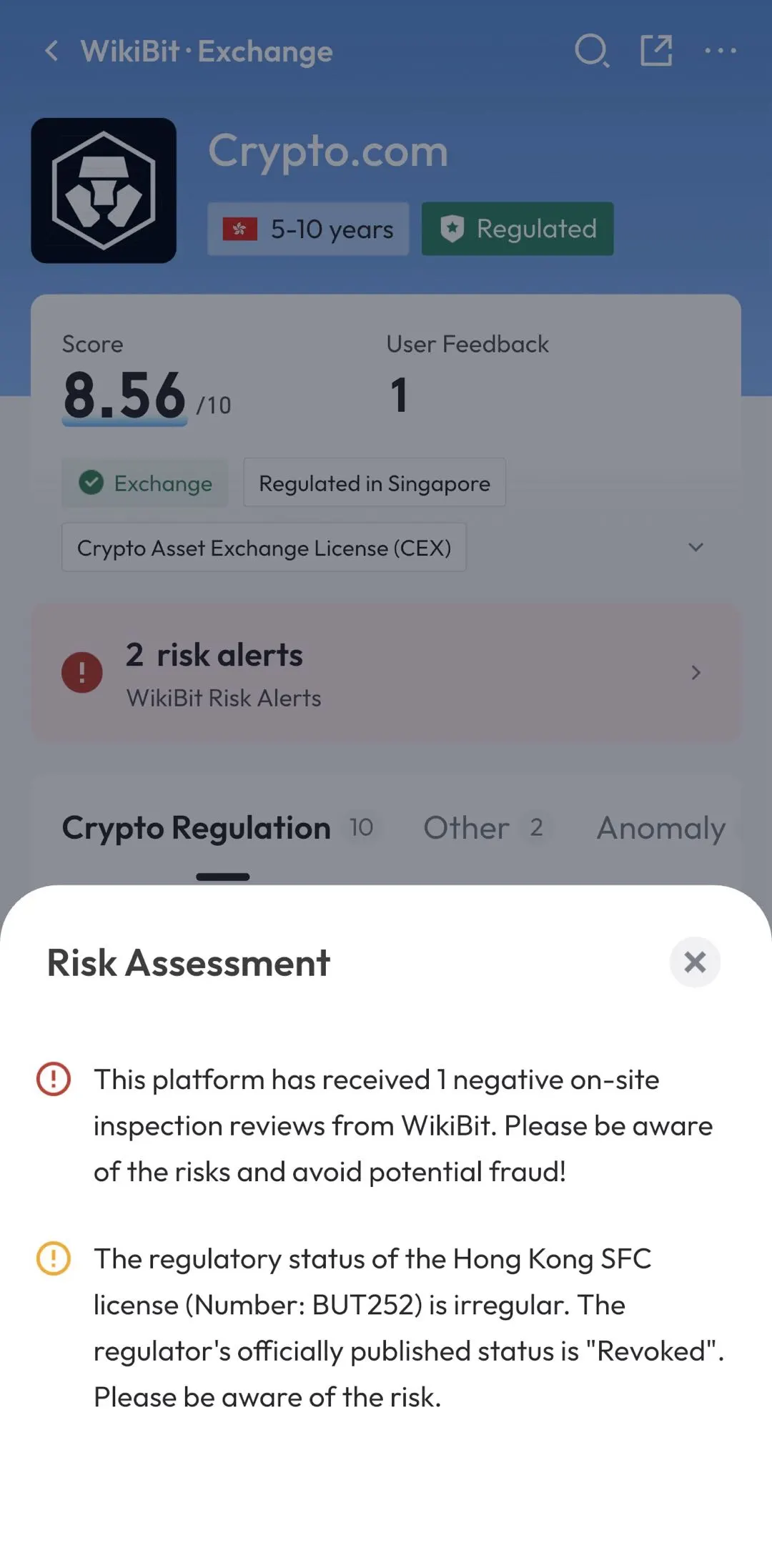
WikiBit Alert: Crypto.com‘s regulatory status with Hong Kong’s Securities and Futures Commission (SFC), under regulatory number BUT252, is abnormal. The regulator lists the status as revoked. Users should exercise caution.
Why does a platform with an extensive portfolio of licenses and a global marketing presence score only 2/5 with users? Lets examine the evidence layer by layer.
1. Regulatory Compliance: MiCA Is a Powerful Asset, but Compliance Is No Get-Out-of-Jail-Free Card
The License Portfolio: One of the Most Extensive Compliance Passports in Crypto
Crypto.coms regulatory footprint places it among the leading tier of mainstream crypto exchanges.
MiCA license: Obtained in early 2025, making Crypto.com one of the first major global crypto-asset service providers to secure MiCA authorization, with coverage across the European Union.
SEC investigation closed with no enforcement action: In March 2025, the SEC formally closed its investigation into Crypto.com without bringing an enforcement action or reaching a settlement. Crypto.com described itself as the only global full-service crypto exchange that had neither been sued by the SEC nor entered into a settlement with it.
More than 100 regulatory approvals: These include FinCEN Money Services Business (MSB) registration, money transmitter licenses (MTLs) in more than 40 U.S. states, CFTC registrations as a DCM and DCO, FINRA-registered broker-dealer status, and qualified digital-asset custodian status.
Dutch central bank fine: Crypto.com was previously fined by the Dutch central bank for a registration-related violation. This was a jurisdiction-specific compliance issue, although it does not fundamentally change the broader picture of its regulatory footprint.
In terms of the breadth of its regulatory credentials, Crypto.com ranks behind Bitstamps 50-plus licenses in certain respects within our 47-part series. In other areas, such as its early MiCA authorization and its record of avoiding SEC enforcement, it has an especially strong position.
But Compliance Does Not Solve the Problem of Users Being Unable to Access Their Money
The absence of an SEC lawsuit does not guarantee a good user experience. A MiCA license covering the EU does not mean your account in the United States cannot be frozen if the platform considers your activity reasonably suspicious.
Crypto.coms terms of service reserve the right to suspend, restrict, or terminate accounts based on reasonable suspicion. In certain circumstances, the company may not be required to provide a detailed explanation.
Potential triggers include transfers involving blockchain addresses flagged by risk-analysis tools, card chargebacks, account activity inconsistent with KYC information, third-party use of an account, and broadly defined “suspicious activity.”
A regulatory license helps protect a platform from regulatory shutdown. It does not guarantee that the platform will never freeze your account. These are two entirely different things.
Risk Rating: Low Risk — Regulatory Compliance
Crypto.coms regulatory credentials are substantial: early MiCA authorization, no SEC enforcement action, and more than 100 regulatory approvals. But being a compliance star does not guarantee smooth withdrawals.
2. Account Security and Withdrawals: A 2/5 Trustpilot Score and the Problem of “Money You Can See but Cannot Touch”
Trustpilot: 2/5, with 72% One-Star Ratings
Crypto.com has a Trustpilot score of 2/5, categorized as “Poor.” The complaints follow strikingly similar patterns and often describe specific problems.
“My Account Was Suddenly Restricted, and Completing All Verification Steps Did Nothing”
“My account was suddenly restricted, without any clear reason or explanation, even after I completed all the verification steps. I can see my money, but I cannot access it. Many people on Trustpilot report the same problems—deposit and withdrawal issues, and accounts unexpectedly frozen. Customer support is extremely unhelpful. I followed their instructions multiple times and provided all the documents they requested, yet I still received vague responses with no real solution.”
“My Withdrawal Was Frozen, and I Was Told to Pay a ‘Management Fee’”
“The withdrawal button stopped responding, and the dashboard stopped updating my activity. I was told I needed to pay 500 units as a ‘management payment’ to complete the final verification of my account status. My case was then referred to a designated administrative agency called Qvyize for a second audit of my assets.”
A supposed “management payment” is a variation of the pay-to-unlock scam pattern. It resembles allegations previously discussed in our coverage of KCEX, LBank, and Biconomy.
Such demands deserve particular scrutiny. Users should verify any payment request through official support channels and should never send additional funds to an unverified third party to unlock an account or withdrawal.
“My Account Was Closed, My Balance Was Still Inside, and I Received Scripted Replies for Weeks”
An independent analysis by Leodex summarized recurring complaints on Trustpilot and Reddit: accounts being closed while balances remained inaccessible, scripted responses continuing for weeks or even months, difficulty reaching a human support agent, and reports of cases remaining unresolved for two months.
“My €18,000 Withdrawal Was Locked, and I Nearly Lost Everything as a Single Mother”
One Trustpilot user complained:
“As a single mother, when Crypto blocked my €18,000 withdrawal—the money I needed for my shop—I nearly lost everything. Endless procedures…”
Individual complaints do not, by themselves, establish that a platform systematically withholds funds. However, repeated reports describing similar account restrictions and unresolved withdrawal problems warrant closer scrutiny.
The Core Pattern: A Recurring Withdrawal Freeze Scenario
Crypto.coms withdrawal-related complaints point to a recurring pattern:
Normal account activity: Users deposit funds, trade, and sometimes use the platform for years without apparent problems.
Withdrawal attempt: When they try to withdraw—particularly to their own cold wallets or in larger amounts—their accounts are suddenly restricted.
Additional verification: They are asked to submit extensive KYC documents and proof of funds, yet restrictions may remain after submission.
Unresponsive customer support: Users report receiving scripted replies, struggling to reach human agents, and waiting weeks or months without a resolution.
Additional payment demands in some reports: Certain complainants describe being asked to pay “management” or “verification” fees to unlock their funds.
This goes beyond a poor withdrawal experience. The central concern is that the money remains visible in the account, but the user cannot freely access it.
Crypto.coms 2/5 Trustpilot score did not emerge in a vacuum. It is among the lowest user ratings featured in this series. However, Trustpilot reviews are self-selected user reports rather than independently verified evidence of every allegation, so they should be assessed alongside regulatory records, official disclosures, and documented cases.
Risk Rating: Extremely High — User Experience and Withdrawals
The primary concern is not simply whether Crypto.com holds regulatory licenses. It is whether users can reliably access their assets when they need them. The volume and consistency of reported account-restriction and withdrawal complaints warrant caution, particularly for users who depend on immediate access to their funds.
3. Proof of Reserves Transparency: The “Zombie Audit” of 2022, Followed by Self-Published Data
Official Page: Mazars Group, December 7, 2022
Crypto.coms Proof of Reserves (PoR) page states that its reserve verification was conducted by Mazars Group using a Merkle tree structure, allowing users to independently verify their account balances. The verification was dated December 7, 2022. CRO and VET were excluded because “the tools used by Mazars did not support these tokens at the time.”
The Critical Problem: Mazars Withdrew From All Crypto Audit Engagements in December 2022
After completing PoR reports for Crypto.com, Binance, and KuCoin, Mazars announced on December 16, 2022, that it was suspending work for all crypto clients, citing concerns about “the way these reports are understood by the public.”
Since then, Crypto.com has had no confirmed active third-party auditor for its PoR reporting.
Fomoeds 2026 review put it bluntly: “Crypto.com publishes proof of reserves, but its only independent attestation was completed by Mazars in December 2022—and Mazars withdrew from all crypto audit work that same month. No active third-party auditor has been confirmed since, leaving the reserve data effectively self-published and outdated.”
PoR Proves Asset Coverage, Not Liabilities or a Willingness to Process Withdrawals
A CoinMarketCap community article citing expert commentary from CoinDesk points out that without proof of liabilities, proof of reserves is of limited value.
Crypto.coms PoR is a snapshot taken on December 7, 2022. After that snapshot, Mazars exited the crypto audit business, and no independently confirmed auditor has emerged to verify subsequent reserve data. Meanwhile, numerous users have complained about frozen withdrawals.
A snapshot showing asset coverage in 2022 cannot explain why withdrawals might be delayed in 2026.
Risk Rating: High Risk — Proof of Reserves Transparency
Within this series, Crypto.coms PoR status falls into the category of “exists, but is no longer reliable as current evidence.” The 2022 Mazars attestation was real, but more than three years have passed without a confirmed independent audit to follow it. The data is self-published and outdated, making its practical value only marginally better than having no current PoR at all.
4. Financial Strength: A $20 Billion Valuation and 140 Million Users, but CROs “Self-Referential” Structure Raises Concerns
The Impressive Numbers
User base: More than 140 million users, according to Crypto.coms own claims. This figure is self-reported and has not been independently audited.
Valuation: In July 2026, Crypto.com received a $400 million investment from Citadel Securities at a reported valuation of $20 billion. This was its first external investment since 2016.
Brand investment: $700 million for the naming rights to Crypto.com Arena in Los Angeles, alongside sponsorships of Formula 1, the UEFA Champions League, and Matt Damons advertising campaign.
Regulatory assets: More than 100 regulatory approvals, including MiCA authorization, CFTC DCM and DCO registrations, and FINRA broker-dealer status. These licenses carry substantial strategic value and would be costly to replicate.
But CROs “Self-Referential” Structure Deserves Scrutiny
CRO is Crypto.coms native token. It is used for exchange fee tiers, card staking, and gas fees on the Cronos blockchain. Its history, however, has been controversial.
In 2021, Crypto.com burned 70 billion CRO tokens, reducing the supply from 100 billion to approximately 30 billion and reinforcing a deflationary narrative. In 2025, tokens were minted again, undermining the previous commitment regarding the supply cap.
The more important issue is the reserve structure. Crypto.coms PoR page explicitly states that the Mazars verification did not cover CRO.
This means part of the platforms ecosystem consists of a token issued by Crypto.com itself, and the reserve status of that token was not independently verified in the PoR report.
When a platform‘s own ecosystem token is treated as part of its broader financial strength, a self-referential risk can emerge. CRO’s market value depends partly on demand for the Crypto.com ecosystem. If that demand weakens and CRO‘s price falls, the token’s market value can decline at the same time as confidence in the platform—potentially reducing the real economic value of the assets held by ecosystem participants.
This does not, by itself, establish that customer deposits are backed by CRO or that Crypto.com is insolvent. Rather, it highlights why independently verified reserve composition and clear disclosures matter.
Risk Rating: Medium-High Risk — Asset Structure
A reported $20 billion valuation, a $400 million investment from Citadel Securities, and more than 100 regulatory approvals are meaningful indicators of financial and institutional credibility.
However, CRO‘s burn-and-remint history and its exclusion from the PoR verification are important risk factors. The self-referential element in Crypto.com’s asset ecosystem is a key distinction between its model and that of an exchange whose reserves consist primarily of independently verifiable fiat currency and conventional financial assets.
5. Internal Operations and Management: Kris Marszaleks Growth-Driven Strategy and Crisis Communications
CEO: Kris Marszalek
Crypto.com is led by Kris Marszalek. Headquartered in Singapore, the company was founded in 2016 under the Monaco brand and rebranded after acquiring the Crypto.com domain in 2018.
Marszaleks management style has been defined by aggressive brand building and marketing: the Matt Damon campaign, the $700 million arena naming-rights deal, and sponsorships involving Formula 1, the UEFA Champions League, and the UFC.
Crypto.coms brand visibility is among the highest in the exchange industry, behind major names such as Coinbase and Binance.
In December 2025, Marszalek also met then-President-elect Donald Trump at Mar-a-Lago. The following day, Crypto.com withdrew its lawsuit against the SEC.
The Other Side of a Marketing-Driven Strategy: A Trust Deficit
When an exchange commits substantial resources to brand marketing rather than reserve audits and customer support, users may feel the consequences of those spending priorities.
A 2/5 Trustpilot score, numerous complaints about being unable to reach a human support agent, and more than three years without a confirmed independent PoR audit are not merely technical issues. They raise questions about operational priorities.
Bloomberg: An Undisclosed Attack and a Data Breach Affecting 69,461 People
In September 2025, Bloomberg Businessweek reported on a previously undisclosed attack involving Crypto.com. According to the report, Noah Urban, a member of the Scattered Spider cybercrime group, obtained access to an employees account through a phishing attack. The incident reportedly occurred before March 2023.
Crypto.com responded that the incident affected the personal information of a “very small number” of people and did not involve customer funds.
CEO Kris Marszalek disputed the characterization of the incident as undisclosed, stating that the company had reported the 2023 incident to regulators.
The distinction matters: a reported data breach does not automatically mean customer assets were stolen, but unauthorized access to personal information can still expose users to phishing, identity fraud, and targeted social-engineering attacks.
Risk Rating: Medium Risk — Management and Operations
Marszalek is an accomplished growth operator. He helped transform Monaco into Crypto.com, build a claimed user base of more than 140 million, and establish a company with a reported $20 billion valuation.
But a growth operator is not necessarily an equally effective operational steward. The low Trustpilot score and the outdated status of its PoR verification raise questions about the costs of prioritizing growth over customer support and ongoing transparency.
6. Product Experience and Trading Liquidity: The App Is a “Toll Booth,” While the Exchange Is the Actual Trading Venue
Two Products, Two Different Experiences
Fomoed‘s 2026 review clearly distinguishes Crypto.com’s two main products.
Crypto.com App — Retail Platform
Trading costs are embedded in variable spreads of approximately 0.5%–2% or more, without a clearly published, fixed trading-fee schedule comparable to that of a conventional order-book exchange.
As Fomoeds review suggests, this can become a costly trap for casual users who do not understand how spreads affect their transactions.
Crypto.com Exchange — Professional Trading Platform
The Exchange uses a transparent maker/taker fee structure. The base tier is 0.25% for makers and 0.50% for takers, with rates potentially falling to 0% maker and 0.025% taker at higher tiers, depending on trading volume or CRO holdings.
For users looking to reduce costs, a common approach is to deposit through the App and trade through the Exchange. Transfers between the App and Exchange are free.
Who Gets Hurt by the Apps “Toll Booth” Model?
The people most likely to overpay are ordinary users who do not know they can use the Exchange instead.
A beginner buying BTC through the App may incur costs of 2% or more through the spread. A comparable taker trade on the Exchange carries a base trading fee of 0.50%.
Crypto.com uses a super-app interface to attract retail users, while variable spreads generate revenue from their transactions. This is not inherently fraudulent, but it can amount to an unfair pricing advantage created by information asymmetry when users do not understand the true cost of execution.
Users should compare the actual quoted price with the prevailing market price before confirming a trade, rather than looking only at the amount displayed on the purchase screen.
Exchange Liquidity
Crypto.com Exchange offers acceptable liquidity for major cryptocurrencies. However, among professional traders, its market depth generally does not match that of leading venues such as Binance, OKX, or Coinbase Advanced.
Fomoed‘s assessment is that Crypto.com Exchange’s base taker fee of 0.50% is lower than Coinbase Advanced‘s standard fee in some comparable scenarios, but considerably higher than Binance’s approximately 0.10% base taker fee.
Actual fees depend on account tier, trading pair, region, and applicable promotions. Liquidity and execution quality also vary by asset and market conditions.
Risk Rating: Medium Risk — Product Experience
The App is primarily designed for retail convenience, while the Exchange is the more cost-efficient tool for active traders.
If you use only the App, your trading costs may be relatively high compared with those of other major platforms. If you use the Exchange, the trading experience is more conventional—but you still need to consider account-access and withdrawal risks.
7. Community Feedback: A 2/5 Rating, with “Frozen Accounts” as the Dominant Complaint
Ratings and Feedback Across Platforms
Trustpilot: 2/5, rated “Poor.”
PissedConsumer: Multiple complaints describe withdrawal attempts made 14 days earlier that remain unresolved.
Reddit: Complaints echo the same themes found on Trustpilot, including account closures, repeated verification requests, and rejected withdrawals.
Positive Feedback
Everyday spot trading in small amounts and CRO card cashback generally work well. For users who do not make large withdrawals or trigger risk-control reviews, deposits and withdrawals can be relatively smooth.
Following the 2022 account-compromise incident, affected users were reportedly fully reimbursed, demonstrating a stronger crisis-response safety net than many competing platforms offered at the time.
Multiple fiat on-ramps and an integrated payment-card ecosystem give Crypto.com distinctive advantages.
Four Major Areas of Negative Feedback
These themes recur across multiple platforms, suggesting that they warrant investigation rather than being dismissed as isolated complaints. However, user reviews alone cannot establish that every allegation is accurate or that coordinated manipulation is absent.
1. Unpredictable risk controls: Account freezes dominate complaints. Users report repeated, seemingly endless KYC requests and opaque decision-making criteria.
2. Lengthy manual reviews for large withdrawals or transfers to unfamiliar addresses: Some users describe prolonged delays and support tickets that appear to go unanswered.
3. Weak after-sales support following DeFi bridge or Earn product failures: Users complain about inadequate follow-up and difficulty obtaining effective assistance.
4. CRO staking ties users to the ecosystem: Users who stake CRO for fee discounts or card benefits may find that the value of those benefits shrinks substantially when the token price falls, leaving them exposed to losses.
The objective takeaway: Crypto.com may offer a satisfactory experience for casual beginners and users making small transactions. However, the risks may be materially greater for users holding substantial balances, high-frequency traders, altcoin traders, and users relying on Earn products.
Risk Rating: High Risk — Community Feedback
8. Comprehensive Exchange Exit Risk Assessment
| Risk Dimension | Risk Rating | Key Evidence |
| Regulatory compliance | Low | Early MiCA authorization, no SEC enforcement action, and 100+ regulatory approvals. The Dutch central bank fine concerned a specific registration issue. |
| Account security and withdrawals | Extremely High | Trustpilot 2/5; reports of sudden account restrictions and inaccessible funds; alleged “management fee” demands to unlock funds; scripted support responses lasting weeks or months. |
| Proof of reserves transparency | High | The only identified independent attestation was conducted by Mazars in December 2022. Mazars exited crypto auditing that same month. No subsequent active third-party auditor has been confirmed, and CRO was excluded from the PoR coverage. |
| Financial strength and asset structure | Medium-High | Reported $20 billion valuation, $400 million Citadel Securities investment, and 100+ regulatory approvals. However, CROs burn-and-remint history and lack of PoR coverage raise transparency concerns. |
| Management and operations | Medium | Marszalek is an accomplished growth operator, but the emphasis on marketing raises questions about the resources allocated to customer support and independent audits. |
| Product experience | Medium | App spreads of approximately 0.5%–2% or more can be costly and are not as transparent as conventional order-book fees. Exchange fees are clearer, but market depth is below that of leading competitors in some markets. Withdrawals remain a key concern. |
| Community feedback | High | Trustpilot 2/5; account freezes and rejected or delayed withdrawals dominate complaints, alongside reports of scripted responses and difficulty reaching human support. |
Overall Rating: High Exchange Exit Risk
Crypto.com is one of the most contradictory cases in this series. Its status as a global compliance leader and its reputation for withdrawal-related complaints can coexist without contradiction.
Its primary risk profile is not that of an obscure exchange that suddenly disappears with customer funds. Rather, it is the risk that a major regulated platform may use its contractual authority to restrict access to customer funds based on “reasonable suspicion.”
Four Core Risk Factors
1. The licenses are real, but compliance does not guarantee access to your funds.
MiCA authorization, the absence of SEC enforcement action, and more than 100 regulatory approvals contribute to Crypto.coms institutional credibility. Yet users may still face contractual provisions allowing restrictions based on reasonable suspicion, repeated KYC requests, and scripted customer support responses.
Licenses help protect a platform from regulatory shutdown. They do not guarantee that your account will never be frozen.
2. Its PoR is a snapshot from 2022, with no confirmed independent audit since Mazars.
The December 7, 2022, Mazars attestation was real. However, Mazars withdrew from all crypto audit engagements that same month. More than three years later, Crypto.coms subsequent reserve disclosures have not been independently verified by a confirmed active third-party auditor.
A snapshot of asset coverage from 2022 cannot explain why withdrawals might be frozen in 2026.
3. The 2/5 Trustpilot score is a warning signal, not merely background noise.
A 2/5 score places Crypto.com among the lowest-rated platforms in this series. More importantly, complaints follow recurring patterns: restricted accounts, stalled withdrawals, and ineffective customer support.
These reports do not prove that every complaint is justified, but their consistency warrants serious attention.
4. CROs self-referential role introduces a structural risk into the ecosystem.
CRO is excluded from the PoR coverage, yet it remains a core asset within the Crypto.com ecosystem. If demand for CRO declines, its market value could fall, weakening the economic value of assets held by token holders and ecosystem participants.
This is not proof of imminent insolvency, but it is a structural consideration that should not be overlooked when evaluating reserve quality and ecosystem exposure.
9. Recommendations for New and Existing Users
For New Users
1. If you value a polished brand experience and convenient app features, understand the cost structure first.
Crypto.coms Visa card, app interface, and fiat on-ramps can offer a smooth experience. However, compare the quoted prices and fees carefully. For active trading, consider using the Exchange rather than buying and selling directly through the App, where variable spreads of 0.5%–2% or more can eat into returns.
2. If you plan to deposit more than a small discretionary amount, test withdrawals first.
Make a small deposit and complete the entire process: deposit funds, execute a trade, and withdraw to an external wallet you control.
The key lesson from the withdrawal complaints is that deposits may be quick, while withdrawals can reportedly take weeks or remain unresolved. A successful small test is useful, although it cannot guarantee that future or larger withdrawals will proceed smoothly.
3. If you are in the EU, understand your regulatory complaint options.
MiCA authorization provides a regulatory framework for covered services, subject to the applicable rules and the terms of authorization. If your account is frozen and customer support fails to resolve the issue, consider escalating the matter to Maltas Financial Services Authority (MFSA), where appropriate, rather than relying exclusively on in-app support.
4. Be extremely cautious about demands for a “management payment.”
Any instruction requiring you to send additional money to unlock a withdrawal is a serious warning sign. Verify the request through independently confirmed official support channels, and do not pay an unverified third party.
Crypto.coms terms may permit account restrictions based on reasonable suspicion, but an upfront payment to release funds should never be accepted without rigorous verification.
For Existing Users
1. Test your withdrawal route now.
Do not assume that a major brand automatically means reliable withdrawals. Try withdrawing a small-to-medium amount from Crypto.com to an external wallet you control.
If the transaction completes successfully, that confirms the route worked for that transaction. It does not guarantee that future withdrawals will be processed without restrictions. If a withdrawal is delayed, begin documenting and resolving the issue before larger balances become inaccessible.
2. Keep a complete record of every interaction.
If your account is restricted, preserve customer support conversations, emails, withdrawal requests, and KYC submission records.
Leodex recommends initiating a formal written request for the return of funds and keeping screenshots of account-closure notices, balances, and every support response.
3. Know how to escalate an unresolved complaint.
If customer support remains unresponsive for more than 14 days, consider the appropriate escalation channel:
United States: Consider filing a complaint with the Consumer Financial Protection Bureau (CFPB) if the issue falls within its jurisdiction. Response requirements and deadlines depend on the complaint and applicable rules.
European Union: Consider contacting the MFSA or the relevant competent authority, depending on the service, entity, and applicable regulatory framework.
A formal regulatory complaint may be more effective than repeated in-app messages, particularly when you have a clear written record of the problem.
4. Do not treat CRO as a substitute for a deposit.
If you stake CRO for fee discounts or card benefits, remember that CRO is excluded from the cited PoR verification. Its market value depends partly on demand for the Crypto.com ecosystem rather than on independently audited reserve backing.
Your staking rewards come with both token-price risk and ecosystem risk.
5. Diversify, diversify, diversify.
Even if Crypto.com has MiCA authorization and more than 100 regulatory approvals, avoid concentrating a disproportionate share of your assets on a single platform.
As a conservative personal risk-management guideline, consider keeping no more than 20% of your total assets on any one centralized platform, adjusting that limit to your circumstances and risk tolerance. This is a general risk-management suggestion, not a guarantee of safety. The case for diversification is particularly strong when a platform has a low user-review score and no confirmed recent independent PoR attestation.
Final Verdict: Who Should Use Crypto.com Exchange?
Potentially suitable for:
EU users whose relevant services are covered by the applicable MiCA regulatory framework.
Retail users who prioritize brand recognition, app convenience, payment cards, and fiat on-ramps.
Traders who understand the difference between App spreads and Exchange trading fees.
Users who have successfully tested their withdrawal routes and are comfortable with the remaining risks.
Less suitable for:
Anyone who considers consistently reliable withdrawals their top priority.
Users who need immediate access to large balances.
Traders who rely on transparent, independently verified reserve disclosures.
Users whose strategy depends heavily on CRO staking benefits or Earn products without fully understanding the associated risks.
Crypto.coms 2/5 Trustpilot score is not something to dismiss as irrelevant noise. Combined with recurring withdrawal complaints and the lack of a confirmed recent independent PoR attestation, it highlights meaningful concerns about account access and transparency.
A 2022 reserve snapshot and a 2/5 user rating in 2026 form a revealing picture of the platforms risk profile: its licenses strengthen its institutional credibility, while user complaints raise questions about how easily customers can access their money.
Crypto.coms primary concern is not necessarily an exit scam, but what might be called “access-restriction risk.” Your money may not disappear, but your ability to move it could be restricted—and the platform initially controls how it interprets the “reasonable suspicion” provisions in its terms.
That distinction matters. A platform does not need to disappear overnight for users to experience serious financial harm.
Coming Next: WikiBit Exchange Exit Risk Rankings #48 — HTX Exchange. Stay tuned!
Risk Disclaimer: This article reflects an analytical assessment and does not constitute investment advice. Cryptocurrency investments involve substantial risks. Conduct your own research before investing.
Information in this article is current as of October 21, 2026. Verify the latest developments against multiple independent sources before making any decisions.
WikiBit, a regulatory app co-building protection with over 1 billion crypto investors. More crypto exchange real-time regulation info, please feel free check and download WikiBit App athttps://www.wikibit.com/
Apple Store: https://apps.apple.com/sg/app/wikibit-crypto-reg-check/id1541570520
Google Play: https://play.google.com/store/apps/details?id=com.wikifx.wikibitglobal