Solanas Alpenglow upgrade reaches devnet with 150ms finality target

Solanas Alpenglow upgrade has reached its public developer network, letting application teams test a system designed to cut transaction finality from about 12.8 seconds to roughly 150 milliseconds.  SummaryAlpenglow is active on Solanas devnet and testnet, while mainnet still uses the current consensus system.The upgrade replaces onchain validator vote transactions with direct votes that can finalize a block in one or two rounds.Applications that only send transactions and read balances need no migration, but block-data services must update their systems.Anza has announced no firm date for Alpenglows mainnet activation.  According to the Solana Foundation‘s upgrade page, Alpenglow is now active on devnet and testnet but has not been activated on mainnet. Anza, which develops Solana’s core validator software, announced the devnet switch on Sept. 25, one day after testnet completed its transition.  The two networks serve different parts of the rollout. Application teams can use devnet to check how their software behaves with tokens that have no real value, while testnet gives validators and infrastructure operators a place to test the network software under more demanding conditions.  For developers, the new devnet stage means they can check applications against Alpenglow without waiting for the system to reach the blockchain that handles users‘ funds. Solana’s


1 ہفتوں کے اندرانڈسٹری

ARK partners with Securitize to put a venture fund on Ethereum, but leaves exit doors locked

ARK Invest and Securitize announced on Sept. 24 that eligible investors would be able to hold tokenized interests in the ARK Venture Fund on Ethereum.  Related Company Ark Invest Precision lens on thematic investing  This new ownership route puts an established interval fund on blockchain infrastructure, so investors still face the funds limited exit options when trying to sell their shares.  ARKVX invests across private and public technology companies, and its tokenized interests represent exposure through the managed fund, giving holders a stake in ARKVX. According to the announcement, Securitize will handle the on-chain issuance and investor experience.  Related Company Securitize Issuance and management of digital securities platform  Shares remain hard to sell  ARKs 2026 calendar sets Sept. 30 as the next repurchase request deadline, days after the tokenization announcement. The fund offers to buy back up to 5% of its outstanding shares at net asset value each quarter.  The published calendar and launch terms leave open whether someone acquiring a tokenized interest after Sept. 24 can participate in this months offer.  ARKVX investors can seek quarterly fund repurchases or a future secondary sale, but no trading venue or guaranteed buyer is announced.  ARK and Securitizes launch disclosure says the shares are unlisted and that no secondary market is

1 ہفتوں کے اندرانڈسٹری

NFT sales rise 57.17% to $55.5M as Ethereum leads

NFT sales reached approximately $55.51 million over the seven days ending Sep. 26, up 57.17% from the prior seven-day period, according to a CryptoSlam dashboard captured on Sep. 26. Ethereum led blockchain sales, while CryptoPunks ranked first among collections.  According to data from CryptoSlam, seller addresses rose 39.19% to 150,410. The 39.65% increase in buyer addresses was much larger than the 5.93% rise in transactions. CryptoSlam counts addresses, so those buyer and seller figures do not establish how many individual people traded NFTs.  The NFT increase took place alongside gains in the two largest cryptocurrencies. Bitcoin traded near $83,914, up 3.60% over seven days, while Ethereum traded near $2,686, up 2.70%. CoinGecko put the total crypto market capitalization near $2.97 trillion.  Ethereum leads NFT sales with $30.33 million  Ethereum recorded approximately $30.33 million in seven-day NFT sales, a 113.52% increase. Its 19,043 buyer addresses were up 40.61%. CryptoSlam separately listed about $1.07 million in wash-trading volume for the network; that measure should not be added to its sales figure.  Ethereum led seven-day NFT sales by blockchain with $30.33 million | Source: CryptoSlam  Polygon placed second with $7.44 million in sales, up 6.66%, and 37,499 buyer addresses, up 41.04%. Its listed wash-trading volume was far larger, at

1 ہفتوں کے اندرانڈسٹری

Crypto VC funding: HIFI raises $37M, Atum secures $13.5M

Crypto and blockchain companies announced more than $104.2 million across eight disclosed financings from Sep. 19 to Sep. 25, 2026.  SummaryEight disclosed transactions brought in more than $104.2 million, including $25 million from a public stock offering.HIFI raised $37 million in a Series A led by Left Lane Capital.Forward Industries completed a $25 million registered direct offering for its Solana treasury strategy.Atum launched with $13.5 million from investors including Variant and PayPal Ventures.Stablecoin payments accounted for several of the largest private financings.  HIFI‘s $37 million Series A was the largest venture round. The total also includes Forward Industries’ $25 million registered direct stock offering, which is public-company financing rather than venture capital.  Atum‘s $13.5 million raise and MeshWallet’s $10 million private round put payment infrastructure among the weeks largest deals. The total is a floor because infiniFi described its new round as more than $3 million. Two other tracked investments had no disclosed amount.  The inventory draws on DropsTab‘s funding table and DefiLlama’s raises database, with material deals checked against company announcements, filings, and crypto.news coverage. The total counts new financing announced during the reporting period. It excludes acquisitions, older rounds, and valuations.  You might also like:  Crypto VC funding: Kaiko leads $180M week  HIFI raises $37

1 ہفتوں کے اندرانڈسٹری

SEC staff clarifies when staking tokens may avoid securities rules

SEC staff has clarified when staking receipt tokens may be treated as digital tools rather than securities under U.S. law, alongside new answers on wrapped assets, token buybacks, and functional crypto networks.  The Securities and Exchange Commission‘s Division of Corporation Finance issued the FAQs on Sep. 25 to explain parts of the agency’s March interpretation of federal securities law. The answers describe how the staff would classify certain tokens and assess an issuers promises to buyers; they are neither a new rule nor a Commission decision.  For staking receipts, the staff focused on what the token gives its holder. If it serves as proof of ownership of an underlying digital commodity that is not subject to an investment contract, the receipt is a digital tool under the circumstances set out in the March interpretation.  A receipt issued by a protocol-based liquid staking provider may also be classified as a digital commodity when its value is linked to the operation of a functional crypto system and market supply and demand.  When SEC staff treats a staking token as a receipt  In the FAQs, staff described a receipt as proof that a stated amount of an asset has been deposited while the holder retains ownership. It does

1 ہفتوں کے اندرانڈسٹری

EU faces September 30 clock to decide future of DeFi loans

The European Banking Authority has asked the European Commission to examine new MiCA rules for crypto firms that connect customers to DeFi loans.  Its September 24 response calls for a cost-benefit analysis of possible duties for intermediated borrowing and lending, and for crypto-asset service providers (CASPs) that give clients access to DeFi lending through interfaces or products.  A loan can run on an on-chain protocol while a company supplies the app that brings a customer to it. The EBA‘s recommendation puts that company-controlled route within the Commission’s review, and it is a request to assess legislation, so the EBAs response itself changes no lending rule.  The regulator said consumer risks prompted its call to examine the issue.  The EBAs MiCA review maps potential CASP roles in DeFi lending, while direct smart-contract use remains unresolved and no new rule is enacted.  The EBA identified two possible changes. The first would add intermediating crypto borrowing and lending to MiCAs list of CASP services, while the second would set requirements for CASPs facilitating access to DeFi lending protocols, whether through an interface or a product offering exposure to DeFi.  The Commission would need to weigh the scale of these activities, retail participation and the seriousness of the risks before

1 ہفتوں کے اندرانڈسٹری

AI Agents Opt for Ripple USD Not XRP, While BlackRock Makes Stunning New Prediction

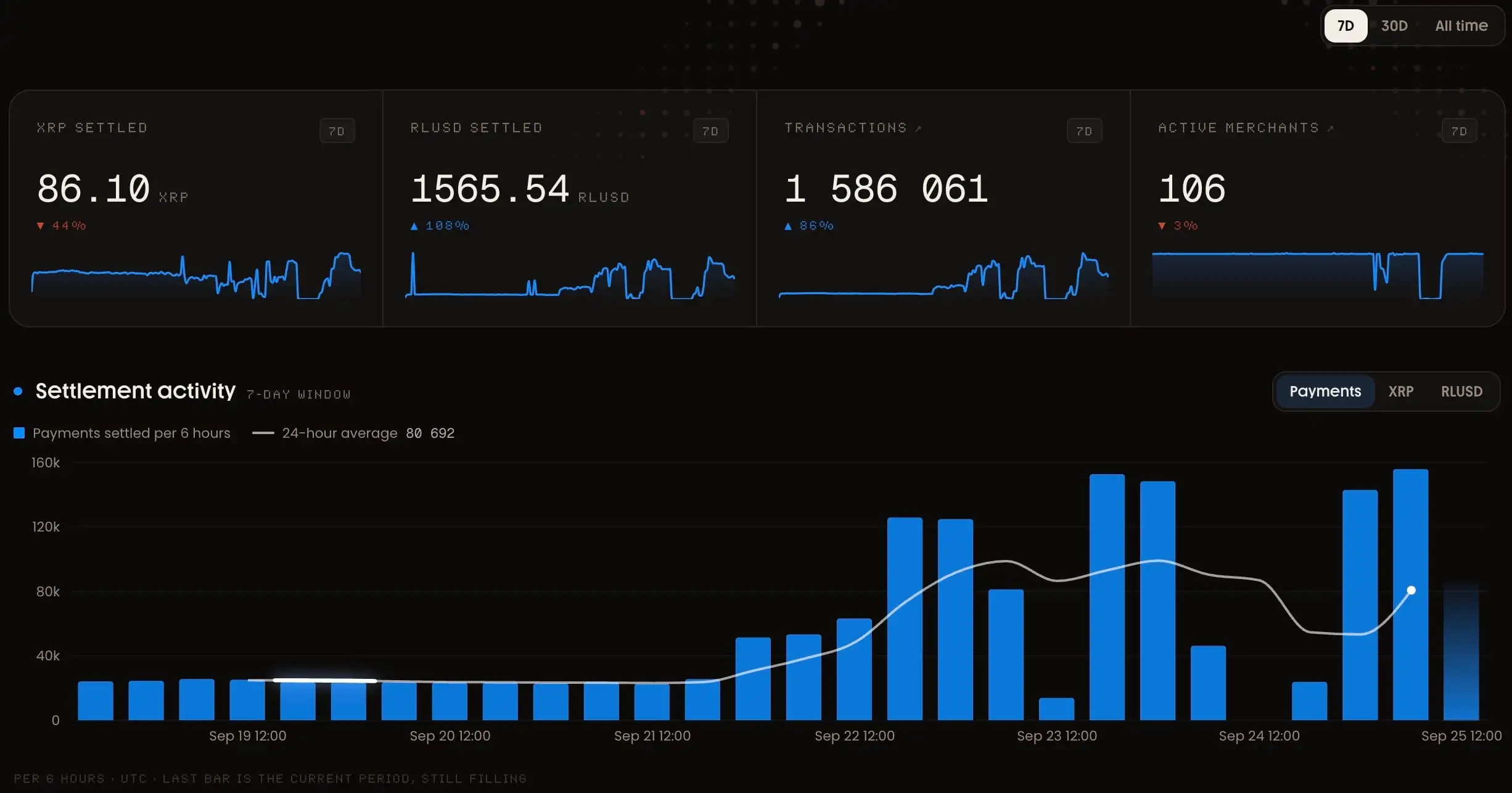
Autonomous AI agents using $XRP Ledger infrastructure for around-the-clock settlements have begun to favor regulated stablecoins over native crypto assets on a large scale, according to XRPL AI Hub data.  According to on-chain payment activity data, an analysis of all-time highs and the 30-day trend in direct clearing settlements shows the sustained dominance of Ripples stablecoin, while transaction volumes in the networks native cryptocurrency, $XRP, have stagnated over the past week.  BlackRocks new forecast: AI agents will build the economy of the future  This trend highlights the relevance of BlackRocks research note, “The Machine-Native Economy.” The financial giant points to a tectonic shift: the traditional banking system, tied to human schedules, is technically unable to handle millisecond micropayments made by autonomous software.  According to BlackRock, the global stablecoin market has already surpassed $300 billion, while its annual transaction volume of $11.6 trillion has turned this asset class into a basic unit of account for AI. This circulating liquidity allows machine networks to reliably run high-frequency micropayments without causing friction or systemic blockages.  Rising demand for stablecoin clearing on $XRP Ledger over a 7-day period, Source: XRPL AI Hub Dashboard  Robots need to purchase computing power around the clock and pay for API access, making tokenized GPUs

1 ہفتوں کے اندر

Fed Moves to Tighten Stablecoin Rules With Two New GENIUS Act Proposals

The Federal Reserve has proposed two rules to help establish oversight for stablecoin issuers under the Guiding and Establishing National Innovation for US Stablecoins ($GENIUS) Act.  The proposals were announced by the central bank on Thursday and opened for public comment.  Stricter Stablecoin Oversight  The first proposal would require payment stablecoin issuers supervised by the Fed to fully back their tokens with approved reserve assets. These include short-term US Treasury bills and other high-quality liquid assets. The proposal also sets capital requirements for credit and operational risks. It would add risk management standards for stablecoin activities.  The institution also proposed rules for firms that hold assets backing stablecoins. The rules would clarify which stablecoin activities are allowed for banks supervised by the Fed. The second proposal, meanwhile, focuses on applications from supervised banks seeking to issue payment stablecoins. Banks would need to provide business plans, financial information, and other documents. The proposal also covers appeals and hearings for applications.  The public comment period will close 60 days after the proposals are published in the Federal Register. Fed Governor Michael Barr said stablecoins can only remain stable if users can quickly redeem them at full value. This should hold even during market stress or when the

1 ہفتوں کے اندر

Polygon price rises 12% since 100M POL burn—can it hold above $0.11?

Polygons POL token has gained nearly 12%since the network permanently removed 100 million tokensfrom circulation on September 23.  The price has climbed to around $0.113, but its next challenge is holding above the $0.11price level and overcoming resistance near the $0.115price area.  Polygon permanently removes 100M POL  Polygon Foundation CEO Sandeep Nailwal confirmed that the network had completed the burn, which removed about 1% of POLs total supply.  The on-chain transaction shows that 100 million POL, worth around $10.22 millionat the time, was destroyed on September 23.  When there is a burn, it permanently removes crypto from circulation. The idea is that if the available supply is reduced, the remaining tokens will become more scarce, but this is if demand is steady or increases.  The tokens that were burned were from network fees that had accumulated inside Polygons fee-collection system.  The burn also introduces a process that allows the community to trigger future fee-funded burns. This connects the amount removed from circulation more closely to activity on the Polygon network.  POL approaches an important price barrier  POL was trading near the $0.113price area at the time of this writing. It was up by about 11.6%from its level around the burn date.  It briefly reached the $0.11497 price area during the

1 ہفتوں کے اندرانڈسٹری

Brazil targets self-custody crypto with $10K reporting rule, 24-hour transfer delay

Brazil crypto rules are set to get tougher in Q4 2025 and get even stricter from next year.  The Central Bank of Brazils order this week formally expands reporting requirements for crypto transfers above $10K across self-custody wallets.  Here, its worth noting that the new reporting regime is not strictly on crypto transfers. Any payments or funds transfers via foreign exchange or local cash above R$50,000.00 (about $10K) must be reported.  In the statement, the Central Bank of Brazil said the move is aimed at “preventing the use of the financial system for money laundering, concealment of assets or financing of terrorism.” The rule will be effective from 1st October.  However, the scrutiny over crypto assets has intensified.  Brazil imposes 24-hour delay for crypto transfers  Last month, Brazil imposed a mandatory 24-hour delay for crypto transfers. According to the countrys central bank, the move is aimed at minimizing harm to victims of fraud, while also helping law enforcement rein in anti-money laundering (AML) or illicit flows.  It argued that the instant settlement nature of crypto transfers makes it challenging to catch fraudsters and block illicit flows in time. The rule will go into effect in January 2027.  The surprising part, however, is the countrys plan to integrate with

1 ہفتوں کے اندرانڈسٹری
1
...
5355
...
1000