Citi × Coinbase: Stablecoin Payments Become Invisible Banking Infrastructure

Stablecoins are becoming more useful by becoming less visible.  Citi and Coinbase expanded their payments partnership on September 28 with two connected products that blur the boundary between a bank account and a stablecoin wallet.  First, Coinbase is using Citis Virtual Account Wallet infrastructure to power Coinbase Virtual Accounts. Businesses can accept, hold and pay fiat through an account-like interface, while incoming fiat can be automatically converted into stablecoins underneath.  Second, Citis institutional clients can accept stablecoin payments through Spring by Citi. The merchant does not need to hold or manage the stablecoin. Coinbase handles the digital-asset payment rail and converts the stablecoin into fiat, while Citi settles the fiat as the bank of record.  This is more important than another merchant announcing “crypto payments.” It shows how stablecoins can enter mainstream finance without requiring the end user to behave like a crypto user.The User Interface Is Becoming Currency-Agnostic  Most businesses do not want to manage two treasury systems — one for fiat and another for stablecoins. They want money to arrive, move and settle.  The Citi-Coinbase model abstracts the asset type. A Coinbase customer can receive fiat into a virtual account and automatically convert it into stablecoins. A Citi merchant can receive a stablecoin payment


4 گھنٹے پہلےانڈسٹری ریسرچ

Chainlink CCIP 2.0: Why Cross-Chain Security Is Becoming Configurable Infrastructure

Cross-chain infrastructure is moving away from a simple question — “which bridge is secure?” — toward a more complicated one: who gets to define the security model for each transfer?  Chainlink launched CCIP 2.0 on September 28 with a new architecture aimed at institutions, asset issuers and applications that want more control over how cross-chain transactions are verified, screened and finalized.  The most important new feature is the Cross-Chain Verifier, or CCV. CCIP already uses a default Committee Verifier made up of 16 independent node operators. CCIP 2.0 lets an issuer or application add another verification layer on top of that default network. An institution can operate its own CCV or select an independent third-party verifier, and a destination-chain transaction can be configured so that both the default verifier and additional CCV must sign before execution.  That changes the responsibility model for bridges.Cross-Chain Security Is Becoming Additive  Many bridge designs force users into one security assumption. The bridge has one validator set, signer group or message-verification system. If that layer fails, every application using the bridge inherits the failure.  CCIP 2.0 takes a layered approach: base verification + application-defined verification. The security improvement depends on genuine independence. Two verifiers hosted on the same infrastructure, operated

4 گھنٹے پہلےانڈسٹری ریسرچ

Bitget resumes Bitcoin withdrawals as hacker swaps ETH via THORChain

Crypto exchange Bitget is resuming withdrawals after a security breach affecting nearly $388 million in assets, as the attacker continues moving stolen crypto through THORChain.  Bitget said it resumed Bitcoin (BTC) withdrawals Monday after suspending them following last weeks security incident, with additional assets and networks set to follow over the coming days.  The Sept. 24 breach compromised part of Bitgets hot and warm wallet infrastructure, while its cold wallets remained secure, according to the exchange.  Bitget later revised the stolen amount from $351.6 million to $387.5 million after accounting for additional transfers on Zcash and Tron.  Ether and USDT withdrawals next as security checks progress  BTC withdrawals on the Bitcoin network and the BNB Smart Chain resumed first, Bitget CEO Gracy Chen said during a Monday ask-me-anything session.  “We restored BTC first because the withdrawal pipeline is the first to be completed,” Chen said, adding that Ether (ETH) and Tethers USDt (USDT) would follow as security checks progress.  Related: Bitget clarifies $388M in assets affected by security breach  Under Bitgets announced schedule, ETH withdrawals are set to resume Tuesday across Ethereum, BNB Smart Chain, Arbitrum, Base and Optimism, followed by USDT on Wednesday across Ethereum, BNB Smart Chain, Solana and Tron. Withdrawals for other assets and peer-to-peer

14 گھنٹے پہلےانڈسٹری

Bitget CEO says $388M hack exploited third-party security vulnerability

Bitget CEO Gracy Chen said the crypto exchanges recent $388 million exploit stemmed from a vulnerability in a third-party security product that allowed the attacker to obtain “high-level internal credentials.”  In comments to Cointelegraph, Chen said the attacker used those credentials to issue fraudulent withdrawal commands. Bitgets private keys were not compromised, and its cold wallets were not affected, she said.  Bitget said it has since addressed the security flaw and tightened its withdrawal controls, including restricting internal access, adding independent verification for withdrawals and increasing monitoring for unusual activity.  The attack occurred on Sept. 24, when Bitget detected unauthorized transfers from several of its hot wallets and temporarily suspended withdrawals. The exchange initially estimated that about $352 million in assets had been affected.  Related: Bitget resumes Bitcoin withdrawals as hacker swaps ETH via THORChain  Bitget has yet to disclose recovery figures  The exchange has not disclosed how much of the stolen crypto has been recovered or frozen. Chen said some assets have been frozen with help from other industry participants, but Bitget would release a total only after verifying the amounts.  Bitget had previously called on THORChain, a protocol for swapping assets between blockchains, to refuse services to addresses linked to the attack.  The exchange said it

14 گھنٹے پہلےانڈسٹری

Analyst Links 53 Robinhood Chain Tokens to One $18.4M Rug-Pull Ring

A single operation may have extracted at least $18.43 million from 53 memecoin launches on Robinhood Chain in just over two months, according to an onchain investigation by pseudonymous analyst Wazz.  The alleged activity ran from July 10 through Sept. 21 and largely centered on Pons V2, a token launchpad on Robinhood Chain. Wazz linked the launches through wallet-funding patterns, shared collector addresses and, in several cases, private keys used across multiple launches.  How the Alleged Scheme Worked  Pons V2 normally imposes a 99% anti-sniping tax on purchases made immediately after a token launches, with the tax quickly falling toward zero.  However, creators can exempt selected addresses from that mechanism.  Onchain records reviewed by The Block showed creators of nine launches from late August onward exempting groups of roughly 15 to 25 wallets. Within seconds, bundled transactions bought most of each tokens available supply.  The creator and exempt wallets ultimately controlled between 82% and 86% of supply in those launches.Linked token launches53Estimated extraction$18.43M+Operation periodJuly 10–Sept. 21Wallets used per launchUp to 70–200Supply captured in reviewed launchesUp to 86%  The largest alleged extraction was CRUMBS at $3.12 million, followed by LEGS at $2.9 million and PINK at $1.44 million.  Robinhood Chains Memecoin Boom Faces a New Test  The allegations arrive during

14 گھنٹے پہلےانڈسٹری

OKX US to sell USD trading bot positions if users miss Sept 30 deadline

OKX US plans to cancel open orders and trading bots left on affected dollar trading pairs when it retires those order books on Sept. 30. Positions in Grid and Smart Portfolio bots on the affected pairs will also be sold, the exchange says, making inaction potentially costly for traders using those strategies.  According to the US customer notice, the corresponding USDC pairs have been available alongside the affected USD pairs since Sept. 23. Traders have until the migration to cancel open USD-pair orders, stop those bots and recreate them on the USDC pairs. Orders and bots created on the replacement pairs during the parallel window will keep running afterward.  What the deadline changes  OKX US says the old books will be retired between 3 and 4 a.m. Eastern time on Sept. 30, equivalent to 7 to 8 a.m. UTC. All remaining orders and bots or automated trades on affected USD pairs will be canceled. OKXs migration schedule says bots using those pairs may close gradually over that hour and the relevant USD pairs will be delisted at 8 a.m. UTC.  Related Asset USDC USDC · Stablecoin  The cancellation has different consequences for the positions behind different bots. OKX says it will sell positions in Grid

15 گھنٹے پہلےانڈسٹری

Tether and Shiga plan self-custodial wallets for Africa and the GCC

Tether and Shiga have announced plans to bring self-custodial wallets for USD₮, Bitcoin, and Tether Gold to individuals and institutions across Africa and the Gulf Cooperation Council.  Tether said in its Sep. 28 announcement that both products will use its open-source Wallet Development Kit, or WDK. Shiga will offer one product directly to users and another to institutions building payment and treasury services for their customers.  The plan extends a relationship that began with Tether‘s investment in Shiga Digital in June 2025. At the time, crypto.news covered the investment and Shiga’s existing services for African businesses, including virtual accounts, foreign exchange, treasury management and over-the-counter transactions.  Shigas ENTA will put three assets in user-controlled wallets  Under the new plan, ENTA will serve individuals, high-net-worth users and businesses. Tether said customers will be able to add funds using local currency, U.S. dollars, or Bitcoin, then hold and transfer USD₮, Bitcoin and XAU₮ from self-custodial wallets.  The funding options and the assets held in the wallet serve different roles. A customer adding local currency, for example, would use it to fund access to the supported digital assets; the announcement does not say that ENTA will hold local currency as a wallet asset. Tether also did not give

15 گھنٹے پہلےانڈسٹری

Bitget had 30 minutes to contain its hack before $290 million started moving

Bitget detected unauthorized wallet transfers about 30 minutes before attackers began draining hundreds of millions of dollars from the crypto exchange, raising questions about why its security response failed to contain the breach.  Related Company Bitget Trading platform for crypto products  The exchange said its systems flagged unauthorized transfers at 18:31 UTC on Sept. 24 and that its security team immediately activated emergency protocols.  However, blockchain security firm Hypernatives reconstruction of the attack shows that most losses came later: $87.6 million left hot wallets at 19:01, and another $202.8 million left warm wallets at 19:16.  Those two bursts, completed in a combined 24 seconds, accounted for about three-quarters of the $387.5 million Bitget ultimately said was moved to attacker-controlled addresses.  The sequence suggests Bitget had roughly half an hour after its initial alert to prevent the first major wave and about 45 minutes before the largest transfer burst. It also shifts scrutiny from how the attacker first gained access to how the exchange responded once its own systems indicated something was wrong.  Hypernative said the attacker initially tested the compromised route at 18:31 with transfers of 0.84 ETH and 93 TRX to new addresses. After waiting about 28 minutes, the attacker moved $34.75 million of USDT

16 گھنٹے پہلےانڈسٹری

Bitcoin ETFs Pull $2.39 Billion in Best Week Since October 2025

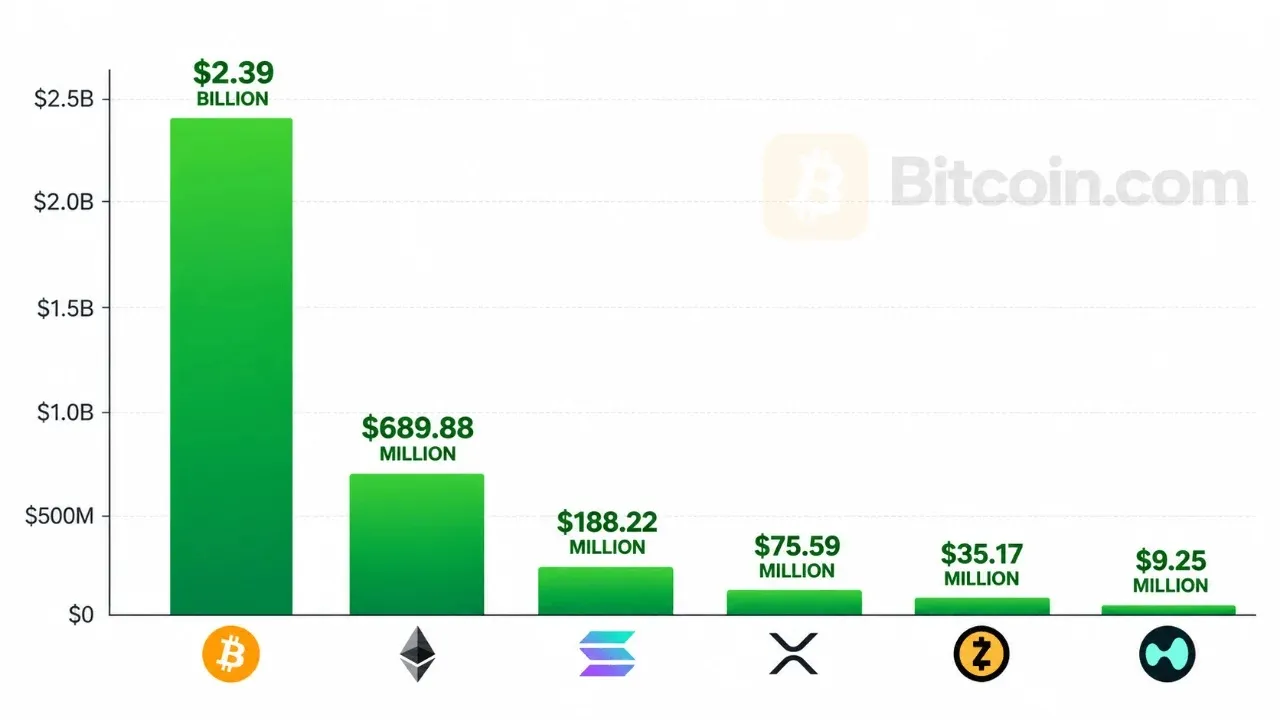
U.S. crypto ETFs delivered a powerful week of inflows for the week ending Sept. 25, led by $2.39 billion entering bitcoin funds. Ether funds attracted $689.88 million, while solana, XRP, zcash and HYPE ETFs all finished the week with net gains.  Key TakeawaysBitcoin ETFs drew $2.39B from Sept. 21-25, their strongest week since Oct. 2025.Blackrock led as ether, solana, XRP, zcash, and HYPE also gained, broadening crypto demand.This week, markets will test whether ETF buying holds if bitcoin consolidates and macro pressure returns.  Blackrock, Fidelity Drive $1.86B Into Bitcoin ETFs in One Week  The remarkable part of last weeks bitcoin ETF rally was its persistence.  Capital entered the funds every trading day, even as bitcoins price retreated from around $87,000 later in the week. Investors added exposure through the pullback, turning five consecutive sessions into the strongest weekly bitcoin ETF inflow since October 2025.  Monday set the pace with $998.95 million, the largest single-day bitcoin ETF inflow of 2026 and the ninth-largest on record. On Tuesday, investors added $714.75 million. The pace cooled after that without breaking. Wednesday brought $346.98 million, Thursday added $190.65 million, and Friday finished with another $134.47 million pumped into bitcoin funds.  Blackrock‘s IBIT dominated the weekly tally with $1.16 billion, while

16 گھنٹے پہلےانڈسٹری

Why BingX strategy chief Kevin Lee says traders want 'The Whole Board'

Markets stopped behaving like separate worlds a while ago. A Federal Reserve decision can move Bitcoin, gold, the Nasdaq and the dollar within hours. A geopolitical shock can hit oil before spilling into currencies, equities and crypto. Traders may start with one view of the market, then find that the opportunity appears somewhere else entirely.  SummaryBingX strategy chief Kevin Lee says traders increasingly want to act on opportunities across crypto and traditional markets from one account.BingX now offers more than 500 instruments across stocks, indices, commodities and forex alongside its crypto markets.Lee says unified capital, liquidity and execution matter more than simply adding more assets to an exchange.Traditional asset perpetuals can reduce account fragmentation, but derivatives, leverage and extended trading hours introduce their own risks.  Kevin Lee argues that trading platforms are still catching up. The recently appointed Chief Strategy Officer at BingX spent more than 15 years working with exchanges in traditional finance before taking on his current role. Lees argument goes beyond instrument count.  “The move was never opportunistic,” he said. “It was structural.”  One macro view, multiple markets  Bitcoin still has its own market dynamics. Lees point is that it now reacts more like a high-beta risk asset, especially when macro conditions

16 گھنٹے پہلےانڈسٹری
1345
...
1000