Introduction: The Two Faces of a “Degen-Only” Exchange
In the previous 31 editions, we investigated a series of exchanges ranging from HashKey to CoinW. For the 32nd edition, we are looking at one with perhaps the “youngest” image of them all — Ourbit.
Its résumé is certainly impressive when it comes to attracting younger traders: “Founded in 2020,” “built by the former core MEXC team,” “registered in the BVI,” “1:1 Proof of Reserves (PoR),” “Hacken penetration testing + SlowMist partnership,” “zero spot trading fees permanently,” “No. 1 meme-coin liquidity across the entire market,” “meme projects including SPX6900, Retardio, and HarryPotterObamaSonic10Inu,” “backed by Lil Pump and Iggy Azalea,” “No. 27 in spot trading and No. 20 in derivatives on CoinMarketCap,” and a “CoinGecko Trust Score of 8/10.”
Sounds like a paradise for degen traders, right?
But there is another side.
In a judgment issued in December 2025 by the Dashiqiao People's Court in Liaoning Province, 34 people were sentenced in a criminal case involving a fraud ring that operated under the name “OURBIT Digital Currency Trading Platform.” The group allegedly claimed that it was “registered in Singapore” and “held financial licenses in the UK and the US,” fabricated K-line charts based on Bitcoin prices, and induced nearly 30,000 people to invest, involving approximately RMB 460 million.
In July 2026, the Suzhou Dongwu Securities Investor Education Base listed Ourbit as a typical virtual-currency fraud case.
Also in July 2026, a user publicly disclosed that after depositing 100,000 USDT into Ourbit and trading normally, withdrawals were disabled and the account was locked. The withdrawal review was reportedly postponed until July 3, 2027.
WikiBit's rating for Ourbit is only 4.96/10, with the platform marked as having “no valid crypto regulation” and its claimed Singapore MAS regulatory status unverified. One WikiBit user review states: “Its completely a scam. You can get in, but you will never get any money back.”
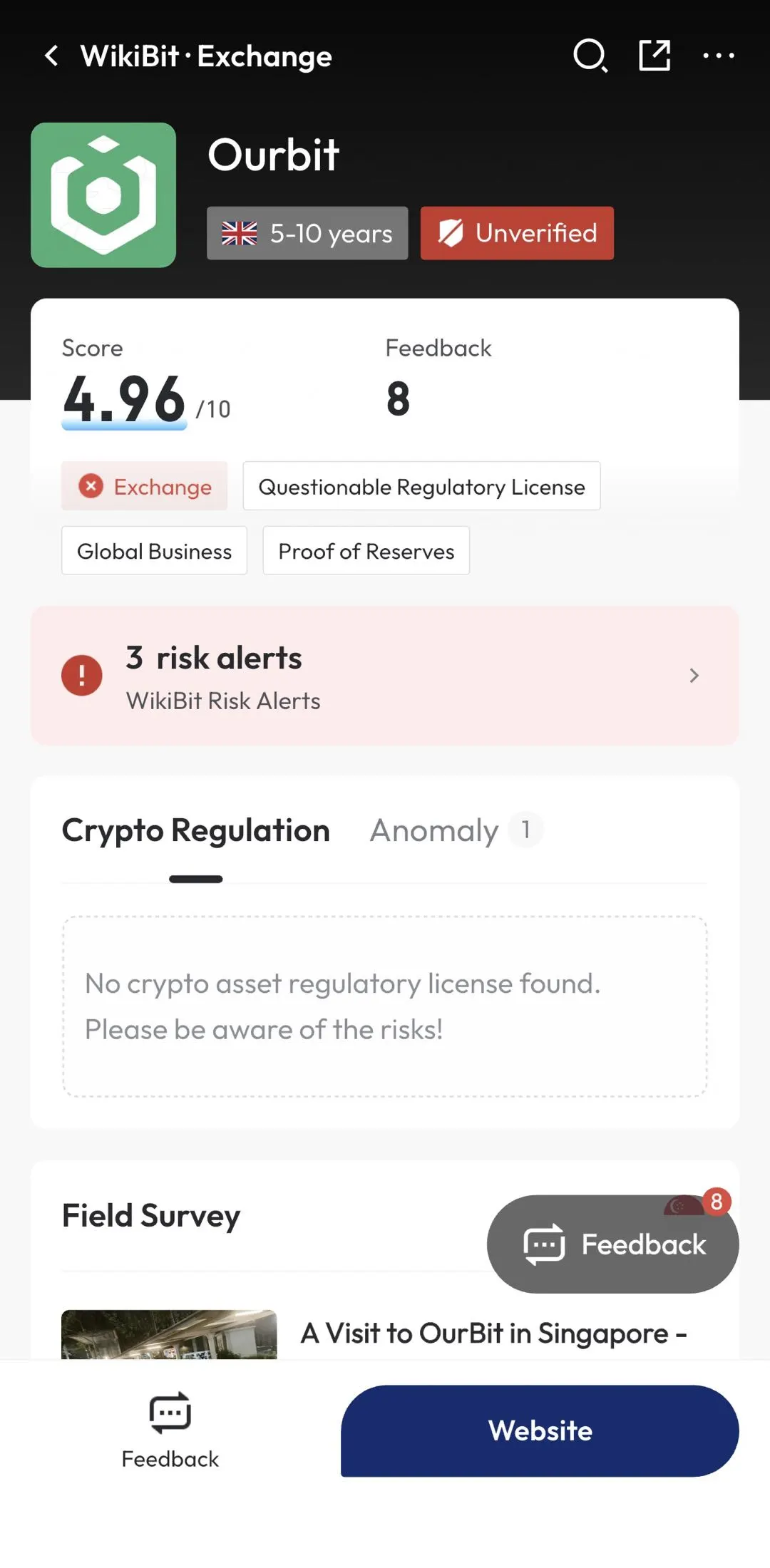
An exchange named in a Chinese court judgment, listed as a fraud case by an investor education institution, and facing a publicly reported withdrawal review delayed until 2027 — should users trust its “degen paradise” image, or the court judgment?
Let's break it down layer by layer.
1. Regulatory Compliance: Offshore Registration, No Valid Crypto License, and Very Limited Regulatory Protection
Regulatory compliance is currently one of Ourbit's biggest weaknesses.
Ourbit's operating entity is registered in the British Virgin Islands (BVI), a typical offshore jurisdiction. The platform publicly promotes its compliance with AML standards, but it has not obtained cryptocurrency operating licenses from major financial jurisdictions such as Singapore's MAS, the UK's FCA, or the US CFTC.
According to WikiBit's on-site inspection information, the Singapore office address claimed by Ourbit does not appear to correspond to an actual operating entity, suggesting that the platform operates as an offshore entity without a verifiable physical operating presence.
For ordinary users, offshore registration can mean that when asset disputes arise, there may be limited access to a local financial regulator for complaints or dispute resolution. The platform may also have greater flexibility to modify its rules, while users may have fewer legal protections.
The platform supports low-KYC and, in some cases, no-KYC trading. Against the backdrop of tightening global cryptocurrency regulation, this creates a potential risk of access restrictions in certain jurisdictions.
UK FCA: Public Warning Already Issued
On May 14, 2026, the UK's Financial Conduct Authority (FCA) issued a warning concerning “Ourbit / www.ourbit.com.”
The warning stated clearly that Ourbit was not authorized by the FCA and might be providing or promoting financial services in the UK without authorization. Users dealing with the platform would not have access to the protection of the Financial Ombudsman Service, nor would they benefit from the relevant protections under the Financial Services Compensation Scheme (FSCS).
One point must be emphasized:
An FCA warning does not mean that the FCA has determined that Ourbit is a scam.
The core issue identified by the FCA is the provision or promotion of financial services without authorization. Nevertheless, for exchange users, this remains an important risk signal.
Because the most important question about an exchange is not whether its app is easy to use. It is:
Who is responsible when something goes wrong?
If a platform does not have authorization from the local financial regulator, users will generally have significantly weaker legal protections than they would with a regulated exchange.
Taiwan Regulators Also Issued a Warning
On May 8, 2026, the Taiwan Virtual Asset Service Association issued a warning concerning Ourbit.
Public information indicates that Ourbit had not completed the relevant local AML registration requirements for virtual-asset service providers and therefore could not provide virtual-asset services or solicit customers through advertising within Taiwan.
Taiwanese authorities also advised the public to refuse related services and avoid transferring funds to accounts provided by the platform.
This highlights a broader issue:
Ourbit's global expansion may be moving faster than its regulatory authorization in individual jurisdictions.
For an exchange, this creates a typical regulatory expansion risk. A platform can enter 100 countries relatively quickly, but it cannot obtain 100 licenses in 100 countries simultaneously.
In addition, Ourbit's own user agreement states that it does not provide services to entities appearing on the US Treasury's SDN list, EU financial sanctions lists, or UK sanctions lists.
However, an important distinction remains:
A platform's own statement that it complies with sanctions lists does not mean that it holds a financial regulatory license.
Registered in the BVI: Another Offshore Jurisdiction
Ourbit's operating entity is Ourbit Holdings Ltd., registered in the British Virgin Islands (BVI).
What is the BVI?
It is one of the world's well-known offshore incorporation jurisdictions, where company registration can be relatively straightforward and regulatory oversight of offshore entities can differ substantially from that of major financial centers.
We have encountered this structure repeatedly in the previous 31 editions — UZX, Azbit, FameEX, MGBX, and others.
Risk Rating: Extremely High
The FCA has issued a public warning.
Taiwanese authorities have issued a warning.
The platform has a broad global operating footprint, while publicly verifiable top-tier regulatory licenses appear limited.
There are some discrepancies between publicly available information concerning its legal entity and registration details.
The extent of legal protection available to users remains unclear.
2. Account Security and Withdrawals: 100,000 USDT Frozen, Review Delayed Until 2027
“Deposited 100,000 USDT, Withdrawals Disabled, Review Pushed Back to 2027”
On July 28, 2026, crypto user @HowardLouisHL publicly disclosed his experience, which was subsequently reported by ChainCatcher and several other media outlets.
On June 30, 2026, the user deposited 100,000 USDT into Ourbit and conducted normal trading for approximately one week. On July 4, he attempted to withdraw the funds to Binance, but the system blocked the withdrawal. Customer service only replied that the account had “triggered risk controls” without providing a specific reason. The following day, the user's account was restricted from logging in.
After being required to submit all identity and account-related documents, the user received an official email from Ourbit on July 20 stating that the review had been postponed until July 3, 2027, while also stating that the review “may be extended again without reason.”
In plain English:
The user deposited 100,000 USDT, traded normally for a week, and then tried to withdraw — only to have the withdrawal blocked. The account was locked. After submitting all the requested documents, the user was told to wait until July 2027 for the review, with the possibility that it could be extended again without explanation.
“490 USDT Trapped for a Month”
One WikiBit user review states:
“They blocked the account on the first day, and 490 USDT was trapped for a month. Support claimed it was because of risk. I do not recommend them. They are scammers!!!”
An account allegedly being blocked on the first day raises a basic question about the platform's withdrawal controls and account-review procedures.
“Unable to Withdraw, With Various Reasons Used to Extract More Money”
Another WikiBit user wrote:
“I was unable to withdraw funds from Ourbit, and they used various reasons to extract money, such as money laundering, account freezing, margin requirements, manual withdrawal fees, etc. This platform is a scam. Stay away.”
“Money laundering,” “account freezing,” “margin requirements,” and “manual withdrawal fees” — four different types of alleged charges.
Similar allegations have appeared in complaints involving platforms such as KCEX, BVOX, and Deepcoin.
“Its Completely a Scam. You Can Never Get Any Money Back”
Taken together, the complaints point to a recurring alleged “freeze-and-review” pattern:
The user deposits funds and trades normally.
When the user requests a withdrawal, the platform cites “risk control” and freezes the account.
The user's account access is restricted.
After the user submits the requested documents, the review is postponed indefinitely — in the reported case, until 2027.
Customer service allegedly states that the review may be extended again without explanation.
This goes beyond a simple complaint about a poor withdrawal experience.
The key risk is whether users can actually access their assets when they need to withdraw them.
Risk Rating: Extremely High
3. Proof-of-Reserves Transparency: 1:1 PoR + Merkle Tree, but “Frozen Funds” Raise a Different Question
Official Data: 1:1 Reserves + Merkle Tree + Open-Source Verification
To its credit, Ourbit has implemented a relatively detailed Proof-of-Reserves (PoR) system.
According to Ourbit's official PoR page, the platform maintains 1:1 reserves for all user assets held in spot and derivatives accounts, covering USDT, USDC, BTC, and ETH.
It also uses a Merkle Tree + open-source verification system, allowing users to independently verify whether their assets were included in the platform's reserve snapshot.
Users can click “View My Proof of Assets” on the PoR page, download the Merkle-path data file merkel_tree_ourbit.json, and use Ourbit's official open-source verification tool to perform their own verification.
The platform also publicly discloses reserve wallet addresses, balances, and block heights on its PoR page, allowing users to check the relevant on-chain information.
But where is the problem?
First: PoR Is a “Snapshot,” Not the Same as an Independent Audit
Ourbit's PoR operates through a model in which the platform publishes the reserve data and users can independently verify it.
There is no signature from an independent third-party auditing firm confirming the entire system.
“Verifiable” does not automatically mean “independently audited.”
A Merkle-tree-based PoR can demonstrate that certain assets were included in a particular snapshot, but it does not by itself provide the same assurance as a comprehensive independent financial audit.
Second: 1:1 Reserves and 100,000 USDT Frozen Are Not Contradictory
These two things can theoretically exist at the same time.
An exchange can have 100% reserve coverage while some users are unable to withdraw their funds — if the platform restricts withdrawals.
The reported 100,000-USDT account being frozen and the review being postponed until 2027 therefore raises a different issue.
A 1:1 PoR demonstrates asset coverage at a given point in time. It does not, by itself, prove that every user can withdraw those assets whenever they request.
In other words:
PoR answers “Are the assets there?”
It does not necessarily answer:
“Can I withdraw them right now?”
Third: Certain Wealth-Management and Locked-Earning Assets Are Excluded from PoR
Ourbit's 1:1 reserve disclosure explicitly excludes assets held in certain wealth-management and locked earning products from its PoR calculations.
In other words, assets held in spot and derivatives trading accounts are included in the reserve verification, while assets placed into certain wealth-management or locked-yield products are outside the scope of the publicly disclosed PoR.
Therefore, users should not automatically interpret the platform's “1:1 reserves” claim as meaning that every asset deposited anywhere on the platform is covered by the publicly disclosed reserve proof.
Third-Party Security Assessment Also Raises Questions
Meanwhile, the third-party security platform CER.live reportedly assigns Ourbit a DD security rating, with relatively low scores for its overall security infrastructure.
Ourbit also does not appear to have a publicly disclosed, continuously operated bug-bounty program. Some security audits are promoted as part of the platform's external partnerships, while complete audit reports are not necessarily publicly available for independent review.
Risk Rating: Medium-High
Compared with exchanges that provide no proof-of-reserves mechanism at all, Ourbit has made some progress in reserve transparency.
However, its PoR has clearly defined limitations: certain wealth-management and locked-earning assets are excluded from the publicly disclosed reserve calculation, and PoR is not equivalent to an independent financial audit.
Therefore, users should not interpret the platform's marketing phrase “100% backed” as meaning that all assets are automatically covered by publicly verifiable reserves or immediately withdrawable at any time.
4. Asset Strength: Considerable Reported Scale, but Underlying Strength Remains Unclear and Institutional Backing Is Limited
Impressive Headline Numbers
CoinMarketCap spot ranking: No. 27
CoinMarketCap derivatives ranking: No. 20
24-hour spot trading volume: More than $1 billion
Users: More than 1 million across 100+ countries and regions
Listed assets: 800+ crypto assets + 90+ traditional assets
Platform assets: Approximately $162 million
However, these figures do not necessarily tell the whole story.
First: CoinPaprika Confidence Score Is Only 74.98%
For an exchange ranked within the top 30 on CoinMarketCap, a CoinPaprika confidence score of only 74.98% is relatively low.
This suggests that, from the perspective of a professional market-data platform, there are questions surrounding the quality and reliability of Ourbit's reported trading-volume data.
Second: “No. 1 Meme-Coin Liquidity Across the Entire Market” Is a Self-Claim
The statement that Ourbit has the “No. 1 meme-coin liquidity in the entire market” is a claim made by the platform itself and does not appear to have been independently verified.
Moreover, meme coins are inherently a highly volatile and high-risk asset class. An exchange that makes meme coins a core selling point exposes its users to a market environment that can be considerably more volatile than one centered on major cryptocurrencies.
Third: Limited Public Evidence of Institutional Capital Backing
There are no publicly disclosed investment records showing major venture-capital firms or large institutional investors holding stakes in Ourbit, nor is there a major institutional backer publicly positioned as a source of financial support.
There is also no publicly disclosed proprietary fund or dedicated insurance/risk reserve pool.
If a large-scale run on the platform or a major hacking incident were to occur, the absence of clearly disclosed external insurance or institutional capital buffers could leave users bearing a significant portion of the potential loss.
Risk Rating: Medium-High
The headline numbers look impressive, but the platform has limited publicly disclosed institutional backing, leaving its underlying ability to withstand major financial stress difficult to independently assess.
5. Internal Operations and Team: Former MEXC Core Team, but Limited Public Information About the Founders
Team Background: Former MEXC Core Team
One of Ourbit's most prominent selling points is that it was “built by the former core team of MEXC.”
According to an evaluation article targeting Taiwanese users, Ourbit was established by members of the former core team of MEXC, while operating independently and having no equity relationship with MEXC.
The article noted that the “core team came from the same group of people” and that its product strategy was also similar. MEXC itself previously gained attention through strategies such as zero trading fees and rapid token listings.
But where are the problems?
First: Limited Disclosure of the Core Management Team
The name Joseph Han appears in Ourbit's official website and external promotional materials.
However, detailed biographies, previous professional experience, and verified identities of most core team members have not been publicly disclosed in significant detail.
Second: Aggressive Marketing and Customer Acquisition
Ourbit has engaged heavily in KOL and community marketing, promoting features such as zero-fee spot trading, high-yield financial products, and rapid listings of large numbers of speculative meme coins.
The platform has also organized numerous trading campaigns and prize-pool promotions, using incentives to attract users.
However, the platform's underlying operating cash flow and financial sustainability cannot be independently verified from publicly available information.
Third: Who Are the Other Key Team Members?
Beyond the relatively vague description of a “former MEXC core team,” Ourbit's core management team remains largely invisible in the public domain.
There is limited publicly disclosed information concerning key positions such as a CTO, COO, or dedicated compliance officer.
Fourth: Poor Customer-Service Reputation
A significant number of complaints claim that customer support mainly provides standardized risk-control responses, while users facing asset freezes have difficulty obtaining substantive explanations or effective resolutions.
In some reported cases, the resolution process is allegedly prolonged for an extended period.
Risk Rating: Medium
6. Product Experience and Trading Depth: Feature-Rich, but Withdrawals Remain the Critical Issue
Product Lines
Ourbit offers a relatively broad range of products:
Spot trading: 800+ crypto assets, with zero trading fees
Derivatives: USDT-margined perpetual contracts
Tokenized stocks, ETFs, commodities, and foreign exchange
Super IPO
Prediction markets
Permanent zero-fee spot trading
On paper, the product range is extensive.
But the Most Serious Issue Is Withdrawal Access
First, withdrawals are the biggest concern.
“100,000 USDT frozen with review delayed until 2027,” “490 USDT trapped for a month,” and “unable to withdraw” are all serious allegations.
Second, liquidity is acceptable for major cryptocurrencies, but many newly listed small-cap meme coins have wider bid-ask spreads and thinner order books.
This can increase the risk of price spikes, large slippage, and execution at prices significantly different from expectations.
Third, a meme-coin-focused strategy inherently involves higher market risk.
One of Ourbit's core selling points is its claimed “No. 1 meme-coin liquidity.” But meme coins can experience extreme price volatility, and users trading heavily in this segment face substantially higher market risk than users primarily trading major cryptocurrencies.
The platform offers a wide variety of speculative products, which may appeal to traders seeking short-term opportunities, but small-cap token trading itself carries substantial liquidity and volatility risks.
Risk Rating: High
7. Community Feedback: Highly Polarized, With Withdrawal-Freeze Complaints at the Center
Rating Distribution
WikiBit: 4.96/10, with the platform marked as having “no valid crypto regulation”; its claimed Singapore MAS regulatory status has not been verified.
CoinPaprika Confidence Score: 74.98%
Trustpilot: 2.0/5, with 67% of reviews rated one star
Community sentiment appears highly polarized.
Positive Feedback
A significant number of ordinary users report that when their accounts do not trigger risk controls, trading and small withdrawals can be completed normally.
Users also cite:
Zero trading fees, which reduce transaction costs
A large number of newly listed tokens
Frequent promotional campaigns and attractive rewards
Negative Feedback
Across crypto communities and WikiBit's complaint section, recurring complaints include:
Accounts being frozen by risk controls without sufficient explanation, involving both small and large balances
Reviews allegedly being extended indefinitely
Slow customer-service responses
Limited channels for resolving disputes after assets become inaccessible
High-yield financial products being promoted even though certain financial-product assets are outside the scope of the publicly disclosed PoR
Occasional WikiBit dispute posts concerning abnormal derivatives-account activity and unexpected liquidations
Objectively speaking, not every user will necessarily experience an account freeze.
However, when risk controls are triggered, users may find themselves in a highly passive position, particularly if there is no clearly defined and rapid appeal process.
For a centralized exchange, the ability to resolve account restrictions and restore access to legitimate funds is an important operational risk factor.
Negative User Reviews Focus on the Most Critical Issue: Withdrawals
One user wrote:
“I am a user of Ourbit.com and only use my main account for trading. My withdrawal was suddenly restricted without any clear explanation or notice of a violation. I was told to wait 30 business days, but I was not told what specific issue was being investigated. I am willing to provide any additional documents if necessary. I believe every user should have transparent access to their funds and fair access to their assets.”
Another user reported:
“After my account received a 30-day risk-control warning, $2,330 was frozen for 32 days. After 30 days, Ourbit said that my account had failed its risk-control review. Now I don't know when the funds will be released.”
Risk Rating: Extremely High
8. Overall Exit Risk Assessment
| Dimension | Risk Level | Summary |
| Regulatory Compliance | Extremely High | Offshore registration, no valid crypto license, and very limited regulatory protection |
| Account Security / Withdrawals | Extremely High | 100,000 USDT frozen with review delayed until 2027; “490 USDT trapped for a month”; “you will never get any money back” |
| Proof-of-Reserves Transparency | Medium-High | 1:1 PoR + Merkle Tree + open-source verification, but no independent third-party audit; PoR does not guarantee withdrawals |
| Asset Strength | Medium-High | Considerable reported scale, but underlying financial strength remains unclear and there is limited institutional backing |
| Team & Operations | Medium | Former MEXC core team, but limited information about the founder and management team |
| Product Experience | High | Zero-fee trading + strong focus on meme coins, but withdrawals remain the platform's biggest weakness |
| Community Feedback | Extremely High | WikiBit: 4.96/10; CoinPaprika Confidence Score: 74.98%; Trustpilot: 2.0/5, with 67% one-star reviews |
Overall Rating: High Exit Risk
Ourbit is an especially unusual case in this series — a contradiction of “impressive data, an elusive team, and a withdrawal nightmare.”
Its key risk characteristics include:
1. Offshore Registration and Limited Regulatory Protection
Ourbit is registered offshore, has no valid crypto license publicly verified in major jurisdictions, and offers very limited regulatory protection.
The UK FCA has issued a public warning, while Taiwanese authorities have also issued a warning. The platform has a broad global footprint, but the number of publicly verifiable top-tier regulatory licenses remains limited.
2. “Indefinite” Withdrawal Delays
The reported 100,000-USDT account was frozen, with the review postponed until July 2027, while the platform reportedly stated that the review “may be extended again without reason.”
A withdrawal review allegedly pushed to 2027 is an unusually serious issue. Among the first 31 editions of this series, only KCEX's reported review delays to 2027 are comparable.
3. Singapore MAS and US FinCEN Registrations Reportedly Marked as “Out of Scope”
Ourbit's Singapore MAS and US FinCEN-related registrations have reportedly been described as operating beyond their applicable scope.
A Singapore company registration is not a financial services license, and an MSB registration is not equivalent to a comprehensive financial regulatory license.
Therefore, Ourbit's broader “compliance” narrative should not be interpreted as equivalent to holding full cryptocurrency operating licenses in these jurisdictions.
4. Zero Fees + Meme Coins = A High-Risk Combination
Zero-fee trading attracts users, while meme coins can create the perception of rapid wealth.
But when users eventually try to withdraw their funds, the reported experience can shift to “risk control,” “review,” and “delay.”
5. A Partially Hidden Team
The “former MEXC core team” narrative serves as an important part of Ourbit's branding.
However, publicly available information about founder Joseph Han is limited, while detailed information about other core management team members is difficult to verify.
9. Recommendations for New and Existing Users
For New Users
1. Enter With Caution
Ourbit is not a platform that can simply be dismissed at first glance as an obviously fraudulent exchange. It has a CoinMarketCap top-30 ranking, a CoinGecko Trust Score of 8/10, and a 1:1 PoR system.
However, it is offshore registered, lacks clearly verified major crypto licenses, has limited regulatory protection, and has been publicly warned about by the UK FCA and Taiwanese authorities.
The key question for users is therefore:
Why take on additional regulatory and withdrawal risk if it is not necessary?
2. If You Still Decide to Test It, Start Small
Test the complete process with a small amount:
Deposit → Trade → Withdraw.
Pay particular attention to withdrawals.
The users who reported having 490 USDT trapped for a month encountered problems specifically when attempting to withdraw.
3. Be Cautious With the “Zero Fees + Meme Coins” Narrative
Zero fees can attract users, while meme coins can create the expectation of rapid gains.
But when it is time to withdraw, the reported process may involve risk controls, reviews, and delays.
For Existing Users
1. Review Your Exposure Immediately
If funds held on Ourbit account for more than 5% of your total assets, consider testing a withdrawal and reducing your exposure if you are uncomfortable with the platform's regulatory and withdrawal risks.
2. Test a Withdrawal Now
Try making a small withdrawal.
If it succeeds, that only indicates that the withdrawal works at that moment; it does not guarantee future access.
If it fails, identifying the issue early is generally more useful than discovering it after increasing your balance.
3. If You Cannot Withdraw, Do Not Pay for “Unlocking”
Be cautious about requests for additional payments allegedly required for:
“Risk-control reviews”
“KYC verification”
“Margin requirements”
“Account unfreezing”
“Manual withdrawal fees”
Users should independently verify any such requirement before sending additional funds.
4. Preserve All Evidence
If you encounter withdrawal problems, preserve:
Customer-service conversations
Trading records
Deposit records
Withdrawal requests
Account screenshots
Emails and other official communications
The publicly reported case involving the 100,000-USDT account attracted community attention in part because the user maintained detailed records of the process.
5. Do Not Deposit More Money Until the Issue Is Resolved
This may be the simplest and most important precaution.
Final Takeaway
Who Might Consider Ourbit?
Users who understand the risks associated with offshore exchanges, are specifically interested in highly volatile meme-coin markets, and have not encountered withdrawal problems may find Ourbit's product offering relevant to their trading needs.
Who Should Be Particularly Cautious?
Users who place a high priority on withdrawal certainty, strong regulatory protection, and transparent corporate governance should pay particular attention to the platform's regulatory status, withdrawal policies, and publicly reported complaints.
Ourbit occupies an unusual position.
Compared with offshore platforms that have very little publicly disclosed information, it has several visible strengths: a CoinMarketCap top-30 ranking, a CoinGecko Trust Score of 8/10, a 1:1 PoR system, and a claimed connection to former MEXC team members.
At the same time, compared with exchanges operating under more established regulatory frameworks, Ourbit faces significant questions around regulatory authorization, public warnings from the UK and Taiwan, the scope of its registrations, and reported cases involving prolonged withdrawal reviews.
The result is a platform with a strong public-facing image but significant unresolved questions around regulation, transparency, and withdrawal access.
It is like a young person dressed in designer streetwear, deeply embedded in the meme-coin scene, and seemingly doing very well — until you ask them to return the money you lent them, only to hear:
“The review is still in progress. Please wait until 2027.”
Coming Next
WikiBit Exchange Exit Risk Ranking No. 33 — Pionex Exchange. Stay tuned.
Risk Disclaimer
This article represents an individual analytical perspective and does not constitute investment advice. Cryptocurrency investments involve significant risks. Please exercise caution and conduct your own due diligence before making investment decisions.
Information in this article was updated on September 21, 2026. Please cross-check the latest information through multiple sources before making any decisions.