Trump Talks About His Familys Crypto Money – “A Little Bit Dangerous”

Donald Trump made more than $1.4 billion from crypto last year. On Friday, he said he has “always felt” digital money was “a little bit dangerous.”  Both facts are on the record. The first sits in his own financial disclosure. The second came from the Oval Office, a day after hackers stole about $6.3 billion from crypto exchange Binance.  Sponsored  Sponsored  Trump Called Crypto Risky Again on Friday  Reporters asked about the Binance theft. Trump answered by talking about paper checks.  “You know, the old-fashioned way when you used to sign a check… These are different. People never see the money anymore. So Ive always felt it was a little bit dangerous,” he said.  He has said this before. In July 2019, he wrote that crypto was “not money” and “based on thin air.” In June 2021, he told Fox Business that Bitcoin (BTC) “seems like a scam.” That December, he called crypto “a very dangerous thing.”  Timeline of Trump‘s crypto remarks and his family’s crypto earnings, file chart-trump-crypto-timeline.png, Source: BeInCryptoWhere Trumps $1.4 Billion in Crypto Money Came From  Then the family went into business. Trumps 2025 disclosure lists the income.  Sponsored  Sponsored  The largest line was $636 million from a license deal for the TRUMP meme coin, a token sold on

10-31Industry

Bitcoin price metrics hint at rebound as $1.6B liquidations follow Binance hack

Bitcoin (BTC) traded above $77,000 on Friday as crypto market liquidations passed $1.5 billion over 24 hours.  Key points:Bitcoin stemmed losses after dropping to $76,320 as markets processed details of a $6.3 billion hack on Binance.The effects of the hack on crypto markets were compounded by tech-stock losses that came with Q4 earnings projections. Intel Corporation (INTC) was down 26% premarket on Friday.Bitcoins relative strength index prints a bullish divergence on four-hour timeframes as sell-side pressure waned below $77,000.  US tech-stock sell-off adds to crypto jitters after Binance hack  Data from TradingView showed BTC/USD dropping as low as $76,320 amid the fallout from a $6.3 billion hack of the largest cryptocurrency exchange Binance.BTC/USD one-day chart. Source: Cointelegraph/TradingView  Rolling 24-hour liquidations of traders across the industry reached $1.56 billion. Long positions accounted for the majority of this figure at $1.31 billion, per CoinGlass data.BTC/USD vs. crypto liquidations (screenshot). Source: CoinGlass  In its latest update on X, Binance described the attack as “complex,” reporting more than a single security breach during the episode.  “We are still gathering the facts, and will share more directly as we have them,” it wrote.  Downside momentum cooled after the company confirmed that all user losses would be covered from its dedicated SAFU fund

10-31Industry

DeFi DNS attack hits 12 sites with Step Drainer toolkit

A Halloween attack has targeted at least 12 DeFi websites, with Blockaid identifying the Step Drainer toolkit across affected pages and teams warning users against connecting wallets or signing transactions.  Blockaids initial warning named Flap and Kintsu as targets of a potential frontend attack on Oct. 31. In a subsequent alert, the blockchain security company listed 10 additional domains that it said were actively serving Step Drainer.  The affected teams began issuing their own warnings as the incident unfolded. Flap confirmed that visitors to its official address were being redirected elsewhere, while StonkFun later reported that it had restored its website after taking it offline and moving to new infrastructure.  Blockaid identifies Step Drainer across 12 DeFi sites  In its initial alert, Blockaid asked users to avoid interactions with Flap and Kintsu until the issue was resolved. Its expanded list named StonkFun, Pickle Finance, Echelon, Origami Finance, and FluxBeam.  The remaining projects were StakePoint, SupSwap, Longbow, Shprd Finance and APEX. Together with Flap and Kintsu, the list covered 12 distinct websites.  In addition to our earlier alert, the same attack has now been identified on additional sites. These are actively serving the Step Drainer:  • stonkfun[.]xyz  • pickle[.]finance  • echelon[.]market  • origami[.]finance  • fluxbeam[.]xyz  • stakepoint[.]app  • supswap[.]xyz  •…  — Blockaid (@blockaid_) October 31, 2026  Blockaid

10-31Industry

Binance $6.3B record hack sparks pre-election political chatter

Soon after the $6.3 billion hack of Binance, the biggest in crypto history, some political and administration figures began offering opinions with a US election approaching on Nov. 3 and voting already having begun in many locations.  President Donald Trump was asked at a news conference on Friday about the hack of Binance. “We don‘t know. We’re looking at that, the hack with Binance. They‘re saying they’re going to get it back, they‘re saying they’re guaranteeing it,” he replied.  The crypto exchange said in a post on X late Friday that it would cover any losses. “We want to be clear about our commitment: Binance will absorb the financial impact of these stolen funds, not our users.” It added that about $3 billion of the stolen funds had already been frozen in various locations.  It was not clear whether there was any immediate political advantage to be gained from the hack, which was widely attributed to a North Korean group, but Republican and Democratic sides began staking out positions almost immediately.  Wyoming Senator Cynthia Lummis, a Republican and longtime crypto advocate, cited the stalled Clarity Act in a Friday post on X. “Yesterday, hackers stole more than $6 billion from Binance in less than

10-31Industry

Bitcoin ETFs lose $643m in biggest daily exit since June

U.S. spot Bitcoin ETFs have recorded $643.2 million in net outflows on Oct. 30, their largest daily withdrawal since June, wiping out four consecutive sessions of inflows and leaving the week in the red.  SummaryBlackRock‘s IBIT led Friday’s withdrawals with $233.7 million, followed by Fidelity and ARK 21Shares.Bitcoin ETFs finished Oct. 26–30 with $202.4 million in net outflows after four positive sessions.Ether funds lost $155.7 million on Friday, bringing their October withdrawals to approximately $1.61 billion.Cumulative net inflows into U.S. Bitcoin ETFs remained above $57 billion despite the latest selling.  According to Farside Investors, Fidelity‘s FBTC lost $201 million, and ARK 21Shares’ ARKB shed $129.5 million during the final trading session of October. Grayscale‘s GBTC recorded $53.3 million in withdrawals, while investors pulled $25.7 million from Bitwise’s BITB.  Together, BlackRock, Fidelity and ARK 21Shares accounted for $564.2 million, or roughly 87.7%, of the days net withdrawals. None of the other seven Bitcoin products in the table recorded a positive flow.  Bitcoin ETF withdrawals erase the weeks buying  Before Fridays reversal, the funds had collected $440.8 million across Oct. 26–29, as crypto.news previously reported. Daily inflows started at $110.3 million on Monday, reached $176 million on Tuesday and totaled $137.3 million on Wednesday before slowing to

10-31Industry

Iron Fish ends support after 2019 inflation bug exploit

Iron Fish has announced an end to all remaining network support after uncovering an inflation bug dating back to early 2019 that allowed an attacker to spend the same shielded funds repeatedly and exit through the ChainPort bridge.  SummaryIron Fish traced the exploit to its Merkle tree implementation and a flaw involving note nullifiers.The attacker repeatedly spent the same notes before aggregating funds and moving them through ChainPort.Internal and external audits covered the affected code path but failed to identify the vulnerability.The team said it committed a patch and included a postmortem before archiving its repository.  According to Iron Fishs announcement, the investigation began after the team noticed abnormal activity involving wIRON and ChainPort several days earlier. Working with the bridge operator and reviewing its logs, developers traced the problem to the Iron Fish blockchain itself.  The statement did not disclose the total amount created through the exploit, the value withdrawn through the bridge, or a compensation plan for affected holders.  Iron Fish traces repeated spending to a 2019 flaw  The team traced the vulnerability to an early 2019 code commit implementing a standard Merkle tree, a structure used to organize and verify blockchain records.  In its explanation, Iron Fish identified an interaction between that implementation

10-31Industry

Recall Foundation plans 35.86% burn with no holder payouts

Recall Foundation has announced plans to wind down and burn 358.6 million RECALL tokens, with no treasury payouts or buybacks for holders.  Recall Foundation said in its Oct. 30 announcement that its board had reviewed adoption, operating costs, and growth projections before deciding further protocol development was no longer commercially viable.  After considering strategic alternatives, the board chose an orderly shutdown. The decision was not caused by a hack or security incident, according to the notice.  The Foundation will stop software development, administrative assistance, and liquidity support. Exchanges will independently decide whether RECALL remains available for trading, and the Foundation said it expects delistings.  RECALL holders will receive no treasury distribution  The shutdown plan rules out token purchases, redemptions, and any proportional distribution of remaining treasury assets.  “There is no buyback, redemption mechanism, or pro-rata distribution of treasury assets to token holders,” the Foundation said.  Its estimated $3.7 million in USDC, USDT, and fiat assets, measured as of Oct. 30, is fully allocated to outstanding obligations and closure expenses.  Creditors and vendors account for $3.45 million. Another $200,000 is reserved for legal work, liquidation, security, engineering, insurance, and team transition. The remaining $50,000 will cover potential claims and contingencies until liquidation ends.  On those estimates, nothing remains after the

10-31Industry

Binance Starts Shopping for Stolen Coins as Ethena Ships $24M in ENA

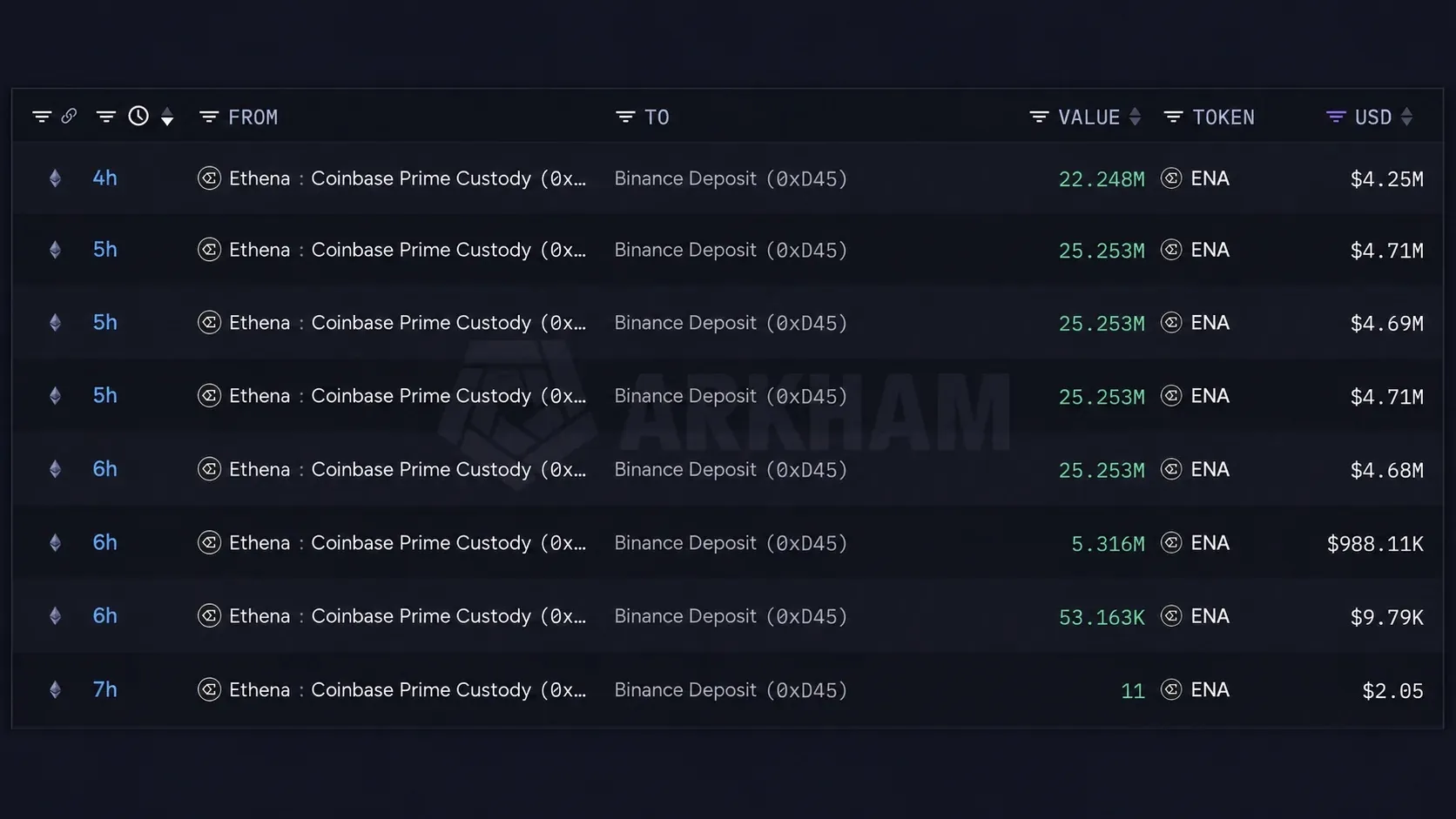
Binance has started buying back the tokens lost in its $6.3 billion hack, and onchain data shows wallets associated with Ethena sent 128.63 million ENA worth about $24 million to the exchange.  Key TakeawaysLookonchain tracked 128.63M ENA, worth about $24M, moving from Ethena-labeled wallets to Binance on Oct. 31.Binance says it already holds $5B of the $6.3B in stolen assets and is buying the remaining 20%.Reserve Protocol expects Binance to finish repurchasing 3.38B RSR before its Nov. 2 reserves report.  Ethena Tokens Flow Into Binance  Blockchain trackers flagged the transfers early on Oct. 31, writing:  Binance is buying back the stolen assets through market channels and OTC deals,  Binance is buying back the stolen assets through market channels and OTC deals,  At press time, Ethena has deposited 128.63 million ENA into the exchange over eight hours. Moreover, Arkham Intelligence data has shown the tokens leaving an address labeled “Ethena: Coinbase Prime Custody” in batches of roughly 25.25 million ENA (all of which eventually landed in a Binance deposit address).  The size lines up with what was taken, as onchain analyst EmberCN pointed out that 217.5 million ENA was stolen from Binance on Oct. 29. That means the Ethena transfers cover roughly 59% of the missing tokens.  The hacker

10-31Industry

XRP Reserves on Binance Hit Lowest Level Since 2022

As the broader crypto market continues to face intense selling pressure due to the prolonged market volatility seen over the past weeks, XRP appears to be seeing rising demand instead.  While its price is also struggling amid the market downturn, onchain data from crypto analytics platform CryptoQuant shows that more tokens are leaving major exchanges instead, which could be interpreted as intense buying.  XRP supply shrinks to 4-year low on Binance  The data shows that XRP reserves on the worlds largest exchange by volume, Binance, have dropped to their lowest level since December 2022.  As of October 30, Binance has seen its XRP reserve fall to 2.47 billion XRP from the 2.69 billion XRP it recorded on October 28, marking a sharp decline in its holdings in just two days.  This signals rapid accumulation from traders as it marks a decrease of about 8.18% in the amount of XRP available for sale on Binance, with over 220 million XRP withdrawn in just a two-day period.  While decreases in exchange reserves simply mean a reduction in the amount of XRP readily available for trading, it potentially reduces immediate selling pressure if demand remains steady, thereby providing a bullish outlook for the token.  XRPs falling supply extends to other

10-31Industry

Bitcoin whitepaper turns 18 amid renewed custody debate

Bitcoin‘s whitepaper turned 18 on Oct. 31, bringing fresh attention to Satoshi Nakamoto’s proposal for payments without trusted intermediaries days after Binance reported a $6.3 billion theft.  SummarySatoshi published the Bitcoin whitepaper on Oct. 31, 2008, through the cryptography mailing list.The nine-page document proposed preventing double-spending without relying on a bank or central mint.Binance has pledged to cover losses after attackers drained billions from its cryptocurrency wallets.Self-custody advocates and US investor guidance describe different responsibilities for safeguarding private keys.  Satoshi Nakamotos original announcement, preserved in the mailing-list archive, described an electronic cash system that would let people transact directly without a trusted third party. Posted at 2:10 p.m. EDT on Oct. 31, 2008, the email linked to the paper titled “Bitcoin: A Peer-to-Peer Electronic Cash System.”  Eighteen years later, anniversary posts have returned to that opening promise while the industry deals with another major exchange breach.  Bitcoin Archive shared an image of the original email alongside the message, “18 years of Bitcoin.” Another anniversary post from Lucky celebrated permissionless participation and verification, describing Bitcoin as a global financial movement.  18 Years of Bitcoin. 18 Years of Challenging the System.  On October 31, 2008, Satoshi Nakamoto introduced an idea that would change the world of finance forever.  A

10-31Industry
1
...
9597
...
1000