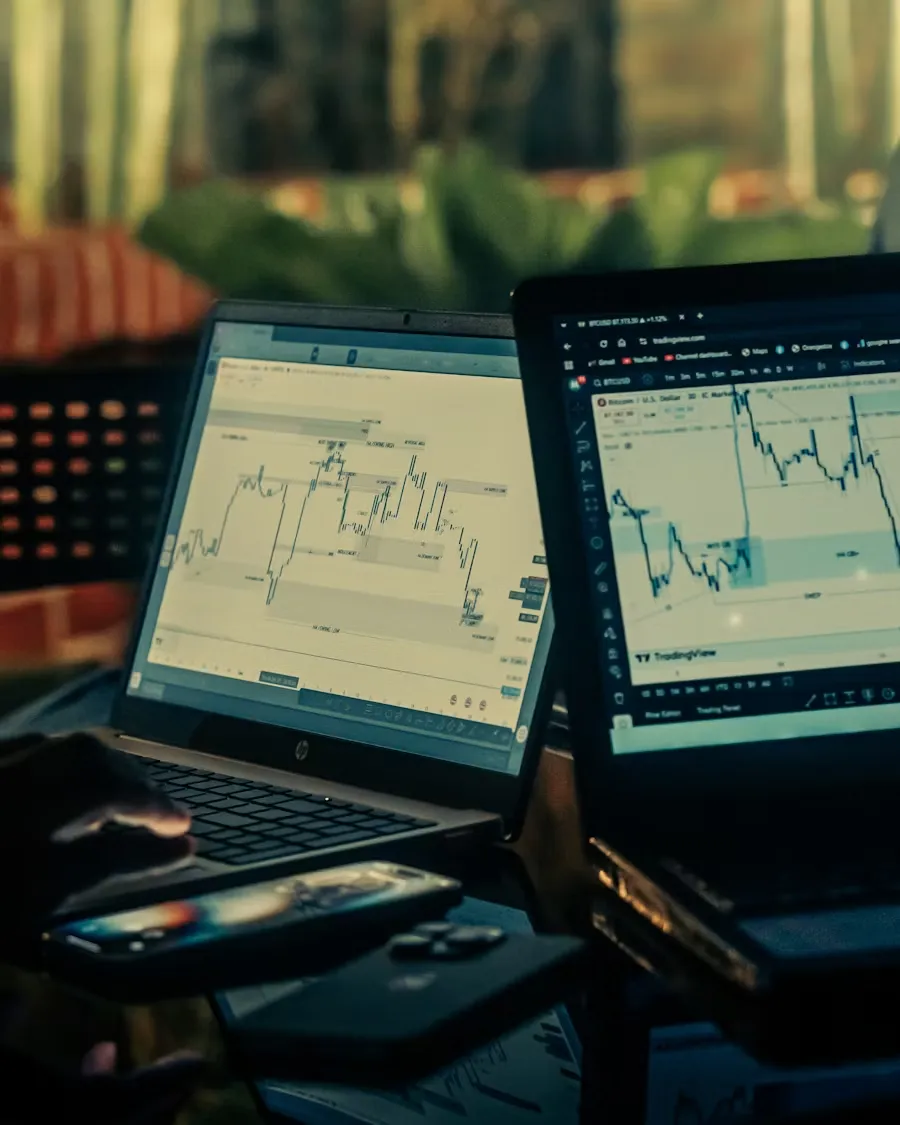
Robinhood (HOOD) Stock Plummets 14% as Crypto Revenue Crashes 47%

The fundamental issue centered on cryptocurrency performance. Cryptocurrency transaction revenue plummeted 47% compared to the same period last year, pulling total revenue down to $1.07 billion — falling $70 million below Wall Streets $1.14 billion projection. Adjusted earnings per share of $0.38 came in 10% under analyst estimates.  Despite achieving 15% year-over-year revenue growth overall, the substantial cryptocurrency revenue contraction dominated investor sentiment. While executives had previously warned about weakening retail crypto activity, the magnitude of the deterioration exceeded market expectations.  Broad-Based Weakness Across Crypto Trading Platforms  The selling pressure extended well beyond Robinhood. Coinbase (COIN) shares declined approximately 8% to $179, while Webull (BULL) retreated about 8% to $6.77 — even though neither platform released earnings reports Wednesday.  Coinbase appears to have suffered spillover effects from Robinhoods cryptocurrency revenue figures. A critical question emerges: is retail cryptocurrency appetite declining universally, or are traders migrating toward Coinbase? Notably, Coinbase delivered record institutional derivatives revenue in its most recent quarter, suggesting pockets of strength remain within the broader ecosystem.  Bitcoin mining operations Riot Platforms (RIOT) and MARA (MARA) both retreated 6-7%. Strategy (MSTR), the publicly-traded company with the largest corporate bitcoin holdings, fell approximately 4%. Bitcoin itself traded below $76,000, down roughly 0.5% over the previous

04-30Industry

DOGE Analysis: Key Levels That Could Trigger the Next Big Price Move

Dogecoin is at a technical turning point. Price action has tightened within a narrowing triangle structure, and a harmonic pattern is nearing completion. The next move, up or down, could carry .  Triangle Compression Puts Pressure on Key Resistance  Analyst ChiefraT has identified a tightening triangle formation on Dogecoin‘s chart. The asset’s price has been squeezed between converging trendlines, a pattern that typically precedes sharp directional moves. At the time of the post, was testing the triangles upper trendline directly.  This is a critical juncture. When price compresses this tightly within a triangle, it builds pressure. A decisive break in either direction often follows swiftly and forcefully. The Relative Strength Index supports the bullish case. RSI has been climbing steadily and now sits near the upper zone, reflecting growing momentum behind the current price push.  The technical setup is notable for its confluence. Both and momentum indicators are hitting critical levels at the same time. A confirmed break above triangle resistance could push DOGE toward the $0.105–$0.11 range. Sustained momentum above that level could open further upside. Failure to clear resistance, however, would likely extend the consolidation phase within the existing structure.  Harmonic Pattern Signals Possible Reversal  Analyst Klejdi Cuni has a separate but equally significant

04-30Industry

Bitcoin Tests 77K Before Fed, Powell Signal Awaited

Bitcoin  Bitcoin Tests 77K Before Fed, Powell Signal Awaited  Bitcoin traded pushing the 77,000 dollar barrier on Wednesday despite widespread expectations that the Fed would keep rates steady; Jerome Powell sharply signaling “high rates for a long time” could create sudden fluctuations in the markets. According to The Block data, BTC was last trading around 77,100 dollars, with the intraday range before FOMC staying between 75.689-77.837 dollars. Timing is critically important, as this could be Powell‘s last policy meeting in the chairmanship seat; candidate Kevin Warsh, who passed the Senate Banking Committee, could take office by swearing in by May 15. Investors are scrutinizing not only today’s decision but also the new regime that will shape afterward.  Bitcoin Testing Technical Levels Before Fed Decision  Current price at 75.764,54 dollars level, following a horizontal trend with a %-0,40 drop in the last 24 hours. RSI at 57,22 in neutral zone, Supertrend giving bear signal. EMA 20: 75.548 dollars. Strong supports S1 73.664 dollars (⭐ Strong, -%4,05 distance) and S2 76.389 dollars (⭐ Strong, -%0,50). Resistances R1 77.609 dollars (⭐ Strong, +%1,09) and R2 79.467 dollars (medium). Low liquidity makes Powells signal critical; BTC may remain volatile in the 72.000-80.000 band on the BTC detailed analysis

04-30Industry

100,000 Polymarket Accounts Lose Over $1000 Since 2025

Furthermore, the losses are not evenly spread as a separate academic study by researchers from the University of Toronto, HEC Montréal, and ESSEC Business School, which examined 2.4M users and $67B in total trading volume since 2022, found that 68.8% of all Polymarket users have lost money overall.  5% Bot Wallets Drive 75% Volume, Retail Traders Enter Late at Worse Prices  Notably, the imbalance stems from automated bots dominating market activity. Bloombergs analysis shows that roughly 5% of bot-like wallets generated 75% of total trading volume since January 2025. Within this high-frequency group, just 823 accounts each netted more than $100,000 in profit. Together, these bot-driven wallets pocketed a collective $131M.  The difference was timing and price. Retail traders consistently entered positions later, at worse prices, paying more or receiving less per contract than the bots that had already moved the market. According to the University of Toronto, HEC Montréal, and ESSEC Business School study, losing traders placed bets at extreme odds as the bottom 95% of users made 56% of their trades at prices below 10¢ or above 90¢, compared with just 28% for the top 0.1% of earners.  Whats the Impact on Polymarket and Prediction Markets?  As Polymarket and prediction markets expand amid

04-30Industry

100,000 Polymarket Accounts Lose Over $1000 Since 2025

Furthermore, the losses are not evenly spread as a separate academic study by researchers from the University of Toronto, HEC Montréal, and ESSEC Business School, which examined 2.4M users and $67B in total trading volume since 2022, found that 68.8% of all Polymarket users have lost money overall.  5% Bot Wallets Drive 75% Volume, Retail Traders Enter Late at Worse Prices  Notably, the imbalance stems from automated bots dominating market activity. Bloombergs analysis shows that roughly 5% of bot-like wallets generated 75% of total trading volume since January 2025. Within this high-frequency group, just 823 accounts each netted more than $100,000 in profit. Together, these bot-driven wallets pocketed a collective $131M.  The difference was timing and price. Retail traders consistently entered positions later, at worse prices, paying more or receiving less per contract than the bots that had already moved the market. According to the University of Toronto, HEC Montréal, and ESSEC Business School study, losing traders placed bets at extreme odds as the bottom 95% of users made 56% of their trades at prices below 10¢ or above 90¢, compared with just 28% for the top 0.1% of earners.  Whats the Impact on Polymarket and Prediction Markets?  As Polymarket and prediction markets expand amid

04-30Industry

Unprecedented US, China, Dubai Crypto Scam Crackdown Nets 276 Arrests

U.S. authorities cited “unprecedented” cooperation with China and Dubai in arresting 276 suspects.Fraud schemes used pig-butchering tactics, fake platforms, and laundering to steal millions.The case shows authorities are targeting infrastructure behind cross-border fraud operations, not only individual scammers.  Global Scam Crackdown Nets 276 Arrests Worldwide  On April 29, 2026, U.S. authorities announced a major crackdown on investment scam centers that allegedly used fraudulent investment platforms and social manipulation tactics to steal from victims. The operation led to at least 276 arrests and the dismantling of at least nine scam centers. The case highlights how organized fraud networks moved victims beyond their control.  The enforcement action centered on scam centers accused of targeting Americans with fraudulent investment pitches. The U.S. Department of Justice (DOJ) described:  “Unprecedented cooperation between the FBI, Dubai Police Department, and Chinese Ministry of Public Security has resulted in the arrest of at least 276 individuals and the dismantlement of at least nine scam centers used for investment fraud schemes.”  “These centers targeted Americans who have suffered millions of dollars in losses from such schemes,” the DOJ added.  Dubai authorities arrested 275 people, including three defendants charged in San Diego. Thailands Royal Thai Police arrested another defendant. The San Diego cases name Thet Min

04-30Industry

Meta Launches Stablecoin Payouts In Colombia And The Philippines

The social media giant has rolled out USDC payments via Stripe on Solana and Polygon.  Meta has begun rolling out stablecoin payouts for creators, marking the social media giants return to digital currencies four years after shelving its Libra project.  According to a Meta help page, creators in Colombia and the Philippines can now opt to receive payouts in USDC on either the Solana or Polygon networks. Recipients must connect a compatible third-party wallet, such as MetaMask or Phantom, to their Facebook payout account.  “With off-ramps in 150+ countries, our Open Money Stack expands financial access and improves how creators receive and use earnings globally,” the Polygon team wrote on X.  Stripe is handling crypto-specific tax reporting alongside Metas standard forms. Meta is not offering an off-ramp, meaning creators who want to cash out into local currency must move their USDC to a third-party exchange.  Post-Libra Revival  The launch lands four years after Meta wound down Diem, the rebranded version of its Libra global stablecoin project, following sustained opposition from U.S. and European regulators. The Diem Association sold its assets to Silvergate Capital for around $182 million in early 2022.  Metas quiet return follows the 2025 passage of the GENIUS Act, which established the first U.S. federal

04-30Industry

Meta Launches Stablecoin Payouts In Colombia And The Philippines

The social media giant has rolled out USDC payments via Stripe on Solana and Polygon.  Meta has begun rolling out stablecoin payouts for creators, marking the social media giants return to digital currencies four years after shelving its Libra project.  According to a Meta help page, creators in Colombia and the Philippines can now opt to receive payouts in USDC on either the Solana or Polygon networks. Recipients must connect a compatible third-party wallet, such as MetaMask or Phantom, to their Facebook payout account.  “With off-ramps in 150+ countries, our Open Money Stack expands financial access and improves how creators receive and use earnings globally,” the Polygon team wrote on X.  Stripe is handling crypto-specific tax reporting alongside Metas standard forms. Meta is not offering an off-ramp, meaning creators who want to cash out into local currency must move their USDC to a third-party exchange.  Post-Libra Revival  The launch lands four years after Meta wound down Diem, the rebranded version of its Libra global stablecoin project, following sustained opposition from U.S. and European regulators. The Diem Association sold its assets to Silvergate Capital for around $182 million in early 2022.  Metas quiet return follows the 2025 passage of the GENIUS Act, which established the first U.S. federal

04-30Industry

XRP Bearish Pennant Forms: Is a Drop to $1 Next?

XRP at a Crossroads: Bearish Signals Build as $1 Support Comes Into Focus  XRP is once again at a critical juncture, and the market is paying close attention. According to analyst Dan Keller, a is beginning to surface among market participants whether XRP could revisit the $1 level?  At the center of this discussion is a bearish pennant forming on the charts, a technical pattern that typically signals continuation to the downside after a brief period of consolidation.  XRP is currently per CoinCodex data, but the structure of its recent price action leans weakness with $1.36 emerging as a level.  Source: CoinCodex  Lower highs have been consistently printed, indicating that buyers are struggling to push prices upward with conviction. Furthermore, trading volume has been fading, a sign that market participation is cooling rather than strengthening. Even short-term rebounds have lacked energy, often stalling before reclaiming key resistance levels.  The zone between $1.20 and $1.25 has now emerged as a critical battleground. A decisive break below this range could open the door to a retest of $1, a level that carries both technical and psychological weight.  Bearish Pressure Builds as Long-Term Strength Holds  Momentum indicators reinforce the cautious outlook. The MACD remains in negative territory, reflecting bearish momentum, while

04-30Industry

Vitalik’s wallet is programmatically dumping “garbage” memecoins again – on‑chain data shows minute‑by‑minute liquidation

Vitalik Buterin is programmatically dumping unsolicited memecoins again, turning airdropped “spam” into ETH while leaving thinly traded meme markets on edge.Arkham data shows Vitaliks wallet auto‑selling low‑cap memecoins airdropped to him, with minute‑by‑minute swaps into ETH.The pattern echoes past dumps of SHIB‑era memes, CAT and others, reinforcing his stance that unsolicited tokens are spam, not endorsements.Combined with his ongoing ETH disposals to fund public goods, the activity turns his address into structural sell pressure for illiquid meme bets.  On‑chain analytics from Arkham Intelligence indicate that an address attributed to Ethereum co‑founder Vitalik Buterin (0xAb5…) has entered a new phase of high‑frequency selling of assorted memecoins airdropped to his wallet. According to the activity feed, the address is swapping multiple low‑cap meme tokens every minute, with individual transactions typically in the tens to low hundreds of dollars and a continuous inflow of ETH recorded over the same period. The pattern suggests the use of automated scripts to batch‑liquidate unsolicited “junk” airdrops rather than discretionary, one‑off sales.  Market participants are drawing comparisons with earlier episodes. In 2021, Buterin famously sold or donated large allocations of airdropped memecoins such as SHIB, triggering sharp, short‑term price dislocations across several tokens that had tried to co‑opt his

04-30Industry
1
...
920922
...
1000