Coinbase CEO Brian Armstrong gets behind CLARITY Act ahead of Thursday markup

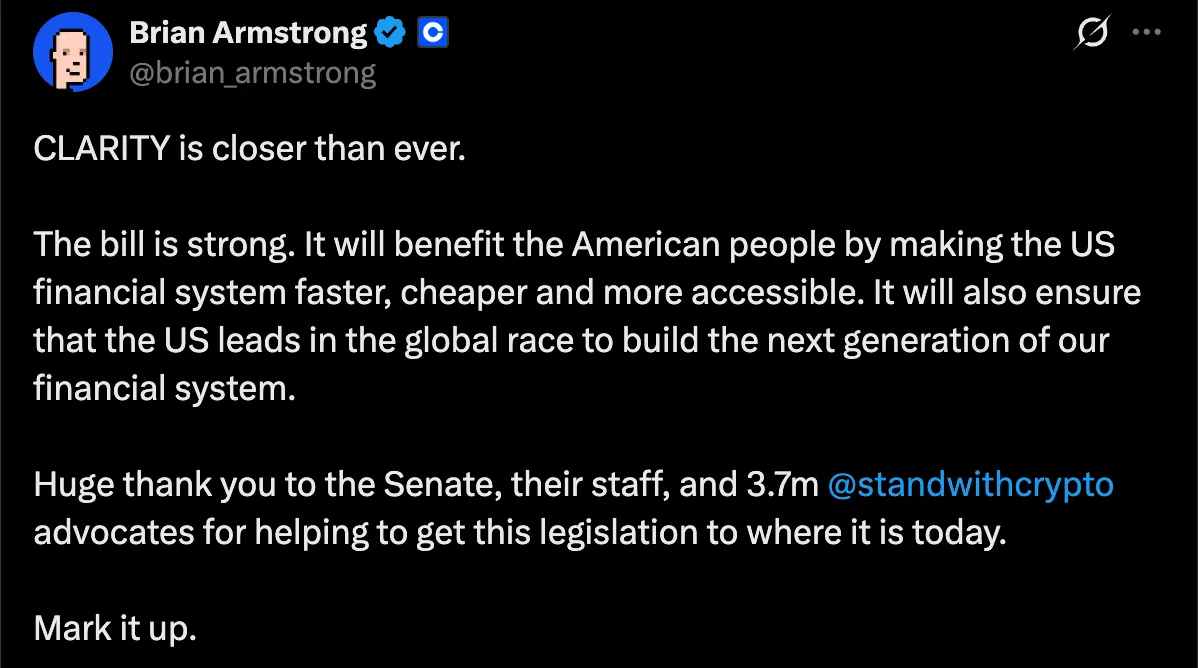
Coinbase CEO Brian Armstrong is supporting the latest version of the Digital Asset Market Clarity Act (CLARITY) ahead of the US Senates markup of the crypto market structure bill on Thursday.  “I dont think its ever been in a stronger or more bipartisan position,” he said about the latest iteration of the market structure bill.  Armstrong said that the banking and crypto industry lobbies have reached a “healthy compromise” on stablecoin yield, which was one of the main issues that stalled the market structure bill in January. He added:  “I think there was a healthy compromise there, brokered by Senators Tillis and Alsobrooks. And you know, it was a good compromise because both sides left a little bit unhappy, but at least we got to a place that we can all live with.”  The latest version of the CLARITY bill also improved provisions surrounding decentralized finance (DeFi), tokenized stocks, and the authority of the Commodity Futures Trading Commission (CFTC) to regulate crypto markets, he said.  Source: Brian Armstrong  The comments and the bills pending markup follow months of back-and-forth negotiations between the banking sector and the crypto industry over the bill, which stalled in January 2025 after crypto industry players, led by Coinbase, rejected the initial

05-14Exchange

First US Hyperliquid ETF (THYP) Sees $1.2M Inflows on Launch

The first Hyperliquid exchange-traded fund (ETF) in the United States, launched by crypto asset manager 21Shares, recorded $1.2 million in net inflows and $1.8 million in trading volume on its debut day, according to data from May 13, 2026. Trading on the Nasdaq under the ticker THYP, the fund aims to track the spot price of the Hyperliquid (HYPE) token, which powers a perpetual futures platform with over $8.4 trillion in trading volume since its 2023 launch.  While the inflows were notable for an ETF debut, they pale in comparison to earlier crypto ETF launches. The Bitwise Solana Staking ETF (BSOL) and the Canary XRP ETF (XRPC) both recorded opening-day volumes exceeding $56 million in late 2025. Bloomberg ETF analyst James Seyffart described THYPs debut as “better than your average ETF launch for sure but nothing too crazy.”  THYP‘s competitive edge lies in its relatively low 0.3% management fee, undercutting Bitwise’s proposed 0.67% fee for its upcoming Hyperliquid Staking ETF (BHYP). Grayscale, another major player in the crypto ETF space, is also awaiting regulatory approval for its Grayscale HYPE ETF (GHYP), although pricing details for that product remain undisclosed.  The launch of THYP comes amid a regulatory shift in the U.S. Securities and

05-14Industry

KRWQ Expands to Solana, Unlocking $100B+ Daily KRW Liquidity

Tech  KRWQ Expands to Solana, Unlocking $100B+ Daily KRW LiquidityKRWQ is expanding to Solana to support faster KRW-linked on-chain settlement.The rollout targets $40B in daily KRW spot volume and $60B in NDF activity.South Koreas stablecoin rules remain under development, limiting local access.  Korea‘s won-pegged stablecoin, KRWQ, is expanding to Solana as it looks to bring Korean won liquidity into faster, crypto-native markets. The move gives traders, institutions, and on-chain applications a new settlement route for accessing KRW-linked liquidity across Solana’s high-speed trading ecosystem.  Per reports, the expansion links one of Asias most active fiat markets with a blockchain built for high-speed execution. IQ, which created KRWQ with Frax, said the rollout targets more than $100 billion in combined daily KRW spot and offshore derivatives activity.  A Korean Won Market moves On-Chain  Basically, KRWQ is designed to maintain a 1:1 peg with the South Korean won. It first launched last October on Base as the first Korean won-denominated stablecoin on that network.  The asset later expanded across multiple chains using LayerZeros interoperability framework. That structure was built to reduce fragmented liquidity across separate blockchain ecosystems.  Its latest deployment, however, brings KRWQ into Solana‘s trading stack, where low-latency settlement can support more active markets. The team said the chain’s

05-14Industry

Ledger IPO plans paused on market conditions

Ledger has put its Ledger IPO plans on hold, citing difficult market conditions and weak investor appetite for crypto listings.The French hardware wallet maker had hired Goldman Sachs, Jefferies, and Barclays to advise on a potential US listing valued at around $4 billion.Ledger has not filed a draft S-1 with the SEC and may pursue a private capital raise instead, according to people familiar with the matter.The pause follows Krakens IPO delay and comes as BitGo, the only crypto-native company to list in 2026, trades 36% below its January IPO price.  Ledger, the French crypto hardware wallet maker, has paused its plans for a US initial public offering, according to two people with knowledge of the matter.  The company had explored a New York listing at a valuation of roughly $4 billion and has not filed a draft S-1 registration statement with the SEC, the standard first formal step toward a US listing.  Ledger had hired Goldman Sachs, Jefferies, and Barclays earlier this year to advise on the offering. A Ledger spokesperson declined to comment. The company may instead pursue a private capital raise, according to one of the people familiar with the matter.  What is driving the pause  The decision reflects a broader cooling

05-14Industry

Wells Fargo Boosts Ethereum ETF Holdings as Institutional Demand for ETH Grows in 2026

The post Wells Fargo Boosts Ethereum ETF Holdings as Institutional Demand for ETH Grows in 2026 appeared first on Coinpedia Fintech News  Institutional interest in Ethereum is rising again. American Top financial services company Wells Fargo has sharply increased its exposure to Ethereum-linked ETFs during the first quarter of 2026.  This comes even while ETH trades near $2,300 and market sentiment stays weak, showing institutions are still quietly accumulating.  Wells Fargo Expands Ethereum Exposure  According to the filing, Wells Fargo raised its position in BlackRocks iShares Ethereum Trust (ETHA) by about 63.5%, increasing its holdings from roughly 672,600 shares in Q4 2025 to nearly 1.1 million shares in Q1 2026.  At the same time, its exposure to the Bitwise Ethereum ETF (ETHW) also grew by around 37%, climbing from about 186,800 shares to over 257,000 shares.  The broad-based increase across multiple Ethereum-linked funds suggests that the bank is not just diversifying, but actively building larger exposure to ETH through regulated investment products.  JPMorgan And BlackRock Pushed Ethereum Tokenization Forward  Wells Fargo is not alone. JPMorgan recently filed for a new tokenized money market fund called JLTXX that will run directly on the Ethereum blockchain. The fund is designed to help stablecoin issuers hold reserves in a regulated and

05-14Ethereum

Charles Schwab rolls out spot Bitcoin and Ethereum trading for retail clients

Charles Schwab, the brokerage managing over $12 trillion in client assets, launched direct spot Bitcoin and Ethereum trading for its retail clients on May 13. The new platform, called Schwab Crypto, charges a 0.75% trading fee and is powered by Paxos alongside Schwab Premier Bank.  Look, when a firm this size decides to let millions of everyday investors buy actual Bitcoin from the same account where they hold their index funds, that‘s not a product launch. That’s a structural shift in how America interacts with digital assets.  The fee war heats up  Schwabs 0.75% fee slots neatly between its two biggest competitors. Fidelity charges 1% for direct crypto purchases, while E*TRADE offers a leaner 0.50% rate for Bitcoin and Ethereum trades.  In English: Schwab is undercutting the largest crypto-friendly brokerage by 25 basis points, while positioning itself as the premium option compared to E*TRADEs discount approach. The classic Goldilocks strategy.  The pricing is aggressive enough to matter. For a $10,000 Bitcoin purchase, a Schwab client pays $75 in fees versus $100 at Fidelity. That $25 difference won‘t change anyone’s life, but multiply it across millions of transactions from Schwabs massive client base and you start to understand why Fidelity might need to revisit its fee

05-14Ethereum

Charles Schwab announces launch of spot Bitcoin and Ethereum trading

Popular banking firm Charles Schwab has rolled out direct Bitcoin and Ethereum trading to its U.S. retail customers via a new platform called “Schwab Crypto.” This platform will give the firms over 39 million account holders access to spot crypto purchases in addition to stocks and bonds.  The brokerage firm confirmed on Tuesday that an initial group of eligible investors can now trade the two largest cryptocurrencies by market cap on its new platform. The launch follows plans Charles Schwab first mentioned last year and then went on to detail in an April 16 press release.  How Schwab Crypto operates  The platform is not a total standalone from existing account profiles. Each client will maintain a fresh crypto account linked to their brokerage profiles.  Each trade costs 75 basis points, which equals 0.75% of the dollar value of the transaction. The service became live in every US state except New York and Louisiana at launch.  “We know our clients want to conduct more of their financial lives at Schwab,” Jonathan Craig, Head of Retail Investing, said in the company announcement. “With Schwab Crypto, clients who want direct access to the asset class can trade it alongside their other investments, while benefiting from the service, education,

05-14Ethereum

Ethereum Introduces Clear Signing to Combat Blind Signing Risks

The Ethereum community has unveiled Clear Signing, a new security feature designed to eliminate blind signing—a practice that has long exposed users to significant risks. Announced as part of the Ethereum Foundations Trillion Dollar Security Initiative, Clear Signing makes transactions human-readable before approval, replacing cryptic hex data with transparent descriptions.  Blind signing, where users approve transactions without fully understanding the details, has led to billions of dollars in losses. The Ethereum Foundation highlighted the $1.4 billion Bybit hack in 2025, where attackers exploited transaction signatures, as a key example of the issue. Calling blind signing a “structural flaw,” the foundation emphasized the urgency of implementing solutions like Clear Signing to protect users.  The new feature uses the open-source ERC-7730 token standard and incorporates key elements such as human-readable transaction descriptions and a descriptor registry. It also includes an attestation framework, enabling auditors to verify the accuracy of these descriptors. Major wallet providers like Ledger, Trezor, and MetaMask are integrating the feature, which aims to provide an additional layer of security for self-custody users.  Trezor CTO Tomáš Sušánka explained that attackers have exploited the lack of transparency in transaction details to deceive users into signing malicious contracts. “This issue has led users to unknowingly

05-14Ethereum

XRP Flips BTC and ETH in Volume on Top South Korean Exchanges

The XRP/KRW trading pair became the most traded on South Koreas largest exchange, Upbit.On Bithumb, XRP pulled around $41 million in volume, second only to the USDT/KRW pair.In April, XRP was the most actively traded among 15 major altcoins on Upbit and Bithumb.  XRP trading has overtaken Bitcoin and Ethereum on major South Korean exchanges, with the XRP/KRW pair becoming the most traded pair on Upbit, the countrys largest exchange.  CoinGecko‘s data shows that XRP trading volume on Upbit reached roughly $110.9 million in 24 hours, surpassing Bitcoin’s $88.6 million and Ethereums $67 million. On Bithumb, XRP pulled around $41 million in volume, placing it second only to the USDT/KRW pair.  This is noteworthy because South Korean traders have long been key drivers of altcoin hype. XRP, in particular, has had an extremely loyal following in the country for years.  The recent spike is not an isolated event, as recent market data has consistently shown XRP leading Korean trading charts all through 2026. For instance, back in April, XRP was leading trading among 15 big altcoins on Upbit and Bithumb, beating out Solana and Dogecoin. Another April report said XRP had already topped Bitcoin in 24‑hour volume on Upbit.  There‘s a bigger picture behind the

05-14Ethereum

JP Morgan Files for Second Tokenized Fund on Ethereum

JP Morgan Chase filed with the US Securities and Exchange Commission (SEC) on May 12 for a second tokenized money market fund on Ethereum, proposing digital tokens linked to a portfolio of US Treasuries and overnight repurchase agreements that investors could hold in digital wallets or deploy as on-chain collateral.  This filing notes that tokenized real-world assets (RWA) tracked by rwa.xyz are estimated to have reached approximately $32Bn in total market value, and that competitors, including BlackRock, are moving forward with comparable institutional offerings under the recently enacted GENIUS Act.  (SOURCE RWA.xyz)  This is not simply another product launch. It is JP Morgan signaling that the pilot phase of institutional tokenization is over – and that Ethereum‘s public infrastructure, not the bank’s own permissioned network, is where the next phase of on-chain finance scales.  We suspect the choice of Ethereum mainnet over JP  Morgans private Kinexys Digital Assets infrastructure for client-facing products reflects a deliberate acknowledgment that institutional liquidity does not accumulate on isolated bank-led networks.  (SOURCE: TradingView)  JP Morgan JLTXX Filing: How the Second Tokenized Treasury Fund Actually Functions  The mechanism functions as follows: the new fund, structured under JP Morgan Trust IV as Token Class Shares and designated JLTXX, files for an effective date of May

05-14Ethereum
1
...
894896
...
1000