Crypto points programs face backlash over unclear rewards

Crypto points programs are facing fresh criticism as users question whether the prospect of future rewards still justifies the time, fees, and capital they commit to projects.  Pseudonymous crypto commentator Nairolf sparked the discussion in Nov. 2 posts arguing that points remain useful for attracting early users, building communities and rewarding loyalty. The problem, he said, is that those benefits depend on participants believing their contributions will eventually receive fair rewards.  im sad points programs got abused so much  they genuinely solve some of the hardest problems for early products: getting people to try something new, bootstrapping a community, rewarding early users, building loyalty  problem is the model only works as intended if people believe…  Years of projects extracting activity from users have damaged that belief, according to his posts. He argued that teams abusing points today are making the same growth tool less effective for other projects tomorrow.  His comments drew sharper responses from other accounts. Coop described points programs as an “anti signal” and said projects abandoning their points commitments had made participation unappealing. Minion questioned whether users could reasonably expect programs to operate in good faith.  its over for points programs for now.  its anti signal.  cant believe how many projects are just outright rugging their

11-03Industry

NEAR Intents Head Names 3 Survival Rules for Crypto Wallets

The end of October 2026 was marked by the largest incident in the history of the crypto market — the $6.3 billion hack of the Binance exchange. This case exposed the vulnerability of the instant exchange (swaps) infrastructure.  While the automated systems of the North Korean group TraderTraitor withdrew $242 million via the Tron blockchain in the first two days, decentralized bridges and liquidity aggregators de facto became the main tool for legalizing the stolen funds.  And what do wallets have to do with it?  Against this backdrop, the head of NEAR Intents Alex Shevchenko issued a warning to cryptocurrency wallet developers. His position is pragmatic: focusing exclusively on finding the best rate for the user turns services into unwitting accomplices in cybercrimes.  Since around $3.5 billion still remains under the hackers control after a wave of emergency freezes, regulatory pressure on the Web3 sector will inevitably increase. To minimize risks, the head of NEAR Intents formulated three basic survival rules for modern crypto wallets when choosing integration partners:Counteracting money laundering (ML counteraction): The protocols ability to recognize flagged hacker assets on the fly and isolate them from liquidity pools.Slippage and refund control (Slippage & Refund rate): Ensuring that the execution price exactly matches

11-03Industry

Binance hacker mixes $2.2m in Bitcoin through CoinJoin

The Binance hacker has begun mixing stolen funds through CoinJoin, moving roughly $2.2 million in Bitcoin through privacy transactions following the exchanges multibillion-dollar theft.  SummaryAround 28 BTC entered 18 CoinJoin transactions between Nov. 1 and early Nov. 2.Theft-linked addresses still held $3.24 billion, mainly in Ethereum and Bitcoin, according to Elliptic.Investigators previously identified $2.85 billion in frozen or seized assets, roughly 44% of the theft.Binance has committed company funds to replace stolen assets while investigators follow the laundering routes.  Elliptics Nov. 2 report traced the first mixing to 05:55 UTC on Nov. 1. Bitcoin obtained from stolen Tron funds entered transactions using WabiSabi, the protocol used by Wasabi Wallet and similar wallets. Later, some ETH was converted into Bitcoin and followed the same route.  By 06:02 UTC on Nov. 2, the firm counted 28 BTC passing through 18 CoinJoins. Its investigation covered approximately 12,000 wallets, 11 blockchains and more than 40,000 transactions.  Binance hacker begins mixing converted funds  According to the report, the 18,270 BTC stolen directly from Binance remained in 19 addresses without further movement. The Bitcoin entering CoinJoin came from assets converted after the theft.  CoinJoin pools multiple participants Bitcoin into shared transactions, making the connection between incoming and outgoing coins harder to follow,

11-03Industry

Surprising US-Iran Peace Talks: Gold and Silver Surge, Oil Prices Fall

Gold and silver surged more than 2% on Monday as unexpected progress in US-Iran peace talks sent oil prices lower.However, Bitcoin struggled, falling to the $76,000 zone.  According to Reuters, Iranian negotiators left talks with Qatari mediators on Sunday, but a revised peace proposal is circulating.  Tehran says its seven-step plan could now be implemented within two days, potentially reopening the Strait of Hormuz if Washington ends its blockade of Iranian ports.  Sponsored  Sponsored  Iranian Foreign Minister Abbas Araqchi described consultations as “very intensive.”  However, Trump rejected an earlier proposal, and Iranian sources still consider renewed US strikes more likely than an agreement.  Why Falling Oil Could Push Gold and Silver Higher  Oil fell more than 6% following the diplomatic developments. Gold rebounded after its worst October since 2008, while silver reclaimed $50.  One market estimate valued an earlier part of golds rebound at $428 billion in paper gains, rather than fresh investment.  Sponsored  Sponsored  The moves suggest oil is becoming a major short-term driver of precious metals.  Cheaper energy reduces inflation fears, potentially easing pressure on the Federal Reserve to raise interest rates. Lower expected rates make gold more attractive because investors sacrifice less interest income by holding it. Silver benefits from similar conditions.  A lasting Iran deal could therefore support a broader

11-03Industry

$106 Million Crypto Theft Hits EU Entity With Multiple Exchange Accounts

An unidentified organisation in the European Union may have lost more than $106 million from accounts held at several crypto exchanges on November 1. Millions of dollars then moved through cryptocurrency wallets within minutes.  Blockchain investigator ZachXBT raised the alarm on Monday. The suspected attacker reportedly withdrew USDC and USDT, two cryptocurrencies designed to maintain a value of $1.  Sponsored  Sponsored  BeInCryptos review of Ethereum transactions found roughly $80 million in USDC arriving at 11 wallets over 11 hours. In five wallets, around $9.6 million was moved out again within three minutes.  The $106 million estimate includes USDT. No victim or exchange has publicly confirmed the alleged theft.  EU ENTITY REPORTEDLY LOSES $106M IN MASSIVE EXCHANGE THEFT  An unnamed European entity is suspected of losing more than $106 million across multiple centralized exchange accounts on November 1, per @zachxbt  The attacker withdrew the funds in $USDC and $USDT before aggressively…  Why Was the Money Moved So Quickly?  Circle and Tether, which issue USDC and USDT, can freeze their tokens. ETH has no equivalent central issuer.  ZachXBT says the suspected attacker exchanged USDC for ETH, sent funds through instant-exchange services including WellWallet and Kyrrex, and used Wagyu to convert some into Monero (XMR).  Sponsored  Sponsored  Monero hides transaction details, making stolen funds harder to trace.

11-03Industry

Binance Hack Fallout Keeps Bitcoin Price Under Pressure Below $77K

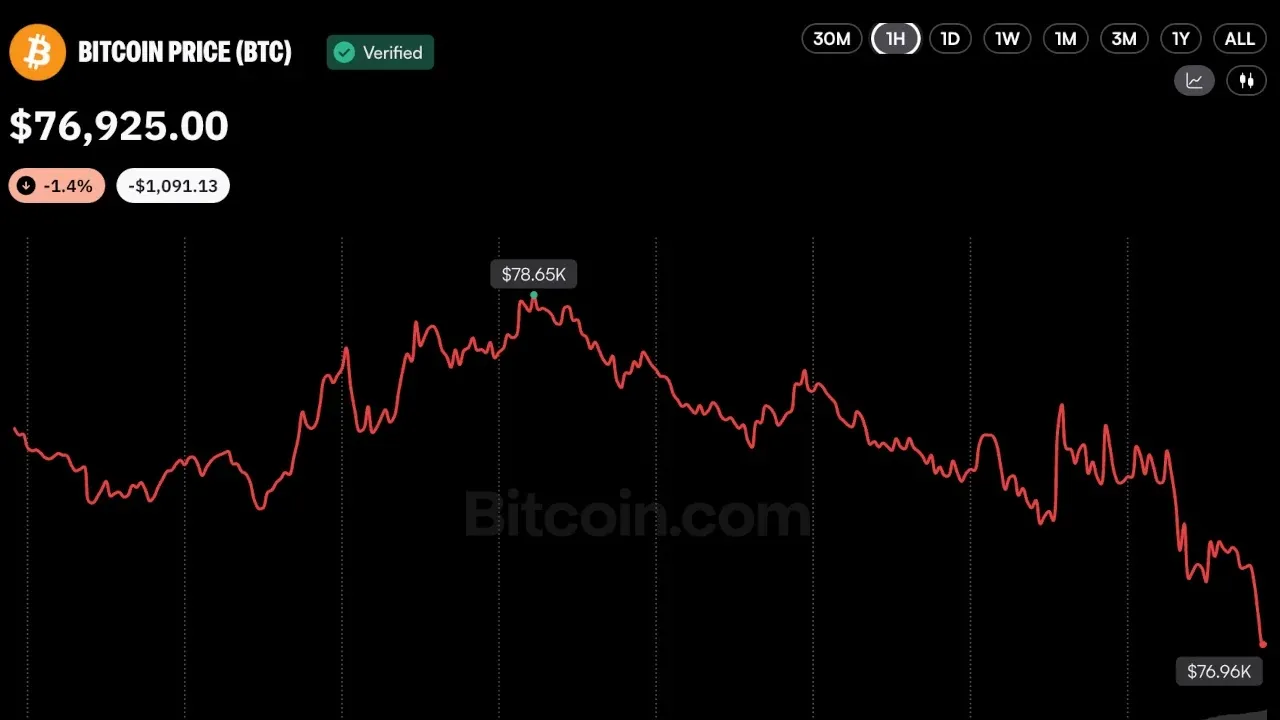
Bitcoin slipped below $77,000 on Monday, despite Binances announcement that it had fully replenished assets lost in the recent hack using its own funds. Another, albeit much smaller crypto exchange hack also popped up on Monday.  Key TakeawaysBitcoin fell below $77,000 on Monday as the Binance hack continued to weigh on investor confidence.Crypto liquidations reached $256 million, while Binance reported 100% backing for major assets.Bitget Wallets Alvin Kan warned that the $6.3 billion Binance breach could prompt a rethink of custody risks.  Bitcoin Drops Below $77K  Bitcoin slipped below $77,000 on Monday as the cryptocurrency continued to grapple with a crisis of confidence triggered by the massive Binance hack. Even Strategy‘s latest bitcoin purchase failed to lift investor sentiment, while the fallout from the breach has driven billions of dollars in outflows from Binance ahead of the exchange’s highly anticipated proof-of-reserves report.  Market data, however, shows that the cryptocurrency experienced another volatile day as it swung heavily on either side of $78,000. Initially, the price was climbing, rising from under $77,600 to peak at $78,750 just before midnight on Sunday as bulls seemingly took charge. However, the upward momentum cooled immediately afterward, and by 9:30 a.m. EST, the price was back below $77,600.  For the

11-03Industry

Eclair tightens Bitcoin funding rules after unconfirmed inputs put Lightning payments at risk

Bitcoin Lightning developer ACINQ has urged node operators to upgrade after fixing security weaknesses that malicious peers could exploit.  Related Asset Bitcoin #1 BTC · $77,042.79 24-hour change: down 1.27% Loading price history… 24H Down 1.27% 7D Down 4.04% 30D Down 9.24%  The company released Eclair version 0.14.6 on Oct. 27, introducing stricter transaction requirements and recovery mechanisms to prevent manipulated channel funding from jeopardizing pending payments.  “We highly recommend upgrading, as some of these issues can be exploited by malicious nodes,” ACINQ said in its release announcement.  The warning centers on a weakness in how Lightning channels handle funding changes before the underlying Bitcoin transactions are confirmed.  Lightning allows users to transfer Bitcoin through payment channels without recording every transaction on the blockchain. Operators can also add or withdraw liquidity from existing channels through a process known as splicing.  However, ACINQs release documentation warns that accepting unconfirmed funding inputs from another node creates an opportunity for manipulation.  A malicious peer could double-spend an unconfirmed transaction after signing a splice, invalidating the funding arrangement that supports the channel.  If the affected channel subsequently closes through Bitcoins blockchain, pending payments secured by conditional contracts known as HTLCs could become vulnerable because their settlement depends on the invalidated funding transaction.  The

11-03Industry

Nvidia and Nike Lead Biggest Wave Yet of Tokenized Stock Objections

In briefTwelve more companies, including Nvidia, Costco and Nike, objected to trading of their shares on OKXICE TSV, according to its Oct. 30 notice, the largest batch yet.The total has climbed from nine on Oct. 15 to 50, spanning tech, finance, retail, health care and energy.Under the SECs innovation exemption, a timely objection bars the venue from listing a third-party tokenized version of a company  Even Nvidia doesn‘t want its shares on OKX and ICE’s planned tokenized stock venue.  The chipmaker is among 12 new companies listed as objecting issuers in an updated notice from OKXICE TSV dated Friday. The others are Costco, Nike, Micron, CrowdStrike, Palo Alto Networks, Reddit, Hewlett Packard Enterprise, Corning, Bloom Energy, IREN, and USA Rare Earth. The additions bring the total to 50 companies.  Predict·EconomyTesla and SpaceX merger officially announced by...?  January 31, 202721%YesNo  December 31, 202614%YesNo  NEW  $4.94 volume  Feb 1Closes: Feb 1, 2027, 04:59 UTC  Closes: Feb 1, 2027, 04:59 UTC  It‘s the largest single batch yet. The list stood at 38 in the venue’s Oct. 28 notice, when Walmart and Eli Lilly joined, and at nine when the first objectors appeared on Oct. 15. It has more than quintupled since.  The newcomers span chips, cybersecurity, retail, and energy. Nvidia, Micron, and Corning join

11-03Industry

Ripple Partner Mercado Suspends Withdrawals After Confirming 'Security Incident'

Leading Brazilian cryptocurrency exchange and Ripple blockchain payments partner Mercado Bitcoin has announced a temporary freeze on cryptocurrency deposits and withdrawals after acknowledging a security breach.  As the firm revealed in an official announcement, the security breach did not cause any harm to its users or compromise their personal data.  “We detected and quickly mitigated a security issue in one of our systems this morning,” Mercado Bitcoin said.  Mercado Bitcoin stressed that the incident did not harm any customers or lead to a data breach.  Nevertheless, as a precautionary measure, the firm decided to temporarily halt deposits and withdrawals while its security teams conduct further investigations into the issue and try to locate any assets that could have been affected.  Additionally, Mercado Bitcoin said that it is working with the appropriate authorities to investigate the incident.  Mercado Bitcoin reveals suspicious wallet addresses  In the latest update, Mercado Bitcoin revealed that it continues to work on restoring its operations to normal.  “We are still working to safely restore operations and will keep our customers updated on our official channels,” the exchange announced.  Interestingly, the company also released some cryptocurrency wallet addresses related to suspicious transactions linked to the incident.  The move aims to assist blockchain investigators and other industry players in

11-03Industry

XRP Ledger targets Nov. 4 fix for token-minting flaw

XRP Ledger has moved closer to activating a Nov. 4 fix for a flaw that can let accounts authorized only to burn issued tokens create new ones under certain conditions.  SummaryDevelopers warn issuers against delegating PaymentBurn permission until the correction becomes active.Validator backing stands at 33 of 35, with activation dependent on sustained support.The flaw concerns issued tokens, including stablecoins, without affecting XRPs native supply.The amendment includes separate repairs for trading pools, vault accounting, and loan checks.  XRPL‘s official documentation identifies the problem in PaymentBurn, a permission designed to let another account destroy fungible tokens on an issuer’s behalf. Until the fixCleanup3_4_0 amendment takes effect, a delegate holding that permission can sometimes mint trust line tokens or Multi-Purpose Tokens, known as MPTs.  The warning specifically excludes other granular permissions from the flaw. Its recommendation is to avoid delegating PaymentBurn while the correction remains pending.  XRP Ledger fix separates token burning from issuance  In the permission reference, XRPL lists PaymentMint and PaymentBurn as separate functions. PaymentMint authorizes payments that create fungible tokens, while PaymentBurn is intended to authorize their destruction without allowing a payment to cross a zero balance.  The Sep. 16 release notes for xrpld version 3.4.0 describe the correction directly: payments using PaymentBurn will be

11-03Industry
1
...
6769
...
1000