Sui Network Restarts After 6 Hour Outage

Sui Network is back online after a nearly six-hour outage on Thursday, which it attributed to a bug introduced by an update, marking the layer-1 blockchains second period of downtime in 2026.  Sui posted to X on Thursday that activity on its mainnet had resumed after “a halt due to a crash bug in the gas charging logic introduced by the 1.72 release. A full incident review will be shared in the coming days.”  Sui had earlier shared that the blockchain was “experiencing a network stall” and said that transactions could be paused until a fix is rolled out.  The outage lasted 5 hours and 55 minutes, according to the networks status indicator. Sui mainnet validators are still listed as having “degraded performance.”  It is the second outage of the Sui blockchain this year, following a similar incident in January where the network was knocked offline for more than six hours. Another incident occurred in November 2024, when all validators were stuck in a crash loop for around two and a half hours, preventing transactions from being processed.  Sui is the 13th-largest blockchain by total value locked at $542 million and hosts 137 protocols, according to analytics platform DefiLlama.  Sui token drops 6.6% before recovery  The Sui

05-30Industry

Sui Network Hits Third Transaction Halt in 48-Hour Outage Wave

The Sui team acknowledged this issue on social media, stating that their mainnet was experiencing a “network stall” and that it was looking for a solution. “Be aware that transactions may be paused at this time. Updates will be shared as soon as they are available,” they posted.  At 11:34 AM EDT, the network was processing transactions again, with Sui‘s team explaining that both today’s and yesterdays problems were linked to the “ gas charging logic” changes that the blockchain recently applied to make stablecoin transactions free.  “Yesterdays implemented fix was an interim measure designed to restore functionality to the network while the Sui Core Team worked on a long-term solution. The interim fix had a known issue with a low probability of causing a halt. This morning, the network hit a variant of the known issue and halted,” Sui explained, stressing that network activity had resumed.  X user 0xarthur.sui alleged that while the first network stall was likely due to a design defect, this second one was perpetrated by a threat actor. “A hacker likely opened short positions in advance, just to make Sui crash,” he declared.  In addition, he believes the fix for the problems was vibe-coded with AI and applied. “For

05-30Industry

Gravity Bridge Loses $5.4 Million in Suspected Signing Key Compromise

Attackers drained roughly $5.4 million from the Gravity Bridge Ethereum-side contract early on May 30. On-chain investigators point to a compromised signing key rather than a smart-contract flaw.  The exploit removed $4.3 million in USD Coin (USDC) and 274 ether (ETH) worth $553,000. PeckShield also recorded $434,000 in Tether (USDT) and PAYG tokens worth $64,000.  Inside the Gravity Bridge hack  The drain came from the bridges verified Ethereum contract, with privileged access enabling withdrawals that appeared authorized. On-chain analyst Specter flagged the incident first, listing two attacker addresses tied to the theft.  PeckShield said the hacker moved part of the proceeds through ChangeNow and Binance to obscure origins. Cyvers Alerts and other on-chain monitors confirmed the figures shortly after.  The attacker swapped most stablecoins into ETH and now controls about 2,102 ETH worth roughly $4.23 million.  Bridges Remain Cryptos Weakest Link  Gravity Bridge connects Ethereum to the Cosmos ecosystem through IBC, letting assets such as USDC move between chains. The bridge held roughly $11.5 million in total value locked before the drain.  Past cross-chain bridge attacks like Ronin and Poly Network exposed how concentrated keys become a single point of failure.  PeckShield previously tallied eight major bridge exploits totaling $328.6 million in May alone.  Earlier incidents include the Meter bridge

05-30Industry

Gravity Bridge Loses $5.4 Million in Suspected Signing Key Compromise

Attackers drained roughly $5.4 million from the Gravity Bridge Ethereum-side contract early on May 30. On-chain investigators point to a compromised signing key rather than a smart-contract flaw.  The exploit removed $4.3 million in USD Coin (USDC) and 274 ether (ETH) worth $553,000. PeckShield also recorded $434,000 in Tether (USDT) and PAYG tokens worth $64,000.  Inside the Gravity Bridge hack  The drain came from the bridges verified Ethereum contract, with privileged access enabling withdrawals that appeared authorized. On-chain analyst Specter flagged the incident first, listing two attacker addresses tied to the theft.  PeckShield said the hacker moved part of the proceeds through ChangeNow and Binance to obscure origins. Cyvers Alerts and other on-chain monitors confirmed the figures shortly after.  The attacker swapped most stablecoins into ETH and now controls about 2,102 ETH worth roughly $4.23 million.  Bridges Remain Cryptos Weakest Link  Gravity Bridge connects Ethereum to the Cosmos ecosystem through IBC, letting assets such as USDC move between chains. The bridge held roughly $11.5 million in total value locked before the drain.  Past cross-chain bridge attacks like Ronin and Poly Network exposed how concentrated keys become a single point of failure.  PeckShield previously tallied eight major bridge exploits totaling $328.6 million in May alone.  Earlier incidents include the Meter bridge

05-30Industry

Sui Network Hits Third Transaction Halt in 48-Hour Outage Wave

The Sui team acknowledged this issue on social media, stating that their mainnet was experiencing a “network stall” and that it was looking for a solution. “Be aware that transactions may be paused at this time. Updates will be shared as soon as they are available,” they posted.  At 11:34 AM EDT, the network was processing transactions again, with Sui‘s team explaining that both today’s and yesterdays problems were linked to the “ gas charging logic” changes that the blockchain recently applied to make stablecoin transactions free.  “Yesterdays implemented fix was an interim measure designed to restore functionality to the network while the Sui Core Team worked on a long-term solution. The interim fix had a known issue with a low probability of causing a halt. This morning, the network hit a variant of the known issue and halted,” Sui explained, stressing that network activity had resumed.  X user 0xarthur.sui alleged that while the first network stall was likely due to a design defect, this second one was perpetrated by a threat actor. “A hacker likely opened short positions in advance, just to make Sui crash,” he declared.  In addition, he believes the fix for the problems was vibe-coded with AI and applied. “For

05-30Industry

Humanity Protocol rebounds from a sharp flush, but can H buyers clear $0.2949?

Humanity Protocol spent late April and early May building a base above the $0.1996 support zone. During this period, volume remained relatively light, suggesting sellers were gradually exhausting available supply.  As that balance shifted, buyers gained control and pushed the price sharply toward $0.2949 by the 13th of May.  Soon afterward, the market began telling a different story. The rejection near $0.2949 was swift, while subsequent rallies produced lower highs instead of continuation.  This behavior suggested larger participants were distributing into lingering demand rather than pursuing higher prices.  The signal strengthened when H revisited the $0.29 region around the 25th of May. Although buyers briefly regained momentum, the advance lacked durability and quickly faded. As a result, liquidity above prior highs increasingly appeared to attract selling pressure.  Thereafter, volatility accelerated dramatically. Price collapsed from nearly $0.28 to $0.1996 on the largest volume spike of the period, highlighting forced liquidations, heavy distribution, or a combination of both.  The reaction near $0.1996 then told a different story. Buyers stepped in aggressively and fueled a sharp recovery toward $0.256. Even so, rebound volume remained weaker than the selloff.  Therefore, reclaiming $0.27–$0.29 remains crucial, as failure could encourage another test of support, while a breakout may restore confidence.  Demand absorption challenges Humanity  is

05-30Industry

Circle Freezes $12.6 Million in Confidential USDC, Exposing Surveillance Risks

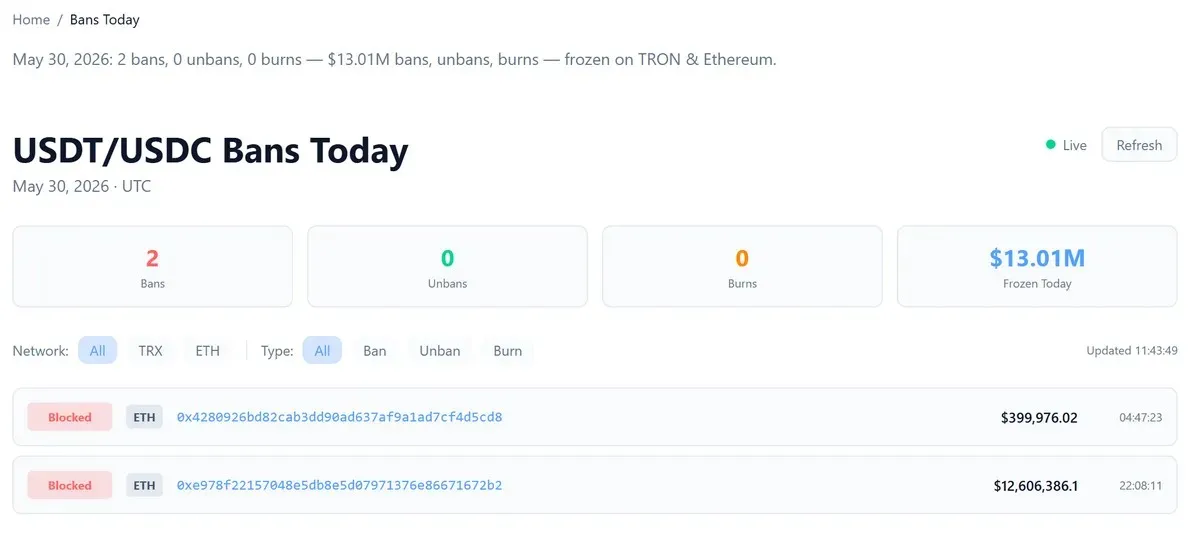
Circle blacklisted Zamas confidential USDC contract on Ethereum on May 30. The blacklist freezes roughly $12.6 million held in a cUSDC token contract.  The freeze prevents holders of confidential USDC (cUSDC) from redeeming the tokens for standard USDC. The action raises fresh questions about issuer control over privacy-focused Decentralized Finance (DeFi) protocols.  Circle Blacklist Halts cUSDC Redemptions  Circle, the issuer of USDC, maintains a built-in blacklist on the USDC smart contract. Authorized Circle accounts add addresses, and blacklisted addresses cannot send or receive the stablecoin.  The frozen contract is an ERC-1967 proxy that holds USDC on behalf of cUSDC token holders. Zamas privacy protocol uses fully homomorphic encryption (FHE) to conceal balances and transfer amounts on public chains.  Circle blacklisted the Zama (privacy protocol) Confidential USDC (cUSDC) contract on Ethereum. Source: USDTBanList  Circle has not publicly explained the decision.  Past freezes have followed sanctions orders, court directives, or suspected illicit activity. The company blacklisted Tornado Cash-linked USDC in 2022 after the U.S. Treasury sanctioned the mixer.  ZachXBT Links Freeze to Overnight Finance  On-chain investigator ZachXBT traced the underlying funds to a wallet, which deposited 12.4 million USDC into Zama on May 11. The wallet appears to belong to Overnight Finance.  Overnight Finance recently held a Snapshot governance vote to distribute

05-30Industry

Bitcoin faces $70K test as Hyperliquids stablecoin supply rises 8% – Capital rotation?

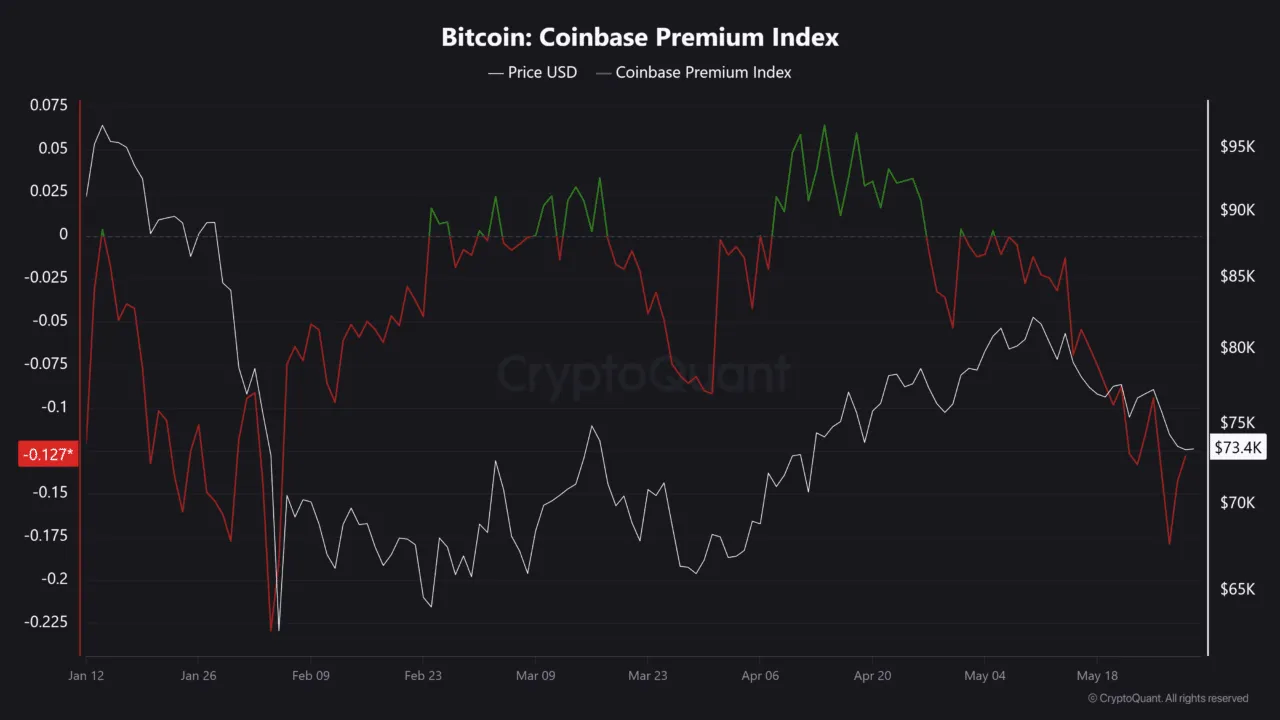
Reading on-chain data at the right time can give investors an early edge.  At the current stage of the cycle, timing matters more than ever. From a technical view, traders have wiped $10 billion+ from the market this week, dragging Bitcoin closer to $70k.  With major liquidity clusters sitting on both the upside and downside, the next move could trigger a significant liquidity sweep in either direction.  That said, several early indicators suggest bulls are gradually losing control. Bitcoin sentiment has dropped into extreme fear, a level that has historically signaled capitulation events.  At the same time, more than 45% of short-term holders (STHs) are now underwater, increasing the likelihood of panic selling as market participants begin to test their conviction.  Source: CryptoQuant  Notably, the same trend is visible among U.S. investors.  According to CryptoQuant, Bitcoins Coinbase Premium Index (CPI) recently dropped to a more than three-month low of -0.17, highlighting weak demand from the U.S.-based participants.  This weakness also shows up in ETF flows, with Spot Bitcoin ETFs recording more than $1.4 billion in net outflows this week alone.  Taken together, these signals suggest that bears currently hold the advantage, leaving Bitcoin [$BTC] vulnerable to further downside.  As a result, the $70k support level looks increasingly difficult to defend,

05-30Exchange

Circle Freezes $12.6 Million in Confidential USDC, Exposing Surveillance Risks

Circle blacklisted Zamas confidential $USDC contract on Ethereum on May 30. The blacklist freezes roughly $12.6 million held in a cUSDC token contract.  The freeze prevents holders of confidential $USDC (cUSDC) from redeeming the tokens for standard $USDC. The action raises fresh questions about issuer control over privacy-focused Decentralized Finance (DeFi) protocols.  Circle Blacklist Halts cUSDC Redemptions  Circle, the issuer of $USDC, maintains a built-in blacklist on the $USDC smart contract. Authorized Circle accounts add addresses, and blacklisted addresses cannot send or receive the stablecoin.  The frozen contract is an ERC-1967 proxy that holds $USDC on behalf of cUSDC token holders. Zamas privacy protocol uses fully homomorphic encryption (FHE) to conceal balances and transfer amounts on public chains.  Circle blacklisted the Zama (privacy protocol) Confidential $USDC (cUSDC) contract on Ethereum. Source: USDTBanList  Follow us on X to get the latest news as it happens  Circle has not publicly explained the decision.  Past freezes have followed sanctions orders, court directives, or suspected illicit activity. The company blacklisted Tornado Cash-linked $USDC in 2022 after the U.S. Treasury sanctioned the mixer.  ZachXBT Links Freeze to Overnight Finance  On-chain investigator ZachXBT traced the underlying funds to a wallet, which deposited 12.4 million $USDC into Zama on May 11. The wallet appears to belong to

05-30Exchange

ETH Price Prediction: $2,200 Target Within 14 Days as Oversold Conditions Create Bullish Reversal Setup

The Immediate Setup  Ethereum is bleeding but showing classic oversold exhaustion signals that veteran traders live for. At $2,017, ETH has carved out a clean 1.70% bounce off yesterdays $1,967 low, with the RSI sitting at a juicy 32.28 – deep enough to trigger institutional buying algorithms but not panic-level oversold. The MACD histogram flatlined at zero tells me momentum is shifting from bearish to neutral, creating the perfect storm for a relief rally.  What‘s particularly compelling is the Bollinger Band positioning at 0.165, meaning price is hugging the lower band like a desperate trader clinging to their last margin. This technical setup screams “buy the dip” to anyone who’s survived more than one crypto cycle, especially with Blockchain.news reporting consistent institutional interest despite the recent pullback.  Key Levels Exposed  The moving average structure paints a clear roadmap for the bounce. With price sitting $48 below the 7-day SMA at $2,065 and $137 below the 20-day at $2,154, we‘ve got a natural staircase of resistance levels that will act as profit-taking zones. The immediate resistance at $2,042 represents the first real test – break that and we’re looking at a run toward the 7-day SMA.  More importantly, the 200-day SMA at $2,512 remains the ultimate

05-30Ethereum
1
...
599601
...
1000