Bitcoin and Ethereum ETFs lose $530 million in one day as $3 trillion Wall Street wipeout rattles crypto

US spot Bitcoin and Ethereum ETFs suffered $530 million in combined withdrawals Thursday as a Wall Street rout erased their post-midterm gains.  Related Asset Bitcoin #1 BTC · $76,059.13 24-hour change: down 5.36% Loading price history… 24H Down 5.36% 7D Down 1.89% 30D Down 9.12%  Data from Farside Investors showed that Bitcoin ETFs lost $430.23 million on Nov. 5, while their Ethereum counterparts recorded another $99.98 million in outflows.  Bitcoin and Ethereum ETF flows on Nov. 5, 2026  Daily US spot ETF net flows, not assets under management. Two-decimal values reconcile to the user-supplied fund list; Farside independently lists rounded one-decimal totals of -$430.2M for Bitcoin and -$99.9M for Ethereum. Additional precision is unverified.  Retry chart  Chart by CryptoSlate  Source: Farside Bitcoin ETF flows, Nov. 5, 2026 · Farside Ethereum ETF flows, Nov. 5, 2026  View dataHide data  Bitcoin and Ethereum ETF flows on Nov. 5, 2026USD -430,230,000USD -99,980,000CategoryNet ETF flowBitcoin ETFsEthereum ETFs  BlackRock ETFs lead outflow streak  The latest ETF withdrawals extended a broader retreat that had begun before Thursdays market turbulence.  Related Asset Ethereum ETH · $2,236.89 24-hour change: down 7.49%  BlackRocks iShares Bitcoin Trust (IBIT) recorded $105 million in outflows, marking its fifth consecutive trading session of withdrawals.  Over that period, investors pulled approximately $1.04 billion from the fund, including $405.3
11-06Industry

Kalshi faces federal injunction over sports contracts on California tribal lands

Kalshi has been barred from offering sports-event contracts on the lands of two California tribes after a federal judge granted a preliminary injunction in a dispute over whether the platforms contracts violate tribal gaming laws.  In a November 4 court order, U.S. District Judge Jacqueline Scott Corley ruled in favor of Blue Lake Rancheria and the Chicken Ranch Rancheria of Me-Wuk Indians. The injunction applies to sports contracts offered on the tribes Indian lands, including those covering football, basketball, baseball, soccer, tennis and Ultimate Fighting Championship events.  The ruling requires the tribes to provide Kalshi with maps showing the boundaries of their lands by November 13. Kalshi must submit a report detailing its compliance measures within 21 days of the November 4 order.  Kalshi faces restrictions on sports contracts on tribal lands  The injunction prevents Kalshi Inc. and KalshiEX from offering sports contracts on the designated tribal lands while the underlying lawsuit continues.  The restriction covers contracts involving golf, hockey, boxing, wrestling, motorsports, pickleball, chess and esports, alongside other sporting events. It does not prohibit Kalshi from operating throughout California or establish a nationwide ban.  The tribes initially challenged Kalshis sports contracts in July 2025, arguing that the platform was facilitating unauthorized Class III gaming under

11-06Industry

DSAs Adrian Wall and Former CFTC Chair Chris Giancarlo Discuss Future of U.S. Crypto Regulation at Strobe Summit

The Digital Sovereignty Alliance (DSA), a nonprofit organization dedicated to advancing clear and ethical public policy, research, and education related to emerging technologies, participated in the Strobe Summit, where DSA Managing Director Adrian Wall moderated a fireside chat with former Commodity Futures Trading Commission (CFTC) Chair Christiopher Giancarlo on the evolving regulatory landscape for digital assets and the future of financial markets.  Titled “Crypto at a Crossroads: Regulation, Institutional Adoption, and the Future of Financial Markets,” the discussion examined the path forward for U.S. digital asset policy amid legislative uncertainty and growing institutional interest in blockchain-based financial infrastructure. Drawing on his experience leading the CFTC and founding the Digital Dollar Project, Giancarlo emphasized an approach to regulation that combines clear exchange rules under existing CFTC authority with congressional action to address remaining gaps. The conversation also explored the implications of the GENIUS Act, including Giancarlos concerns about financial privacy and his view that dollar-backed stablecoins could become a 24/7 global payment rail, raising fundamental questions about how the dollar moves on-chain and who provides that infrastructure.  Wall and Giancarlo also examined the regulatory challenges surrounding prediction markets, perpetual futures, and decentralized finance (DeFi). Topics included the CFTCs role in overseeing event contracts,

11-06Industry

Sui says USDC support is coming to Samsung Wallet in November

Sui has confirmed that its USDC stablecoin integration with Samsung Wallet will become available to eligible Galaxy users in the United States later in November, adding another blockchain network to Samsungs expanding digital payment service.  In a November 5 announcement, Sui said users would soon be able to access USDC on its blockchain through Samsung Wallet, which already supports payment cards, digital keys and boarding passes.  The networks Chinese-language account said the integration could potentially reach around 82 million compatible Galaxy devices in the United States, allowing users to transfer USDC without installing a separate cryptocurrency wallet or holding SUI tokens to cover network fees.  The latest announcement follows the original partnership disclosure on October 8, when Samsung identified Sui as one of its blockchain infrastructure partners alongside Solana.  Samsung has since introduced its Stablecoin Account service with support for USDC on Solana, which went live on November 2. Suis integration is expected to follow later this month.  Suis Samsung Wallet integration will support gasless USDC transfers  Under the arrangement, eligible users will be able to hold and send USDC on Sui directly through Samsung Wallet, with the blockchain handling transactions behind the familiar mobile application.  The feature uses Sui‘s gasless stablecoin transfer infrastructure, which went live

11-06Industry

XRP Ledger's Biggest Lending Upgrade Just Got Closer

The XRP Ledger (XRPL) is on the verge of a significant decentralized finance (DeFi) upgrade that could potentially open up new lending possibilities and liquidity for the XRP Ledger network.  According to Vet (@Vet_X0), a notable XRPL validator and community member, the much-anticipated Lending Protocol amendment has now gained two more Yes votes from validators, moving one step closer to activation.  The Lending Protocol amendment now boasts 21 Yes votes from a total of 35 trusted validators (60%). The amendment needs eight more Yes votes to reach the minimum threshold of 29 validators.  Reaching this threshold doesnt mean that the upgrade will instantly go live. Instead, reaching the supermajority threshold will initiate the mandatory two-week activation period, which requires a minimum of 80% of validators to support the amendment.  XLS-66, explained  The upgrade, known as XLS-66, is geared towards adding a native lending feature to the XRP Ledger.  In contrast to most crypto lending services, where borrowers are typically required to provide more collateral than the loan amount, XLS-66 is specially crafted to enable fixed-term and non-collateralized lending.  This will enable qualified borrowers to secure loans without the need to hold cryptocurrency collateral that exceeds the loan amount.  According to the official XLS-66 document, the Lending Protocol will

11-06Industry

Bitcoin’s rate cut relief stalls as service inflation flares

US services growth slowed in October, while the surveys 12-month average prices index reached its highest level since April 2023. Persistent cost pressure complicates the case for rate relief that could support Bitcoin.  Related Asset Bitcoin #1 BTC · $75,644.48 24-hour change: down 5.91% 24H Down 5.91% 7D Down 3.58% 30D Down 10.26%  The Institute for Supply Management‘s (ISM) October services report, released Nov. 4, put its headline PMI at 54.5, down from September’s 54.9. The reading remained above 50, indicating that services activity was still expanding.  The monthly prices index also eased to 73 from 74, but its 12-month average rose to 69.2, the highest since April 2023. The longer view points to persistent cost pressure even as the latest monthly reading retreats.  ISMs diffusion indexes measure the direction and breadth of reported changes. A prices reading of 73 summarizes those survey responses, while an inflation rate measures the size of price changes in percentage terms. The rolling average summarizes that pressure across a longer window.  Business activity and new orders eased to 53.8 and 55.9, respectively, while the employment index rose to 51.4. Hiring strengthened alongside softer demand measures.  Services slow. Average price pressure builds.  Octobers growth and monthly prices readings eased. The 12-month prices

11-06Industry

IREN stock falls 17% as Bitcoin mining revenue drops 58%

IREN has reported a 58% quarterly decline in Bitcoin mining revenue to $28 million as the Nasdaq-listed company prepares to substantially complete its move away from cryptocurrency mining by December 31, 2026.  SummaryIRENs Bitcoin mining revenue fell 58% to $28 million as the company reduced mining operations.AI cloud revenue surged 182% to $200 million, accounting for most of IRENs quarterly revenue.IREN plans to substantially complete its Bitcoin mining transition by December, with limited operations continuing.IREN shares closed at $18.03 on November 5, falling 16.95% during the trading session that day.Microsoft‘s requested infrastructure changes pushed IREN’s $4 billion annual recurring revenue target into early 2027.  The companys November 5 earnings release showed that AI cloud revenue climbed 182% to $200 million during the three months ended September 30, up from $71 million in the previous quarter. Total revenue reached $228 million, an increase of 66% from $137 million in the June quarter.  New multi-year contracts. Disciplined capital allocation. Flexibility to set our own pace of growth. Value at every layer of the platform.  Last quarter, AI Cloud revenue nearly tripled to $200 million.  Other highlights from our Q1 FY27 results:  – Total quarterly revenue… pic.twitter.com/DPDkvgMhX4  — IREN (@IREN_Ltd) November 5, 2026  The company reported a net loss of $263

11-06Industry

Kalshi CEO Pitches Insider Trading Rules as Democrats Weigh Their Own

Kalshi CEO Tarek Mansour told CNBC he backs insider trading bans for Congress members and administration officials. Democrats won both chambers of Congress this week, and some in the party want election contracts banned outright.  The Senate already barred its own members and staff in April. Meanwhile, Kalshi alone carried about $1.3 billion in midterm wagers by Monday, per a Washington Post analysis.  Sponsored  Sponsored  Will Kalshis Insider Trading Pledge Head Off Tougher Rules?  Kalshi, regulated by the Commodity Futures Trading Commission (CFTC), lets users trade contracts that pay $1 if an event occurs.  CNBC disclosed during the interview that it has a commercial relationship with Kalshi, including customer acquisition and a minority investment.  Mansour said Kalshi has policed insider trading since its 2018 founding.  “If somebody has exclusive rights and privilege in a competition then the competition is fake.”  Tarek Mansour, CEO of Kalshi, on CNBC  He called for strict rules barring Congress, the administration, and others from trading markets they can influence.  Sponsored  Sponsored  He also cited former Rep. George Santos, ordered by the CFTC to pay about $35,000 over bets against himself.  CNBC‘s hosts raised Rahm Emanuel’s call for an ethics bill covering stock and prediction market trading. Emanuel is a former Chicago mayor.  Kalshi also opened a probe in October into

11-06Industry

Unpatched Bitcoin Lightning nodes face channel-draining bug

Core Lightning, software for operating Bitcoin Lightning payment nodes, is urging users to install v26.06.10 to address channel-security, payment-resolution, and remote-access flaws.  Related Asset Bitcoin #1 BTC · $75,534.11 24-hour change: down 5.99% Loading price history… 24H Down 5.99% 7D Down 3.30% 30D Down 10.24%  Maintainers also recommend reviewing the credentials used for remote commands, making access restrictions a separate task alongside the software upgrade.  The release notice recommends upgrading as soon as practical. Maintainers have temporarily withheld security-fix tests to slow the conversion of patches into working exploits and give operators more time to upgrade.  The new version adds checks on a peers transaction signatures during Bitcoin dual-funded channel opening and splicing, following the Lightning protocols BOLT 2 specification, according to the tagged changelog.  A conditional Bitcoin payment contract, known as an HTLC, that had just been removed could be confused with a live one sharing its payment hash, amount and expiry. The node could then fail the live payment upstream even though its peer could still claim it.  Another fix rejects channel opens when a peer proposes a dust limit above 5,000 satoshis. The changelog says the previous behavior let a peer trim the nodes balance into fees during a forced close. Dual-funded opens

11-06Industry

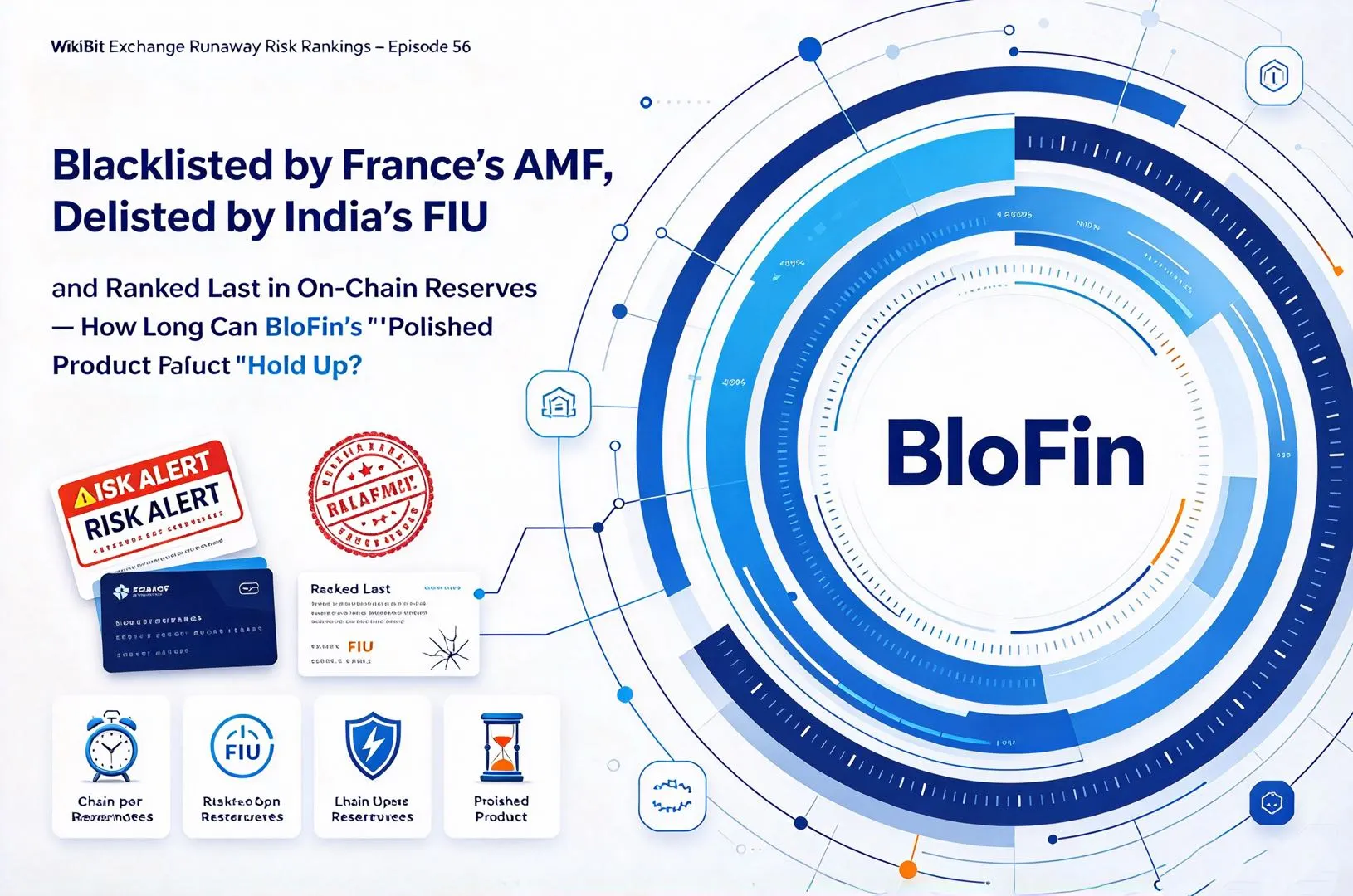
WikiBit Exchange Runaway Risk Rankings – Episode 56: BloFin: Blacklisted by France's AMF, Delisted by India's FIU, and Ranked Last in On-Chain Reserves — How Long Can BloFin's “Polished Product” Hold Up?

Introduction: A Derivatives Exchange with a Polished Product but a Fragile Foundation  In our previous 55 episodes, we investigated a wide range of exchanges, from HashKey to Coinbase. For Episode 56, were turning our attention to a rather specialized player: BloFin.  When it comes to product design, BloFin does have some notable strengths. Founded in 2019 by Matt Hu, the founder of TokenInsight, the exchange officially launched in January 2023. Its core business focuses on perpetual futures and copy trading, offering 508 perpetual trading pairs, leverage of up to 150x, maker/taker futures fees of 0.02%/0.06%, and copy trading with a minimum starting amount of just 100 USDT.  Its copy trading system offers three position modes, while its trader leaderboard additionally discloses risk-adjusted performance metrics such as the Sharpe, Sortino, and Calmar ratios — features that are relatively uncommon among comparable platforms.  BloFin also claims to provide 1:1 asset reserves, Merkle Tree-based Proof of Reserves (PoR), independent monitoring by Nansen, and custody services through Fireblocks.  However, the picture looks very different on the regulatory and financial fronts.  BloFin is absent from ESMAs MiCA CASP register. Frances financial regulator, the Autorité des Marchés Financiers (AMF), has included it on its cryptocurrency blacklist since December 2024. On September 9,

11-06Deep Dive
1
...
4951
...
1000