Brazil sets 24-hour hold on $10,000 crypto transfers

Brazil‘s central bank has ordered virtual asset service providers to hold certain crypto transfers for up to 24 hours from Jan. 1, 2027, adding a new anti-fraud layer to the country’s expanding digital asset rulebook.  Banco Central do Brasil published Resolution BCB No. 584 on Aug. 7, covering transfers above $10,000 destined for foreign crypto providers or self-custody wallets.  JUST IN: Brazils central bank plans 24-hour delay on crypto transfers over $10,000  The anti-fraud rule targets moves to foreign exchanges and self-custody wallets pic.twitter.com/wxGMpKMMmO  — crypto.news (@cryptodotnews) August 9, 2026  The threshold applies either to one transaction or a customer‘s combined transactions during the same day. Smaller transfers can also face additional review when a provider’s risk policies identify reasons for closer scrutiny. The central bank said the measure responds to growing use of virtual assets, including stablecoins, to move proceeds from financial fraud quickly, sometimes beyond Brazil or into wallets controlled directly by users.  Brazil crypto transfers will face new checks  Under the central banks new anti fraud rules, a covered provider must retain the assets for 24 hours before proceeding with qualifying transfers. However, the measure is precautionary rather than a permanent freeze. A provider can complete its risk review and release the transfer before

Within 1 weeksIndustry

10,684,707 SHIB Burned With Shiba Inu Burn Rate Surge of 439%

In a recent hourly update, Shibburn reports that a total of 10,684,707 SHIB were burned in the last 24 hours, with the daily burn rate surging 439.79%. This marked an increase from the previous day, causing the burn rate to increase more than 3x.  The over ten million SHIB tokens burned in the last 24 hours added to a cumulative total of 173.37 million burned in the last seven days. In the last 30 days, over 3.36 billion SHIB were burned, with the burn rate skyrocketing 2811.38% in this timeframe. A total of 410,843,703,896,181 SHIB has been burned in 21,502 transactions, according to the Shibburn website.  At the time of writing, SHIB was down 1.26% in the last 24 hours and 7.38% weekly. The majority of cryptocurrencies were posting modest gains on a weekly basis after the Senate confirmed it would not vote on the Digital Asset Market Clarity Act before leaving for its August break.  The bill, which would clarify which U.S. regulator oversees which digital assets, requires 60 votes to pass, and it is unclear whether it has received 50.  Next week brings the U.S. employment report and July inflation data. The Federal Reserve held rates steady at 3.50% to 3.75% in

Within 1 weeksIndustry

87.5 Trillion: New Reality for Shiba Inu (SHIB) Is Established

With 87.5 trillion tokens of SHIB held on trading platforms, Shiba Inu is entering a new stage of its exchange activity. Exchange reserves are 87.5252 trillion SHIB according to the most recent on-chain data, a decrease of 0.18% over the previous day. More significantly, the seven-day chart indicates that reserves are declining following a significant period of accumulation.  Too big to rally  The shift is significant because exchange reserves quantify the readily available supply that is stored in wallets under exchange control. While persistent withdrawals lower the amount of SHIB that is easily accessible for trading, rising reserves may increase potential sell-side liquidity. However, the absolute supply is still very large at 87.5 trillion SHIB, so the most recent decline should not automatically be seen as a supply squeeze.  SHIB/USDT Chart by TradingView  A much stronger signal is provided by netflow data. With a 24-hour decline of 4.73%, SHIBs total exchange netflow is currently at about -159.4 billion tokens. Withdrawals exceeded deposits during the measured period, which is known as a negative netflow. In contrast, exchange inflows have changed by just 0.04% to 231.187 billion SHIB. Exchange reserves dollar value has decreased more quickly than the token balance.  Shiba Inu reserves stay too high  The USD

Within 1 weeksIndustry

Stripe-owned Bridge joins EU MiCA register after Luxembourg approval

Bridge Building, the Luxembourg-based entity behind Stripe-owned stablecoin infrastructure company Bridge, has joined the European Unions Markets in Crypto-Assets Regulation (MiCA) register after receiving regulatory approval in Luxembourg.  Bridges inclusion brings the number of MiCA-authorized electronic money token (EMT) issuers in the EU register to 42, according to the latest European Securities and Markets Authority (ESMA) update published on Wednesday.  The addition came weeks after Bridge announced on July 2 that it had secured a Crypto-Asset Service Provider (CASP) authorization under MiCA and an Electronic Money Institution (EMI) licence from Luxembourg‘s Commission de Surveillance du Secteur Financier. Bridge’s Head of Product, Mai Leduc Blount, said the approvals allow businesses in the EU to build stablecoin and payment products under a regulated framework.  The same ESMA update added three new CASP entries from Germany, including Volksbank Die Gestalterbank, VBU Volksbank im Unterland and VR-Bank Erding, bringing the total number of authorized CASPs in the EU register to 324.  The update showed no changes to asset-referenced token authorizations, with no ART issuers listed. The list of non-compliant crypto asset companies was also unchanged.  ESMA has published more frequent updates to its MiCA register in recent weeks, with several updates in July.

Within 1 weeksIndustry

Bitcoins BIP-110 supporters split onto minority chain as main network pulls ahead

Quick TakeA small group of Bitcoin nodes that support the BIP-110 proposal broke away from the main network at block 961,632, creating a forked chain supported by only a fraction of the mining power of the main network.While Bitcoins main blockchain continued adding blocks normally, the BIP-110 chain had only produced two new blocks and was already seven blocks behind as of 6:00 p.m. ET.BIP-110 is a one-year change that limits non-financial data, such as Ordinals inscriptions, on Bitcoin. The proposal has sparked a debate over how Bitcoins block space should be used.Only 2.53% of blocks signaled support for BIP-110 over the last two weeks, well below the 55% threshold needed to lock in the proposal without a split.  Bitcoins (BTC) blockchain split into two branches Saturday when nodes running BIP-110 began rejecting blocks that did not signal support for the controversial “anti-spam” proposal. However, only a small minority of miners supports the forked chain.  BIP-110 is a proposed one-year rule that would restrict non-financial data on the Bitcoin blockchain, such as Ordinals inscriptions. The proposal has transformed a technical dispute into a broader fight over who gets to decide how Bitcoins limited block space can be used.  The split began at block

Within 1 weeksIndustry

US spot Bitcoin ETFs post best week since April with $1B inflows

Demand for US spot Bitcoin exchange-traded funds (ETFs) rebounded sharply this week, signaling renewed investor appetite after months of uneven flows, even as uncertainty persists around digital asset regulation and the security of crypto self-custody.  On Saturday, Bloomberg ETF analyst Eric Balchunas said the spot funds attracted roughly $1 billion in net inflows for the week, their strongest showing since April and third-best week since last October — a period he referred to as Bitcoins “silent IPO.”Source: Eric Balchunas  The term was popularized by investor Jordi Visser in November to describe what he viewed as a changing of the guard among Bitcoin holders. Under the theory, early investors were selling into growing demand from ETFs and other institutional buyers, creating enough supply to keep Bitcoin subdued despite substantial new capital entering the market.  That distribution coincided with a deterioration in ETF flows compared with earlier periods of stronger demand, making this weeks rebound particularly notable.  Related: Bitcoin miners‘ AI pivot loses Wall Street’s wow factor  Coldcard hack puts self-custody in focus  The rebound has also followed a major security incident involving Coldcard, a popular Bitcoin hardware wallet developed by Coinkite, that resulted in roughly $116 million worth of Bitcoin being stolen. The exploit was linked to

Within 1 weeksIndustry

Bitcoins BIP-110 enters mandatory signaling with miner support below 3%

Bitcoin Improvement Proposal 110 entered its mandatory-signaling phase at block 961,632 on Saturday, with miners signaling support in just 51 of the preceding 2,016 blocks, or 2.53%, well below the 55% threshold required for early activation, according to the BIP-110 monitor.  Starting at block 961,632, nodes enforcing BIP-110 began rejecting blocks that did not set version bit 4, while ordinary Bitcoin nodes continued accepting both signaling and non-signaling blocks. A minority BIP-110 branch subsequently emerged, but quickly fell behind the dominant chain.  The low signaling rate makes a sustained rival chain unlikely without substantially greater miner participation. With relatively little mining support, a BIP-110 branch could advance slowly or stop producing blocks altogether.  The milestone tests whether supporters can advance a contentious consensus change without broad miner backing, potentially separating enforcing nodes from the dominant chain and escalating a dispute over how Bitcoins block space should be used.  BIP-110 seeks temporary limits on Bitcoin data  Written by pseudonymous developer Dathon Ohm, BIP-110 proposes additional consensus restrictions lasting roughly one year.  It would limit most new output scripts to 34 bytes, cap OP_RETURN outputs at 83 bytes, restrict certain data pushes and witness elements to 256 bytes, and temporarily limit several Taproot features. Unspent transaction outputs created

Within 1 weeksIndustry

Crypto Weekly: ADA and Privacy Coins Outperform While XRP Slides

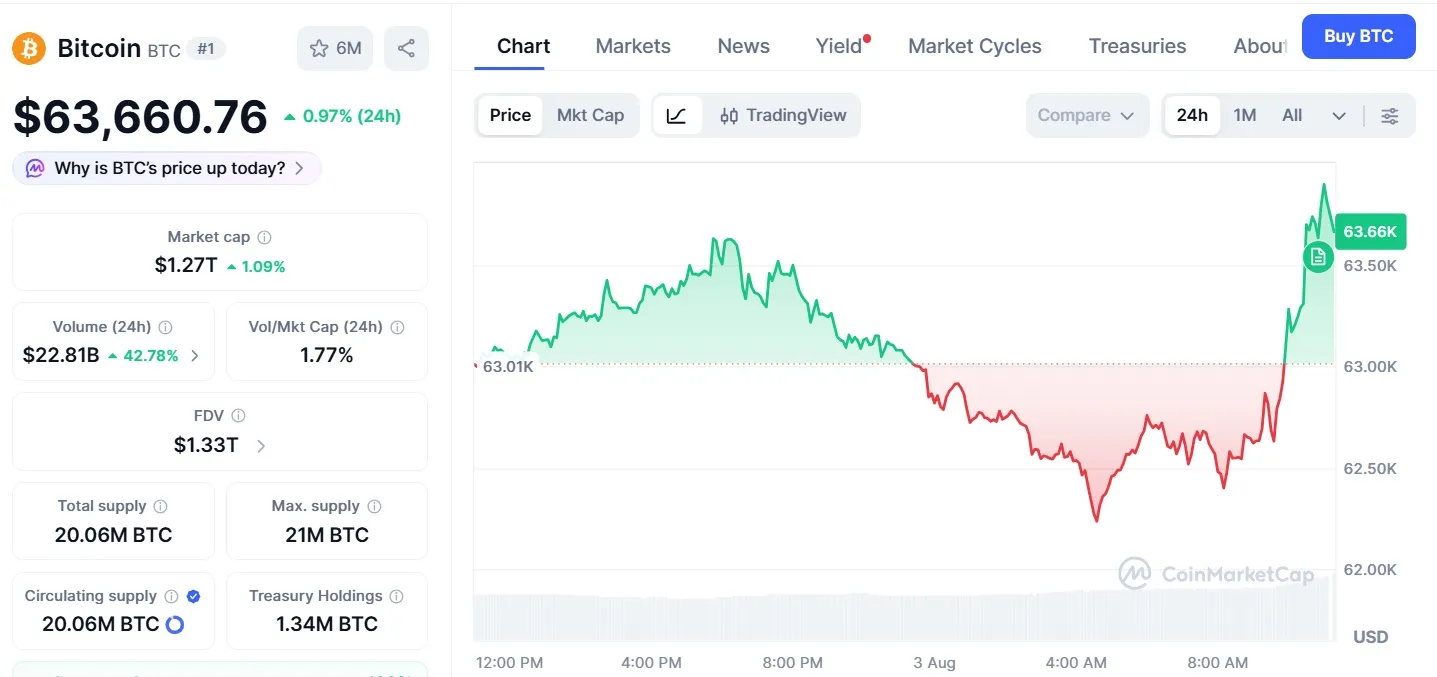
The aggregate crypto market cap rose from under $2.2 trillion to $2.9 trillion during the first week of August 2026. Bitcoin gained over 3% to peak above $65,300, pushing its market cap past $1.3 trillion while Cardano logged a second week of double-digit gains.   Bitcoin Reclaims $65,000 Despite CLARITY Act Setback  The first week of August delivered strong momentum across the cryptocurrency market, with aggregate market capitalization surging from a low under $2.2 trillion to reach $2.9 trillion by Aug. 8. Bitcoin spearheaded the rally, reclaiming the $65,000 threshold for the first time in August and lifting its total market cap back past $1.3 trillion.  Market data shows bitcoin gained over 3% over seven days, ascending from $62,721 to a peak just above $65,300 on Friday before consolidating above key support. Crucially, bitcoin secured these gains despite regulatory headwinds following the U.S. Senates failure to pass the CLARITY Act.  While bitcoin anchored the broader market, Cardano (ADA) emerged as the weeks standout performer, logging double-digit gains for the second consecutive week. ADA rallied from $0.174 to hit $0.211 on Aug. 6—a high not seen since June 4—fueled by news of a strategic integration between Cardano and the Injective protocol. Despite this short-term breakout,

Within 1 weeksIndustry

US Senate to vote on advancing CLARITY Act in September after Thune files cloture

US Senate Majority Leader John Thune has filed cloture on a motion to take up the Digital Asset Market Clarity Act, also known as the CLARITY Act, setting up a key procedural vote on the crypto market structure bill for September.  The vote is expected after the Senate reconvenes on Sept. 15, giving lawmakers several more weeks to resolve disagreements that prevented a deal before the August recess.  The Senate Daily Press confirmed that Thune filed cloture on the motion to bring the CLARITY Act to the Senate floor for consideration. Invoking cloture requires 60 votes, meaning Republicans will need Democratic support to clear the procedural hurdle.  Thunes move puts the CLARITY Act on a path toward Senate consideration after lawmakers failed to reach an agreement before the August recess. Negotiations have been complicated by disagreements over ethics provisions and rules governing stablecoin rewards, among other issues.  Source: Eleanor Terrett  While the move marks progress for the legislation, it does not guarantee that the CLARITY Act will receive a final vote or pass the Senate. The cloture vote concerns whether to take up the legislation for consideration, rather than passage of the bill itself.  The CLARITY Act is considered a landmark piece of US crypto legislation

Within 1 weeksIndustry

Hardware wallet sales in Russia more than double as new crypto rules near

SummaryRetailer M.Videos hardware-wallet unit sales rose 107% in Q2 from Q1, while Wildberries recorded an 84% year-on-year increase in H1.Wildberries average price for hardware wallets fell 13% to 7,900 rubles, and M.Video broadened its range of products, though neither retailer identified the driving force behind the demand.Hardware wallets support self-custody but do not bypass Russias withdrawal restrictions or eliminate device, backup and seed-security risks.  Russian consumers demand for hardware crypto wallets more than doubled in the first half of 2026, according to data from two major retailers, as the country prepares to introduce new crypto rules.  Retailer M.Video said unit sales on its marketplace rose 107% in the second quarter from the first quarter, while sales by value increased 92%. The retailer did not disclose the number of devices sold.  Wildberries, another Russian retailer, also recorded higher demand. Unit sales rose 84% in the first half from a year earlier, RIA Novosti reported, citing RWB, the marketplaces parent company. Sales value increased 60% over the period.  The comparisons cover different periods: M.Video measured Q2 against Q1, while Wildberries compared H1 with the same period of 2025. Neither company released unit totals.  Hardware wallets keep the private keys needed to control crypto on a dedicated device,

Within 1 weeksIndustry
1
...
3537
...
1000