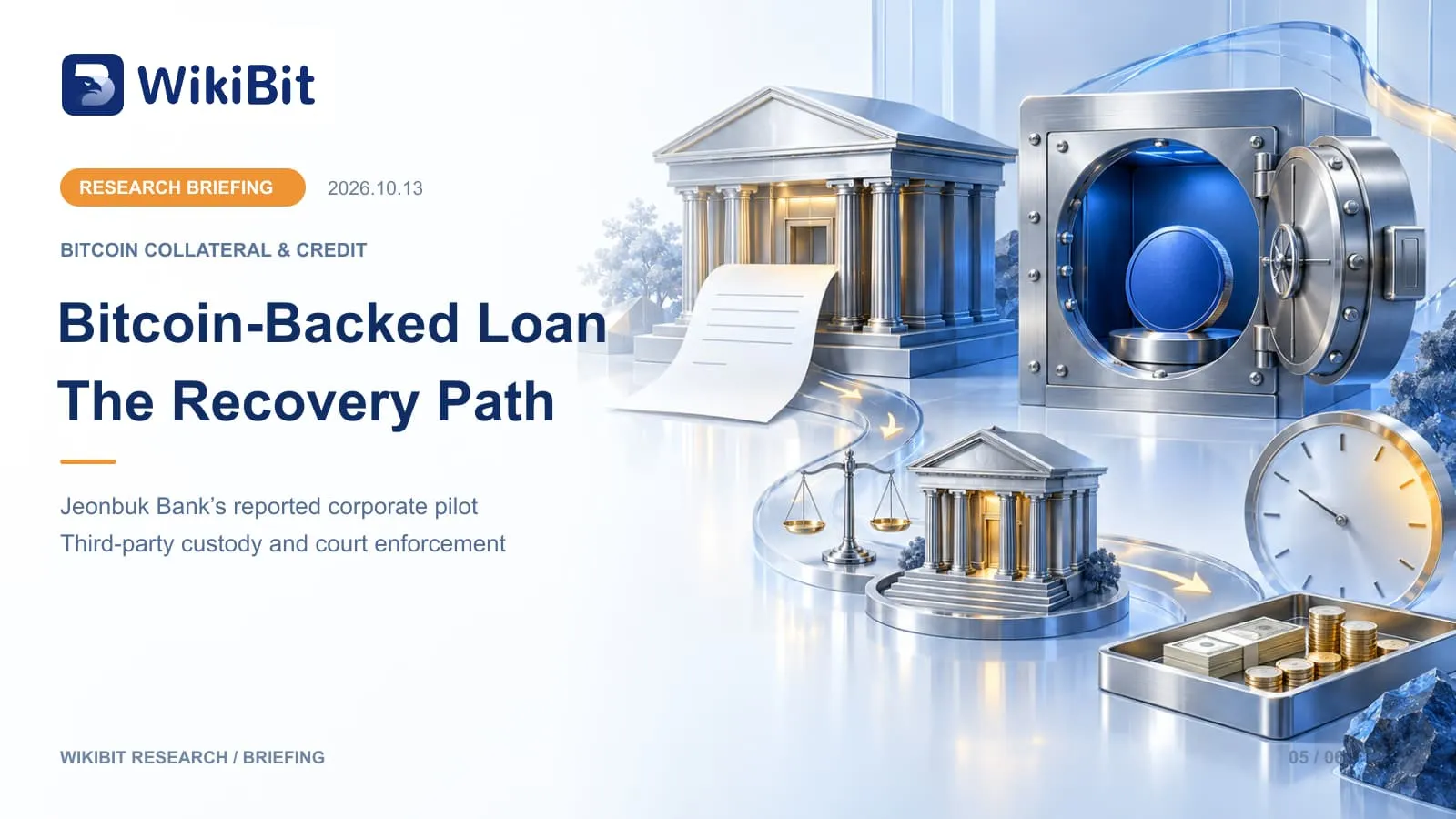
A Korean Bank Lent Against Bitcoin. The Important Part Is How It Can Recover the Collateral.

South Koreas Jeonbuk Bank made a corporate loan in Korean won using Bitcoin as collateral, according to local reporting published on October 12, 2026. Maeil Business described a single pilot transaction within existing corporate lending, not a standardized Bitcoin loan available to all businesses or consumers. EDaily reported comments from bank representatives about the structure. The bank has not released transaction documents identifying the borrower, loan size, interest rate or loan-to-value ratio.  Those limits matter. A completed pilot demonstrates that one legal and operational arrangement could be used in a specific case. It does not establish that the bank has launched a repeatable retail credit product or that Korean regulators have approved unlimited crypto-backed borrowing.A lender can use BTC collateral without taking custody itself  The reported arrangement uses an outside professional custodian to hold pledged Bitcoin, while the bank advances won against a corporate credit exposure. The borrower receives fiat working capital; Bitcoin acts as a contingent recovery asset if the borrower fails to meet its obligations.  Under this model the critical transaction is not an onchain loan contract automatically liquidating collateral. It is a traditional bank loan supported by a digital-asset pledge and a pathway to enforce that pledge. Local reporting describes
10-13Industry Research

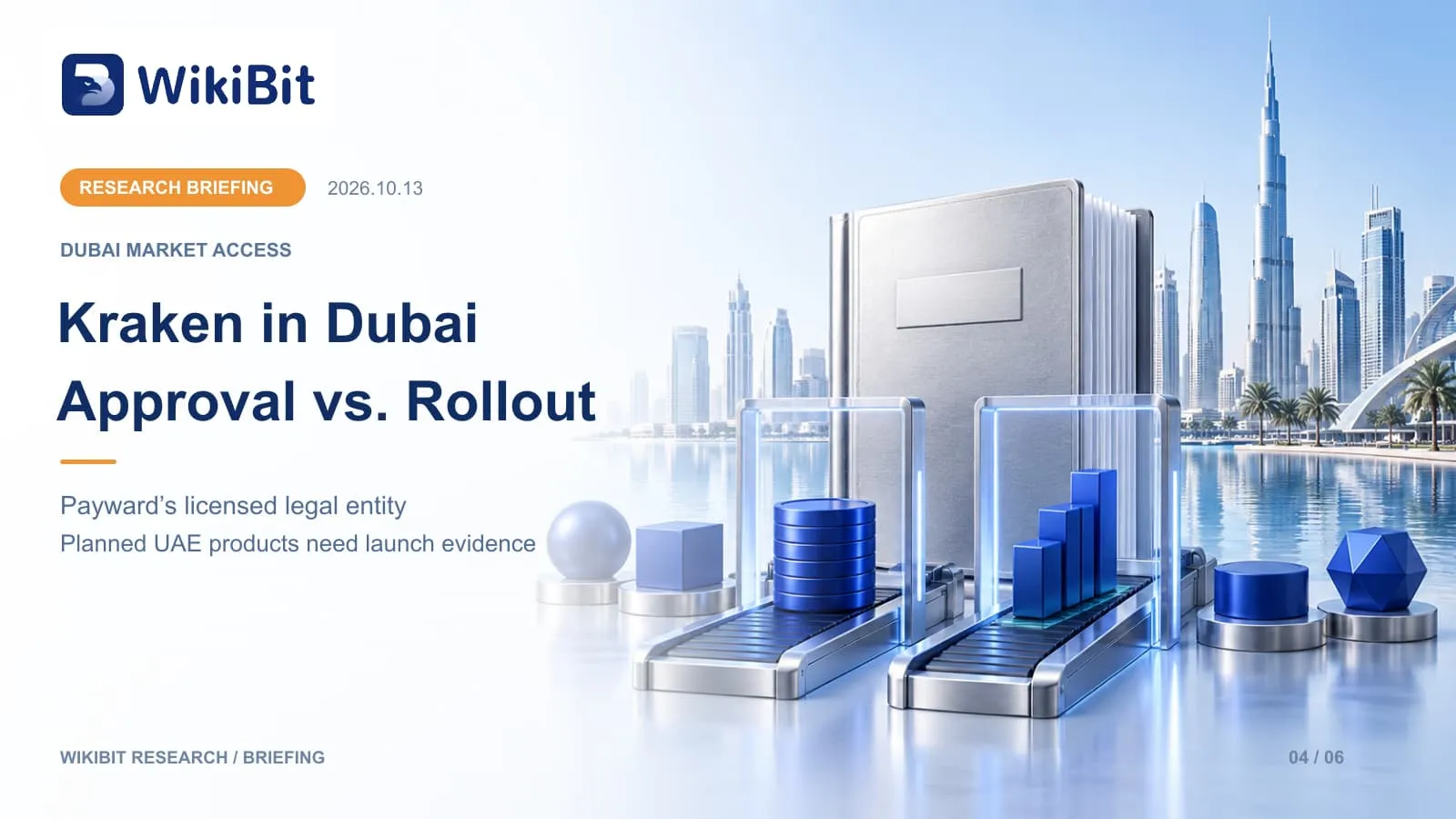
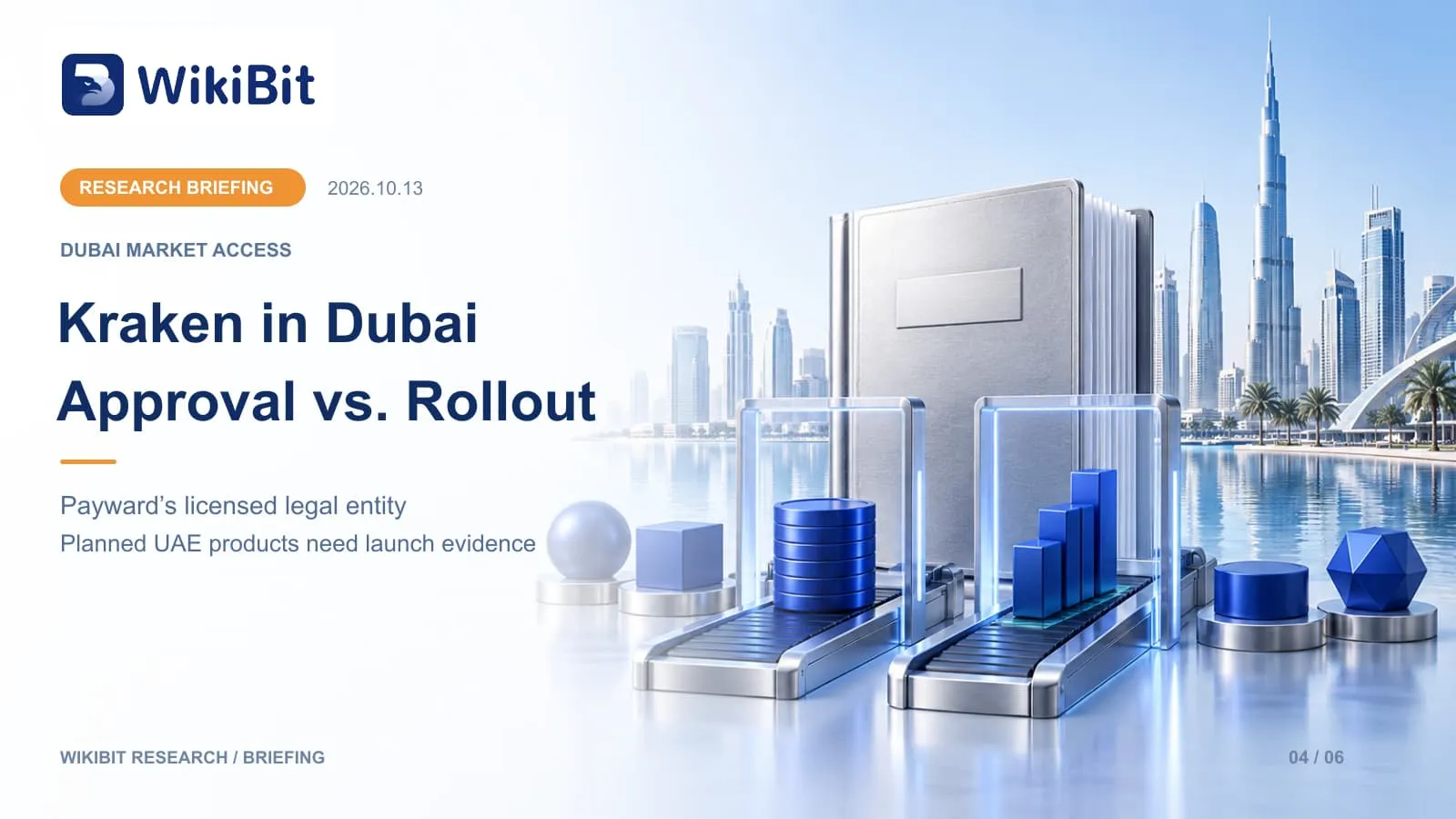
Kraken Dubai VARA Approval: What Is Licensed and When Services May Launch

On October 12, 2026, Kraken announced a Dubai licensing milestone through its Payward group, describing Full Market Approval from the Virtual Assets Regulatory Authority (VARA). The announcement identifies Payward FZCO as the relevant local entity and points to a planned launch of services for eligible customers in the United Arab Emirates over the coming weeks.  This is a meaningful change in Krakens regional regulatory position, but a license announcement and an operational product rollout are different events. Reports and the groups release describe plans for dirham-linked funding, spot and margin services, institutional execution and access to additional Kraken-group products. The announcement does not establish that every advertised feature was already available to all UAE customers on October 12.What the approval actually tells a customer  A licensed legal entity is a more useful starting point for due diligence than a global trading brand. A customer should check which company signs the account agreement, which regulated activities it may conduct, whether the planned service has actually commenced and which asset-protection rules apply to that entity.  VARA oversees virtual-asset activities in Dubai outside the Dubai International Financial Centre. The DIFC has its own financial-services regulator, the Dubai Financial Services Authority. Approval in one perimeter should not

10-13Industry Research

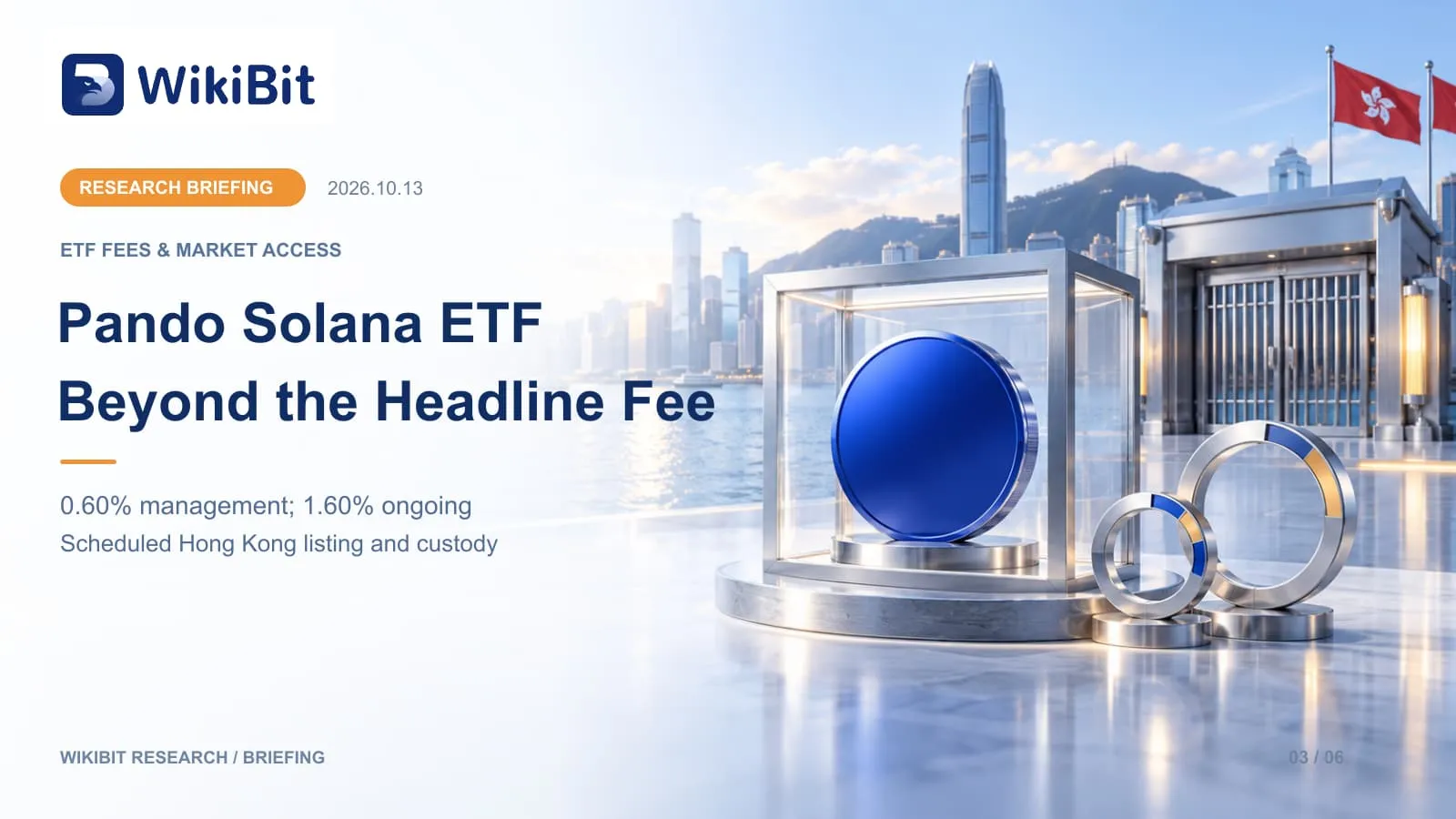
Pando Solana ETF 2831.HK: Hong Kong Listing, Fees, Custody and Risks

Pando Finances Solana exchange-traded fund, ticker 2831.HK, is scheduled to begin trading on the Hong Kong Stock Exchange on October 13, 2026. At the 08:49 Hong Kong-time research cutoff, the date was confirmed by the issuer, but an opening trade, first-day turnover and final initial assets could not yet be verified. Describing the listing as completed would run ahead of the evidence.  This is Hong Kongs second direct-exposure Solana ETF rather than the first. That distinction matters because it creates a competitive comparison: investors now need to assess more than whether a broker account can give them exposure to SOL. They must compare ongoing costs, custody, trading spreads and the funds treatment of staking.Read the fee disclosure beyond the 0.60% headline  Pandos product documents state an annual management fee of 0.60% and estimated annual ongoing charges of 1.60%. The fund reports a cap at the estimated ongoing-charge level for the specified period ending October 13, 2027. These figures are not a pair of charges to add together: ongoing charges represent a broader measure that includes the management fee along with other eligible fund expenses.  At a constant hypothetical investment value of HK$100,000, 0.60% corresponds to HK$600 per year and 1.60% to HK$1,600 per

10-13Industry Research

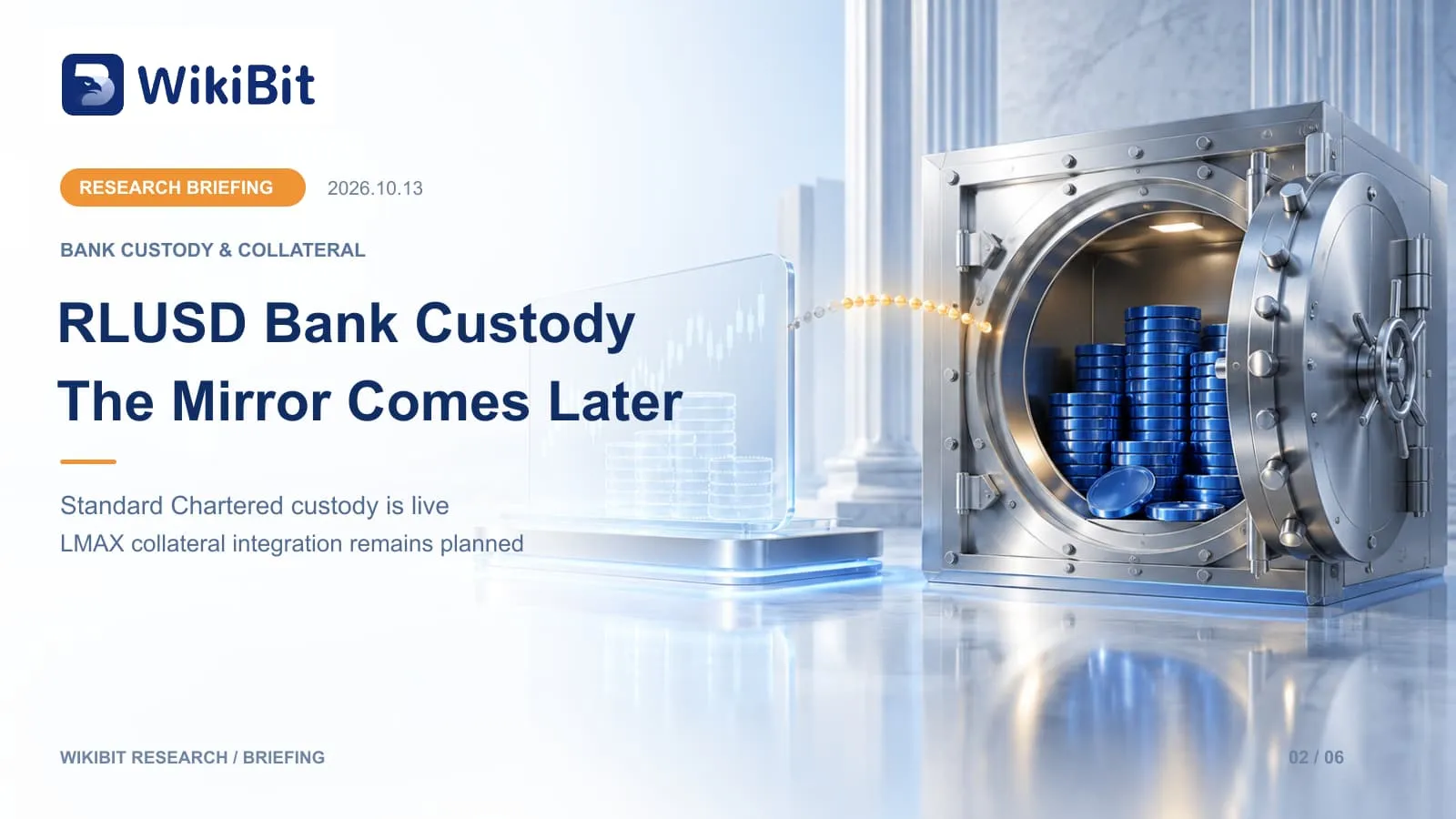
Standard Chartered RLUSD Custody Is Live; LMAX Collateral Link Is Not Yet

Standard Chartered announced on October 12 that institutional clients can now use its custody infrastructure for Ripple USD (RLUSD) issued on the XRP Ledger. The live service is offered through the banks Dubai International Financial Centre branch, regulated by the Dubai Financial Services Authority.  A second, potentially more consequential capability remains unfinished. The bank, Ripple and LMAX Group intend to make eligible RLUSD balances usable as collateral for agreed LMAX products through a mirroring arrangement. The banks announcement explicitly conditions that future capability on documentation, testing, internal approvals, applicable law and jurisdictional readiness. Calling it a live trading or credit facility would misstate what has been launched.Why collateral mirroring changes the operating model  Institutions commonly keep digital assets at a custodian and move them to a trading venue when they need margin. Every transfer can create settlement timing, address-management and counterparty-exposure risks. A collateral mirror seeks to tell a trading venue how much eligible value the custodian holds without requiring the underlying assets to be deposited directly at that venue.  Suppose a fund holds 10 million RLUSD under custody and seeks to support a trading position. In a hypothetical mirror, the custodian would confirm an eligible amount to the venue, while agreed legal

10-13Industry Research

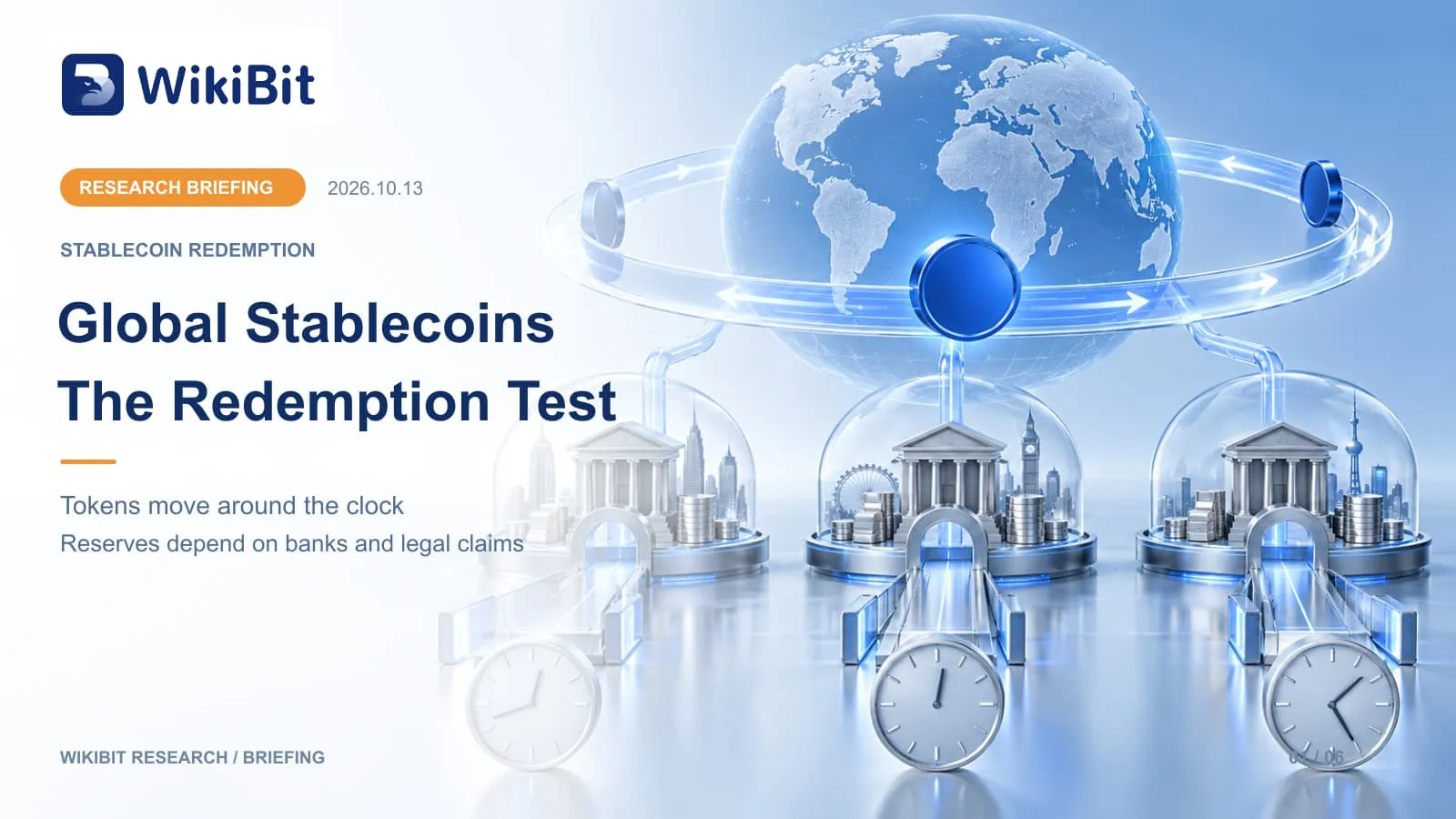
FSB Stablecoin Crisis Report: Cross-Border Redemption and Reserve Risks

On October 12, 2026, the Financial Stability Board published a note for the G20 on cross-border vulnerabilities in global stablecoin arrangements. Its most useful contribution is a practical failure scenario: a token may circulate across borders every hour of the week, while the assets and legal entities backing its redemption are spread across jurisdictions with different banking hours, insolvency regimes and supervisory powers.  The FSB describes the global stablecoin market as approximately $300 billion in mid-2026, with around 99% pegged to the US dollar. Those are the reports historical estimates, not a live market-capitalization reading for October 13. More importantly, the board says these arrangements have not been tested through severe stress or the insolvency of a major issuer. The report is an analysis and monitoring document. It does not impose a new ban, licensing deadline or binding redemption rule.A redemption request is more complicated than a blockchain transfer  Sending a dollar stablecoin from one wallet to another generally does not require banks to be open. Redeeming that same token for bank money does. The issuer must determine who has the legal right to redeem, access eligible reserves, pass operational and compliance checks and deliver fiat to the claimant.  Consider a hypothetical token

10-13Industry Research

Kraken Payward VARA License 2026: Dubai Status and Authorized Activities

Dubais Virtual Assets Regulatory Authority publicly lists Payward FZCO, an entity associated with Kraken, as an active VASP licensee. The regulator records a license issued on October 6, 2026, with reference VL/26/10/002. The local approval attracted wider press coverage on October 12, but the issuance date is October 6—not October 12 or 13.  For users, the consequential distinction is between a real, fully listed license and the marketing shorthand that “Kraken is approved for everything in the UAE.” VARAs register identifies two specific authorized activity categories: Broker-Dealer Services and Management and Investment Services. It does not list separate Exchange Services, Custody Services, or Lending and Borrowing Services under the Payward FZCO entry.What the regulators public record establishes  The current public entry identifies:Legal entity: Payward FZCO.License type: VASP Licence.Reference: VL/26/10/002.Issued: October 6, 2026.Status: Active.Activities: Broker-Dealer Services; Management and Investment Services.UAE CMA registration number: CMA-VASP-0101000-0067.  The register describes the entity rather than every product globally marketed under the Kraken brand. VARA regulates virtual-asset activities in most of Dubai, but the Dubai International Financial Centre (DIFC) operates under a separate regulator. Likewise, a VARA license should not be described as blanket federal authorization for every service throughout the UAE.From preliminary approval to a full license  Kraken announced

10-13Industry Research

FSB Global Stablecoin Risk Report 2026: Cross-Border Runs and Redemption

A stablecoin can circulate internationally at any hour while the banking assets supporting its redemption cannot necessarily be sold or transferred with the same speed. That timing and jurisdictional mismatch is at the center of a Financial Stability Board paper released October 12, 2026.  The FSBs note, Global Stablecoin Arrangements: Cross-border vulnerabilities and financial stability monitoring, is intended to inform authorities working on international oversight. It does not impose a new law, announce an issuer failure or identify a specific stablecoin that has lost its peg. Instead, it describes ways a future stress event could propagate through stablecoin issuers, banking counterparties and cross-border payments.What the $300 billion estimate does and does not say  The FSB puts the total stablecoin market at around $300 billion as of mid-2026, essentially unchanged from a year earlier. It says 99% by value was pegged to the U.S. dollar. Both figures describe the market at the stated midyear reference point, not live balances at October 13.  A market concentration in dollar pegs makes dollar liquidity and reserve governance relevant across jurisdictions, even where holders reside outside the United States. But the estimate is not an issuer-by-issuer solvency measure and says nothing about whether a particular token can honor

10-13Industry Research

OneKey Offers Free Replacements to CryptoBilis Buyers Through December 31 After Ledger Wallet Incident

OneKey is replacing hardware wallets bought through CryptoBilis even though it says no OneKey user has reported asset loss connected to the ongoing reseller incident. The companys October 12 response is preventive: it has removed CryptoBilis as an authorized reseller, frozen new reseller recruitment and begun re-checking its existing distribution network.  The move follows Ledgers discovery of unauthorized hardware inside an affected device sold through the same channel. It does not establish that a OneKey wallet was physically compromised, that OneKey firmware was breached or that all brands sold by CryptoBilis were altered. Those claims require separate evidence.Who qualifies for the free device  OneKeys replacement policy covers any OneKey hardware-wallet model purchased from CryptoBilis between March 1, 2026 and October 12, 2026, the date of its announcement. A device qualifies whether it was used, activated or kept sealed.  OneKey chose March 1 because an ex-cofounder had publicly described a change in CryptoBilis ownership and management around that period. This is the companys stated reason for selecting a precautionary coverage window, not an independently proven start date for physical tampering.  Applications must arrive by December 31, 2026. Customers must supply proof of purchase, the device model and whether it has been activated or used. OneKey

10-13Industry Research

Ledger–CryptoBilis Investigation: Bitquery Revises Estimated Drains to $102 Million and Retracts a Binance Lead

An important correction now sits alongside the rising loss estimate in the Ledger–CryptoBilis investigation. On October 12, blockchain-analytics firm Bitquery withdrew its earlier suggestion that transfers from four Tron wallets to Binance represented payments connected to the attacker. Those wallets were THORChain vault infrastructure, and the Binance-bound transfers belonged to other users of the swapping service. That lead should no longer appear in an account of the theft as proven attacker activity.  On the same day, Bitquery raised its estimate of the stolen assets to $102.0 million from 324 wallets across six blockchains. Its October 11 tally had been $93.2 million from 315 wallets. The numerical change is attributable to nine additional Tron wallets whose estimated 8.8 million USDT outflow occurred on October 9 at 20:49 UTC but was discovered later. These figures are Bitquerys analytical estimate, not Ledgers audited or confirmed total victim loss.The October 12 reconciliation  The arithmetic behind the revision is unusually transparent: 315 previously counted wallets + 9 newly identified wallets = 324; $93.2 million + $8.8 million = $102.0 million, with both values rounded in the analysts reporting. The newly detected transfer is dated October 9, not October 12. WikiBit therefore records it as newly discovered evidence

10-13Industry Research

KuCoin VENOM NFP Delisting: Withdrawals Closed, USDT Buyback Cap

KuCoin has offered VENOM and NFPrompt (NFP) holders a route out of two tokens that they currently cannot withdraw. That route is neither a token transfer nor an unconditional redemption: it is a limited, application-based USDT buyback, capped at 100 USDT per user across both tokens.  KuCoin announced the arrangement on October 12. The exchange says deposit services for VENOM and NFP are already closed and will not reopen. Withdrawals are unavailable and, in the wording of the official notice, will remain closed because the withdrawal service is unavailable. Meanwhile, trading continues only until the announced October 14 delisting, subject to the live platforms operational state.  This is a more severe exit condition than a routine delisting that leaves users a month to transfer their original assets. A holder who wants to retain VENOM or NFP outside KuCoin cannot currently use KuCoin to deliver those tokens on-chain.Two separate clocks: market exit and buyback claim  On October 14 at 06:00 UTC, KuCoin plans to shut down affected Spot Trading Bots. At 08:00 UTC on the same date it plans to delist the spot trading pairs. Outstanding spot orders will be removed when trading ceases; bots that users have not closed will be shut down

10-13Industry Research
1
...
204206
...
1000