Bitcoin Could Rebound to $90K but Risks $65K Retest: 21shares Strategist

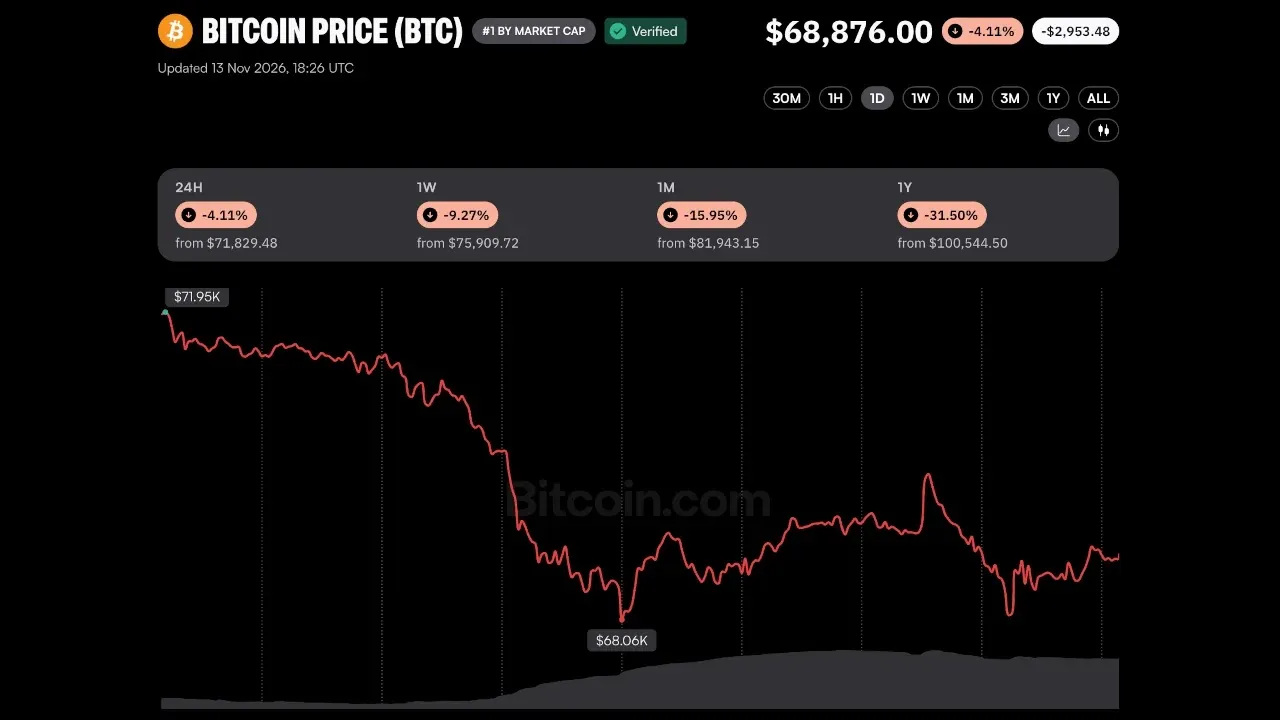
Bitcoin could recover toward $87,000 and eventually exceed $90,000, according to 21shares strategist Matt Mena. He linked the outlook to renewed buying after softer-than-expected producer inflation, while identifying support and resistance levels that would shape the recovery.  Key TakeawaysMena identified $70,000 and $74,000 as recovery thresholds for bitcoin.Losing support near $69,000 could expose $65,000 to another test.October producer prices rose 0.3%, while annual producer inflation reached 6.5%.  Strategist Maps Bitcoins Recovery Toward $90,000  Matt Mena, senior crypto research strategist at crypto investment product issuer 21shares, assessed bitcoins rebound in commentary supplied directly to Bitcoin.com News on Nov. 13. The 21shares research strategist described bitcoin as finding support around $69,000 and retesting $70,000 following the producer price index, or PPI, release. The index measures prices received by U.S. producers.  “We view this bounce as an encouraging sign that buyers are stepping in as selling pressure eases, though a sustained recovery will require bitcoin to reclaim $70K and then $74K,” Mena stated. “Bitcoin is showing immense strength, although it may not seem so, setting higher lows that are ~20% above its $57K cycle low.” He further shared:  “Holding $69K would help establish a base for that recovery, while a break below it would leave $65K vulnerable to
3 days agoIndustry

Fed Chair Warsh Wants Answers on AI Inflation—and Bitcoin May Feel the Impact

In briefFed Chair Kevin Warsh will lead a November 16 forum on AIs impact on inflation, productivity, and employment.AI infrastructure spending could keep interest rates higher for longer, adding pressure to Bitcoin.Bitcoin miners are also feeling AIs impact as technology companies compete for electricity and data centers.  Federal Reserve Chair Kevin Warsh will convene a public forum Monday to examine whether artificial intelligence will bring down inflation, drive prices higher, or replace American workers.  The November 16 conference in San Francisco will bring together technology executives, economists, and employers to examine how AI is reshaping the economy.  The findings could influence how the Fed approaches interest rates, a major factor in Bitcoins price movements as investors weigh whether to put money into risky assets or safer alternatives.  Predict·EconomyWhich companies will IPO before 2027?  Anthropic99%YesNo  Celonis50%YesNo  Remote6%YesNo  Glean5%YesNo  Ledger5%YesNo  +24 more outcomes+23 more outcomes  $625.67K volume  Jan 1Closes: Jan 1, 2027, 04:59 UTC  Closes: Jan 1, 2027, 04:59 UTC  Warsh has argued that AI could help companies produce more goods and services at lower costs, easing inflation without requiring the Fed to keep borrowing expensive.  But some of his colleagues see a different problem: The AI boom is already making things more expensive, while the promised productivity benefits remain largely theoretical.  Building data centers requires enormous quantities

3 days agoIndustry

Aave plan could cut some lenders share of interest by 60%

Aave lenders supplying DAI on Polygon could see their share of borrower interest fall from 75% to 30% under a November 12 proposal by TokenLogic. The plan would redirect more interest to Aaves DAO treasury, with uneven cuts to lender returns across its markets.  The November 12 proposal covers 54 reserves across 12 Aave V3 instances and Ethereum V2. TokenLogic estimates about $4 million in additional annualized DAO revenue using November 9 balances and rates. That total includes roughly $1 million from Plasma USDT0, a change that would enter the formal proposal only once its terms are finalized.  In Aaves lending system, the mechanism is the reserve factor: the portion of borrower interest allocated to the DAO instead of suppliers. Raising it changes who receives the interest, without directly changing the borrowing-rate curve. TokenLogic argues the larger share would better compensate the DAO for the risks attached to borrowable reserves.  Polygon DAI lenders face a larger cut  Polygon V3 DAI illustrates how much that allocation can matter. TokenLogic proposes raising its reserve factor from 25% to 70%, with a modeled supply APY reduction of 270 basis points, or 2.70 percentage points. The same line projects $94,373 in additional annual DAO revenue.  With the amount of

3 days agoIndustry

Bitcoin fell on 92% of stocks worst days since 2022: Sentora

Bitcoin has fallen on 92% of the U.S. stock markets worst days since 2022, according to Sentora research that has challenged the case for treating crypto as protection against equity selloffs.  SummaryBitcoin fell on 92% of stocks worst days since 2022, while Ether declined on 95%.Ether underperformed Bitcoin on 79% of the worst equity sessions in the recent sample.U.S. trading hours accounted for 33% of Bitcoins price variation despite representing 17.1% of time.Weekly exchange inflows reached $3.09 billion for Bitcoin and $1.10 billion for Ether, Sentora said.  Sentoras Nov. 13 research compared Bitcoin and Ether returns with U.S. stock indices from May 2018 through November 2026. Its findings showed that both cryptocurrencies frequently lost ground when equities suffered their heaviest losses, even though their average relationship with stocks looked relatively moderate.  The firm examined the diversification claim following the Nov. 5 selloff. In the figures shared with its newsletter briefing, the S&P 500 lost 4.4%, and the Nasdaq-100 fell 6.4%, while Bitcoin dropped 5% and Ether declined 7.2% over the same window.  Bitcoins stock-market link grew stronger during selloffs  Across the full sample, Sentora identified 107 sessions in the S&P 500s worst-performing 5%, each involving a loss of at least 1.74%. Bitcoin fell in 81%

3 days agoIndustry

BitGo denies breach as Unocoin transfers used client-held keys

BitGo has said its systems were not breached in the Unocoin incident, with its review finding that outgoing transactions were signed using two keys held by the Indian exchange after its account was frozen on Nov. 6.  SummaryBitGo says Unocoins account freeze worked and its signing key was never used in the transfers.Unocoin held two of the three keys in its self-custody wallet setup, according to BitGo.The exchange is investigating suspected misuse of a backup mechanism while working to restore services.  BitGo, in a Nov. 13 statement shared on X, said the transactions were signed with Unocoins user and backup keys and broadcast directly on-chain without its participation. The company said no other clients were affected and directed questions about customer funds to Unocoin.  Unocoins account was frozen on November 6, 2026, and the freeze functioned as intended.  Our review found that the recent outgoing transactions were signed using the user and backup keys held by Unocoin and broadcast externally on-chain, without BitGos participation.  Unocoins…  — BitGo (@BitGo) November 13, 2026  The statement follows the exchanges disclosure of outgoing transactions from an Ethereum address within its BitGo wallet infrastructure. Unocoin identified the activity on Nov. 12, several days after requesting freezes on accounts used for its daily

3 days agoIndustry

Trump‘s First Democratic Picks for SEC and CFTC Could Reshape Crypto’s Regulators

In briefTrump sent four nominees to the Senate for the CFTC and SEC, including his first Democratic picks for either agency.Both CFTC nominees worked on the Clarity Act; Levine would replace crypto advocate Hester Peirce at SEC, while Johnson, with a consumer-protection record, would take skeptic Caroline Crenshaws SEC seat.The picks would restaff agencies driving crypto policy after the Clarity Acts collapse, but a Democratic Senate takeover in January leaves a tight confirmation window.  President Donald Trump has nominated four people to fill vacant seats at the two federal agencies writing the rules for crypto, in a bipartisan slate that could reshape the commissions that have increasingly taken the lead on digital-asset policy after Congress stalled.  The White House said Thursday it sent the nominations to the Senate: Nathan Anonick and Matthew Rowland for the Commodity Futures Trading Commission, and Kristin Johnson and Steven Levine for the Securities and Exchange Commission.  Each requires Senate confirmation. Notably, the slate pairs a Republican and a Democrat at each agency, with Anonick and Levine the Republicans and Rowland and Johnson the Democrats, marking the first time the administration has put forward Democratic nominees for either commission.  Predict·CryptoWill the Clarity Act be signed into law in 2026?  2%  98%  YesNo  $5.86K volume  Jan

3 days agoIndustry

Amazon says no human wrote or reviewed the code for its new cloud testing tool

Amazon released AWS Emulator on Nov. 11, a local tool that imitates AWS services so developers can test cloud applications on their own machines. The company says autonomous AI agents wrote and reviewed its implementation.  In Amazons engineering account, engineer Matthew Goldberg says his team neither wrote nor reviewed the emulator code. He also describes the substantial engineering work needed to turn an experiment into a product, including the guardrails and checks that determine which changes can ship.  Amazon describes three teams of agents: one manages fidelity tests, another finds differences between the emulator and real AWS, and a third fixes individual issues. Changes face checks for compilation, coding standards, security and regressions before merging, according to the company.  The test agents work from public AWS API models and verify their scenarios against the real cloud. The public evaluation suite says every fidelity test was checked against at least two sandboxed AWS accounts.  What a passing test establishes  AWS calls the degree of agreement with its cloud services “fidelity.” A test passes when the emulator matches AWS for every call in that workflow, including status codes, resulting resources, side effects and errors, according to its fidelity documentation. Returning success where AWS returns an error fails

3 days agoIndustry

Bitcoin Coinbase premium stays negative for 51 days

Bitcoins Coinbase Premium Index has stayed below zero for 51 consecutive days, with the latest reading at −0.10% as the US exchange continues to price BTC below Binance.  Summary51 consecutive days of negative Coinbase premiums date back to Sept. 23, according to CoinGlass.The latest −0.10% reading is less negative than the dashboards 30-day average of −0.14%.US Bitcoin ETF withdrawals and analysts demand concerns provide separate evidence of cautious buying.A negative exchange premium alone does not establish that institutional investors are withdrawing funds.  According to CoinGlass data, the negative run began on Sept. 23, with its dashboard showing an annual average premium of −0.06%. Both the latest reading and the monthly average sit below that annual figure.  Source: CoinGlass  The index compares Bitcoin‘s price on Coinbase’s BTC-USD market with its price on Binances BTC-USDT market. CoinGlass describes the measure as a way to observe buying and selling pressure in the US market relative to global markets.  Bitcoins discount persists despite a smaller latest gap  At −0.10%, the latest premium is 0.04 percentage points above the 30-day average of −0.14%, calculated from the dashboard figures. Bitcoin therefore remains cheaper on Coinbase in the comparison, although the current discount is smaller than the average recorded over the past month.  Compared

3 days agoIndustry

Bitcoin Hits 12-Week Low as Fed Rate Fears Undo Most of Summer Rally

In briefBitcoin fell to around $68,500 Friday, its lowest level in 12 weeks, erasing much of its late-summer recovery.Futures markets overwhelmingly expect a December Fed rate hike, while one official has raised the possibility of a larger-than-usual increase.Bitcoins daily RSI has fallen to 25.4, but bearish momentum remains strong, with immediate support around $67,650.  Bitcoin fell to roughly $68,500 on Friday, hitting its lowest price in 12 weeks as renewed U.S. inflation worries and investor withdrawals pushed the cryptocurrency further into the red.  BTC was down about 4.5% over 24 hours and 9.5% for the week, according to Friday market data. Ethereum traded near $1,925, while Solana slipped below $80 as selling spread across major cryptocurrencies.  Predict·CryptoBTC Lows in November  55,0005%YesNo  57,5008%YesNo  60,00014%YesNo  62,50026%YesNo  65,00046%YesNo  +5 more outcomes+4 more outcomes  NEW  $576.77 volume  Dec 1Closes: Dec 1, 2026, 04:59 UTC  Closes: Dec 1, 2026, 04:59 UTC  The latest slide has erased most of Bitcoins late-summer recovery. But not all of it: BTC remains approximately 16% above its late-June low near $59,000, even after retreating roughly 21% from its autumn peak around $86,000.  Inflation raises the stakes for December  Chicago Federal Reserve President Austan Goolsbee warned Friday that inflation had spread beyond energy and tariffs, with rising services and medical costs and demand from AI data centers

3 days agoIndustry

Arthur Hayes ‘flattered’ as Coinbase backs US stock perps

Arthur Hayes, co-founder of BitMEX, said he was “flattered” by Coinbases support for the Commodity Futures Trading Commission (CFTC) in a US legal dispute over stock perpetual futures.  “When we launched the perpetual swap at BitMEX in 2016, Washington‘s reaction was less than warm,” Hayes told Cointelegraph. “Ten years later, Coinbase is in federal court defending the right to offer them on US stocks. I’m flattered. Imitation is the sincerest form of regulation.”  Coinbase and five other companies submitted a brief on Monday opposing the alliances request to block trading in perpetual futures tied to individual stocks. The court accepted the brief on Tuesday.  The Capital Markets Alliance Association (CMAA), which brought the lawsuit, says the contracts should be treated as security-based swaps, which face tighter restrictions on retail trading.  Hayes was CEO of BitMEX when the crypto derivatives exchange launched its Bitcoin perpetual swap, which let traders take leveraged positions on Bitcoin without a fixed expiration date. The product helped make perpetual swaps a staple of crypto trading.  SEC weighs in on stock perpetuals  The US Securities and Exchange Commission (SEC) reportedly submitted a proposed court brief on Monday, opposing the alliances request to temporarily halt trading in the contracts.  The agency said it was reviewing

3 days agoIndustry
1
...
1820
...
1000