Strategy Sinks Nearly 10% on MSCI News But Saylor Is Still $5B Up

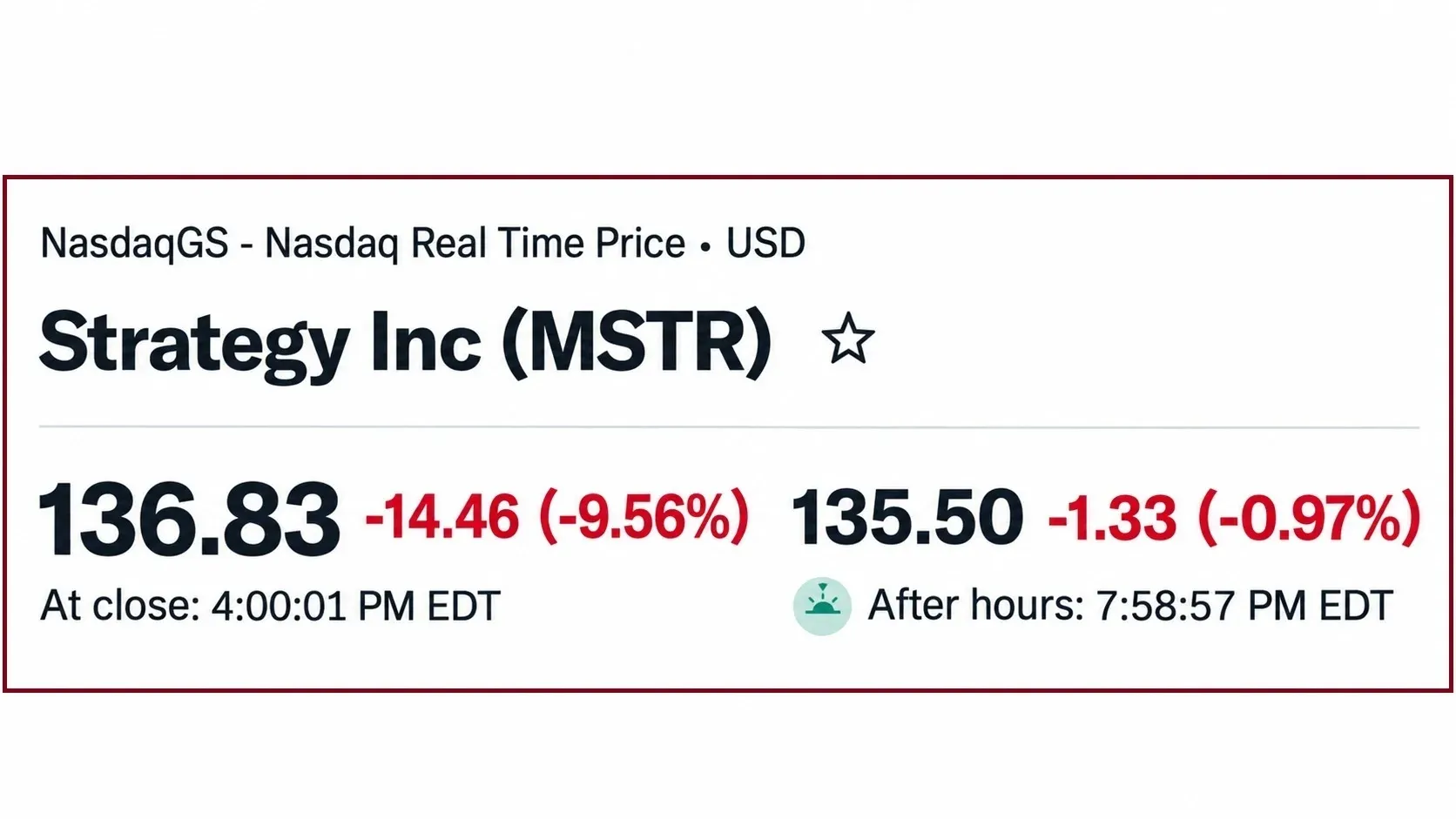
Strategy shares lost 9.6% on Friday in the first full session after MSCI‘s index ruling, even though the company’s 848,250 bitcoin still sit about $5 billion above cost.  Key TakeawaysStrategy (MSTR) closed at $136.83 on Oct. 16, down 9.56% after MSCIs non-operating company ruling.Strategys 848,250 BTC, bought at a $75,444 average, show about a $5.08B paper gain at $81,434.MSCI publishes its final deletion list on Nov. 11, with changes taking effect after the Nov. 30 close.  The Breakdown  MSCI announced on Oct. 15, after U.S. markets closed, that companies which mainly hold assets rather than run a business will lose index eligibility. Friday was the first full trading day to digest it and heres how the Saylor-adjacent board closed:Strategy (MSTR): $151.29 to $136.83, down 9.56%.Stretch (STRC): $99.53 to $97.72, its lowest close since Sept. 16.Strike (STRK): $73.85 to $71.24, down 3.5%.Strive (ASST): $25.65 to $24.09, down 6.1%.Metaplanet (3350.T): $1.68 (¥265) to $1.77 (¥277), up 4.5%.  Trading volume backed the move as some 31.8 million MSTR shares changed hands, which market analysts put at 1.44x its normal level.  The $5 Billion Cushion  The selloff hit the equity, not the stash, and Strategy‘s latest SEC filing shows 848,250 BTC as of Oct. 11, bought for $64 billion at

10-17Industry

NFT sales rise 24.57% to $47.14m as Bitcoin volume doubles

NFT sales have climbed 24.57% to $47.14 million over the past seven days, with Ethereum retaining first place among blockchains and a $2.97 million Bitcoin transaction leading individual sales.  According to data from CryptoSlam captured on Oct. 17, NFT sales reached $47,138,650 in its rolling seven-day dashboard, while seller addresses rose 192.38% to 89,117.  The trackers transaction count moved in the opposite direction, falling to 507,562 despite the rise in sales value and participating addresses. Buyer and seller figures count wallet addresses, which do not necessarily represent separate individuals.  Based on the dashboards rounded growth rate, the preceding seven-day sales total was approximately $37.84 million. The latest figure was roughly $9.30 million higher, calculated by dividing current sales by 1.2457 and subtracting the result from the current total.  The rolling comparison differs from the snapshot published a week earlier, when crypto.news recorded weekly sales of $39.85m. The Oct. 10 report listed 778,055 transactions and 30,332 buyer addresses at its reporting cutoff.  Separately, CoinGecko listed Bitcoin near $81,523 and Ethereum around $2,429 during checks on Oct. 17. Its global market chart put cryptocurrency market capitalization at approximately $2.84 trillion, down 0.87% over 24 hours. Those spot readings use a different timeframe from the seven-day NFT totals.  Ethereum

10-17Industry

Bitcoin’s inflation hedge has a hidden cost, and leverage makes it worse

Borrowing costs, missed interest income, and futures fees can all eat into returns even when Bitcoin holds its value. Thats a big problem, and it gets even worse when inflation stays high.  Related Asset Bitcoin #1 BTC · $81,506.72 24-hour change: down 0.73% Loading price history… 24H Down 0.73% 7D Down 1.45% 30D Up 6.69%  Septembers US inflation report showed consumer prices up 3.7% year over year, fueling concerns about the dollars purchasing power. That same inflation pressure keeps interest rates high, making it more expensive to borrow money to buy Bitcoin and hold it while waiting for it to rise.  Bitcoin reacted immediately to the inflation report, but the bigger question now is what happens next. Two people or companies can buy Bitcoin at the same price, hold it for the same period, and walk away with very different returns, all because they financed their purchases differently.  One Bitcoin bet, three different bills  Someone who buys $10,000 of Bitcoin with cash has no interest payments to make while holding it. The coins can rise or fall in price without a lender demanding repayment.  The Federal Reserves interest-rate release showed a 4.26% three-month Treasury constant-maturity yield for Oct. 13, the day before the CPI report. While

10-17Industry

Crypto VC funding: DATA draws $30m as Fission lands $10m Series A

Crypto and blockchain projects have announced at least $51.4 million across six disclosed financings during Oct. 10–16, led by Sui Foundations $30 million strategic investment in DATA Network.  Crypto Fundraising and DefiLlama provided the starting deal lists, checked against company announcements and reporting on individual transactions. Four further announcements covered investments without a disclosed new-round amount, including Multiliquids seed financing.  The disclosed tally combines venture rounds, equity financing, and strategic investment announcements. It excludes acquisitions, undisclosed checks and Multiliquids cumulative figure, and measures announced financing amounts rather than independently confirmed cash transfers.  DATA Network leads crypto funding with $30 million investment  Sui Foundation‘s Oct. 12 announcement put its planned DATA Network investment at $30 million, establishing the foundation as the network’s largest institutional holder alongside continuing holders PIP Labs and DATA Foundation.  As crypto.news previously reported, the agreement pairs that investment with DATA Network‘s planned migration to Sui. The organizations said DATA’s independent blockchain would retire after the protocol moves, while its token would carry over one-to-one.  Sui Foundation said existing locked and vesting positions would remain unchanged, with holder economics and governance rights at least equivalent to their current terms. Walrus would become the default storage layer for DATA Foundation applications.  The foundation described Trace as

10-17Industry

Pump.fun adds Hyperliquid perpetuals with fees up to 0.10% per order

Pump.fun has introduced a Hyperliquid-powered perpetual futures interface, with published fees of up to 0.10% per order and access restrictions covering the United States and Ontario.  Pump.funs terms, updated Oct. 17, describe the service as a software interface that sends signed trading instructions to Hyperliquid. The protocol handles orders, margin, funding, liquidations and settlement, while Pump.fun says it does not act as the counterparty.  Pump.fun perpetuals follow earlier trading-data discovery  The platforms public website now lists a Perps section alongside its existing trading products. Its accessible market page displayed a market table during this review, although individual contract details did not load.  Reporting on Oct. 16 put the maximum leverage at 40 times for Bitcoin and 25 times for Ether. CoinLaw attributed those figures to a Pump.fun application data response identified on Oct. 9, which contained prices, funding rates, open interest, and trading volumes.  The earlier data discovery and the current published product documents establish different stages of the rollout. CoinLaws report cautioned that the application data alone did not establish whether users could place orders.  Published fees cover orders and bridge transfers  Pump.fun‘s fee schedule sets a builder fee of up to 0.10% of each order’s notional value, covering orders that open, add to, or close

10-17Industry

Cardano shifts $26M to USDCx as bridge controls freeze payouts

Some of Cardano‘s development funding has already moved into dollar tokens, making ADA’s price a less direct guide to the work those budgets can support.  Related Asset Cardano #15 ADA · $0.22 24-hour change: down 2.02% Loading price history… 24H Down 2.02% 7D Down 10.58% 30D Up 14.54%  The SundaeSwap treasury dashboard lists total scheduled budgets of 4,505,955 USDM for Intersect‘s governance and technical stewardship work and 316,253.88 USDM for Se7en Labs’ Daedalus wallet program.  Intersect, which administers treasury-funded projects, said on Oct. 2 that both withdrawals had been minted through Moneta Digital into USDM, a dollar stablecoin on Cardano, and placed in live smart contracts.  After conversion, the token amount stays fixed as ADA moves. Its dollar purchasing power still depends on the peg holding, payment release, and the recipients ability to use or redeem the tokens.  Related Asset USDM USDM · Stablecoin  For these identified Intersect-administered budgets, assessing development runway now requires tracking the commitments currency and conditions through to payment.  The currency of the commitment matters  The two USDM schedules extend into 2027. The Intersect project runs through July 29, while Se7ens Daedalus project runs through Sept. 29.ProjectTotal scheduled budgetFinal scheduled unlockPayment state in Oct. 16 snapshotIntersect governance coordination and technical stewardship4,505,955 USDMJuly 29, 2027Three

10-17Industry

XRP Searches Drop 90% on Yearly Scale in Google Trends

The mass retail investor has temporarily cooled toward XRP, shifting into a deep wait-and-see mode. According to Google Trends, by mid-October 2026 global search interest in the coin had corrected by more than 90% on an annual scale compared with the historical peak of July 2025, when the price was storming the $3.65 mark.  The global popularity index for the query slid to 13 points out of 100, marking the sharpest shift in market sentiment.  Global search interest for XRP hits multi-year lows after a 90% decline from its 2025 peak, Source: Google Trends  The published charts clearly illustrate this dynamic. If the historical curve is unrolled from 2012, the phenomenal surge of mid-2025 looks like an isolated peak, before and after which traffic literally sits at zero.  The statistics for the past 12 months on an annual scale only confirm the trend: search query volume has fallen by exactly half, and the local spike in activity in August–September had faded completely by mid-October.  People are searching for the coin less, but they are not rushing to sell  Still, for the crypto market this is classic off-season apathy: search activity for bitcoin is also at multi-year lows right now. In XRPs case, however, the lull in

10-17Industry

81 Billion Shiba Inu (SHIB) Traded in 24 Hours: There's Hope

Shiba Inu is showing an extraordinary sign of strength. Exchange data shows a large amount of SHIB leaving trading platforms, and the price is holding up at $0.00000514, up 3.92% in 24 hours.  Is the pressure decreasing?  Netflow, which is coins entering exchanges minus coins leaving them, reads negative 32.76 billion SHIB. A negative number means more tokens went out than came in. Holders usually move coins off exchanges to keep them in private wallets, so this often points to less selling pressure.  The reserve chart supports this. Total SHIB on exchanges fell sharply in the middle of the last seven days and has stayed low since. The reserve now sits at 87.09 trillion tokens and moved just 0.02% in 24 hours, so the drop has not reversed.  Source: CryptoQuant  Network use is growing too. Active addresses grew 1.01% to 165,200, and the chart shows a clean jump at the end. More people using the chain while coins leave exchanges is a better mix than outflows alone.  SHIB climbed from a low near $0.00000494 and now trades near the top of its daily range. Over four hours, it is flat, down 0.10%.  The bigger picture remains weak. SHIB is down 15.31% over 180 days, 25.50% this year

10-17Industry

Satoshi-era bitcoin faces a bigger quantum threat after Googles new Willow breakthrough

Google says its Willow quantum chip has cut errors about 40-fold when preparing special states used in quantum calculations, tackling a costly step toward building machines powerful enough to crack bitcoin wallets.  The result, published in Science this week, deals with something that rarely comes up in the bitcoin quantum debate — which usually focuses on how big a machine an attacker would need while underplaying how much of that machine would be occupied getting ready to calculate.  Why the oldest coins give an attacker more time  A bitcoin wallet uses a secret key to approve payments and a matching public key that lets the network check those approvals. Spending typically reveals the public key, while some payment types expose it from the start.  Working backward from it to the secret is supposed to take an impractical amount of computing, which makes it practically impossible to reverse-engineer crypto wallets.  However, a large enough quantum computer running Shors algorithm could, in theory, do that math. Whoever recovered the secret key could sign transactions as the owner, and the network would accept them as genuine. Mathematician Peter Shor first published the method in 1994, but nobody has yet managed to demonstrate it.  A recovery phrase locked in a

10-17Exchange

Visa and Mastercard adopt USDC payouts across 200 countries

Visa and Mastercard announced commercial stablecoin funding routes on Oct. 15 that give eligible businesses new ways to fund payments.  Related Asset USDC USDC · Stablecoin  Visas route prefunds Visa Direct cross-border payouts through Inyo Global, while Mastercards platform through BVNK connects stablecoin balances to local-currency bank payouts.  The change concerns the money supplied at the start of a payment. On Mastercards bank-payout route, a business can use a stablecoin balance while the recipient receives local currency in a bank account. That separates the funding choice from whether the payee uses crypto.  Related Company Visa A global payments technology company  Visa identified Inyo Global, a payments infrastructure provider, as the first enabler to put its Visa Direct stablecoin prefunding capability into commercial production. The offering is for eligible Visa Direct clients and partners.  Related Company Mastercard Global payments local currencies, combining funding and conversion with conventional bank delivery.  Visa Direct uses USDC prefunding through Inyo, while Mastercard and BVNK convert business stablecoins into local bank payouts.  Businesses can contract directly with BVNK and operate through its portal or API for their own treasury and payouts. According to its product documentation, they can also embed accounts and payments under their own brand through an API, with BVNK managing customer

10-17Industry
1
...
151153
...
1000