






Bitcoin posted three consecutive monthly gains from July through September. With only three months left in 2026, can the rally continue?
Looking at historical October performance, Bitcoin rose in 10 out of 13 years between 2013 and 2025, with a 76.9% probability of a positive monthly return, an average monthly return of approximately +17.2%, and a median monthly return of approximately +14.9%.
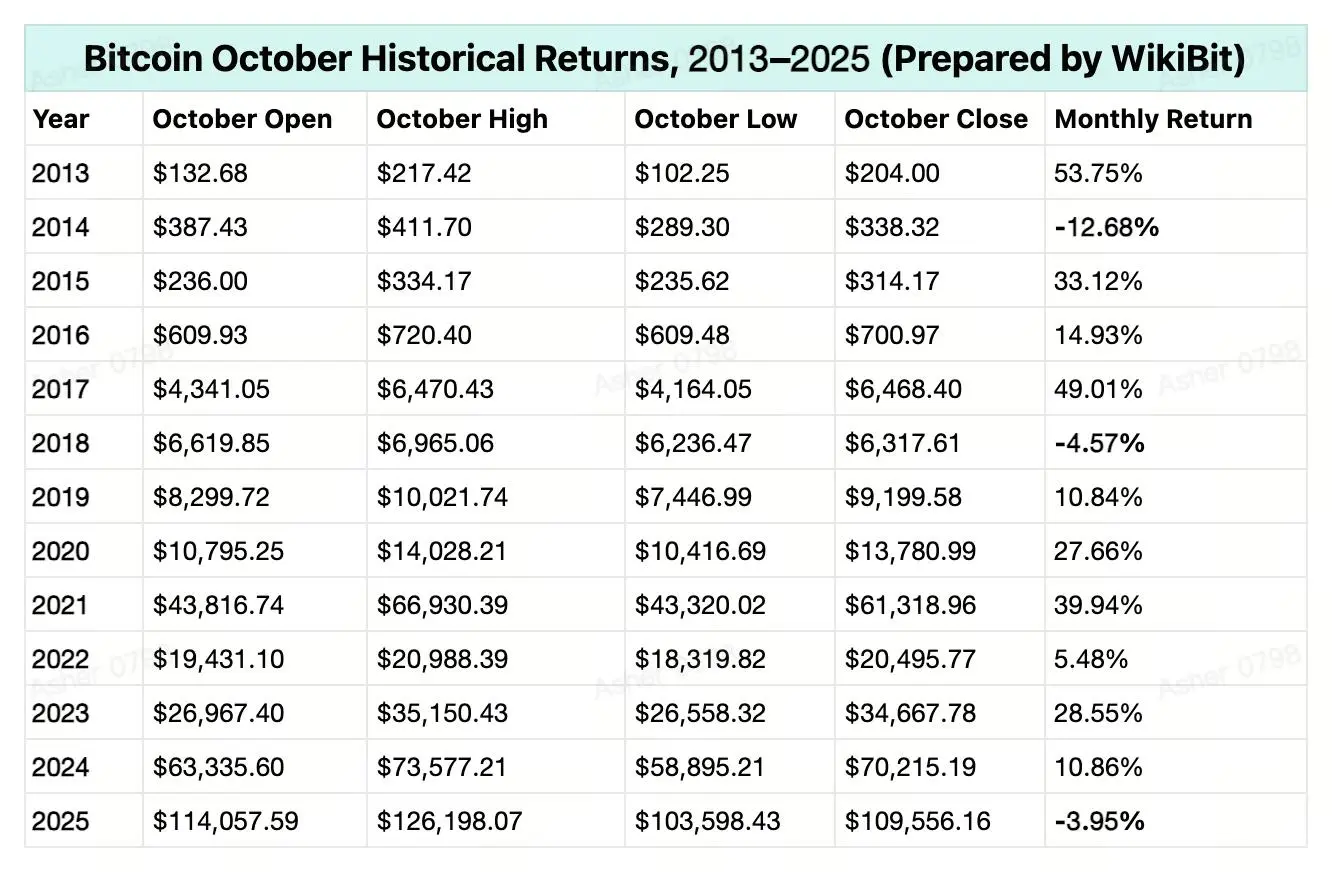
So, purely from a historical perspective, October has clearly been one of Bitcoin's stronger months.
However, October this year presents a major divergence: Bitcoin's fundamentals and technical structure are bullish, while the broader macro environment remains bearish.
From a technical perspective, Bitcoin has climbed back above its 50-week moving average for the first time in 45 weeks. Historically, this signal has often indicated that a bear-market bottom may be coming to an end.
From a market-data perspective, long-term holders have accumulated more than 3 million BTC since 2020, while approximately 81% of the circulating supply has remained unmoved for at least six months. The supply structure has therefore become increasingly concentrated among long-term holders. Bitcoin ETFs recorded $2.4 billion in net inflows last week, the highest weekly inflow of 2026, although daily inflows have been declining, suggesting that bullish momentum may be weakening.
The external macro environment, however, remains challenging. The Federal Reserve is widely expected to continue raising interest rates. The 10-year U.S. Treasury yield has reached a high range of 5.12%–5.18%, uncertainty surrounding the U.S.–Iran conflict remains elevated, Brent crude oil has broken above $106, and the U.S. Dollar Index has risen from 100.95 to 101.15.
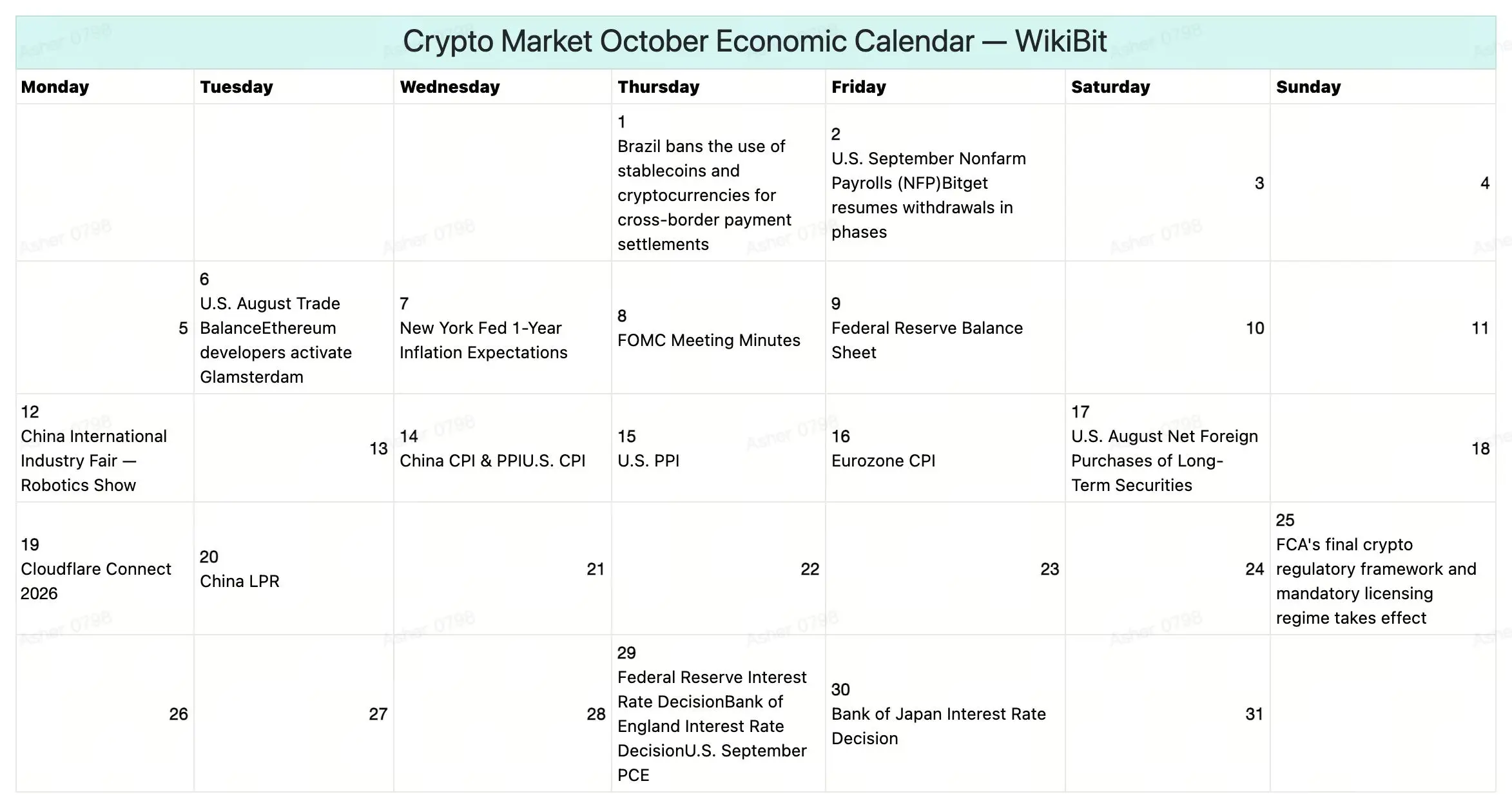
In October, three major central banks—the Federal Reserve, Bank of England, and Bank of Japan—will hold monetary policy meetings, while the U.S. nonfarm payrolls report, PCE inflation data, CPI and other major economic indicators will also be released.
So, where will BTC go next: $90,000 or $100,000—or $70,000 or even $60,000?
Key Economic Events in October: The Market-Moving Events to WatchHere is the detailed October macroeconomic calendar for the crypto market:
1. Federal Reserve Rate Decision — October 29: The Most Important Macro Variable of the Month
This will be the macro event with the most direct potential impact on Bitcoin in October.
The market is currently entering a sensitive phase as expectations for another rate-hiking cycle return. On September 16, the Federal Reserve raised its benchmark interest rate by 25 basis points to 3.75%–4.00%, ending the 38-month rate-hike pause that had lasted since July 2023. The dot plot showed that 16 of the 18 officials expected at least one additional rate hike in 2026, with the median projection pointing to another 25-basis-point increase by year-end.
CME FedWatch data shows that the probability of another rate hike in October has risen as high as approximately 75%.
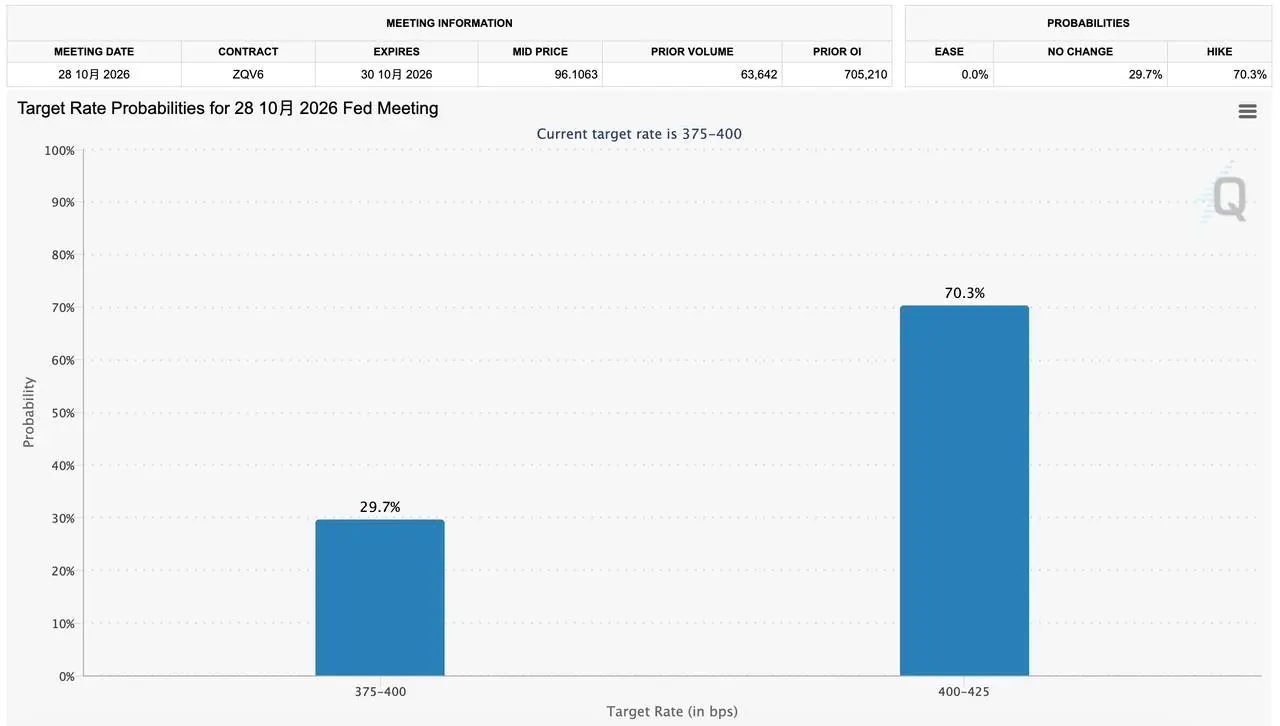
In a rising-rate environment, borrowing costs, the attractiveness of the U.S. dollar, and Treasury yields all increase simultaneously, creating pressure on high-volatility risk assets such as Bitcoin, which does not generate interest income.
However, one important change in market behavior should be noted: a rate hike itself does not necessarily mean that BTC will fall.
After the September 16 rate decision, Bitcoin briefly dropped to around $75,000, but subsequently rebounded strongly above $86,000, supported by renewed ETF inflows, declining Treasury yields, and short-position liquidations.
This demonstrates that when other capital flows—such as ETF inflows—move in the opposite direction from monetary policy, a rate hike does not automatically translate into a sell signal.
For the October 29 decision, the key question is therefore not simply “Will the Fed raise rates?”
The market will focus more heavily on the dot plot's guidance for the future rate path and the wording used by the Fed Chair during the press conference.
Fed Chair Warsh has reportedly used the phrase “remove a dose of accommodation” three times, suggesting that current monetary policy may still be far from sufficiently restrictive.
If the statement maintains a hawkish tone, Bitcoin could remain under pressure from continued tightening expectations even if the Fed does not raise rates in October.
2. U.S. CPI — October 14: Sticky Inflation Could Limit Bitcoin's Upside
Historically, CPI has been one of the most important monthly macroeconomic events for crypto markets. However, its influence has weakened noticeably in recent months.
In 2026, the correlation between Bitcoin and CPI has turned negative, while the implied volatility premium for CPI-day options has fallen from more than 25% at the beginning of 2025 to below 5%.
That does not mean CPI has become irrelevant.
The current core PCE inflation rate stands at 3.4%, still significantly above the Federal Reserve's 2% target, while inflation has remained above target for more than five consecutive years.
If the CPI report released on October 14—particularly core CPI—comes in above expectations, it could reinforce expectations that the Federal Reserve will maintain a restrictive monetary stance, potentially putting downward pressure on Bitcoin.
Although Bitcoin's direct reaction to CPI has weakened, CPI can still affect Bitcoin indirectly by influencing expectations for the future path of interest rates.
Higher-than-expected inflation could increase the probability of further rate hikes and tighten liquidity conditions. With markets currently highly sensitive to monetary policy, the indirect transmission effect of CPI remains an important risk factor.
3. September U.S. Nonfarm Payrolls — October 2: Short-Term Volatility Is Almost Inevitable
The market's median expectation is approximately 100,000 new jobs, but the forecast range is extremely wide, from 35,000 to 180,000, reflecting substantial disagreement among institutions.
Scenario 1: Significantly Below Expectations — <50,000 Jobs
Estimated probability: ~20%
JPMorgan considers 30,000–70,000 jobs an appropriate range.
If payroll growth falls below 50,000, the probability of an October rate hike could potentially fall below 50%.
Bitcoin could rebound in the short term, although investors should watch for a potential “buy the rumor, sell the news” reaction.
The market has already priced in relatively hawkish expectations. If the data is merely weak rather than dramatically weaker than expected, the upside could be limited.
If employment deteriorates enough to trigger recession concerns, Bitcoin could initially fall before potentially recovering.
Scenario 2: In Line With Expectations — 50,000–120,000 Jobs
Estimated probability: ~55%
This is the most likely scenario based on the current range of expectations.
The probability of an October rate hike could remain around 65%–70%, while Bitcoin could potentially trade within a broad $75,000–$82,000 range.
Without a decisive catalyst, market attention would quickly shift toward the October 14 CPI report and the October 29 Fed decision.
Scenario 3: Significantly Above Expectations — >120,000 Jobs
Estimated probability: ~25%
If September payroll growth once again significantly exceeds expectations, the probability of an October rate hike could rise above 80%.
That could increase downside pressure on Bitcoin, including a greater risk of breaking below the $75,000 level.
Wage growth will also be important. Average hourly earnings previously grew 3.1% year over year. If wage growth also exceeds expectations, it could reinforce the narrative of a wage-inflation spiral, adding further pressure to risk assets.
Nonfarm payrolls will be the first major macro anchor for Bitcoin's October pricing.
Weak employment data could provide Bitcoin with a window to recover, while stronger-than-expected data could put the $75,000 support level under direct pressure.
4. UK FCA Crypto Regulatory Framework — October 25: A Regulatory Milestone
An important correction should be made first: according to FCA documents and analysis from several law firms, the full implementation date for the FCA's crypto-asset regulatory framework is October 25, 2027, not October 25, 2026.
The “October 25 effective date” shown on some calendars may instead refer to the opening of the authorization application window, which is scheduled to open on September 30, 2026.
Nevertheless, this development could have important medium- and long-term implications for Bitcoin.
Faster Regulatory Formalization
The FCA has published its final regulatory guidance outlining the scope of crypto activities requiring authorization, including the issuance of qualifying stablecoins, operation of crypto exchanges, trading and arranging transactions, custody of digital assets, and staking services.
Stronger Enforcement
The era of relatively light-touch regulation in the UK is coming to an end. The FCA, working with tax authorities and law enforcement, has taken action against illegal peer-to-peer crypto trading operations in London, signaling a shift from warnings toward more active enforcement.
Indirect Impact on Bitcoin
A clearer regulatory framework could help attract institutional capital through compliant channels, potentially supporting Bitcoin's long-term institutional adoption.
In the short term, however, stricter compliance requirements could increase operating costs for crypto exchanges and push some non-compliant businesses out of the market.
5. Bank of Japan Rate Decision — October 30: The Underestimated “Carry Trade Bomb”
The Bank of Japan will announce its interest-rate decision on October 30. This is one of the easiest events for investors to overlook this month, yet its potential market impact could be second only to the Federal Reserve decision.
The BOJ raised its policy rate to 1.25% on September 18, the highest level since 1995. The 7–2 split vote also suggested that further rate hikes remain possible. Following the decision, USD/JPY fell to around 158, indicating that the yen did not strengthen significantly despite the rate hike.
At the same time, Japan's 30-year government bond yield rose to 4.22%, a record high since 1999, while the 10-year yield climbed to 3.055%, its highest level since August 1996.
The key risk to Bitcoin lies in a potential reversal of the Japanese yen carry trade.
For years, global investors have borrowed low-interest-rate yen and invested in higher-yielding assets—including Bitcoin. This has been an important source of liquidity for risk markets.
As Japanese interest rates continue to rise, higher borrowing costs could force some carry-trade positions to unwind, potentially triggering a chain reaction of selling across risk assets.
If the BOJ signals further monetary tightening on October 30, or if the yen appreciates sharply, Bitcoin could face short-term downside pressure alongside U.S. equities.
6. Bitget Resumes Withdrawals — October 2: A “Stress Test” for Exchange Credit Risk
After a security incident on September 24, Bitget temporarily suspended withdrawals. The incident involved approximately $387.5 million in unauthorized transfers, involving Zcash and TRON assets.
Bitget's Protection Fund exceeded $464 million, which was sufficient to cover the financial impact of the incident. Withdrawals began to resume in stages on September 28, with Bitcoin network withdrawals restored first, and full withdrawal functionality expected to resume by October 2.
The potential impact of this event on Bitcoin is not primarily macroeconomic. Instead, it represents a micro-level test of centralized-exchange credit risk.
Historically, exchange security incidents or withdrawal freezes have triggered two major reactions:
- Panic selling of an exchange's native token or related assets.
- Migration of funds to self-custody wallets or other regulated platforms.
- DeFi
- AI × Crypto
- L1/L2 and ZK infrastructure
- Tokenomics
- Community allocation
- Snapshot dates
- Eligibility requirements
- Official participation rules
- Official announcements
Bitget's handling of the incident—including the vulnerability fix, protection-fund coverage, and phased restoration of withdrawals—has helped alleviate some market anxiety.
However, after full withdrawal functionality is restored on October 2, a large wave of withdrawals or continued weakness in the exchange's native token could reignite broader concerns about the security of centralized exchanges, indirectly affecting Bitcoin's short-term liquidity environment.
Bitcoin is currently in a sensitive phase characterized by a restarted rate-hike cycle and shifting market expectations.
Its price is no longer driven purely by macroeconomic data. Instead, Bitcoin's direction is increasingly determined by the combined effects of macro expectations, ETF capital flows, corporate holdings, and derivatives-market structure.
The October 29 Federal Reserve decision will be the key turning point of the month, while the October 14 CPI report will be a critical signal shaping how markets price that decision.
Investors should closely monitor these two major data points, along with changes in ETF flows. Together, they are becoming more direct short-term indicators of Bitcoin's price than traditional macroeconomic data alone.
Crypto Market-Specific Events: Token Unlocks & Airdrop Opportunities1. October Token Unlocks: Major Supply Releases Create Three Key Sources of Pressure
October is an important window for concentrated token-unlock activity.
According to the latest data from Binance Square and major token-vesting calendars such as Token Unlocks, more than $3 billion worth of tokens are currently scheduled to be released in October, covering more than 200 projects.
The key point is not that “an unlock means the token will definitely fall.”
Instead, investors should focus on three factors:
The amount of new supply entering circulation
The percentage of existing circulating supply represented by the unlock
Who receives the unlocked tokens
Category 1: Large-Value Unlocks
The most important projects to watch include HYPE, TIA, ENA, and 2Z.
HYPE is scheduled to unlock approximately 9.92 million tokens on October 6, worth close to $900 million at current prices, primarily involving core contributors.
TIA is scheduled to release approximately 175.5 million tokens on October 30. The increase in supply relative to its current circulating supply is particularly significant.
ENA is expected to release approximately 1.41 billion tokens around October 5, representing another major supply event.
2Z is scheduled to release approximately 1.66 billion tokens on October 2, equivalent to nearly half of its existing circulating supply.
Category 2: Circulating-Supply Shock Unlocks
These projects may not have the largest absolute dollar values, but the amount of new supply can be very large relative to their existing circulating supply.
Examples include AXS, ZORA, and SCR.
SCR is particularly worth watching. Although the dollar value of its unlock is only in the tens of millions, the new supply represents a relatively large proportion of its existing circulating supply.
Investors should therefore pay close attention to trading volume and on-chain transfers before and after the unlock.
Category 3: Continuous Supply Releases
Projects such as RAIN, APT, ARB, ZRO, and PUMP require a different approach.
Rather than focusing on a single unlock date, investors should examine whether these projects will continue releasing tokens over the coming months and whether investors, teams, or ecosystem funds transfer their newly unlocked tokens to exchanges or market makers.
Key October Unlock Dates
The key dates to remember are:
October 2: 2Z
October 5: ENA
October 6: HYPE
October 10: RAIN
October 20–25: AXS, SCR, ZORA
October 30: TIA
However, remember that an unlock does not automatically mean a price decline.
What really matters is the complete chain:
Unlock → wallet transfers → exchange/market-maker deposits → actual selling.
If BTC remains strong in October, the market may be able to absorb part of the additional supply.
If Bitcoin simultaneously weakens, large token unlocks could amplify volatility across altcoins.
Therefore, when positioning for altcoins in October, the unlock calendar should be analyzed together with Bitcoin's trend, trading volume, and on-chain capital flows, rather than being used as a standalone buy-or-sell signal.
Major Token Unlocks in October 2026
| Date | Token | Unlock Amount | % of Circulating Supply | Estimated Value | Recipients / Key Characteristics | Risk Level |
| Oct. 1 | SUI | ~13.26M SUI | 0.32% | ≈ $16.7M | Community reserves, early contributors, Mysten Labs; regular monthly unlock | Low |
| Oct. 1 | EIGEN | ~36.82M EIGEN | 5.19% | ≈ $10.3M | Ecosystem/team allocations; notable increase in circulating supply | Medium-High |
| Oct. 2 | 2Z | ~1.66B 2Z | 47.69% | ≈ $114M | Jump Crypto, institutions, team, contributors, validators; first major release | Very High |
| Oct. 5 | ENA | ~1.41B ENA | ≈ 14% | ≈ $380M | Final major release related to early investors/VCs; investor unlock pressure expected to decline afterward | Very High |
| Oct. 5 | ASTER | — | ≈ 4% | ≈ $500M | Large increase in circulating supply; significant dollar value | High |
| Oct. 6 | HYPE | ~9.92M HYPE | ≈ 4.46% | ≈ $929M | Core contributors; high-value contributor unlock | Very High |
| Oct. 10 | RAIN | ~37.2B RAIN | ≈ 5.2% | ≈ $445M | Ongoing supply release; recurring monthly supply pressure | High |
| Oct. 12 | APT | — | ≈ 1%–2% | ≈ $48M | Foundation/team/investors; regular release | Medium |
| Oct. 14 | PUMP | — | ≈ 1% | ≈ $55M | Team/investors/ecosystem allocations | Medium |
| Oct. 16 | STBL | — | ≈ 2.31% | ≈ $81M | Relatively significant increase in circulating supply | Medium-High |
| Oct. 16 | ARB | ~92.65M ARB | ≈ 1.98% | ≈ $19.2M | Investors ~36.52M; team/future team/advisors ~56.13M | Medium-High |
| Oct. 20 | ZRO | — | ≈ 2.4% | ≈ $49M | Increased issuance; monitor investor/core-contributor releases | Medium-High |
| Oct. 20 | AXS | — | ≈ 11.5% | ≈ $72M | Relatively large increase in circulating supply | High |
| Oct. 22 | SCR | — | Very High | ≈ $14M | Dollar value is moderate, but circulating-supply impact is significant | Very High |
| Oct. 23 | ZORA | — | ≈ 10% | ≈ $42M | Significant increase in circulating supply | High |
| Oct. 25 | XPL | — | ≈ 0.9% | ≈ $90M | Large dollar value but relatively small impact on circulating supply | Medium |
| Oct. 30 | TIA | ~175.5M TIA | >100% of current circulating supply under some data methodologies | ≈ $1B+ | Large cliff unlock; VC/early-holder supply is the key focus | Very High |
| Oct. 30 | OP | — | ≈ 3% | ≈ $35M | Regular monthly unlock | Medium-High |
2. October Crypto Airdrop Opportunities: Which Projects Should You Watch?
For October airdrops, the focus should be on projects that already have tokens, points systems, reward pools, or clearly defined timelines, rather than simply chasing unconfirmed airdrop rumors.
| Project | Sector | Main Participation Method | October Attention | Airdrop Certainty |
| AlloX | DeFi / RWA | Points and platform interactions | ⭐⭐⭐⭐⭐ | High |
| Amadeus | DeFi | PRIME Points and Season tasks | ⭐⭐⭐⭐⭐ | Relatively High |
| Hyperlynx | DeFi / L2 | The Hunt and ecosystem interactions | ⭐⭐⭐⭐⭐ | Relatively High |
| NOWA Finance | DeFi | Testnet, farming, ecosystem tasks | ⭐⭐⭐⭐ | High |
| Axis Robotics | AI + Robotics | Creator Campaign and Epoch tasks | ⭐⭐⭐⭐ | High |
| InterLink Labs | DePIN / AI | Linkers, community and ecosystem tasks | ⭐⭐⭐⭐ | Relatively High |
| Pharos | L1 / Payments | Testnet and on-chain interactions | ⭐⭐⭐⭐⭐ | Medium-High |
| Aztec | ZK / Privacy | Network interactions and ecosystem incentives | ⭐⭐⭐⭐⭐ | Medium |
Among these projects, AlloX, Amadeus, NOWA, and Hyperlynx are worth putting on the first research list for October because they already have relatively clear points, rewards, or token-allocation mechanisms.
Amadeus Season 01 and related InterLink activities have important timing around October 12, while Pharos is worth monitoring for developments expected later in October.
From a sector perspective, October's airdrop opportunities are concentrated primarily in three areas:
In particular, emerging narratives such as AI + Robotics, RWA, and payment-focused blockchains could be areas to watch when searching for potential airdrop opportunities.
However, one important distinction must be made:
Having a points system does not mean an airdrop is guaranteed.
Before participating, users should verify:
A more measured approach for October is not to commit large amounts of capital simply to farm airdrops.
Instead, prioritize projects with low participation costs, genuinely functioning products, and relatively clear reward mechanisms. Users can participate through legitimate on-chain interactions and ecosystem activities while keeping capital exposure low.
At the same time, remain highly alert to fake airdrops, phishing links, malicious smart contracts, and projects requiring unusually large deposits or upfront payments.
ConclusionOctober's Real Test for BTC Is Not “Up or Down,” but Whether It Can Navigate the Dual Pressure of Liquidity and Supply
When all the macroeconomic events on October's crypto calendar are viewed together, it becomes clear that the core issue is not any single economic indicator or one particular rate hike.
Instead, macro liquidity, Bitcoin's price structure, and changes in crypto-market supply are all entering a highly sensitive period at the same time.
Market attention is already heavily concentrated on October. The Federal Reserve will hold its FOMC meeting from October 27 to 28, while the Bank of Japan will hold its monetary policy meeting from October 29 to 30. The decisions from these two major central banks will come almost back-to-back.
Markets have recently been repricing the future path of interest rates, while Bitcoin remains caught between monetary policy, the U.S. dollar, and global risk appetite.
So, how should we look at BTC in October?
Rather than simply predicting whether “BTC will go up or down,” it may be more useful to view October as a period for confirming market direction.
If inflation data gradually cools, central-bank policy expectations shift toward easing, and ETF and institutional capital flows return to sustained net inflows, the macro environment could once again provide Bitcoin with the conditions for an upside breakout.
Conversely, if inflation remains stubborn, rate expectations move higher again, and the U.S. dollar and Treasury yields continue to put pressure on risk assets, Bitcoin could remain caught in a period of consolidation, pullbacks, or further support-seeking.
Therefore, the most important thing in October is not trying to predict the exact top or bottom.
It is watching whether Bitcoin can hold key support levels after major economic data releases and central-bank meetings, and whether it can rebuild a high-volume upward structure.
There is another scenario that deserves particular attention:
The macro environment does not deteriorate significantly, but BTC still fails to break higher while large-scale token unlocks simultaneously increase market supply.
That could indicate that the market is entering a period of range-bound competition, with selling pressure above and capital waiting on the sidelines below.
What Should Investors Do in October?
1. Avoid Going All-In Before Major Events
CPI, FOMC meetings, and the Bank of Japan's policy decision can trigger sharp short-term volatility.
Rather than betting heavily on the outcome of an event, it may be more useful to wait and observe how the market actually reacts to the result.
2. Analyze BTC and Altcoins Separately
If Bitcoin remains strong while altcoins fail to follow, it suggests that capital is still concentrated in core assets.
If BTC remains stable while certain sectors—such as DeFi, L2, perpetual futures, and RWA—begin to experience capital rotation, it could indicate that risk appetite is starting to spread across the market.
3. Focus on Actual Capital Flows After Token Unlocks
An unlock does not automatically mean selling.
The key questions are:
Are investor wallets transferring tokens to exchanges?
Are exchange balances increasing?
Is the token experiencing high-volume selling after the unlock?
These indicators are more informative than the unlock event itself.
One Final Thought
October may not be a month for “blindly betting on a direction.”
It may be a month for waiting for the market to provide the answer.
Macro determines the water level.BTC determines the direction.Token unlocks determine the supply structure.Airdrops determine where capital flows next.
So instead of asking every day:“Can Bitcoin still go higher?”
ask three questions:
Where is the money coming from?Where are the tokens moving?What is the market rewarding?
When the answers to these three questions begin pointing in the same direction, that is often when the market becomes truly worth paying attention to.
In October, less prediction, more observation; less emotion, more discipline.
Because major market moves are rarely determined by a single red date on an economic calendar. They emerge after countless key events unfold—and capital ultimately chooses a direction.
Finally, none of the information in this article constitutes investment advice. Please conduct your own research, stay informed about market developments, evaluate the market comprehensively, and make your own investment decisions.