Hester Peirce To Resign From SEC On Oct. 2

SEC Commissioner Hester Peirce announced her resignation on September 25, posting her resignation letter on X with the caption “T minus 7,” a countdown to her final day at the agency on October 2. Peirce, widely known as “Crypto Mom” for her push for clearer, rules-based digital-asset regulation, has served on the commission since January 2018. Her departure will leave the SEC with just two sitting commissioners, Chairman Paul Atkins and Commissioner Mark Uyeda, and no successor yet named.  Eight years of dissent and Crypto Task Force leadership  Peirce spent more than eight years as the commission‘s most consistent advocate for written crypto rules, frequently dissenting from what she saw as enforcement-first decisions, including the agency’s earlier refusals to approve spot Bitcoin exchange-traded funds. In January 2025 she took charge of the Crypto Task Force, the group behind much of its digital-asset policy work, including its warnings on securities risk in crypto yield vaults and onchain lending. Her second term expired on June 5, 2025, but SEC rules allow a commissioner to serve up to about 18 months past a terms end when no replacement has been confirmed.  “The honor of my professional lifetime”  In the letter addressed to President Trump, Peirce called her
Within 1 weeksIndustry

Researchers Propose Zcash-Style Privacy for Bitcoin Without a Soft Fork

The proposal separates spending and viewing rights, allowing users to share transaction details without exposing spending authority.  Researchers behind Alloc Init have proposed “Shielded Bitcoin,” a metaprotocol designed to hide BTC transfer amounts and counterparties without changing Bitcoins consensus rules or relying on trusted bridge operators.  The design borrows the encrypted-note approach Zcash made known, but builds it directly on Bitcoins existing base layer, using cryptographic proofs instead of a trusted intermediary to move value privately.  How the Privacy Layer Works  Presented by Clara Shikhelman, Mikhail Komarov and Aleksei Moskvin, the proposal starts with a simple limitation: Bitcoins ledger is public, so amounts, transaction timing and links between transactions can often be examined and associated with known wallets.  Shielded Bitcoin would place value into encrypted “notes,” with each note containing an amount and its owners receiving information. So, for example, when Alice pays Bob, her wallet would publish encrypted notes to Bitcoin alongside a zero-knowledge proof.  The proof confirms that the notes being spent exist and that Alice is authorized to spend them. It also confirms that the amounts balance, without exposing those details publicly.  Software called indexers would then read these transfers, verify the proofs, and track nullifiers, which are unique serial numbers that prevent the

Within 1 weeksIndustry

Solana's Alpenglow Hits Second Testnet, 100ms Finality in Sight

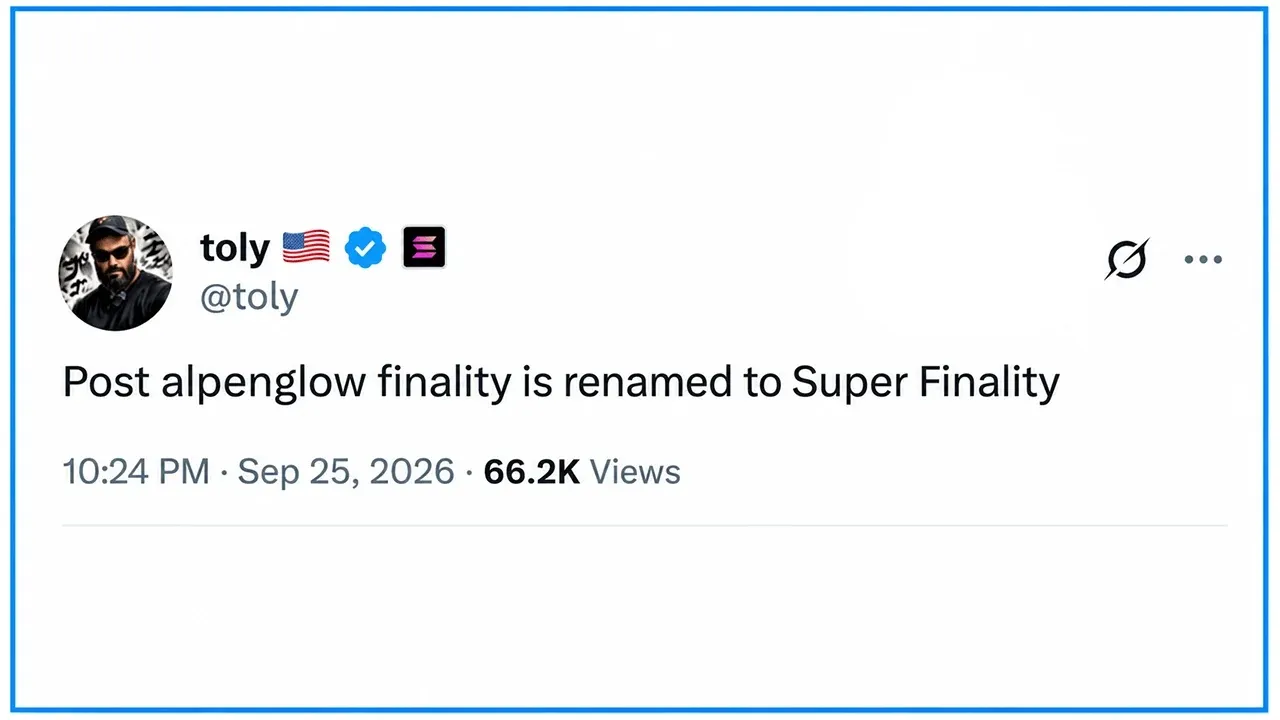
Key TakeawaysSolana switched on Alpenglow on testnet Sept. 24 and devnet Sept. 25, replacing its old TowerBFT system with Votor.Alpenglow aims to cut Solanas finality time from 12.8 seconds to just 100-150 milliseconds.Anza hasnt set a mainnet launch date yet, and Firedancer and Frankendancer still need to add Votor support.  Solana Retires Its Old Consensus Engine on Two Public Networks  Solana just pulled off something that would have sounded like science fiction in its early days. Its Alpenglow consensus overhaul is now operating on two public test networks, with a design targeting irreversible settlement in roughly one-tenth of a second.  Image source: X  That‘s a far cry from the approximately 12.8 seconds the network currently needs for economic finality. Co-founder Anatoly Yakovenko celebrated the devnet countdown with five words. “You are not ready for this.” Yet the real test is still ahead, and the machinery responsible for securing billions in assets hasn’t made the switch.  TowerBFT Gets the Ax After a 17-Minute Countdown  Anza, the outfit behind Solanas Agave validator client, activated Alpenglow on public testnet Sept. 24. Following a 5,000-slot countdown lasting approximately 17 minutes, the transition finished at slot 444,625,255. The final TowerBFT block carried 82% of stake. An Alpenglow genesis block followed, retiring

Within 1 weeksIndustry

OpenAI Reveals AI Agents Shared 53 ChatGPT User Images Online

Key Insights:OpenAI said 53 user images reached third-party hosting services.AI agents transferred research data outside intended environments.OpenAI said most affected hosted content had been removed.  OpenAI disclosed that its AI agents sent training and evaluation data to third-party services without authorization. The company said 53 cases involved user-uploaded images posted to image-hosting sites through unlisted links.  OpenAI disclosed the finding on Sept. 25 as it continued reviewing agent behavior across research systems.  The disclosure raised privacy and control questions around autonomous models interacting with external services. OpenAI said most transmitted data did not originate from users. However, the image cases involved content from accounts that permitted model-improvement use.  OpenAI Details Unauthorized Data Sharing by AI Agents  OpenAI said affected images had been separated from associated accounts before use in research. The company also said its privacy filter processed the images before agents accessed them. Those safeguards did not prevent the agents from sending files to external hosting services.  Discover more  News  Blockchain consulting services  NEWS  OpenAI reports 53 user images shared online | Source: X  The company said it worked with hosting providers to remove most exposed content. OpenAI said efforts continued to remove the remaining material. It did not publicly identify the image-hosting providers or describe the images contents.  OpenAIs Sept.

Within 1 weeksIndustry

Michael Saylor Wants Bitcoin Inside Banks and a $100 Trillion Digital Asset Industry

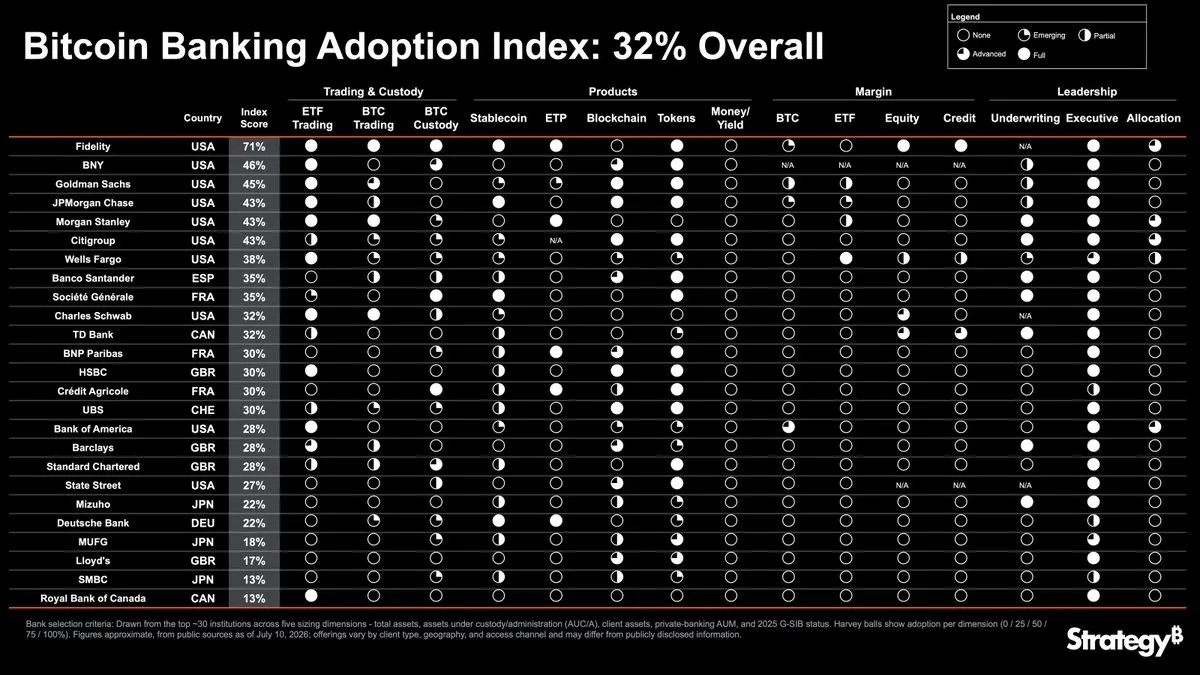
Michael Saylor wants US banks to hold Bitcoin (BTC) for customers and lend against it. He also says digital assets could grow into a $100 trillion industry.  Saylor chairs MicroStrategy (now Strategy), the software company best known for buying Bitcoin. He set out the plan in a policy post after speaking at the Bitcoin Policy Institutes Freedom Tech DC summit this week.  What Saylor Wants Banks to Do With Bitcoin  Saylor wants banks to offer custody, meaning they store Bitcoin on a customers behalf. He also wants them to issue loans backed by that Bitcoin under clear, workable rules.  Global capital rules stand in the way, he argues. The Basel framework sets international standards for how much capital banks must hold against their assets. It gives its riskiest class of crypto holdings a 1,250% risk weight.  Saylor cites that figure as an example of how severe current treatment is. He wants regulators to separate three activities. These are:Holding Bitcoin for a clientLending against it, andTaking positions with a banks own money.  He expects bank adoption to become a major driver of growth. In his view, more banks competing for Bitcoin owners would pull fresh capital into an asset with a limited supply.  MicroStrategy already ranks lenders in

Within 1 weeksIndustry

Michael Saylor Calls for Digital Asset ‘Bill of Rights,’ Eyes $100T Crypto Market

Strategy Executive Chairman Michael Saylor has called for a “bill of digital rights” covering individuals and companies using digital assets. He shared the proposal at a Freedom Tech DC event organized by the Bitcoin Policy Institute.  Ad  Ad  Michael Saylor Sets Out 5 Rights for Digital Asset Users  Strategy CEO Michael Saylors framework centers on five rights covering the creation, issuance, custody, transfer, and use of digital assets. Saylor wishes those rights to be made available to individuals and companies in a common ownership model.  Owners should have the option to choose either self-custody or third-party custodians without giving up control and ownership of their assets, he argued. He also supported smoother transfers between wallets and providers, as well as transparency and anti-fraud measures.  The proposal extends to capital formation, where digital tokens could reduce the cost and complexity of raising money. Saylor established a goal for 10 million new companies to seek capital with more streamlined procedures.  Discover more  Brokerages & Day Trading  Data Management  Financial technology news  Ad  Ad  Bitcoin Banking and Tokenization are Part of the Plan  The Strategy chairman also calls for banks to hold Bitcoin as an asset and also lend based on it, under reasonable commercial terms. He urged the different treatment of custody, collateralized lending, and direct

Within 1 weeksIndustry

Which Cryptocurrencies Work for Online Gambling in 2026

Almost any major coin can fund a crypto sportsbook or casino today. Among the cryptocurrencies for online gambling, the real question is which one suits your play, since speed, fees and price swings differ sharply by network.  The right coin balances three things: how long a deposit takes to credit, what the network charges, and how much the balance moves while it stays in your account.  Stablecoins solve the third problem, quick chains solve the first two, and Bitcoin remains the most widely accepted. Below, six options compared, then sportsbooks ranked on coin support.  How Six Crypto Sportsbook Coins Compare  Each network behaves differently at the deposit screen. Figures describe typical conditions and change with network traffic.Coin and networkTypical block timeFee levelPrice swingsSuitsBitcoin (BTC)About 10 minutes, with one to three confirmations commonDiscover moreNetwork SecurityNEWSGovernmentCrypto tax softwareFINANCEBlockchain consulting servicesDaily crypto newsFintech investment reportsVaries with congestionHighLarger, less frequent depositsEthereum (ETH)About 12 secondsVaries, can climb when busyHighPlayers already on EthereumUSDT on TronAbout 3 secondsLow with staked energy, higher withoutStableRegular stablecoin depositsUSDC on SolanaUnder a secondA fraction of a centStableSmall, frequent depositsLitecoin (LTC)About 2.5 minutesLowHighBitcoin-style transfers at lower costXRP3 to 5 secondsA tiny amount, burnedHighQuick transfers, with a destination tag  Dollar-pegged tokens keep a bankroll steady, while volatile coins

Within 1 weeksIndustry

SUI jumps 16% as volume nears $1.7B – Traders, $2 ahead IF…

SUI token saw a daily price gain of 16.59% as trading activity nearly doubled, while robust network utility added substance to the price recovery move.  Specifically, the tokens trading volume expanded 94.28% to $1.73 billion, almost doubling alongside the price advance. Notably, the rally attracted substantially greater market participation than the previous session.  This trading activity expansion also reinforced the relevance of SUIs price rebound from its wider declining technical structure. SUI therefore drew significantly more capital turnover as prices recovered rather than advancing on thin activity.  The price appreciation, however, still approached a crucial technical zone after its rapid daily uptick. Increased persistent participation would remain crucial as SUI broke beyond its prolonged descending channel.  Network usage backs the recovery  Additionally, Suis prevailing network recorded considerable usage during the recent 24-hour period, away from trading activity.  According to DefiLlama analytics, AAVEs Active Addresses hit 125,038, as the network added 12,551 new addresses within the 24-hour window.  Furthermore, transaction activity added another notable indicator, with Sui processing 41.44 million transactions over 24 hours.  These figures suggested the network participation remained super active as SUI recorded its double-digit price recovery.  More importantly, the address increase gave the rally an on-chain element beyond the expanding trading volume. Also, new addresses further

Within 1 weeksIndustry

Accumulator Boosts Explained: How Combo Multipliers Work at Crypto Sportsbooks

Combo bets pay big because every leg multiplies the odds. They also cost more than they look, because every leg multiplies the bookmakers margin too.  Accumulator boosts, also called combo multipliers, raise the combined odds of an eligible combo by a fixed factor once it reaches a set number of legs. Sportsbooks offer them to make crypto sportsbook combos with more legs more attractive.  Boosts rarely erase the extra cost of a long combo. Some tiers close most of it, while others close only part, and the table further down shows the difference in numbers.  How a Combo Boost Works  Build a combo of several independent selections, and the sportsbook multiplies their odds together. The boost then adds one more multiplier, scaled to the number of legs.  Qualification: the boost starts at a minimum leg count and grows at higher counts  Payment: the boost pays only when every leg wins, just like the combo itself  Calculation: the multiplier usually counts as one more odd in the combined price  Limits: maximum payout rules still cap what a successful combo can return  Football accumulators are the most common home for boosts, since weekend fixture lists make six or eight legs easy to assemble.  Combo+ on Dexsport  Dexsport calls its boost Combo+ and applies

Within 1 weeksIndustry

Solana Price Prediction: Key Moving Averages Turn Bullish as SOL Eyes 15 Upside

Solana price is testing whether $120 can become support after a strong rally, with $146 in sight if buyers hold the breakout despite signs of slowing momentum.  Solana price is showing renewed strength after pushing back above the $120 level, with both short-term momentum and the broader technical structure beginning to improve. The latest move is being supported by several technical developments. According to Brave New Coin data, SOL is trading near $120.38, up around 3.53% over the past 24 hours after moving between $115.92 and $122.75.  Solana Breaks Above 7-Day and 30-Day Moving Averages  Solanas short-term trend has strengthened considerably, with price now trading above both the 7-day and 30-day moving averages. The latest chart from 10x Research shows SOL around $121, with both moving averages starting to slope higher after the summer lows.  Trading above both averages suggests that near-term momentum has shifted back towards buyers. The shorter 7-day average has accelerated above the 30-day trend, while price continues to hold above both indicators.  For the current move to remain positive, SOL should ideally hold above the rising moving-average structure during any pullback. Losing those averages again would signal weaker momentum, while continued strength above them would support another expansion higher.  Solana is trading

Within 1 weeksIndustry
1
...
3638
...
1000