CLARITY Act gets final GOP offer before Senate vote

Senate Democrats have met to assess a final 635-page Republican CLARITY Act proposal before a Sept. 15 procedural vote requiring 60 senators to begin debate.  Politico reported that Senate Minority Leader Chuck Schumer convened the Democratic caucus on Sunday evening after Republicans released the revised text. No Democratic leader had announced the caucuss position on the motion as of Sept. 14.  Senate Banking Digital Assets Subcommittee Chair Cynthia Lummis released the proposal with Senate Banking Committee Chair Tim Scott and Senate Agriculture Committee Chair John Boozman. Their statement called the draft the product of more than one year of negotiations and said it incorporated 126 substantive changes requested by Democrats.  A Republican aide described the proposal to Politico as the party‘s “last, best and final” offer before Tuesday’s vote. Republicans hold 53 Senate seats, so at least seven members of the Democratic caucus must support cloture if every Republican votes yes.  Senate Minority Leader Chuck Schumer convened a Democratic caucus meeting Sunday evening (tonight) to discuss the CLARITY Act ahead of Tuesdays procedural vote. https://t.co/yH4jmEi5Ss  — James Rule XRP ⟐ ???????? (@allthemoney) September 14, 2026  CLARITY Act ethics text puts pressure on Democrats  Government ethics rules have remained the main obstacle in negotiations. Democratic senators have sought


09-14Industry

King Charles to host AI chiefs amid industry call to slow development

Leaders of the world‘s most powerful AI firms are set to convene in Scotland this week at a summit hosted by Britain’s King Charles III to discuss responsible AI development, amid industry fears that the technology could outpace human control.  The event will be held this week at Dumfries House and overseen by the Ditchley Foundation, according to The Sunday Times. Leaders from companies including Nvidia, OpenAI, Anthropic, IonQ and Google DeepMind have been invited to discuss how AI could be developed “for the good of humanity.”  The summit would come a week after Anthropic CEO Dario Amodei, OpenAI CEO Sam Altman and SpaceXAI CEO Elon Musk called for greater restraint in frontier AI development.  In an open letter on Friday, Amodei warned that the technology had been “advancing drastically faster” since the summer, driven by AIs ability to improve itself, a process known as recursive self-improvement.  He said a “swarm” of AI agents, like those that attacked Hugging Face in July, could be capable of “taking over the entire internet” in the next six to 12 months. Altman agreed that the firms “need to pace the frontier.”  Sources close to Charles said he had taken an interest in AI development and its potential risks,

09-14Industry

Robinhood CEO says issuers should not have veto over tokenized stocks

Robinhood CEO Vlad Tenev said companies should not have veto power over tokenized stock products that do not change shareholder rights, issuer obligations or a companys official stock ledger.  In a post on X on Friday, Tenev said the question of issuer consent depends on whether a tokenized product changes the rights attached to the underlying shares or creates new obligations for the company or its transfer agent. If it does, he said the issuer should be involved.  However, Tenev said if the product creates a separate financial instrument that holds or references freely transferable shares without changing the issuers rights, obligations, or shareholder record, issuer consent should not be required.  The comments came after AMC Entertainment CEO Adam Aron criticized Robinhoods tokenized stock offerings on Sept. 4, saying AMC had no affiliation with the products and would ask securities counsel to review them.  Tenev said Robinhood Stock Tokens use a third-party structure, with separately issued instruments backed 1:1 by underlying shares. The products provide economic exposure to stocks and exchange-traded funds without changing an issuers cap table or rights attached to its shares.  “Going onchain shouldnt give the issuer a veto it never had offchain,” Tenev said.

09-14Industry

Bitcoins Biggest Week of 2026 Is Here: Fed and CLARITY Vote Take Center Stage

Bitcoin investors are approaching what is likely to become the crypto industrys most important week so far this year.  Although there are several major economic events taking place in the following five business days, the reality is that only a handful of them could (and most likely will) impact the cryptocurrency market. That impact, though, is expected to be quite vicious in either direction.  The Kobeissi Letter highlighted an auction of 20-year securities, August retail sales, and, most importantly, the Federal Reserves September interest rate decision on Wednesday. The latest data shows that markets assign an 85%-90% probability that the central bank will hike rates by 25 basis points, following contrasting economic data.  Fed in Focus  The Fed setup has changed dramatically in just a few weeks, starting with the August employment data from early September, which showed that the US economy had added 162,000 jobs last month, triple expectations. Later on, the PPI numbers indicated that the annual producer inflation had accelerated to 5.4%. Last Fridays CPI report subsequently confirmed headline inflation at 3.4%, with monthly core CPI slightly hotter than expected.  This combination, plus the fact that oil prices remain above $100 and diesel hit a new record in the States, has strengthened

09-14Industry

U.S. House weighs two crypto tax bills on Sept. 16

House tax writers have reportedly scheduled a Sept. 16 review of two bills that could change how U.S. miners, stakers and traders calculate federal taxes.  The House Ways and Means Committee plans to consider H.R. 9175 and H.R. 9172 on Wednesday. The committees public calendar had not posted a markup notice as of Sept. 14, leaving the meeting time and final bill list unconfirmed in official records.  The introduced bills address separate parts of the tax code. H.R. 9175 would create an optional income-deferral system for qualifying mining and staking rewards. H.R. 9172 would apply existing wash-sale and constructive-sale restrictions to covered digital assets.  A committee markup would allow lawmakers to debate, amend and vote on the legislation. Reports that Republicans may remove the mining deferral or limit it to five years have not been confirmed through a published committee amendment or substitute text.  The U.S. House Ways and Means Committee plans to review two crypto tax bills on Sept. 16.  The Mining and Staking Tax Clarity Act would defer taxes on newly generated tokens until disposal, while treating the income as ordinary income. Republicans are reportedly considering… pic.twitter.com/nOeoYRuT1R  — Wu Blockchain (@WuBlockchain) September 14, 2026  Reported crypto tax markup remains off the calendar  Representatives Mike Carey and

09-14Industry

Yen Up Near 4% This Month: Why a Fed Hike Could Force BOJ's Hand

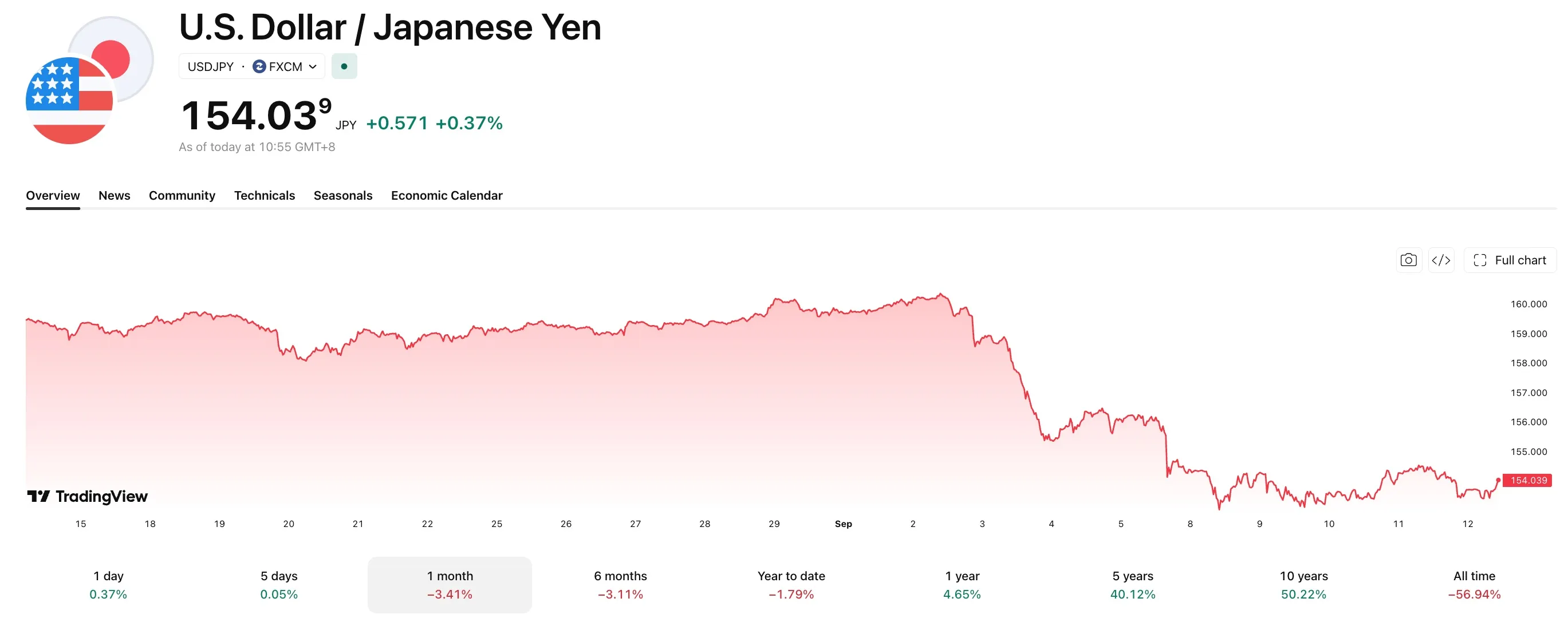
The yen‘s four-week climb collides with the Federal Reserve’s Wednesday rate decision. The size of the Fed‘s move could decide whether Tokyo’s currency gains hold or reverse.  The yen traded at 153.49 per dollar on Monday, just off the 152.89 seven-month high reached last week. Speculators turned net-long on the yen for the first time since February, marking a shift in positioning.  Why the Fed Comes First  Consumer prices in the U.S. accelerated in August, based on data released Friday. Traders now price Fed rate hike odds at 86% for Wednesday. That figure comes from the CME FedWatch tool, which estimates odds using futures pricing.  The Bank of Japan meets two days later, on Friday. MUFG analysts said a quarter-point hike is already largely priced into markets. However, the bank said the yen needs a signal of faster future hikes to strengthen further.  The Yen has held onto its gains made since the unprecedented US intervention. Image Source: Trading View  A different risk applies if the BOJ leaves further hikes off the table for October and December. TD Securities therefore said that scenario could send dollar/yen back toward the 157 to 160 zone.  The Stakes Reach Beyond Tokyo  Hedge funds have already adjusted carry trade positioning as the

09-14Industry

Bitcoin buyers wary of July sub-$58K floor amid onchain data ‘anomaly’

Bitcoin (BTC) buyers avoided “buying the dip” as BTC price fell to $57,800 in July, analysis reports.  Key points:The Bitcoin HODL Waves metric showed that buyers did not rush to enter the market as BTC/USD fell below $58,000 at the start of July.A single whale may have been among the only dip-buyers at the time, said analyst Willy Woo.Analysis continued to warn that the bear market shows no concrete signs of structural shift based on current price action.  Willy Woo: Bitcoin bottom buyer could be lone whale  Data from Bitcoins HODL Waves metric shows an unusually muted reaction to the most recent macro lows.  HODL Waves group the BTC supply by how long coins have remained dormant in their wallets, plotting each group over time to create the charts signature wave-like pattern. The newest supply, coins dormant between one and seven days, offers insight into investor buying activity following key BTC price events.  On July 1, BTC/USD briefly dropped below $58,000, reaching its lowest levels since September 2024. On that day, the portion of the supply dormant between one and seven days stood at 1.97%, per data from Look Into Bitcoin. The figure increased only marginally in the days after, reaching a mere 2.35% on

09-14Industry

US Republicans send ‘final’ CLARITY Act offer to Democrats

Senate Republicans on Sunday released revised text of the CLARITY Act aimed at swaying Democrats ahead of a procedural vote on Tuesday, featuring major changes to rules relating to government officials involvement with digital assets.  The 635-page proposal, released by US Senate Banking Digital Assets Subcommittee Chair Cynthia Lummis alongside Chairmen John Boozman and Tim Scott, also includes changes to the Blockchain Regulatory Certainty Act (BRCA) and provisions governing stablecoin yield. Lummis said the new ethics provisions had been agreed to by US President Donald Trump.  “After a year of intense daily bipartisan negotiations, this bill is ready,” she said. “President Trump voluntarily agreed to unprecedented ethics restrictions, holding every federally elected official, judge, and their spouses to some of the toughest ethics restrictions in US history.”  The new bill text comes just two days before a procedural vote on the CLARITY Act on Tuesday at 2:15pm ET, which will determine whether the Senate can advance the bill toward floor consideration. The proposal has been described as a final offer on the bill, a Republican aide told reporters on Sunday.  Key changes in final CLARITY Act text  Lummis said the final bill text reflects a year of bipartisan negotiations and 126 changes made at the

09-14Industry

Revolut attackers threaten daily customer data leaks

Threat actors who obtained sensitive Revolut customer information appear to have begun posting the information online and are threatening to release more data every day until “revolut pays.”  The newly leaked information reportedly includes selfies and copies of identity documents belonging to tennis player Alexander Shevchenko and Gamdom CEO Felix Römer, CEO of online crypto casino Gamdom, according to an X post from International Cyber Digest on Sunday.  “Were going to start releasing more and more data everyday until revolut pays for leaking their customers,” the attackers reportedly said on Telegram. Cointelegraph reached out to Revolut and Römer for comment.  The exposed identity documents and facial-verification images could increase the risk of identity theft. Revolut on Friday told customers the leaked data also includes customers full name, date of birth, occupation, contact information, account statements and full transaction history, including records of Bitcoin transactions.  Related: Revolut says customer data exposed through fake government email  Revolut told Cointelegraph on Saturday that the customer data was leaked due to a “sophisticated external impersonation scam” in which the attacker used an email address from a legitimate government agency domain email to submit fraudulent requests for information.  Revolut later told Cointelegraph the breach affected a “⁠limited number” of customers, and

09-14Industry

Michael Saylor calls Bitcoin ‘digital capital’ - But BTC's bull case faces a reality test

Strategys Michael Saylor never misses a chance to praise Bitcoin [BTC] and its long-term potential.  In a recent appearance on X, he went ahead and provided an investment thesis where he referred to Bitcoin as a form of “digital capital” and potentially a new global reserve asset.  Why did Saylor refer to Bitcoin as an open global reserve asset?  Strategy argues that Bitcoin combines qualities found across traditional assets – scarcity, portability, divisibility, global liquidity, independent verification, and the ability to transfer ownership without a central issuer.  Hence, he believes that instead of viewing Bitcoin mainly as a payment network, investors should consider it as a store of wealth and potential hedge against the loss of purchasing power.  However, in no sense did Saylor argue that Bitcoin must replace the dollar, banks, or traditional financial markets.  Instead, he believes that Bitcoin could capture a portion of the monetary premium held in assets such as gold, real estate, equities, bonds, and collectibles. In fact, in a previous report published by AMBCrypto, Saylor called Bitcoin ‘digital monetary energy’ and said,  Bitcoin is the engineering solution to the problem of money.  Saylor does not view BTC through rose-colored glasses  Besides shedding light on the theoretical aspect of Bitcoin. Saylor also highlighted a

09-14Industry
1
...
170172
...
1000