At 2:00 a.m. Beijing time on July 30, the Federal Reserves interest rate decision was announced: the Fed kept rates unchanged at 3.50%–3.75%, marking the fifth consecutive meeting this year in which it has held rates steady.
Starting from July 2023, when the Federal Reserve completed 11 rate hikes and raised interest rates from near-zero levels to 5.25%–5.50%, the Fed has maintained a high-rate environment for 36 months. Historically, during the previous tightening cycle (2004–2006), the Feds peak interest rate level lasted only around 24 months before the 2008 financial crisis erupted.
Todays interest rate curve shows striking similarities to the period before the 2008 crisis, as illustrated in the chart below:
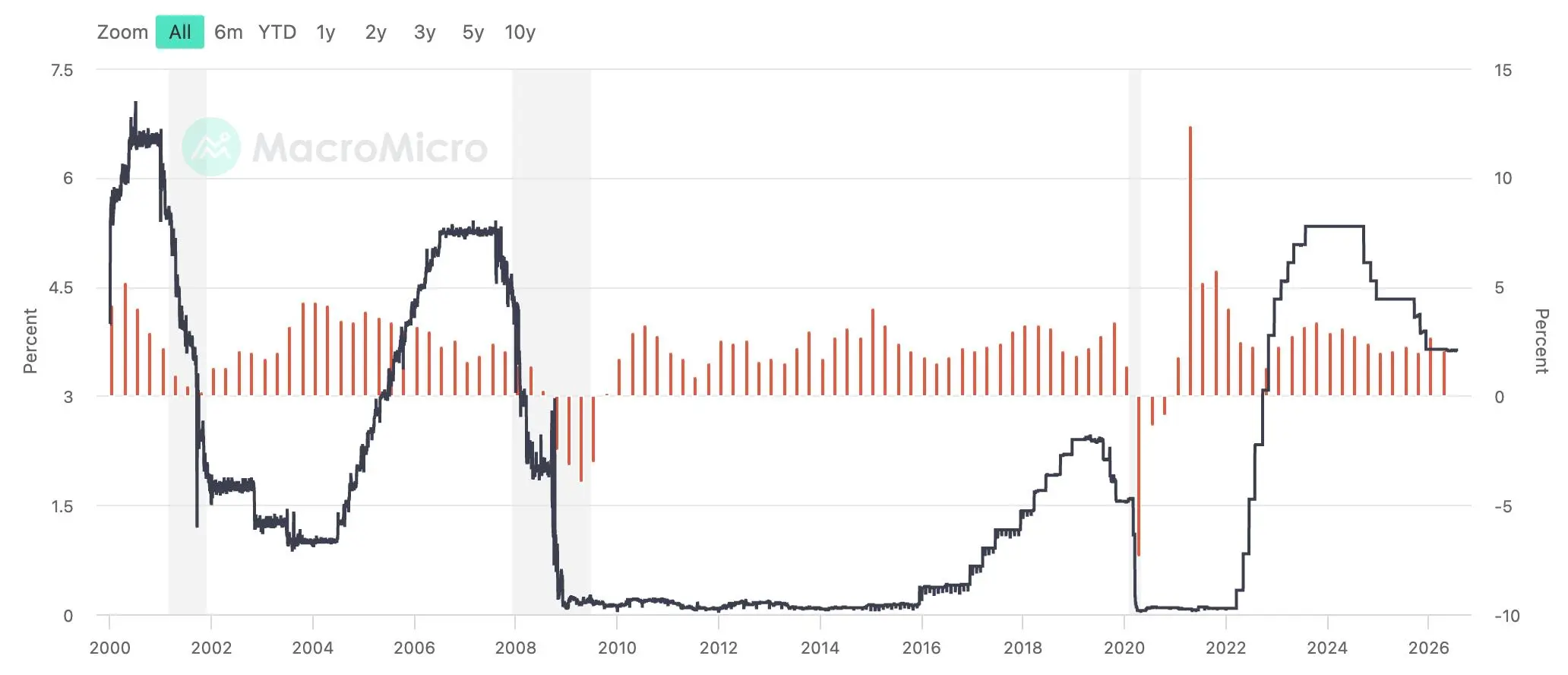
Federal Reserve Interest Rates Since the 21st Century (Source: Macromicro)
Among the 15 major financial crises over the past century, 12 occurred within one year after the Federal Reserve entered a rate-hiking cycle. The current high-interest-rate environment has already lasted 36 months, far exceeding the historical 18-month critical cycle, meaning delayed impacts have been accumulating for a long time.
Now, as the “canary in the coal mine” of global financial markets, South Koreas stock market has triggered full-market circuit breakers nine times this year. In July alone, it plunged approximately 33%, marking the largest monthly decline on record. More than 350,000 retail investor accounts were forcibly liquidated in full, wiping out their principal overnight.
When the nest collapses, no egg remains intact. Against this backdrop, Bitcoin and the broader crypto market have also been declining for 10 consecutive months, with losses exceeding 50% from the peak. However, this may not yet be the darkest moment. If a broad-based financial crisis erupts, the crypto market could face another major collapse — potentially an even more severe one.
The Feds High Interest Rates: A “Sword of Damocles” Hanging Over Global FinanceIn March 2022, in an effort to combat the most severe inflation surge in 40 years, the Federal Reserve began raising rates from near zero. Over 17 consecutive months, it delivered 11 rate hikes totaling 525 basis points, marking the most aggressive tightening cycle since the 1980s.
The current interest rate level of 3.50%–3.75% is still considered relatively high compared with the past 26 years of the 21st century. It is only lower than the peak level of 5.25%–5.50% maintained from July 2023 to September 2024.
To understand the current risk of crisis, we must first understand the underlying logic behind the Feds high-rate policy — it is both a “powerful weapon” against inflation and a “sharp blade” capable of bursting asset bubbles.
The primary goal of central banks such as the Federal Reserve is to ensure that the currency they issue does not lose value too quickly. This is why controlling inflation remains a top priority, and why the Fed repeatedly emphasizes its 2% inflation target.
However, looking back through history, almost every major economic and financial crisis in the modern era has been accompanied by periods of high interest rates from the Federal Reserve. In this sense, the Feds high-rate policy is indeed a “Sword of Damocles” hanging over global finance — once it falls, the consequences can be devastating.
So why hasnt the sword fallen yet?
Because the economy has not “broken” yet.
The labor market still retains some strength, the AI investment boom continues to support corporate expansion, and while inflation has declined, it has not yet been firmly anchored at the Feds 2% target.
The logic of Fed Chair Waller is that as long as financial conditions are already tightening — with long-term bond yields rising independently — the policy rate does not necessarily need to move.
But this is precisely what makes the swords position even more unusual: the market is effectively carrying out part of the tightening process on behalf of the central bank, while the Fed is willing to let it happen. This, in turn, encourages the market to continue “scaring itself” and tightening financial conditions further.
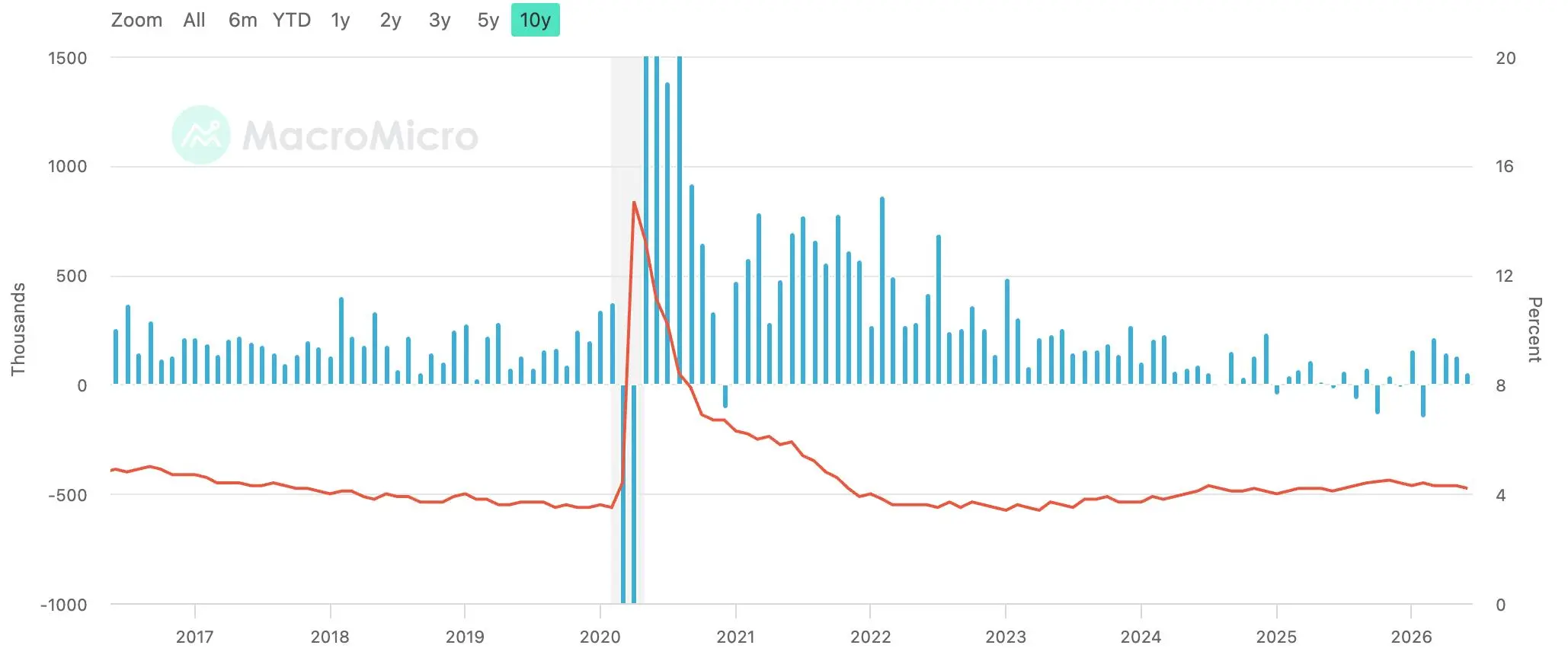
U.S. Nonfarm Payrolls and Unemployment Rate Over the Past 10 Years (Source: Macromicro)
At present, the Sword of Damocles is swaying but has not truly fallen. What is holding it in place is a fragile “horsehair thread.” This thread is currently twisted together by three vulnerable forces: the “illusion of growth” created by the AI narrative, the “appearance of subtle consensus” within the Federal Reserve, and the “passive trust” global capital places in U.S. dollar assets.
The valuation of U.S. equities supported by AI is essentially a growth illusion driven by a severely imbalanced input-output ratio (16:1). Its sustainability is increasingly being questioned by analysts. Meanwhile, beneath the Feds apparent consensus of keeping rates unchanged, the opposition from three hawkish officials reveals that there is no fundamental agreement within the committee regarding the future direction of interest rates.
At the same time, global confidence in U.S. dollar assets is not based on conviction, but rather on a passive choice of having “no better alternative.” This thread, maintained largely by inertia, is becoming increasingly stretched as overseas buyers continue to reduce their exposure to U.S. assets.
From the current perspective, the question is no longer whether the Sword of Damocles will fall, but rather what event will cut the horsehair thread first?
Possible triggers include:
- A sudden collapse of the AI bubble;
- A liquidity crisis in the U.S. Treasury market;
- A “black swan” event emerging from an emerging market, such as a debt crisis in a major developing economy like India or Brazil.
If any one of these scenarios materializes, panic could quickly spread across global risk assets. At that point, Bitcoin, U.S. equities, and credit bonds could face simultaneous selling pressure. The severity of the market turmoil may go far beyond simply “bloodshed.”
Facing this sword, the most important thing ordinary investors need to understand is this:
The sword hanging above itself is already a force.
It causes consumers to reduce spending, discourages companies from borrowing, increases government interest expenses, and continuously pressures risk-asset valuations — even if the sword never actually falls.
And when everyone is watching the same sword, any sudden gust of wind — an unexpectedly weak employment report, a profit warning from an AI giant, or an escalation of geopolitical tensions — could cause it to swing, triggering a market stampede.
South Korea‘s Canary Has Fallen: The Risk of a Global Contagion Has IncreasedOn July 28, South Korea’s KOSPI index plunged 10.76%, marking its largest single-day decline since 1998. The following day, the KOSPI triggered another circuit breaker, briefly falling more than 12% intraday. This marked the first time in the history of the South Korean stock market that circuit breakers were triggered on two consecutive trading days.
Although the KOSPI rebounded sharply during intraday trading on July 31, surging more than 16% to recover to 6,508 points, it remained roughly one-third below its previous high. For the entire month of July, the KOSPI recorded a monthly decline of 33.19%, the largest monthly drop in its history — even exceeding the 27.24% decline during the Asian financial crisis in October 1997.
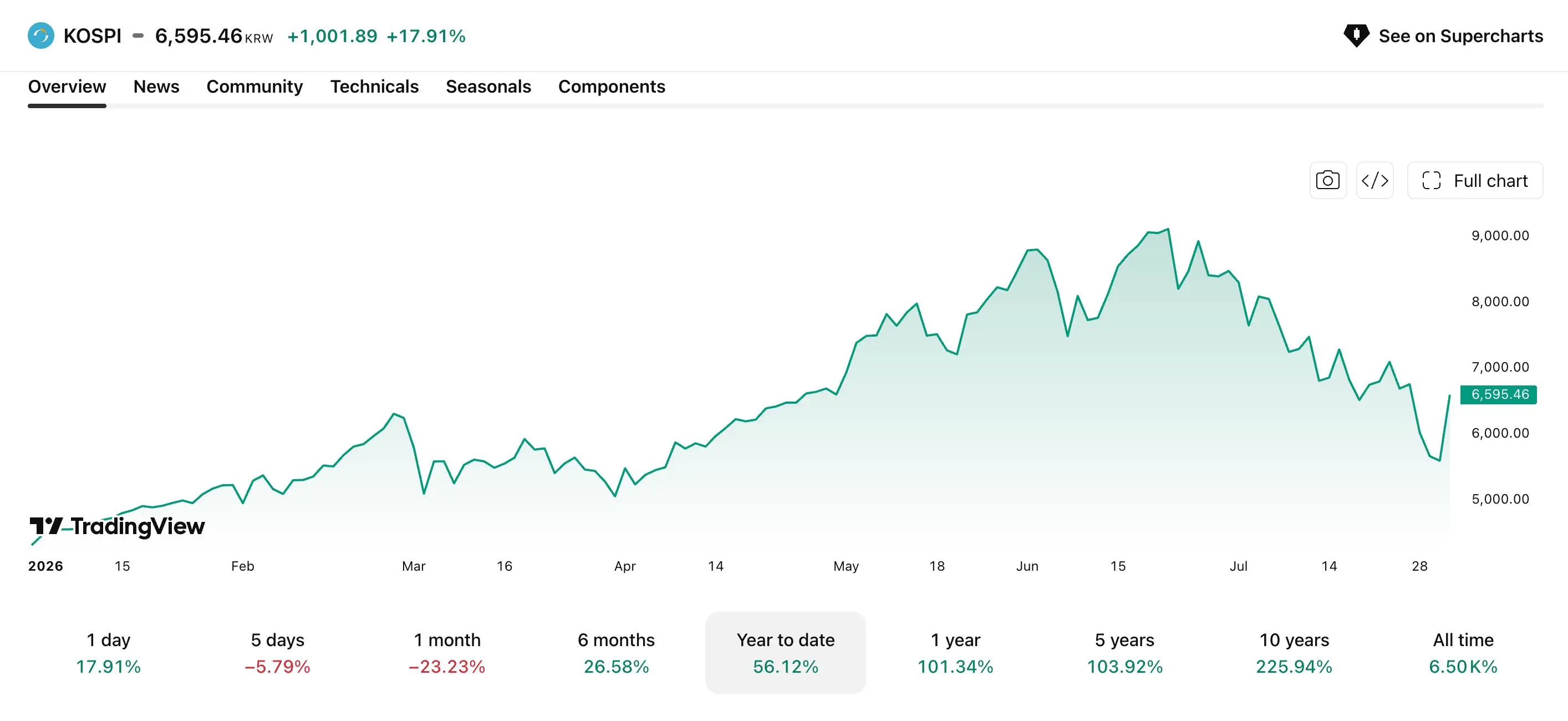
South Koreas KOSPI Index in 2026 (Source: TradingView)
The disaster unfolding in the South Korean stock market is no longer a simple “market correction” — it represents a structural collapse.
As the “canary in the global financial market,” South Korea being described as a leading indicator of financial crises is not a joke, but a pattern repeatedly validated by history.
- 1997 Asian Financial Crisis: The Korean won collapsed first, the stock market plunged more than 40%, and South Korea was forced to seek assistance from the IMF.
- 2000 Dot-com Bubble: Three months before the Nasdaq peaked, South Koreas semiconductor sector had already begun declining.
- 2008 Global Financial Crisis: In July, South Koreas stock market entered a sharp downturn ahead of the global market, and Lehman Brothers collapsed just over a month later.
- 2020 COVID-19 Shock: South Koreas stock market declined first, followed three weeks later by consecutive circuit breakers in U.S. equities.
Why does South Korea tend to fall first?
Because it has relatively open capital markets with no strict foreign exchange controls, allowing global capital to move in and out freely. Once global liquidity tightens, capital often exits South Korea immediately, triggering a simultaneous collapse in both equities and the currency.
The triggers behind this crash are strikingly similar to previous crises: the reversal of the AI investment narrative, concentrated foreign capital outflows, and forced deleveraging by leveraged investors. These three factors together are repeating the same Korean crisis playbook seen before previous global downturns.
Currently, South Koreas crisis is spreading outward like a wildfire jumping from one area to another.
First came synchronized valuation corrections among global semiconductor stocks. Then came a chain reaction across Asian markets, with South Korea and Japan facing aggressive selling pressure as investors unwound AI infrastructure-related leverage.
The Nikkei 225 closed down 1.49%, while Taiwans weighted index plunged nearly 3,000 points. The reversal of momentum-driven trading “is spreading from South Korea toward broader markets.”
The most alarming concern now lies in the U.S. Treasury market.
The collapse of South Korean equities is essentially the concentrated release of global liquidity tightening pressure at a vulnerable point. If this pressure continues spreading, the next market under stress could be U.S. Treasuries themselves.
At that point, the fire would not merely “reach” the Treasury market — it could originate from the Treasury market itself and then sweep across global financial markets.
The canary has already fallen.
Historically, each time this canary collapsed, it signaled a much larger storm ahead. This time, the storm could be triggered by the bursting of the AI bubble, a chain reaction of global leveraged liquidations, or a liquidity crisis in the U.S. Treasury market.
The answer remains unknown.
But the fire has already started — and the wind is blowing toward a much larger battlefield.
Global Financial Crisis: “Already Underway” or Merely a “Warning Signal”?To answer this question, we must first distinguish between a crisis being “already underway” and a “warning signal.”
If “already underway” refers to the moment Lehman Brothers collapsed in 2008 — when a major financial institution suddenly failed and a global credit freeze spread rapidly — then the answer is no. The world has not reached that stage yet.
However, if “already underway” means that a crisis has already erupted in certain vulnerable areas and is beginning to transmit into broader markets, then the answer is yes.
South Koreas canary has fallen. The fire has begun.
As a result, previous scattered warnings about a potential “global financial crisis” are now gaining wider acceptance, with many investors and analysts increasingly sharing similar concerns.
Gao Zhikai, Deputy Director of the Center for China and Globalization (CCG), former Morgan Stanley Asia executive, and former policy advisor to the Hong Kong Securities and Futures Commission, stated that:
“From late 2026 to the first half of 2027, a historic global financial crisis is highly likely, with destructive power potentially 10 times greater than the 2000 dot-com bubble collapse, and possibly exceeding the 2008 crisis.”
What does “10 times” mean?
During the 2000 dot-com bubble, the Nasdaq fell roughly 40% within one year, wiping out trillions of dollars in technology market capitalization. A crisis ten times larger would represent a scale almost beyond imagination.
This view is supported by the convergence of three systemic risks:
- The U.S. debt “Ponzi-like cycle” approaching its limits;
- The AI bubble becoming increasingly detached from the real economy;
- Geopolitical conflicts accelerating energy shocks and economic instability.
- Jim Rogers, co-founder of the Quantum Fund, has predicted that 2026 could bring “the worst global financial crisis in history” and reportedly has exited all U.S. equities.
- Jamie Dimon, CEO of JPMorgan Chase, has warned that markets are underestimating risks from geopolitics, fiscal deficits, and bond markets, stating that he is currently not buying either U.S. stocks or long-term U.S. Treasury bonds.
- Meredith Whitney has warned that the U.S. economy could face a “clearing moment” in the fourth quarter of 2026. She became known as a financial “whistleblower” after warning about Citigroup before the 2008 crisis.
- Ray Dalio, founder of Bridgewater Associates and an investor who successfully anticipated the 2008 financial crisis, has estimated that the probability of a global debt crisis occurring within the next five years is as high as 65%. He believes U.S. debt is approaching an “irreversible” point and risks entering a debt “death spiral.”
- Raising rates could crush economic growth and the bond market;
- Cutting rates could reignite inflation and fuel asset bubbles;
- Holding rates steady leaves markets to continue intimidating themselves through uncertainty and fear.
Of course, the prediction has also attracted significant criticism. Critics argue that the “10 times worse” claim is exaggerated.
However, even many critics do not dismiss the broader possibility that a global financial crisis may be approaching.
Warnings from Financial “Whistleblowers” on Wall Street and in the Investment WorldSeveral prominent investors and financial figures have openly expressed concerns about a potential crisis:
Of course, there is still debate regarding the timing and real-world impact of a potential financial crisis.
The main reason is that the current situation may still be in an “early contagion phase.”
South Korea represents a fallen frontline indicator, but the situation has not yet evolved into a 2008-style global systemic credit freeze. The core markets — the United States, China, and Europe — have not yet been breached.
However, the fire is spreading.
Furthermore, this potential crisis is fundamentally different from 2008.
In 2008, the problem was concentrated in the private sector — mortgages and banks — and governments could respond by printing money and providing bailouts.
In 2026, however, the problem lies increasingly in the government sector itself — U.S. Treasury debt and fiscal sustainability.
If governments respond with another massive wave of monetary expansion, it may not solve the problem. Instead, it could directly reignite inflation and create an even more difficult dilemma.
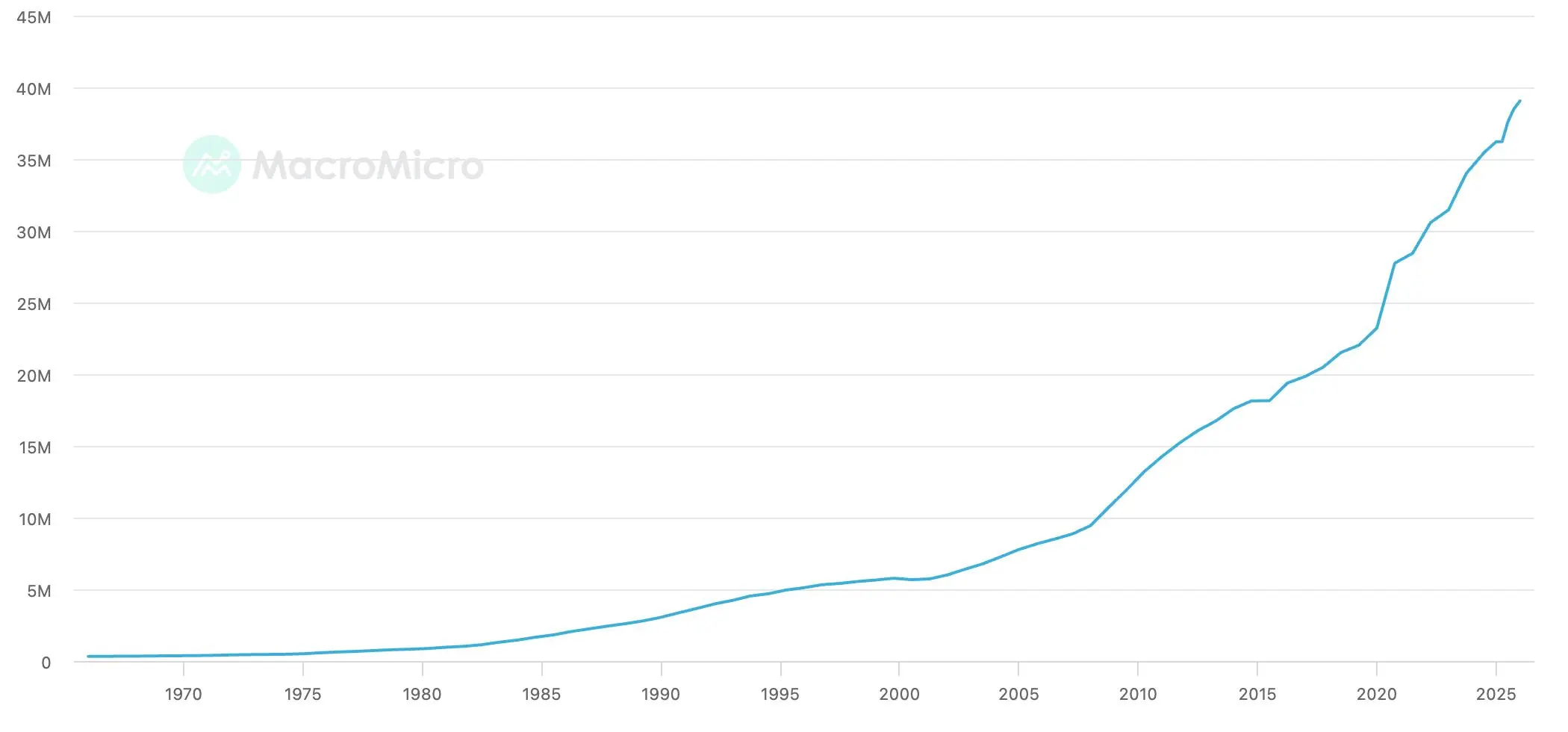
U.S. Treasury Debt Trend Chart (Source: Macromicro)
In this crisis scenario, AI assets represent a burning powder keg — the input-output ratio is severely imbalanced, debt chains are highly complex, leveraged capital is heavily concentrated, and valuations are approaching historical extremes. Once triggered, the transmission mechanism is already clear:
Valuation collapse → Credit crisis → Real economy slowdown
U.S. Treasury debt represents the Sword of Damocles hanging at the highest level. If an AI bubble collapse forces the Federal Reserve to launch another massive liquidity injection, the credibility of the U.S. dollar could suffer permanent damage. At that point, the foundation of the global financial system itself could be shaken.
The Federal Reserve is the decision-maker trapped in the middle:
No matter which path the Fed chooses, there will be a cost.
Put vividly:
The fire has already spread to the doorstep. The only uncertainty is when it will break through the final firewall.
Crypto: A “Vulnerable Group” Under High Interest Rates — How Much Downside Risk Remains?Returning our focus to the crypto market, the key question is:
Under the current conditions, could crypto experience another major decline?
Lets start with the bad news:
High interest rates are a natural enemy of crypto assets.
As the Federal Reserve maintains restrictive monetary policy, the attractiveness of fixed-income assets has increased significantly. Since 2022, high interest rates have continuously compressed risk appetite, redirecting institutional capital toward traditional yield-generating assets.
Bitcoins performance in 2026 reflects this pressure.
Bitcoin fell 32% during the first half of the year, dropping more than 50% from its all-time high of $126,000 reached in October 2025. The market‘s reassessment of Federal Reserve policy expectations has been one of the biggest drivers behind Bitcoin’s decline.
Now, the less negative news:
After the latest Fed rate decision was announced in July, the market experienced a brief decline, but there was no panic selling. Bitcoin demonstrated some resilience around the $64,000 level.
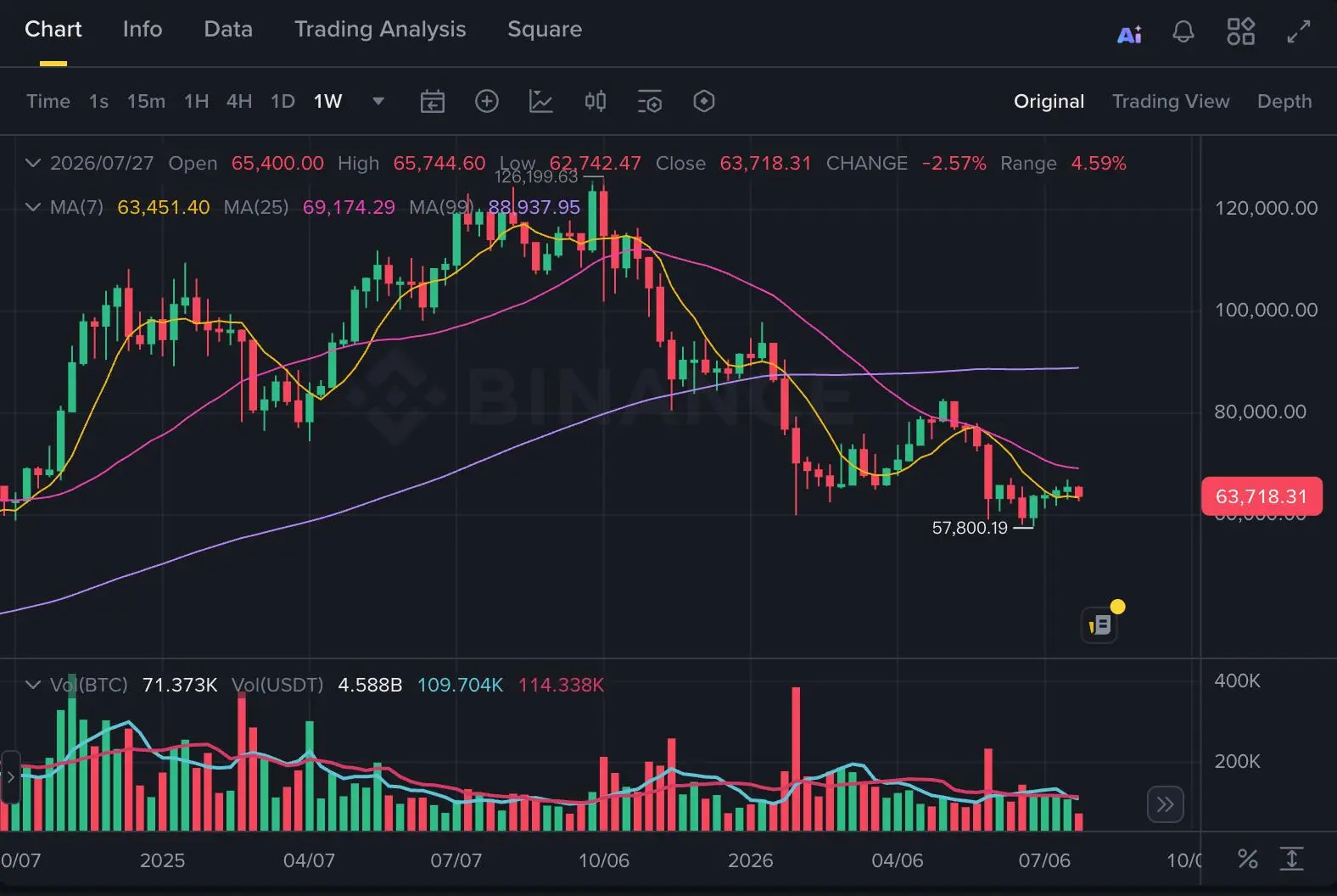
Bitcoin Price Trend Since 2025 (Source: Binance)
More importantly, a structural shift is taking place: the correlation between Bitcoin and semiconductor stocks is weakening.
Over the past few weeks, the market capitalization of major U.S. technology companies has declined by approximately $797 billion, while South Koreas stock market suffered a sharp sell-off. However, Bitcoin has remained relatively stable.
Some analysts point out that when market pressure comes from macroeconomic factors, Bitcoin typically moves in the same direction as equities. But when pressure originates from stock-market-specific factors — such as concerns over an AI bubble — Bitcoin may begin to decouple from traditional risk assets.
There are also potential regulatory tailwinds.
The U.S. Digital Asset Market Clarity Act is currently at a critical stage of Senate review. If passed, the crypto industry could move from a regulatory “gray zone” toward a clearer compliance framework.
Overall, the Feds elevated interest rates represent a prolonged challenge for the crypto market.
If high interest rates remain in place for longer, the crypto market may not necessarily experience an immediate crash. Instead, it could enter a prolonged “boiling frog” scenario — characterized by sideways trading, gradual declines, and shrinking liquidity.
However, if the Federal Reserve resumes rate hikes, that could mark the beginning of a major downturn. Bitcoin could potentially fall to the $35,000–$40,000 range before October.
Furthermore, as the crypto market has become deeply integrated with traditional financial markets, if a global financial crisis continues to expand and eventually erupts on a large scale, there will be no safe haven under a collapsing system. The crypto market could suffer an even more severe decline.
What Should Ordinary Crypto Investors Do Now?With the Federal Reserve maintaining high interest rates and early signs of a potential global financial crisis emerging, what should crypto investors do?
First: Recognize a harsh reality — crypto is no longer an “independent kingdom.”
Over the past decade, Bitcoin has primarily been driven by factors such as:
U.S. dollar liquidity;
Real interest rates;
Risk appetite;
Regulatory cycles.
However, in 2026, Bitcoin must also confront a new variable:
Will AI continue absorbing global marginal risk capital?
If AI investment continues expanding, the crypto market may remain in a situation where there is “sufficient liquidity, but no control over incremental capital flows.”
The launch of Bitcoin spot ETFs has allowed institutional capital to enter the market rapidly — but it also means that institutional funds can exit quickly when market conditions deteriorate.
The connection between the crypto market and the global macro-financial system is now stronger than ever before.
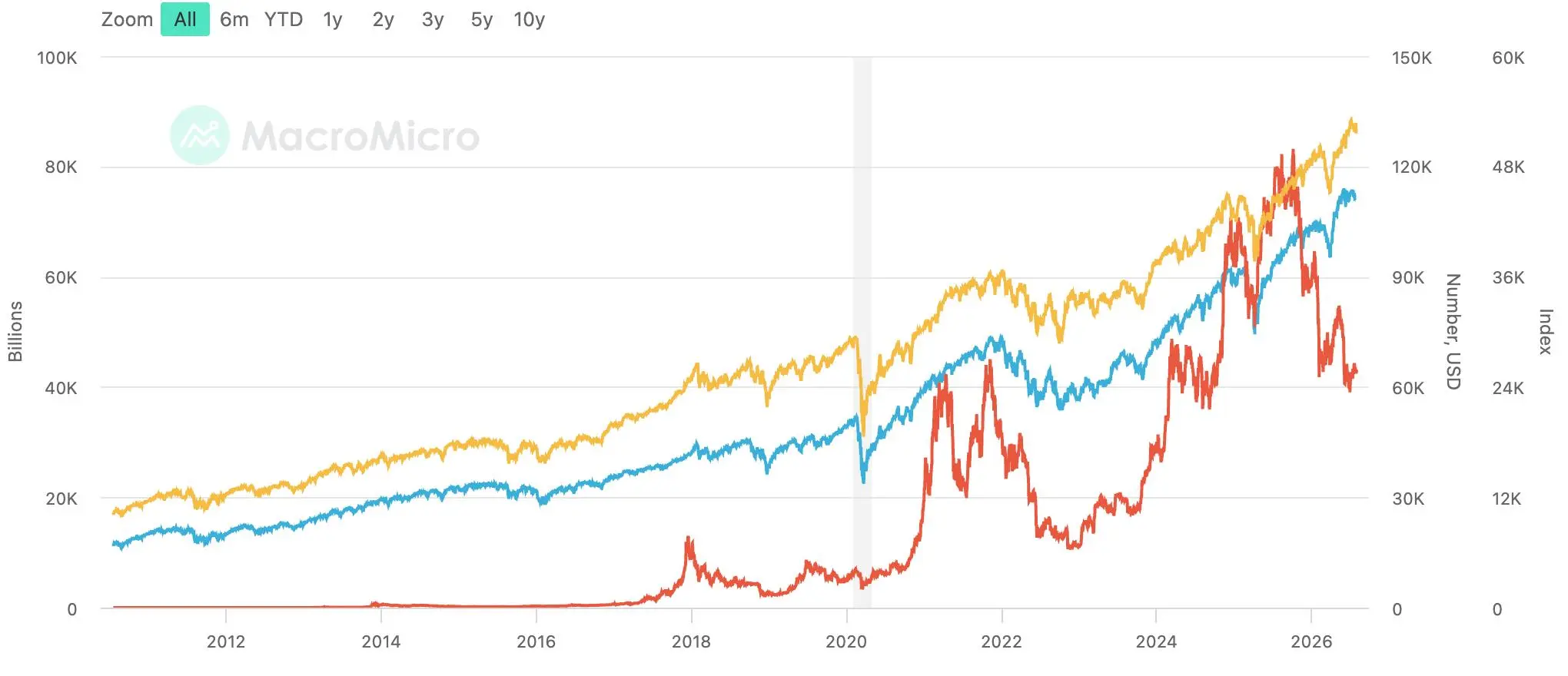
Bitcoin Correlation with U.S. Stocks (Source: Macromicro)
Second: If the AI Bubble Bursts, Crypto May Fall First and Rise Later — But the Initial Decline Could Be Brutal
If the AI bubble bursts, the crypto market will likely follow equities lower at first, and the decline could even be more severe.
However, after credit has been flushed out and monetary policy shifts back toward easing, Bitcoin could once again become one of the first assets to rebound during the next cycle of liquidity recovery.
Third: In terms of practical strategy, remember these principles:
① Position size determines whether you can hold your assets through a crash — and the ability to hold through extreme volatility is the true key to long-term profitability.
② In crypto markets, so-called diversification often fails during crises because asset correlations rise sharply. The most effective risk management is controlling overall portfolio exposure.
③ With the market currently trading within a range and trading volume remaining weak, the core strategy before a clear direction emerges should be defense first: protect capital.
④ For ordinary investors, the current approach should be: maintain a “core position with idle funds + phased DCA (dollar-cost averaging)” strategy. Completely avoid leverage and high-risk altcoins, keep sufficient cash reserves, and establish strict stop-loss rules to preserve capital for future opportunities.
Finally, investors should closely monitor three key signals:
First: Whether AI capital expenditure shifts from accelerating expansion to marginal slowdown;
Second: Signals from the Federal Reserve regarding rate cuts — with the first potential rate-cut window possibly arriving in September or December;
Third: Whether the crypto market can attract independent capital inflows again, rather than continuing to be driven by risk appetite in the U.S. technology stocks.
Another extremely important point:
The successive shutdowns of exchanges such as BitMEX and BitMart have shown that choosing the right trading platform is the foundation of crypto investing.
The issue is not simply whether investors make profits or losses — choosing the wrong platform can result in losing everything.
When selecting a trading platform, investors can use exchange research platforms such as WikiBit to evaluate whether an exchange is reliable.
WikiBit covers more than 20,000 cryptocurrency exchanges worldwide, features its proprietary “Eye of Blockchain” risk scoring system, and monitors over 60 official regulatory authorities, helping investors identify and avoid high-risk platforms.
In an environment of extreme uncertainty, choosing the right tools is just as important as choosing the right investment direction.
Conclusion: For Ordinary Crypto Investors, This Is Not the Time to “Take a Gamble” — It Is the Time to Survive
Protect your capital. Control your position size. Avoid leverage. Stay patient.
Before the storm truly arrives, prepare everything within your control.
Then — wait.
Wait for the bubble to clear.
Wait for liquidity to recover.
Wait for the next spring of cryptocurrency.
After all, a genuine technological revolution does not mean asset prices will always remain reasonable.
But conversely, irrational asset prices can never erase the value of the technological revolution itself.