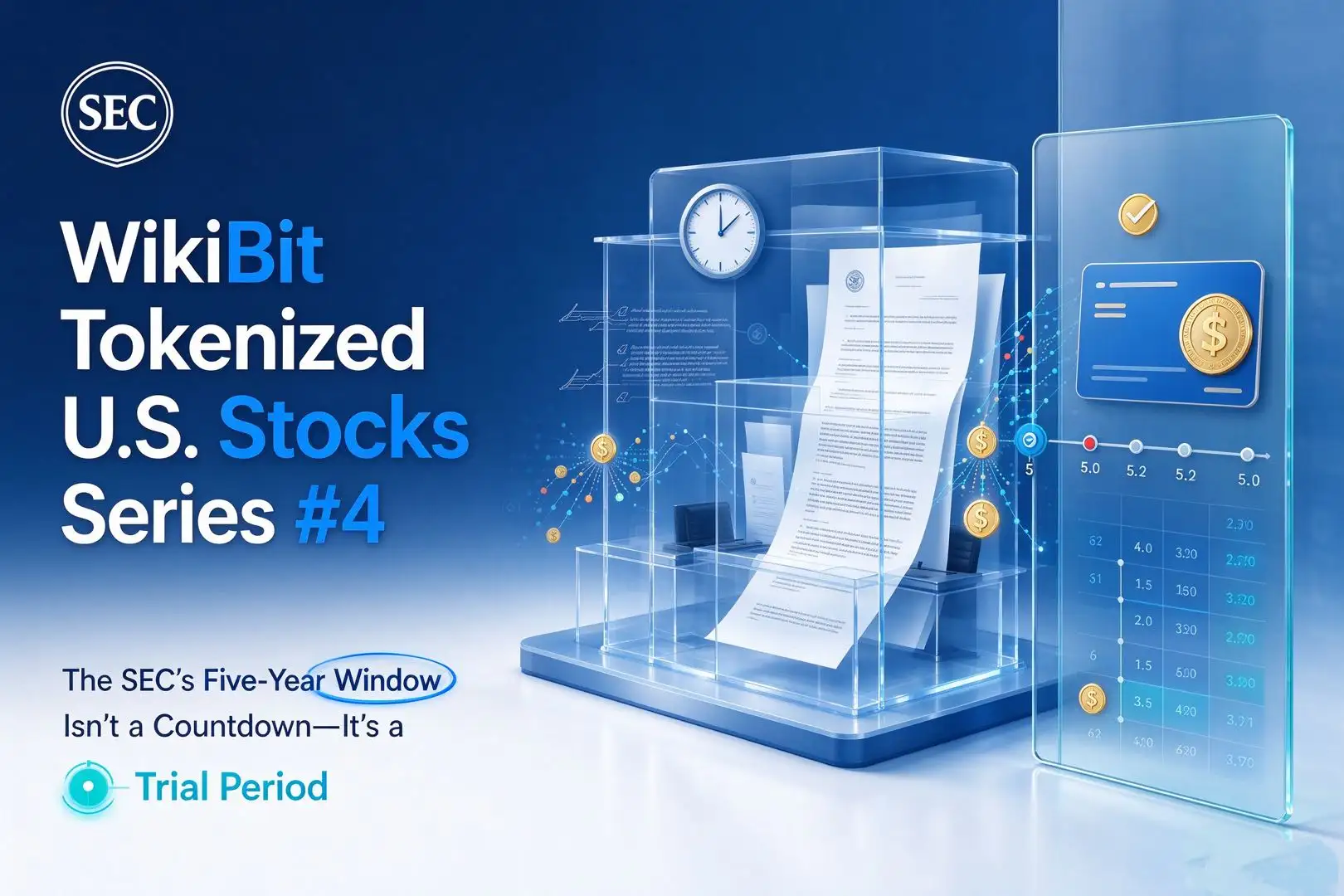




WikiBit Tokenized U.S. Stocks Series #4: The SEC’s Five-Year Window Isn’t a Countdown—It’s a Trial Period
Imagine this: You buy a tokenized version of Apple stock on a blockchain and transfer it to a friend seconds later. While you sleep, blockchain transactions continue around the clock, and smart contracts settle trades automatically. Sounds great, right? But questions immediately arise. If Apple trades at $200 on Nasdaq while its tokenized version sells for $206 on-chain, which price should you trust? If Apple pays a dividend, are token holders entitled to receive it? If the platform goes bankrupt, do you actually own Apple shares, or just a contractual claim against the platform? And if market manipulation, a hack, or a liquidity run occurs, who is responsible? These are the real questions the SEC must answer. The five-year period is not a countdown to the full-scale opening of the market. It is a financial experiment with defined boundaries: innovation gets a chance, but that does not justify handing the entire securities market over to a new model that has yet to prove itself.1.A Stock Is More Than a String of Code: Four Major Challenges Tokenization Must Address Blockchain technology can make transaction records easier to track, automate asset transfers, and potentially reduce intermediaries. But the securities market is much more than a