
EasyBit.pro
3.55
10-15 years
Not Regulated
Questionable Regulatory License

No Regulatory License

Be aware of the risks!

Basic Information

Country/Region
Russia
Exchange AbbreviationEasyBit.pro
Trade TypeFiat Trading
Operating Period10-15 years
Websitehttps://easybit.pro//?Partners=21738&utm_source=partners&utm_medium=partners21738&utm_campaign=click
Emailsupport@wmirk.ru
0.00/10

Score

Regulation
Risk Control
Business
Reputation
Tech

RiskNotice

2 risk alerts
High Risk 1
Medium Risk 1

Exchange Overview

Exchange Overview

No Data

Business Region

InfluenceD
0
2
4
6
8
10

News

41

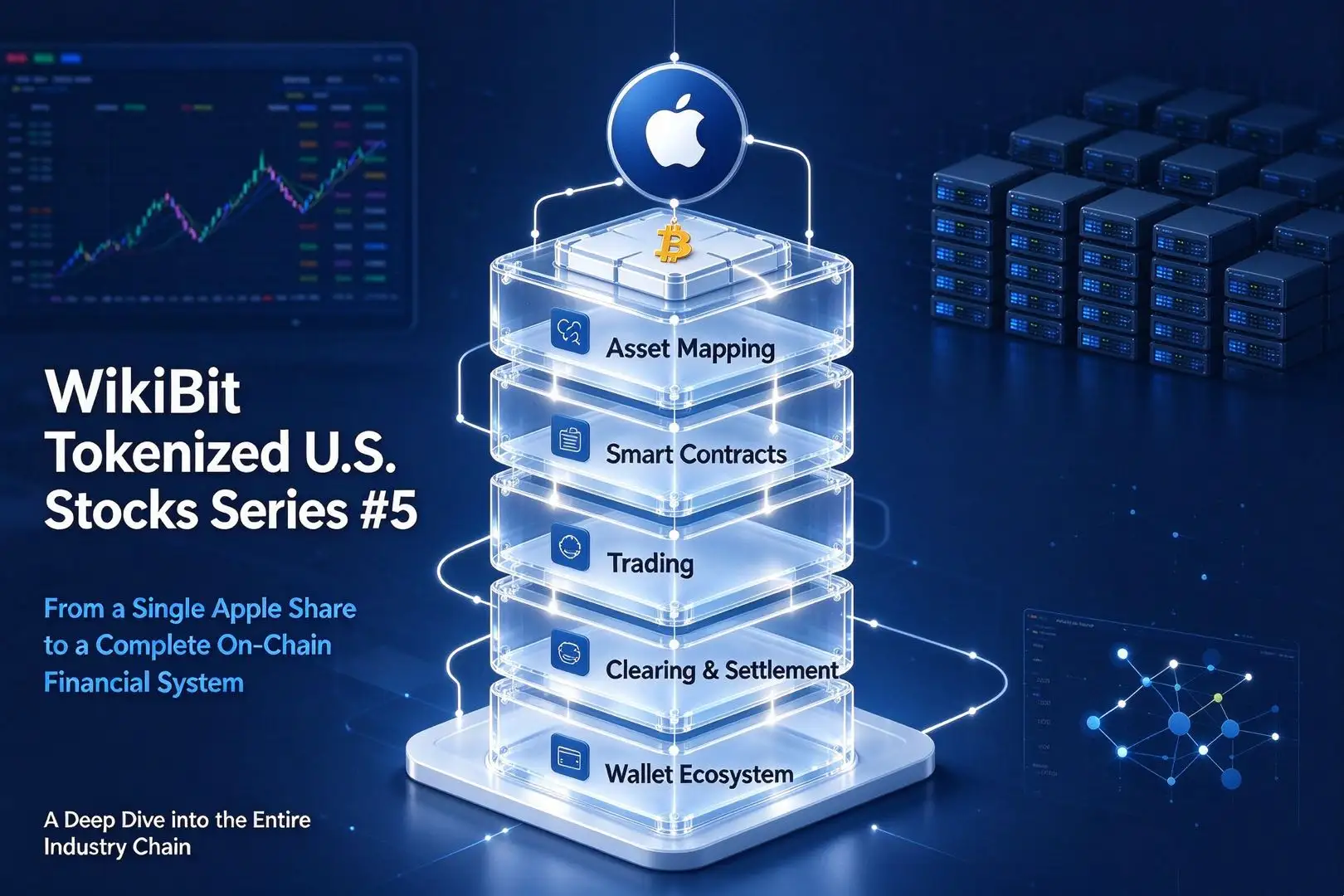
WikiBit Tokenized U.S. Stocks Series #5: From a Single Apple Share to a Complete On-Chain Financial System — A Deep Dive into the Entire Industry Chain

Tokenized stocks are not as simple as “taking a screenshot of a stock and putting it on the blockchain.” They are more like a matchmaking event spanning Wall Street and public blockchains.  The matchmakers include listed companies, custodian banks, brokers, exchanges, stablecoins, oracles, wallets, and auditing firms. The dowry consists of custody fees, issuance fees, trading fees, settlement fees, and data fees. In the end, whoever wins the users business becomes the tollbooth operator collecting the fees.  Imagine there is one share of Apple stock that needs to travel all the way from Nasdaq into your crypto wallet. You might think it is just a matter of clicking a button and putting Apple on-chain.  Not quite. Behind the scenes lies an entire industry chain: the asset layer ensures the underlying shares actually exist; the compliance layer keeps everyone on the right side of the law; the data layer makes sure nobody feeds you a pear when you ordered an Apple; the settlement layer ensures your money doesnt disappear along the way; the technology layer keeps the blockchain running smoothly; and the access layer brings the whole experience to your fingertips.  In a nutshell, tokenized stocks are not a single project, but an entire on-chain
WikiBit Tokenized U.S. Stocks Series #5: From a Single Apple Share to a Complete On-Chain Financial System — A Deep Dive into the Entire Industry Chain
Within 1 weeksDeep Dive

$5.6 Billion Stolen: Both Are World No. 1—Will Binance Repeat Mt. Gox’s Fate?

At 4 a.m. today, Binance had $5.6 billion stolen, making it the largest exchange theft in history. So the question is: Will it become the second Mt. Gox? How will the market move next? Is it time to bottom-fish?  Let me give the conclusion first: Binance will not repeat Mt. Goxs fate. But “not repeating Mt. Gox” does not mean “your money is necessarily safe.” These two things must be viewed separately.1. What Exactly Did Binance Lose, and What Did It Not Lose?  As soon as the news of the Binance theft broke, the first name that came to many people‘s minds was not the hacker, but Mt. Gox. Because it was also an exchange theft, also the world’s largest, and also triggered user panic. Mt. Gox lost 850,000 BTC back then; the exchange went bankrupt, creditors waited ten years, and in the end they only received about 23.6% of their original claims as compensation.  So people ask: Is Binance going to go down the same road?  No. But the reason is not that Binance is more moral or luckier, but that between the two eras lies an entire set of structural firewalls.  First, one point that is especially easy to be misled by: the

$5.6 Billion Stolen: Both Are World No. 1—Will Binance Repeat Mt. Gox’s Fate?
10-30Deep Dive

The Fed Holds Rates Steady in October, Yet Wall Street Heavyweights Sound the Alarm: Is a Financial Crisis Already on the Horizon?

Bitcoin is stuck around $80,000, ETH around $2,300, and SOL near $100. They seem unable to break higher or move lower—like sprinters waiting for the starting gun.  And this week is certainly packed with potential market-moving events:  October 29, 2:00 a.m. Beijing time (Thursday): Federal Reserve interest rate decision  October 29, 8:30 p.m.: U.S. PCE inflation data  October 29, 9:15 p.m.: European Central Bank interest rate decision  October 30, 11:00 a.m. (Friday): Bank of Japan interest rate decision  Each starting gun could send markets sprinting in either direction, triggering a sharp rally or a sudden sell-off. The biggest event is the Feds decision on October 29. The prevailing expectation is that it will leave rates unchanged, maintaining the federal funds rate at 3.75%–4.00%.  On the surface, that sounds like a chance for markets to catch their breath. Yet almost simultaneously, another group of voices is raising the alarm: the probability of a global financial crisis over the next six months to two years may be increasing.  This creates an apparent contradiction: If central banks are standing pat, why are financial heavyweights growing more nervous?  The answer lies in a simple observation: The Feds pause does not mean the risks have disappeared. It may simply mean the central bank is

The Fed Holds Rates Steady in October, Yet Wall Street Heavyweights Sound the Alarm: Is a Financial Crisis Already on the Horizon?
10-27Deep Dive