

Complex
3.60
2-5 years
Not Regulated
Exchange
Questionable Regulatory License

No Regulatory License

Be aware of the risks!

Basic Information

Country/Region
Mongolia
Exchange AbbreviationComplex
Company NameComplex Digital Ecosystem LLC
Operating Period2-5 years
Websitehttps://complex.mn/
Exchange TypeCentralized Exchange
0.00/10

Score

Regulation
Risk Control
Business
Reputation
Tech

RiskNotice

2 risk alerts
High Risk 1
Medium Risk 1

Exchange Overview

Exchange Overview

Комплекс Крипто Бирж шинэчлэгдлээ.

Илүү олон боломжууд тун удахгүй...

Business Region

InfluenceC
0
2
4
6
8
10

News

14

WikiBit Exchange Runaway Risk Rankings – Episode 56: BloFin: Blacklisted by France's AMF, Delisted by India's FIU, and Ranked Last in On-Chain Reserves — How Long Can BloFin's “Polished Product” Hold Up?

Introduction: A Derivatives Exchange with a Polished Product but a Fragile Foundation  In our previous 55 episodes, we investigated a wide range of exchanges, from HashKey to Coinbase. For Episode 56, were turning our attention to a rather specialized player: BloFin.  When it comes to product design, BloFin does have some notable strengths. Founded in 2019 by Matt Hu, the founder of TokenInsight, the exchange officially launched in January 2023. Its core business focuses on perpetual futures and copy trading, offering 508 perpetual trading pairs, leverage of up to 150x, maker/taker futures fees of 0.02%/0.06%, and copy trading with a minimum starting amount of just 100 USDT.  Its copy trading system offers three position modes, while its trader leaderboard additionally discloses risk-adjusted performance metrics such as the Sharpe, Sortino, and Calmar ratios — features that are relatively uncommon among comparable platforms.  BloFin also claims to provide 1:1 asset reserves, Merkle Tree-based Proof of Reserves (PoR), independent monitoring by Nansen, and custody services through Fireblocks.  However, the picture looks very different on the regulatory and financial fronts.  BloFin is absent from ESMAs MiCA CASP register. Frances financial regulator, the Autorité des Marchés Financiers (AMF), has included it on its cryptocurrency blacklist since December 2024. On September 9,
WikiBit Exchange Runaway Risk Rankings – Episode 56: BloFin: Blacklisted by France's AMF, Delisted by India's FIU, and Ranked Last in On-Chain Reserves — How Long Can BloFin's “Polished Product” Hold Up?
Within 1 weeksDeep Dive

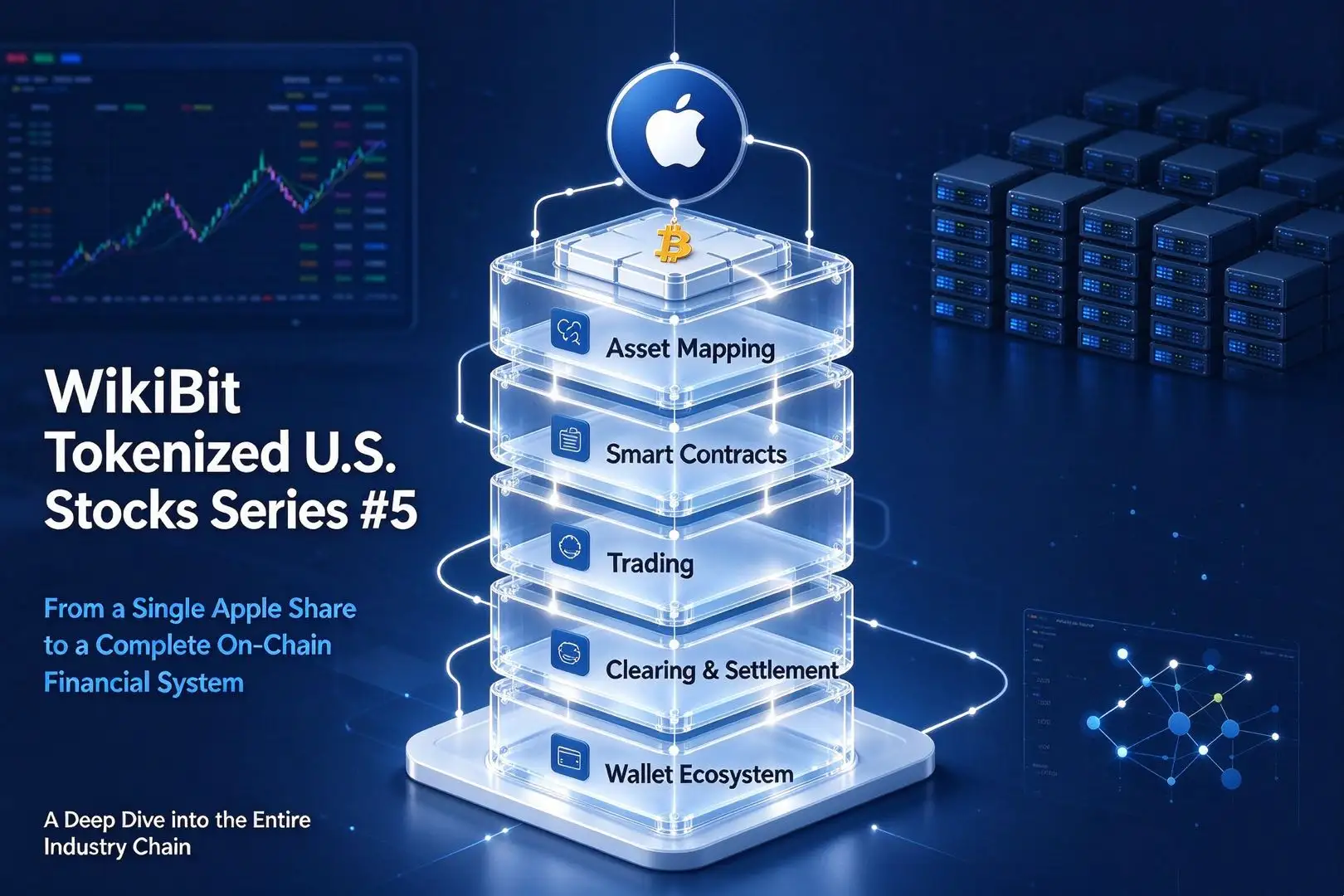
WikiBit Tokenized U.S. Stocks Series #5: From a Single Apple Share to a Complete On-Chain Financial System — A Deep Dive into the Entire Industry Chain

Tokenized stocks are not as simple as “taking a screenshot of a stock and putting it on the blockchain.” They are more like a matchmaking event spanning Wall Street and public blockchains.  The matchmakers include listed companies, custodian banks, brokers, exchanges, stablecoins, oracles, wallets, and auditing firms. The dowry consists of custody fees, issuance fees, trading fees, settlement fees, and data fees. In the end, whoever wins the users business becomes the tollbooth operator collecting the fees.  Imagine there is one share of Apple stock that needs to travel all the way from Nasdaq into your crypto wallet. You might think it is just a matter of clicking a button and putting Apple on-chain.  Not quite. Behind the scenes lies an entire industry chain: the asset layer ensures the underlying shares actually exist; the compliance layer keeps everyone on the right side of the law; the data layer makes sure nobody feeds you a pear when you ordered an Apple; the settlement layer ensures your money doesnt disappear along the way; the technology layer keeps the blockchain running smoothly; and the access layer brings the whole experience to your fingertips.  In a nutshell, tokenized stocks are not a single project, but an entire on-chain

WikiBit Tokenized U.S. Stocks Series #5: From a Single Apple Share to a Complete On-Chain Financial System — A Deep Dive into the Entire Industry Chain
11-02Deep Dive

Wall Street Is Moving Finance On-Chain: Who Will Be the Biggest Winners, and What Should Retail Investors Watch Out For?

Traditional finance is entering the crypto world through ETFs, tokenization, and on-chain services. But institutional adoption does not automatically mean ordinary users will benefit. The real questions are: As Wall Street moves on-chain, who gains access to new opportunities, and who is simply being swept along by the hype?  This article is based on the transcript of an X Space livestream organized by WikiBit on the theme “Wall Street Goes On-Chain.” The discussion focused on a straightforward question: As Wall Street moves onto the blockchain, who stands to benefit the most in the crypto world?  The host opened by highlighting a central contradiction. On one hand, traditional finance is accelerating its entry into crypto, with ETFs, tokenized assets, and on-chain services emerging at a rapid pace. On the other, markets remain caught between inflation, interest rates, global risk sentiment, and concerns over user protection. Institutional activity is growing, but confidence has not automatically translated into demand.  This raises two key questions:Who actually benefits from Wall Streets entry into crypto?For ordinary crypto users, what constitutes meaningful adoption?  The livestream featured three guests from different backgrounds: MEJ from Gold House, a representative from RBC Group, and Akai, Community Manager at Bazaars.  The diversity of the panel highlighted

Wall Street Is Moving Finance On-Chain: Who Will Be the Biggest Winners, and What Should Retail Investors Watch Out For?
10-26Deep Dive