

CG FinTech
3.47
2-5 years
Not Regulated
Broker
Questionable Regulatory License

No Regulatory License

Be aware of the risks!

Basic Information

Country/Region
Saint Lucia
Exchange AbbreviationCG FinTech
Company NameCGTrade (Mauritius) Limited
Operating Period2-5 years
Websitehttps://www.cgfintech108.com/en
Trade TypeContract Trading、Leveraged Trading
0.00/10

Score

Regulation
Risk Control
Business
Reputation
Tech

RiskNotice

2 risk alerts
High Risk 1
Medium Risk 1

Exchange Overview

Exchange Overview

CG FinTech is a challenger fintech company focuses on innovative financial solutions and empowerment to reshape financial services landscape in challenging markets where traditional financial institutions fail to reach.

Business Region

InfluenceD
0
2
4
6
8
10

News

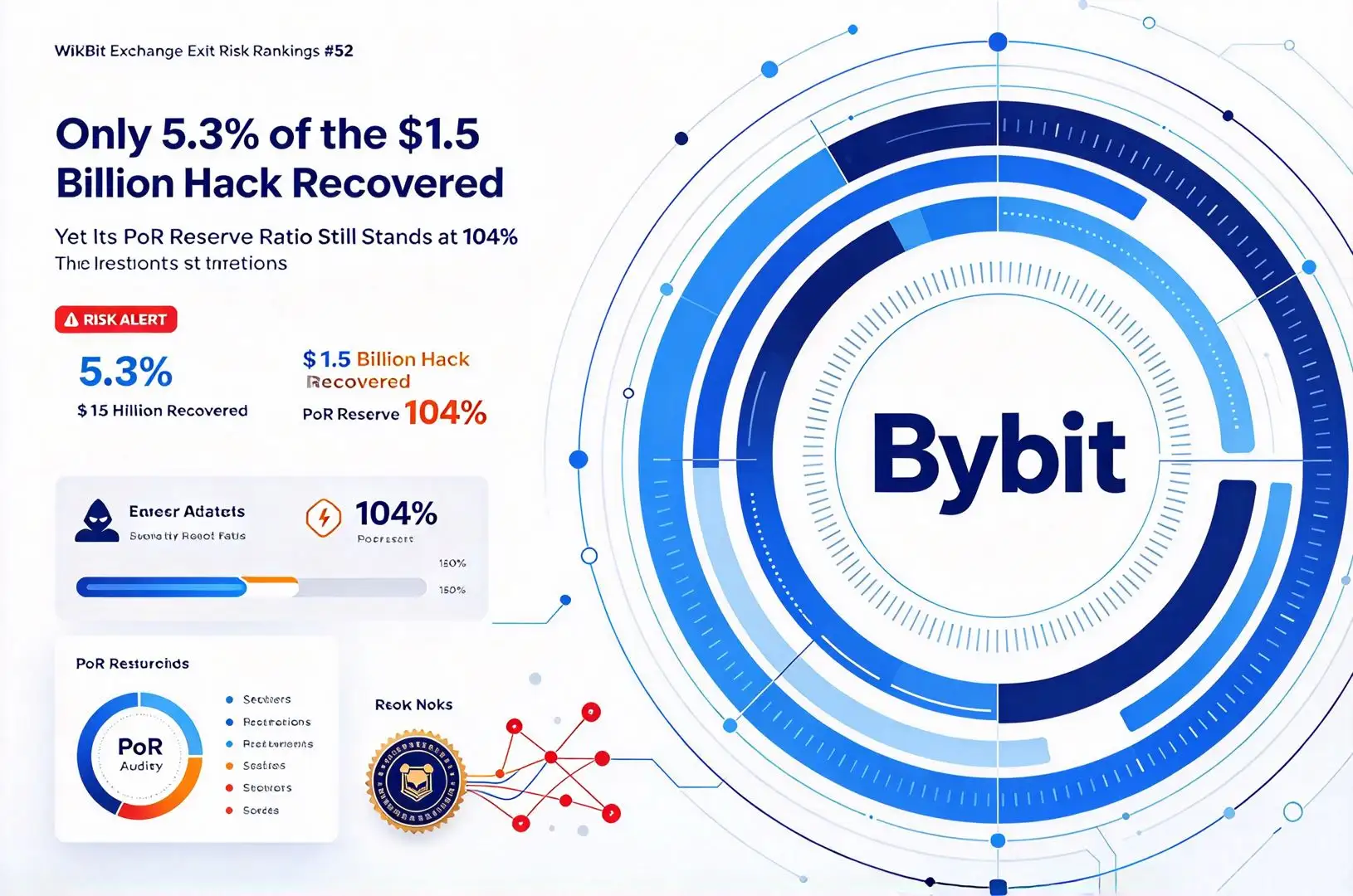
WikiBit Exchange Exit Risk Rankings #52: Bybit — Only 5.3% of the $1.5 Billion Hack Recovered, Yet Its PoR Reserve Ratio Still Stands at 104%

Introduction: The Worlds No. 2 Exchange — Perfect on Paper, Vulnerable in Practice  In our first 51 installments, weve investigated a range of exchanges, from HashKey to Bitget. For Episode 52, were turning our attention to a name that cannot be ignored: Bybit.  On paper, Bybits numbers are among the most impressive in the crypto industry. It was once the worlds second-largest cryptocurrency exchange, with more than 80 million users, average daily trading volume exceeding $18 billion, and the worlds third-largest derivatives market, recording $1.49 trillion in trading volume in Q1 2026. It has published 40 consecutive Proof of Reserves (PoR) reports, covering 50 tokens and $19.6 billion in assets. Its reserve ratios stand at 104% for BTC, 103% for ETH, and 110% for USDT.  Judging by these static metrics alone, Bybit looks like an industry giant that is simply too big to fail.  But theres another side to the story.  In February 2025, North Korean hackers stole approximately $1.5 billion from Bybit in what was then the largest single hacking incident in crypto history—surpassed only by Binances reported $6.3 billion theft today. The FBI identified North Koreas Lazarus Group as the culprit and dubbed the operation TraderTraitor. Nearly two years later, the total amount
WikiBit Exchange Exit Risk Rankings #52: Bybit — Only 5.3% of the $1.5 Billion Hack Recovered, Yet Its PoR Reserve Ratio Still Stands at 104%
11-02Deep Dive

WikiBit Tokenized U.S. Stocks Series #4: The SEC’s Five-Year Window Isn’t a Countdown—It’s a Trial Period

Imagine this: You buy a tokenized version of Apple stock on a blockchain and transfer it to a friend seconds later. While you sleep, blockchain transactions continue around the clock, and smart contracts settle trades automatically. Sounds great, right?  But questions immediately arise. If Apple trades at $200 on Nasdaq while its tokenized version sells for $206 on-chain, which price should you trust? If Apple pays a dividend, are token holders entitled to receive it? If the platform goes bankrupt, do you actually own Apple shares, or just a contractual claim against the platform? And if market manipulation, a hack, or a liquidity run occurs, who is responsible?  These are the real questions the SEC must answer. The five-year period is not a countdown to the full-scale opening of the market. It is a financial experiment with defined boundaries: innovation gets a chance, but that does not justify handing the entire securities market over to a new model that has yet to prove itself.1.A Stock Is More Than a String of Code: Four Major Challenges Tokenization Must Address  Blockchain technology can make transaction records easier to track, automate asset transfers, and potentially reduce intermediaries. But the securities market is much more than a

WikiBit Tokenized U.S. Stocks Series #4: The SEC’s Five-Year Window Isn’t a Countdown—It’s a Trial Period
10-28Deep Dive

Wall Street Is Moving Finance On-Chain: Who Will Be the Biggest Winners, and What Should Retail Investors Watch Out For?

Traditional finance is entering the crypto world through ETFs, tokenization, and on-chain services. But institutional adoption does not automatically mean ordinary users will benefit. The real questions are: As Wall Street moves on-chain, who gains access to new opportunities, and who is simply being swept along by the hype?  This article is based on the transcript of an X Space livestream organized by WikiBit on the theme “Wall Street Goes On-Chain.” The discussion focused on a straightforward question: As Wall Street moves onto the blockchain, who stands to benefit the most in the crypto world?  The host opened by highlighting a central contradiction. On one hand, traditional finance is accelerating its entry into crypto, with ETFs, tokenized assets, and on-chain services emerging at a rapid pace. On the other, markets remain caught between inflation, interest rates, global risk sentiment, and concerns over user protection. Institutional activity is growing, but confidence has not automatically translated into demand.  This raises two key questions:Who actually benefits from Wall Streets entry into crypto?For ordinary crypto users, what constitutes meaningful adoption?  The livestream featured three guests from different backgrounds: MEJ from Gold House, a representative from RBC Group, and Akai, Community Manager at Bazaars.  The diversity of the panel highlighted

Wall Street Is Moving Finance On-Chain: Who Will Be the Biggest Winners, and What Should Retail Investors Watch Out For?
10-26Deep Dive