






Scientists in Germany took blood cells from an 80-year-old and made them register as younger than 20. More than 60 years of molecular aging appeared to disappear in a laboratory dish.
The discovery raises a question that researchers and investors are spending billions to answer. Could the same science eventually make aging human tissues young again?
Anti-Aging: The Next Evolution of Tech?
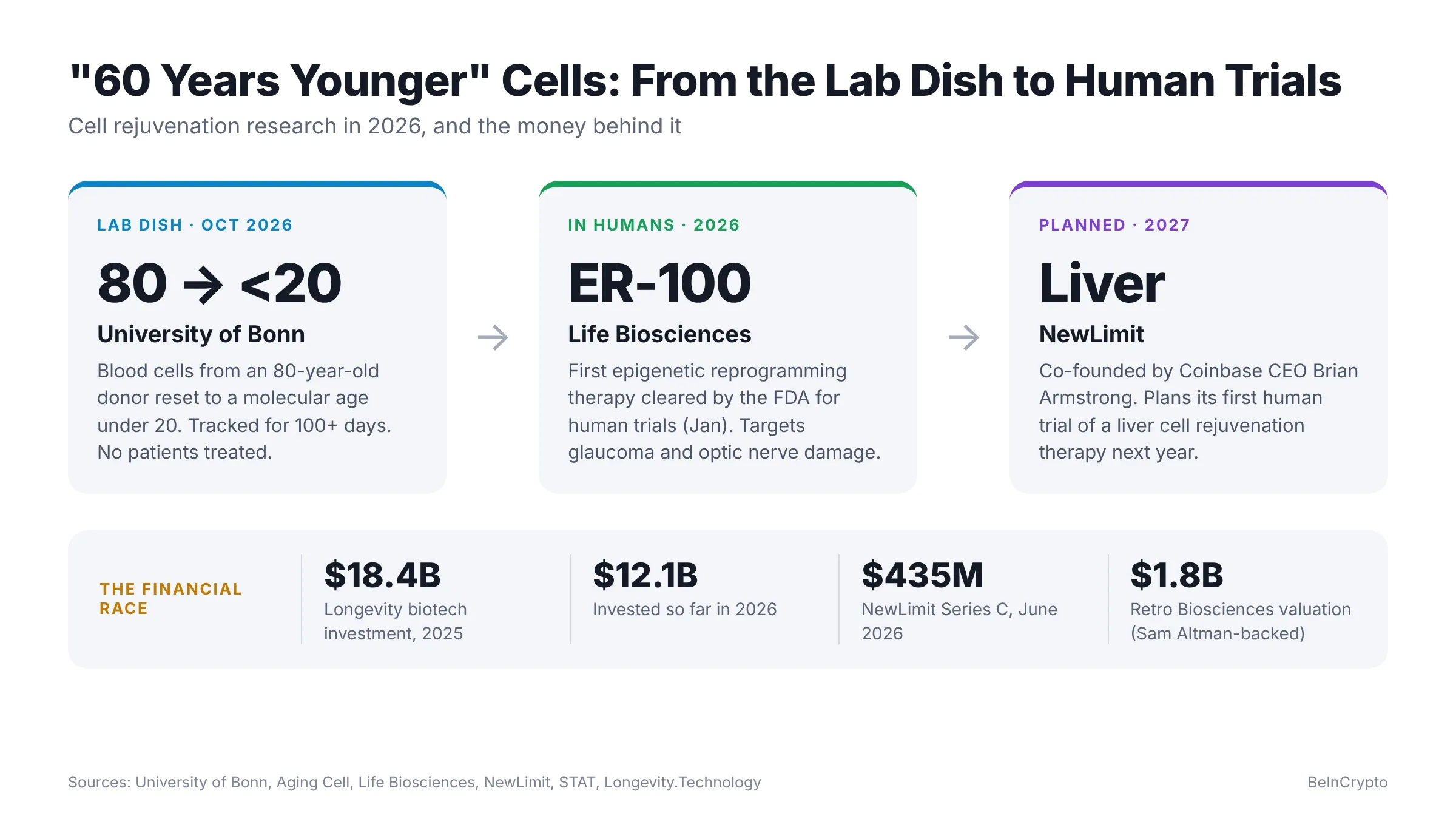
At the University of Bonn, researchers converted immature blood cells directly into neural stem cells, which can develop into brain cells. They then measured their age using epigenetic clocks, which track chemical changes to DNA associated with aging.
The clocks showed a remarkable reversal. More importantly, researchers could watch it happen.
Earlier techniques had reset cellular age rapidly by passing through an intermediate stem-cell stage. Bonns method skipped that step, allowing scientists to observe rejuvenation gradually.
“In our approach, rejuvenation occurred gradually and could be tracked for over 100 days,” said Professor Oliver Brüstle, who led the research.
That gives scientists time to investigate which substances accelerate or interrupt the process. It could eventually help researchers understand diseases such as Alzheimers, where aging is a major risk factor.
However, the experiment has yet to establish whether this process can safely treat disease in people.
The First Human Test Is Already Underway
In January, US regulators cleared Life Biosciences to test ER-100, an experimental treatment designed to rejuvenate damaged cells in the eye.
The company has since reported its first human results.
Three glaucoma patients tolerated the treatment through 56 days. Two showed preliminary improvements in vision tests. The findings, released on October 8, remain limited to a tiny, uncontrolled safety trial.
The approach differs from Bonns experiment, although both aim to reset age-related cellular processes.
Whether those changes produce lasting improvements in human health remains unknown.
The Billion-Dollar Race to Reverse Aging
Investors are already committing enormous sums to that possibility.
Longevity biotech attracted a record $18.4 billion in 2025, compared with $4.7 billion in 2024. Another $12.1 billion had been invested by mid-September 2026.
Coinbase co-founder Brian Armstrongs NewLimit raised $435 million in June, with Eli Lilly Ventures among its backers. It plans to begin human testing of a therapy targeting aged liver cells in 2027.
Sam Altman-backed Retro Biosciences reached a $1.8 billion valuation in May and is already testing an experimental Alzheimers pill.
Altos Labs has raised $3 billion to pursue cellular rejuvenation, while crypto-funded VitaDAO has supported more than 30 longevity projects.
These companies are pursuing different approaches to age-related disease. All face the difficult task of showing that their treatments work safely in people.
The Bonn experiment offers researchers a new way to investigate that question. Its molecular clocks have already moved backward by six decades.
Whether medicine can turn those laboratory findings into healthier years of human life is the much bigger test.