






SpaceX has expanded its partnership with NVIDIA to power Starmind, a proposed network of orbital data centers designed to process artificial intelligence workloads in space.
Summary
- SpaceX will use NVIDIAs Vera Rubin platformfor its planned Starmind satellite network.
- The company has requested FCC approval for up to one million orbital data-center satellites.
- NVIDIA says its Space-1 module provides up to 25 timesthe AI compute of an H100 GPU.
- SPCX gained 9.8%, while NVIDIA shares rose 2.5%following the announcement.
SpaceX adds NVIDIA chips to Starmind network
SpaceX plans to equip its Starmind satellites with NVIDIA‘s Rubin graphics processing units and Vera central processing units. The hardware forms part of NVIDIA’s Space-1 platform, which was developed for AI processing and other computing workloads in orbit.
https://twitter.com/nvidia/status/2084733460690903204
The partnership expands NVIDIAs list of space-computing customers after the chipmaker introduced the platform in March. Its initial launch partners included Aetherflux, Axiom Space, Kepler Communications, Planet Labs, Sophia Space and Starcloud.
SpaceX was not included in the original announcement but has now joined the companies working with NVIDIA on orbital computing. Musk later said SpaceX would build its AI infrastructure exclusively on NVIDIA platforms and described Vera Rubin as the strongest available option.
You might also like:
CLARITY Act misses Senate agenda as deadline nears
The companies also plan to jointly design computing payloads for future satellites, according to reports following SpaceXs investor call.
NVIDIA says its Space-1 Vera Rubin module combines GPUs, CPUs and high-bandwidth connections in a system designed for the power and weight limits of satellites. It can run large language models and process data in orbit instead of transmitting all raw information back to Earth.
One million satellites still need FCC approval
SpaceXs broader plan remains subject to regulatory approval in the United States. The company filed an application in January seeking permission to launch and operate as many as one million non-geostationary satellites.
The proposed system would operate between 500 and 2,000 kilometers above Earth. SpaceX said optical links would connect the satellites through a high-capacity network capable of moving data between orbital computing nodes.
The Federal Communications Commission accepted the application for filing in February and opened it for public comment. That procedural decision did not constitute final approval, correcting reports that the FCC had already authorized the full constellation.
The requested scale is far larger than the existing satellite population around Earth. It could also face questions involving orbital congestion, collision risks, radio interference and effects on astronomical observations.
SPCX and NVIDIA shares rally
SPCX closed Tuesday at $125.33, up $10.80, or 9.43%, after investors responded to the NVIDIA partnership ahead of SpaceXs earnings report.
However, the stock reversed course after the closing bell. SPCX fell 6.82% to $116.78 in after-hours trading as investors assessed the companys quarterly results and AI spending plans.
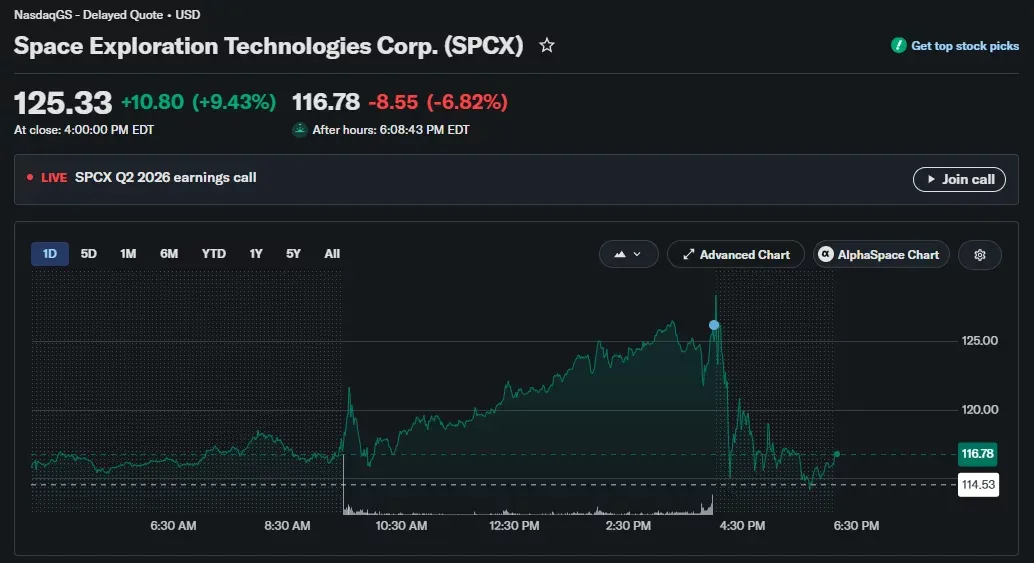
Source: Yahoo Finance
NVIDIA shares gained 3.03% to $212.91 during Tuesday afternoon trading. The move reflected investor expectations that orbital data centers could create another market for the chipmakers AI computing hardware.
NVIDIA says its Space-1 Vera Rubin module can provide up to 25 times the AI computing power of an H100 GPU. The platform is designed for space-based inference, autonomous operations and real-time satellite-data processing.
SpaceX faces cost and execution questions
Starmind could allow SpaceX to combine its launch capabilities, Starlink communications network and AI operations within one infrastructure project. However, deploying orbital data centers would require large investments in satellites, launches, power generation and thermal management.
SpaceX must also demonstrate that the system can operate safely alongside existing spacecraft before receiving final FCC authorization. Even if approved, the company would likely deploy the network in stages rather than launching the full requested number.
For U.S. investors, the NVIDIA agreement provides a clearer hardware path for SpaceXs AI strategy. The next tests will be regulatory progress, the cost of building the constellation, and whether orbital computing can produce enough revenue to justify the required spending.