





Disclosure: The views and opinions expressed here belong solely to the author and do not represent the views and opinions of crypto.news editorial.
As the scandal continues to unfold and experts examine just how severely top officials have compromised US national security in that Signal chat leak—and embarrassed themselves through controversial post-statements—I want to take a closer look at one particular episode from the story.
At first, the White House denied that the chat ever existed. But when it became clear that there was too much evidence to refute, they shifted tactics, denying that the chat ever contained any classified information of national security significance. And indeed, what proof can journalist Jeffrey Goldberg present after leaving that chat? Moreover, the chat was set to self-destruct messages after a period of time. So imagine a court hearing where parties are required to present evidence, and the only available proof consists of screenshots—in other words, virtually nothing, as such evidence is almost impossible to verify.
The answer is rather simple—if the journalist had taken care to properly preserve such evidence. He could prove that he had access to sensitive information at a time when he should not have, by publishing cryptographic hash sums of that information. Had he not been in the chat, he would not have known when and where they were planning to strike Yemen, who the target was, and so forth. Certain details may become public later, but not at the time the chat occurred—correct?
The solution lies in a cryptographic method known as proof of existence without disclosure. It involves two basic elements: cryptographic hashes and reliable timestamps. This can be done on blockchain manually—if one knows the process—or through a variety of applications and services offering blockchain-based timestamping proofs.
Here‘s how it works: you write a message (for example, by copying and pasting from the chat), generate a hash sum of the message, publish it on a blockchain, and save the private key for the address used to publish it. You’ll later need this private key to prove that it was your address (i.e., you personally) that published the hash, and thus that you had knowledge of the original message at that time. A social media account might also serve a similar function, but remember that social platforms are centralised systems—vulnerable and, unlike blockchains, not immutable.
So, there it is—a note for all journalists who may one day need to prove the existence of a fact without revealing its contents.
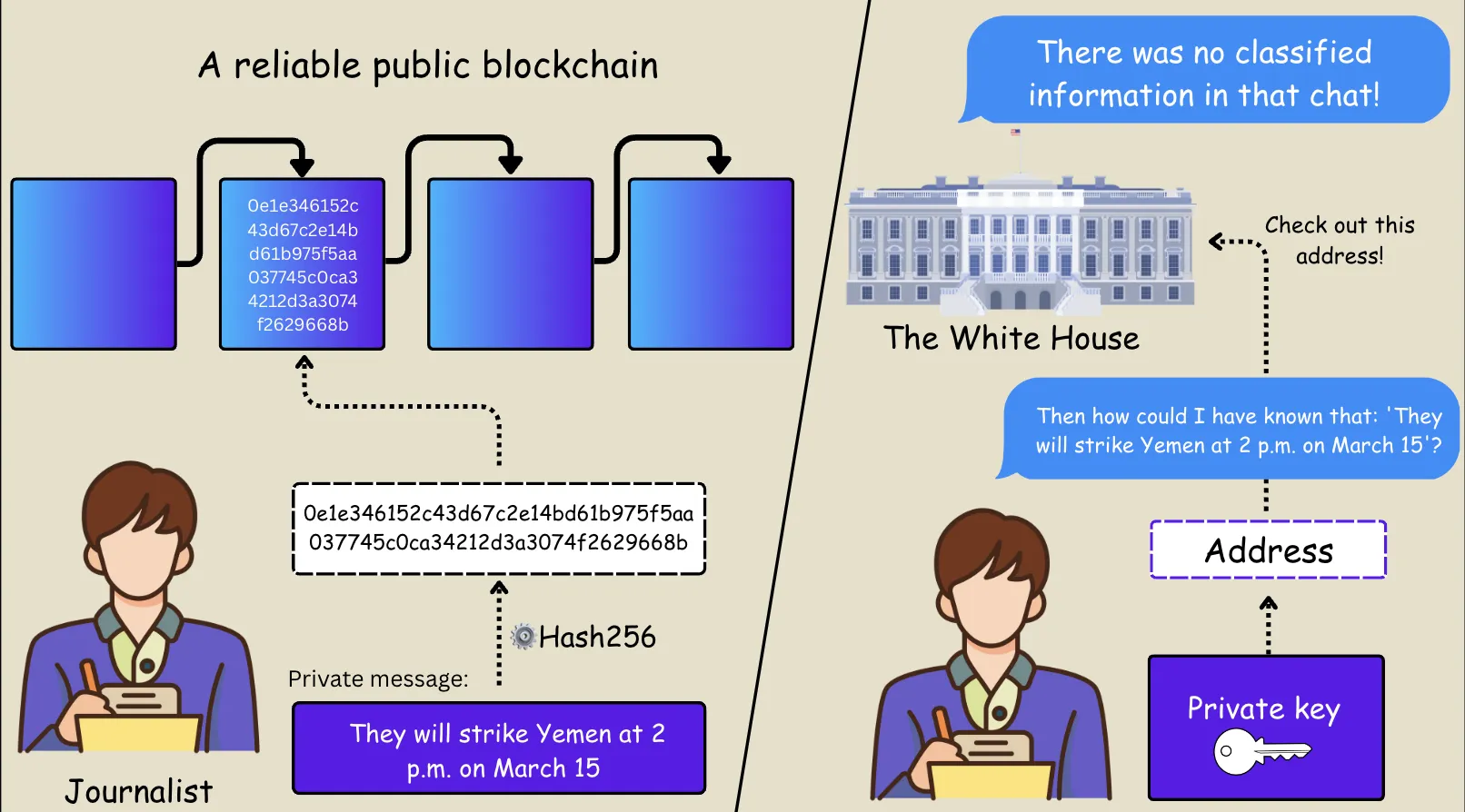
Process diagram: Proof of existence using blockchain | Source: Courtesy of the author
This process creates an undeniable, timestamped record confirming that a specific original message existed and was known to the publisher at the time the blockchain transaction was confirmed—all without revealing the content publicly until the journalist chooses to do so.