In his annual letter to his shareholders, J.P. Morgan Chairman and CEO Jamie Dimon addressed the status of regulations towards Bitcoin and cryptocurrencies in the United States. At the beginning of the letter, Dimon calls 2020 a “strong” year for the banking institution in spite of the pandemic Covid-19.
Dimon seems to have changed his stance, as have other executives in the banking sector, after giving statements against Bitcoin and cryptocurrencies. In a section dedicated to the inability of the United States to “deal” with its past, he states that the country has been “distracted” about its future.

In that sense, Dimon points out 3 “serious emerging issues”: shadow banking, financial information management, and the legal framework on cryptocurrencies. J.P. Morgan executive calls on regulators and financial system actors to take a more active stance, Dimon said:
“Regulators need to decide what they want included in the regulatory system – and what they dont want included (…). We need to recognize that if a regulated system has higher capital requirements than the market demands, then the product will move outside of the regulated system.”
U.S. losing edge on Bitcoin?
The U.S. banking system holds close to $4 trillion in cash o Treasury securities. JP Morgan‘s CEO wonders if the bank shouldn’t use that liquidity to “help the economy grow”. However, he claims there are many obstacles that prevent this capital from “actually” reaching the banks or the “broader” economy.
Therefore, he reaffirms his argument that regulations in the United States must undergo “calibration”. Dimon wrote:
“This calibration will be one of the main factors in determining what ends up in the regulatory system – and what doesnt. It is a fine balance. Too much capital and liquidity could possibly slow down the economy and push lots more to the shadow banking system. Too little capital and liquidity could make banks riskier and more subject to failure.”
When referring to cryptocurrencies several members of different regulatory bodies in the U.S., from SEC Commissioner Hester Pierce or former OCC Brian Brook, have acknowledged that “well” regulated products are a benefit for all players in the economy.
Dimon agreed, adding that regulated assets “generally” have greater transparency, more scrutiny, and support.
In the United States, numerous institutions have called for the approval of an Exchange Traded Fund (ETF) for Bitcoin. In that way, institutional investors hope to gain exposure to the BTC.
If regulators continue to fail to recognize the growth of the crypto market, they could deepen the advantage that other countries, such as Canada, appear to be consolidating in the area.
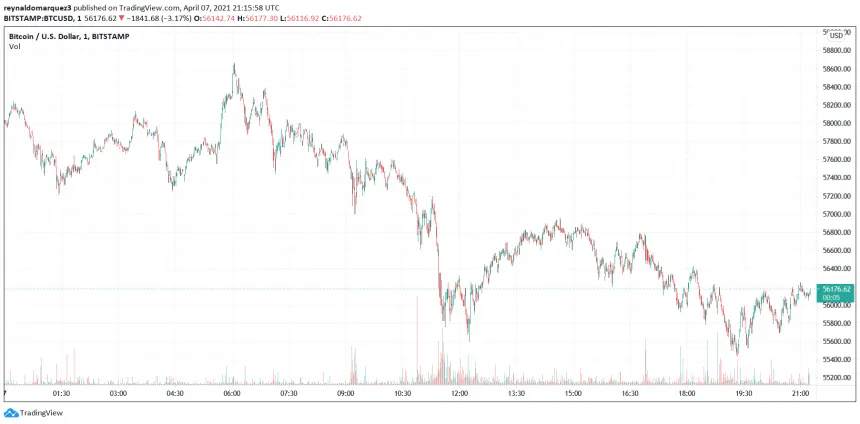
At the time of publication, Bitcoin is trading at $56,180 with 2.8% losses in the last 24 hours.