






Bitcoin dropping below $60,000 to a fresh cycle low has left investors searching for a culprit. According to Greg Cipolaro, global head of research at NYDIG, there probably isn't only one.
In a report last week, he argued that bitcoin and the broader crypto market is facing several overlapping headwinds that have been weighing on prices.
The AI trade sits near the top of his list as bitcoin is increasingly competing for capital with a sector that has become the market's dominant growth story.
The overlap between AI and crypto investors is larger than many assume, he argued. Both attract investors seeking exposure to emerging technologies and outsized returns. As AI-related stocks continue to outperform, capital followed and rotated from crypto, he wrote.
Investors are also preparing for what could be the largest tech IPO cycle in years. Companies such as SpaceX, OpenAI, Anthropic are widely expected to eventually go public, with SpaceX already deep into the process of making its debut. Large IPOs often prompt institutions to raise cash and reduce existing positions ahead of new offerings, creating a potential headwind for crypto demand, he wrote.
Crypto has also been grappling with a series of industry-specific concerns.
Treasury Secretary Scott Bessent's claim that U.S. authorities seized roughly $1 billion of Iranian-linked crypto assets raised questions about government reach into digital asset markets. Details remain limited, but the episode challenged one of crypto's core narratives for some investors, Cipolaro said.
Threat of quantum computing also returned to the conversation after researchers published new work showing that the computational resources required to attack widely used cryptographic systems may be falling faster than previously thought.
Then there is Strategy (MSTR) selling bitcoin.
The sale of 32 BTC, worth $2.5 million at the time, was insignificant from a supply perspective but carried more weight psychologically. Strategy has spent years acting as one of the market's most consistent buyers, Cipolaro said. Any suggestion that it could become a source of supply, he argued, forces investors to rethink an important pillar of the bull case.
Taken together, those developments could explain why bitcoin has struggled despite no obvious deterioration in underlying network activity or adoption trends.
“Viewed independently, none of these developments appears sufficient to drive a major correction in bitcoin,” Cipolaro wrote. “Viewed collectively, they help explain why price action has weakened despite the absence of a clear deterioration in underlying adoption metrics.”
Has bitcoin found a bottom?
Cipolaro's onchain analysis offers a mixed answer.
Several indicators are approaching levels that have historically coincided with major bottoms, he noted. Bitcoin's MVRV ratio has fallen to 1.2, close to the level where market value converges with investors' aggregate cost basis. The percentage of supply held in profit recently slipped below 50%, another metric often associated with capitulation.
Yet the drawdown itself remains relatively modest by historical standards.
Bitcoin fell down roughly 53% from its peak ($126,000 in October), a much shallower decline than the 75%-90% drawdowns seen in prior cycles, he pointed out.
There's also a time element: the previous three bitcoin bear markets lasted more or less a year from peak to trough, with the exception of its first-ever bear market ending in 163 days in 2011.
Friday's sub-$60,000 plunge came only 242 days after the peak.
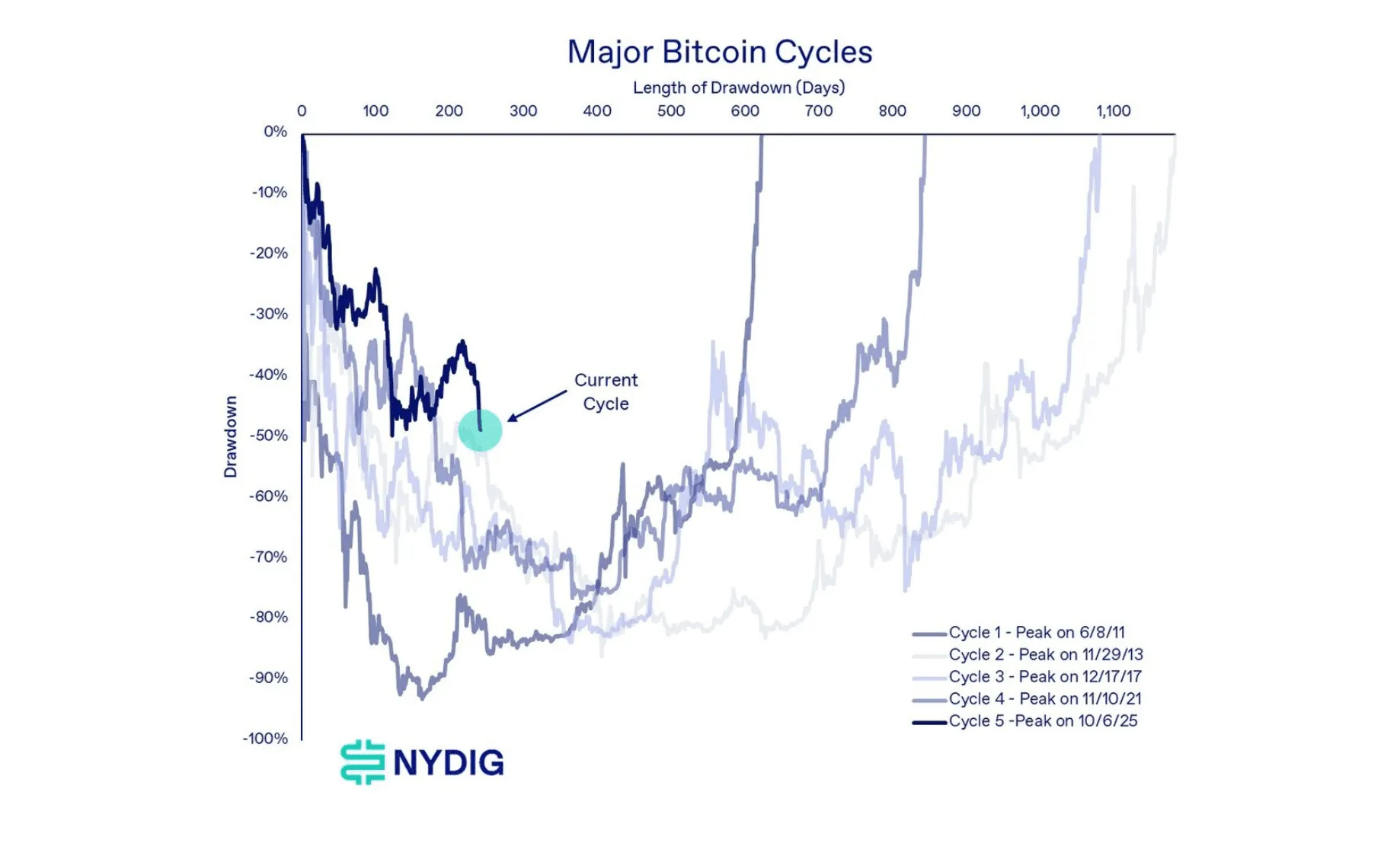
That means either institutional adoption has fundamentally changed bitcoin's cycle behavior — or that the market simply hasn't reached a true capitulation phase yet.
“The onchain data suggests the market has undergone a meaningful reset,” Cipolaro wrote.
But whether the low is already in place “likely depends on whether institutional demand has structurally altered the cycle or merely delayed a deeper reset,” he added.