‘Decentralized blockchain is inevitable future’- Hunter Biden signals support for Bitcoin

The son of former U.S. President Joe Biden, Hunter Biden, has voiced support for blockchain and Bitcoin. In a recent post on X, Hunter Biden was asked his opinion on the current fiat financial system.  In response, he signaled support for Bitcoin and blockchains as an “inevitable future.” But he warned that incumbent banks will fight the disruption to death.  Source: X  His outlook was spot on for the ‘incumbents’ fierce opposition. So far, JPMorgan has vowed to rally banks to oppose the CLARITY Acts stablecoin yield deal.  But what‘s more surprising is Hunter Biden’s pro-crypto stance. This contrasted Joe Bidens administration and the general Democratic Party position.  Biden-era anti-crypto position  For the unfamiliar, the Biden-era SEC (Securities and Exchange Commission) intensified enforcement actions against the sector.  During this period, nearly every top player across various vertical segments (from centralized exchanges to DeFi platforms) was investigated or charged. The platforms include Binance, Coinbase, Uniswap, MetaMask, Ripple, Aave, and more.  Most were investigated for money laundering and facilitating unregulated security offerings. Several startups and crypto firms were also debanked and barred from the banking sector.  Effectively, any bank or financial firm that tried to custody crypto assets became a target. Attempts to repeal this move with bipartisan support were vetoed


06-07

DCA Crypto: How to Survive Crypto Crashes with Dollar Cost Averaging and Invest for the Long Term

Bitcoin has done it again: From an all-time high of around $120,000, it has dropped to about $60,000 within a few months – a decrease of around 50%. Those who invested at the peak are now staring at a halved portfolio. However, those who invested with a clear plan and the right investment strategy are already familiar with this scenario from previous cycles and know: Right now is when the foundation for future returns is being laid.  Key InsightsBitcoin fell from about $120,000 to around $60,000 in 2025/2026 – a decline of about 50%, which is historically not unusual in the crypto space (comparable to 2017/18 and 2021/22).Dollar cost averaging (DCA) is a proven strategy where you regularly invest a fixed amount – regardless of the current price. This smooths out your entry price and helps you avoid the trap of market timing.Large investment funds and pension funds operate on the same principle: they invest regularly over decades instead of reacting to short-term market fluctuations.During crash phases, you as an investor have three options: continue DCA consistently, partially shift into stablecoins, or pause your savings plan and wait for recovery signals.The perfect entry point is less important than having a clear

06-07

Korean Traders Pull $135M in XRP from Upbit, as Global Exchange Outflow Hits $321M

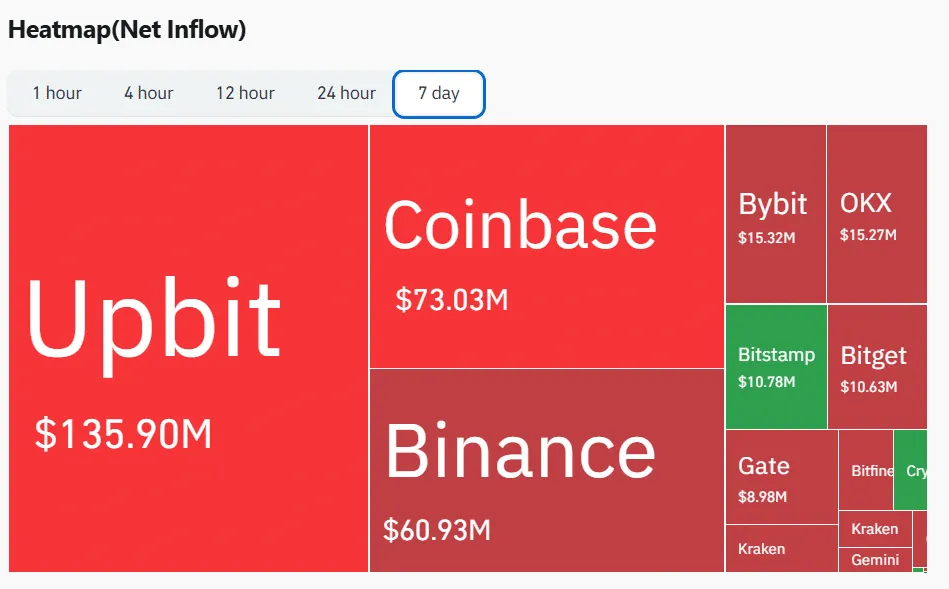
South Korean $XRP traders have led the charge, as investors pull $XRP tokens off exchanges despite the latest price crash.  In the past seven days, traders have withdrawn more than $321 million from crypto exchanges, pointing to investor resilience amid the ongoing decline. Of this figure, Upbit, Koreas largest exchange, accounts for the largest share at $135 million.  Key Points$XRP Investors have pulled more than $321 million worth of the token from exchanges over the past week.South Korean traders are leading the charge, having withdrawn $135 million in $XRP from Upbit.Exchange withdrawals often point to bullish investor sentiment, leading to reduced selloffs on these platforms.$XRP reserves on Upbit have collapsed this month due to these outflows.The trend comes despite $XRPs latest struggles, as prices retest the $1 psychological mark.  Global $XRP Exchange Outflows Hit $321M  Data from market analytics resource Coinglass confirms this ongoing trend. Specifically, over the past week, global exchanges have recorded a combined net outflow of $321 million worth of $XRP tokens, as investors pull their assets off centralized trading platforms.  For context, when exchange outflows spike, it means large amounts of crypto are being withdrawn from exchanges into private wallets. This indicates that holders are moving to self-custody rather than preparing

06-07

South Korean Traders Push Bitcoin Into Its Deepest Discount Since 2021

As bitcoin slipped to a 2026 low of $59,100, market data reveals that $BTC priced against the South Korean won has been changing hands at a discount. In fact, the Kimchi premium has vanished, and bitcoin has been trading below global market prices in South Korea for nearly a month.  Key Takeaways:Bitcoin hit a 3.1% KRW discount on June 1, its deepest gap since February 2021.Upbit logged $1.21B on June 6, yet $BTC traded 2.46% below global prices.SK Hynix gained 1,000%+ as AI stocks rallied; $BTC demand may stay muted.  Nearly a Month of Discounts Signals a Dramatic Shift in Korean Bitcoin Demand  For bitcoin pricing in South Korea, 2026 has delivered an unusual twist, with a substantial share of the year marked by pronounced discounts rather than the countrys customary premium. According to Cryptoquant metrics, the discount trend first emerged at the beginning of March and has persisted ever since, with the first week of June recording the deepest discount of the year.  Since May 13, 2026, bitcoin has traded at a discount in South Korea every day except May 19, marking a stretch of nearly 24 consecutive days. June 1 registered the deepest discount of 2026, as $BTC priced against the South

06-07

Will Solana price slide to $50 next as whales cut exposure?

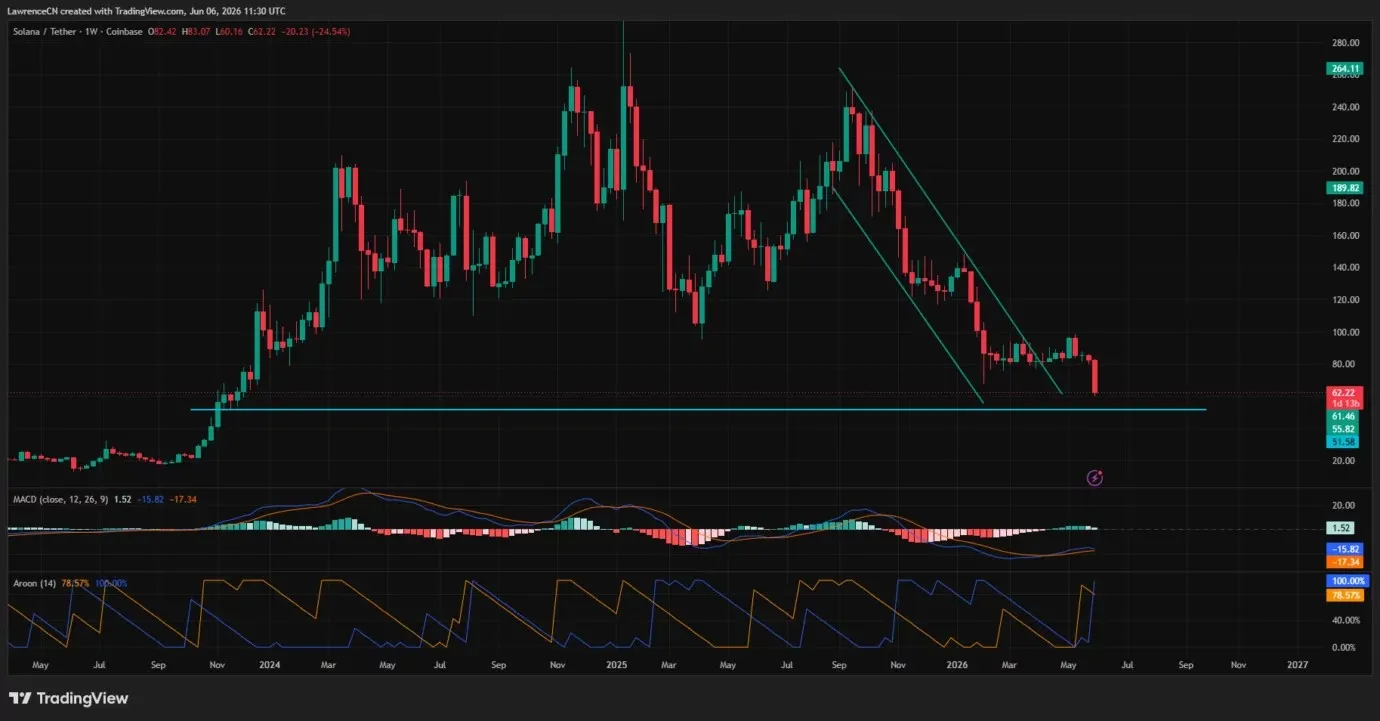
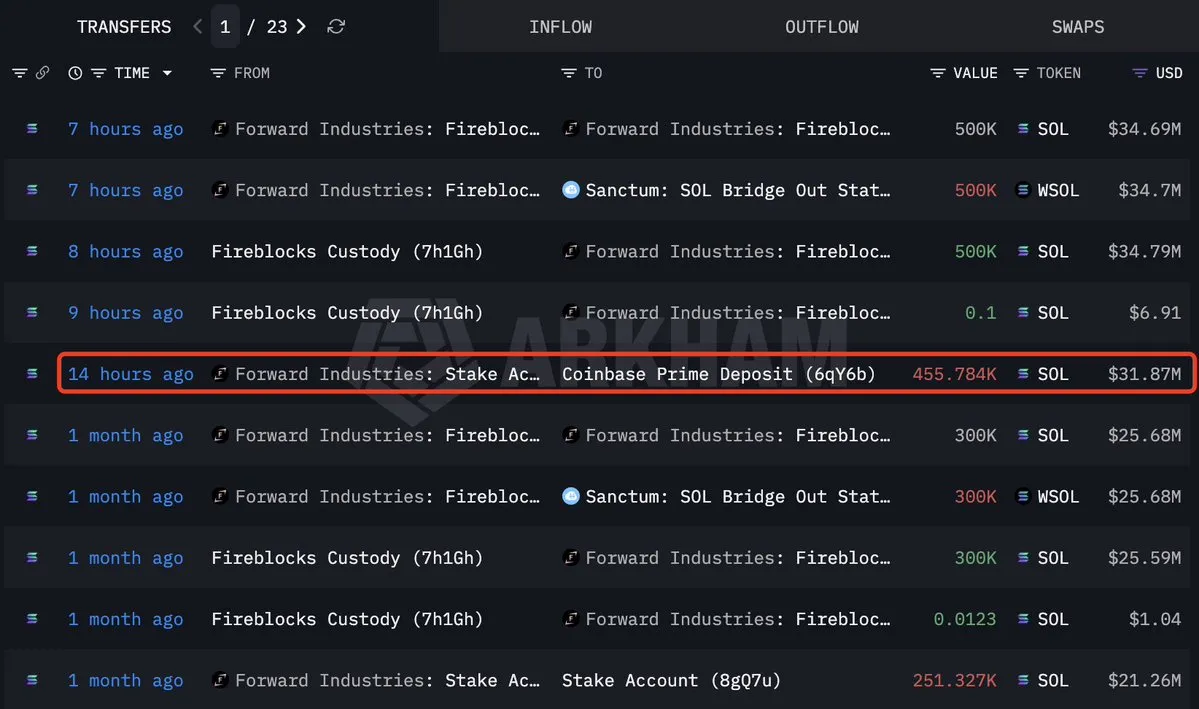
Solana price has fallen to a multi-year low as a major corporate holder moved $31.9 million worth of $SOL to Coinbase Prime, adding to fears that whales are reducing exposure during the market selloff.  According to data from crypto.news, Solana ($SOL) traded near $62 on June 6 after briefly falling to the $60 area. The token has lost roughly 24% over the past week, more than 30% over the past month, and about 50% since the start of the year as traders continued reducing exposure to risk assets amid a broader crypto market selloff.  Large holders have added to concerns about the markets outlook. According to blockchain analytics platform Lookonchain, Forward Industries transferred 455,784 $SOL worth approximately $31.9 million to Coinbase Prime after a month of inactivity.  Since adopting a Solana treasury strategy in September 2025, the company has spent roughly $1.59 billion acquiring 6.83 million $SOL at an average price of $232. Lookonchain estimates those holdings are now worth about $458.6 million.  The transfer does not confirm an outright sale, but traders frequently monitor deposits to institutional trading venues for signs that large investors may be preparing to reduce positions. The transaction arrived as $SOL traded near its lowest levels since 2024 and

06-07

‘More stable returns’ – Ethena expands RWA exposure with AAA-rated CLO funds

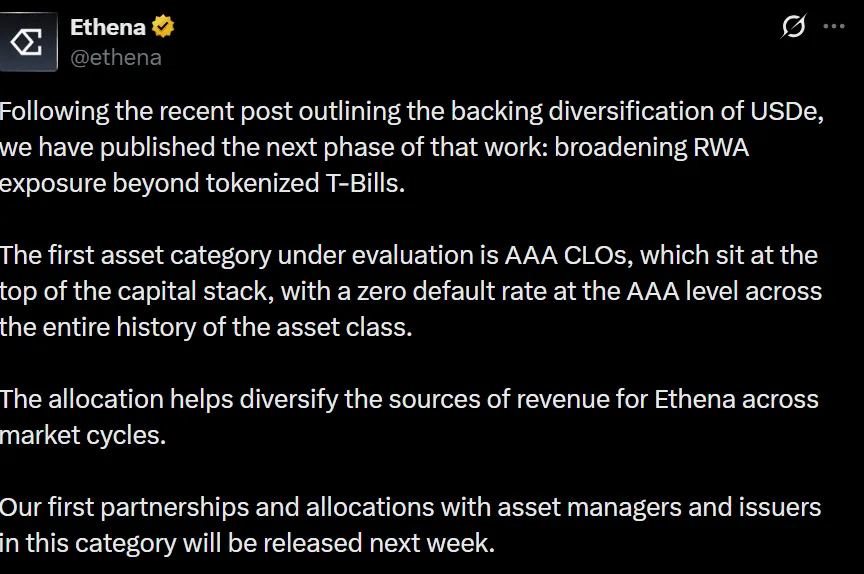
Ethena protocol has begun expansion to RWA (real-world asset) tokenization to boost yields and decouple from crypto market cycles. On Friday, the firm behind the yield-paying stablecoin $USDe said,  The first asset category under evaluation is AAA CLOs, which sit at the top of the capital stack, with a zero default rate at the AAA level across the entire history of the asset class.  Source: X  Collateralized Loan Obligations (CLOs) are a pool of loans from individual companies handled by asset managers. Think of it as an ETF index tracking different stocks of various companies and offered to investors. But instead of tracking stocks, CLOs track pooled corporate loans.  Now, the AAA mark is the highest evaluation score rating firms like Moodys can place on such financial products. The AAA rating means the product has the lowest level of default or high credit quality.  Why Ethena is betting on CLOs  Beyond credit quality, Ethena is seeking an RWA asset with high liquidity and a low downside profile. According to the team, CLOs, especially the Janus Henderson Anemoy AAA CLO Fund, fit this criteria.  Notably, during the financial crisis, like the COVID-19 era and high Fed interest rates, the broader CLO sector only fell 8% and 2%, respectively.

06-06

Why Did Bitcoin Crash? On-Chain Data Points To One Missing Ingredient

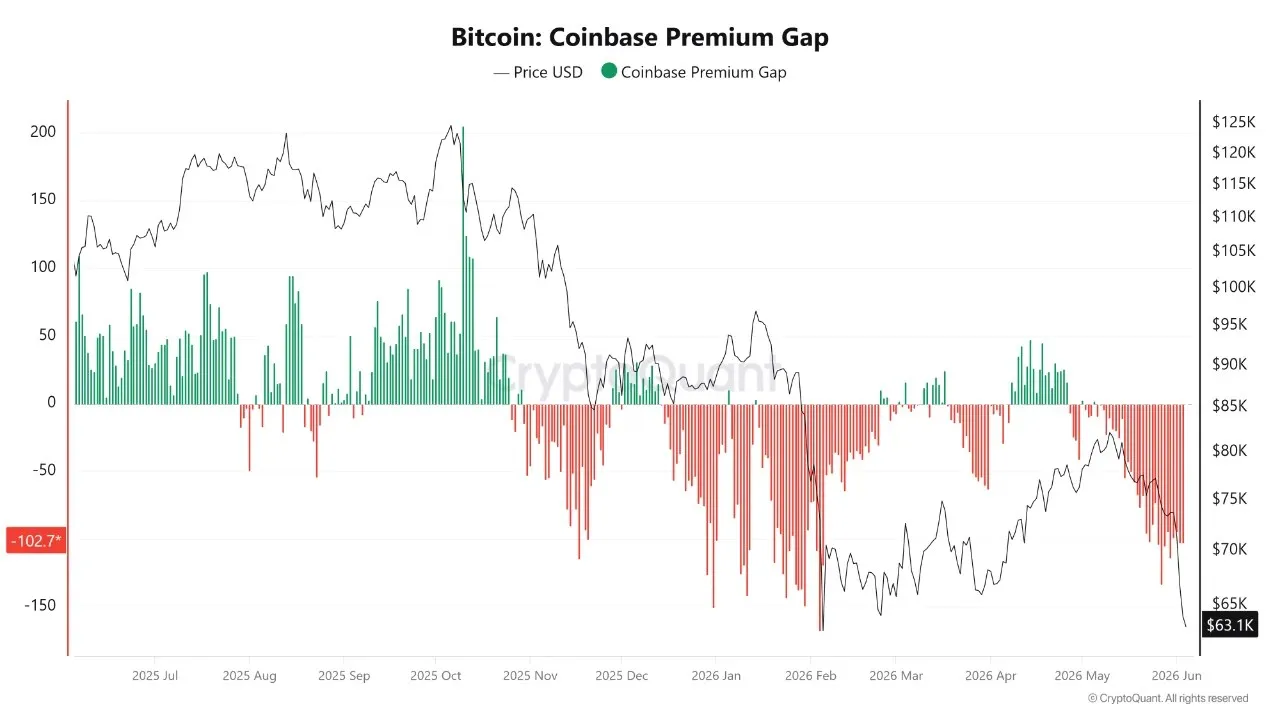
Bitcoin is struggling as the price tests $62,000 as support — a level that would represent a significant extension of the correction from the cycle highs and a test of the structural foundation that bulls have been pointing to throughout the decline. The weakness is real and the selling pressure is persistent — and XWIN Research Japan has published an analysis that cuts through the competing macro narratives to identify what the on-chain data suggests is the actual driver of the current correction.  The explanations circulating in the market range from geopolitical tensions to Federal Reserve policy to Strategy‘s recent small Bitcoin sale. XWIN Research Japan’s CryptoQuant analysis suggests a simpler and more fundamental explanation: buyers disappeared.  The engine that powered Bitcoins 2024 to 2025 rally was not leverage, not retail momentum, and not speculative excess. It was consistent and sustained inflows into US spot Bitcoin ETFs — a structural demand source that absorbed supply methodically and provided the bid that supported progressively higher prices. In 2026, that engine reversed. ETF outflows increased while the Coinbase Premium remained negative for an extended period. Confirming that US institutional demand, the most durable and most significant category of buyer the market has ever seen,

06-06

Solana Treasury Bet Turns Sour: Firm Sits On $1.13B Unrealized Loss

Solana has been struggling with selling pressure as the broader market feels the weight of a correction that has tested support levels across the ecosystem. The price is under stress — and data from Arkham Intelligence has identified a specific institutional transaction that adds a direct supply dimension to the current weakness on one of the most closely watched blockchains in crypto.  Forward Industries — a publicly traded company that has been building a Solana treasury strategy, accumulating $SOL as a primary reserve asset in a model that draws direct comparison to MicroStrategys Bitcoin approach — has deposited 455,784 $SOL worth approximately $31.87 million to Coinbase Prime after a month of complete inactivity.  Forward Industries moves Solana to Coinbase | Source: Arkham  A company that has been building a $SOL treasury and has shown no exchange-directed activity for a full month, choosing this specific moment to move nearly $32 million worth of Solana to Coinbase Prime, describes a deliberate decision rather than routine portfolio management.  Whether the deposit represents preparation for selling, a financing arrangement, or strategic repositioning is the question the Arkham data raises — and the answer carries direct implications for Solanas ability to hold current support levels.  Forward Industries Is Sitting on

06-06

Bitcoin Falls Below $60,000 on Binance for First Time Since 2024

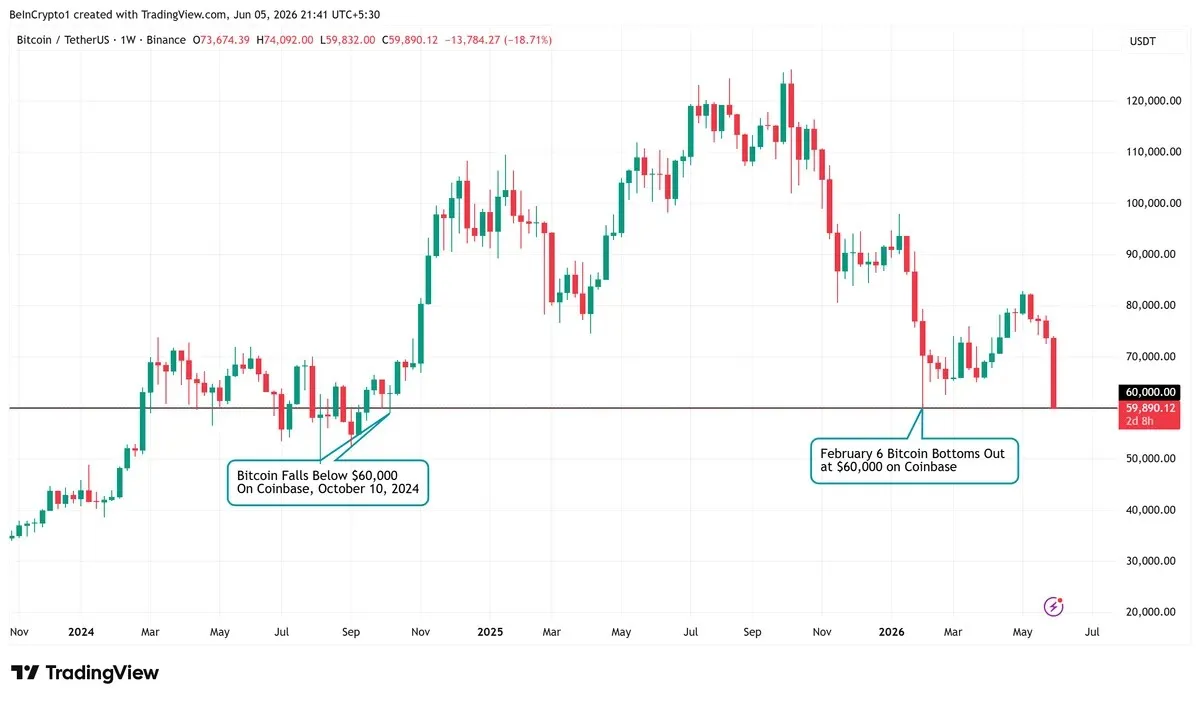
Bitcoin briefly dropped below the critical $60,000 mark on Binance on June 5, marking the pioneer cryptos first break beneath that level since October 2024.   The move comes amid a broader risk-off selloff across financial markets, as investors react to strong U.S. employment data, persistent fund outflows, and growing concerns over liquidity conditions.  Bitcoin Price Performance. Source: TradingViewBitcoin Loses Key Support as Market Pressure Intensifies  Bitcoin fell to a low below $60,000 during Friday trading, breaking a psychological support level that had largely held throughout 2026.  The crash saw $BTC bottom out at $59,750 on Coinbase and $59,799 on Binance against the US dollar (USD). Against USDT, the pioneer crypto bottomed out at $59,786 on Binance, as of this writing.  The drop represents the first confirmed move under $60,000 since October 10, 2024, when $BTC bottomed near $58,863 before recovering.  The decline pushed Bitcoin into a key technical zone that many traders have been watching for months, renewing debate over whether the market is experiencing a temporary sentiment shock or a deeper correction.  The latest decline follows a difficult stretch for digital assets. Bitcoin has lost more than 17% over the past week, while broader crypto markets have also faced heavy selling pressure.  Market participants pointed to

06-06

Bitcoin is Bleeding: Is It Too Early to Say “This is the Bottom”? 4 Reasons Behind the Decline

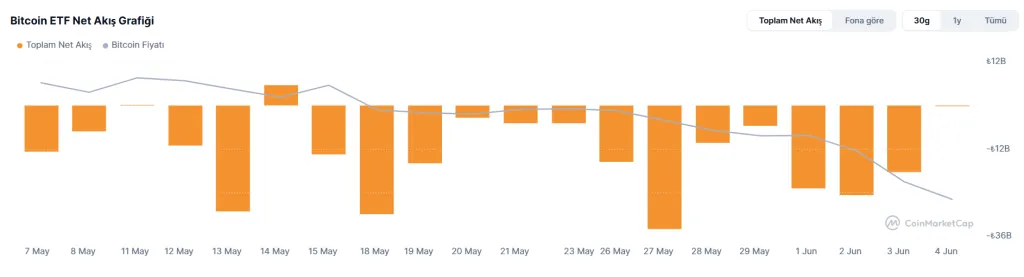
The cryptocurrency market started June with a very sharp correction. Bitcoin ($BTC), which had been trying to hold its ground and turn upwards for weeks, is bleeding dry due to successive selling pressure in recent days. The leading cryptocurrency, which quickly fell to the $60,400 mark, dragged the altcoin market along with it, causing a veritable “red bath.”  So, amidst the panic in the market, the only question on investors minds is: Has Bitcoin hit bottom, or will the decline deepen further?  Related News When Will Institutional Selling Pressure on Bitcoin End? What Does On-Chain Data Coinbase Premium Show?  What Triggered the Market? The 3 Big Reasons Behind the Decline  There isn‘t a single reason behind Bitcoin’s sudden pullback; a combination of macroeconomic factors and institutional actions brought the market to this point.Massive Cash Outflow from ETFs: US spot Bitcoin ETFs have experienced net cash outflows for 14 consecutive days. Total outflows exceeding $4.4 billion indicate a significant decrease in institutional risk appetite.Strategy and Whale Sales: The Bitcoin sale carried out by Michael Saylors company Strategy and the transfer of large amounts of $BTC by major whales to exchanges (especially Binance) amplified the selling pressure exponentially.Liquidation Earthquake in Futures Trading: With the downward break

06-05
1
...
580582
...
1000