NFL v. Kalshi at the Supreme Court: Sports Event Contracts, Swaps and State Gambling Law

The National Football League filed an amicus curiae brief on October 8, 2026 in Flaherty and Davenport v. KalshiEX, LLC, No. 26-299, asking the U.S. Supreme Court to grant review of the dispute between New Jersey officials and the prediction-market venue. The document does not mean the Court has already agreed to hear the case or ruled that Kalshis sports contracts are unlawful.What the NFL is asking the Court to decide  The question is whether federally listed sports event contracts count as swaps under the Commodity Exchange Act, potentially invoking exclusive CFTC jurisdiction and displacing state gambling oversight. The NFL sides with state regulators: it argues that contracts on game outcomes and individual events are essentially sports gambling, not ordinary derivatives used to hedge economic exposure or discover a financial price.  The brief is an outside-party legal submission, not a court decision or CFTC regulation. It supports the state officials petition for certiorari following litigation in the Third Circuit.Why this case matters to crypto and event-market platforms  Event contracts now appear next to crypto, equities and derivatives within major trading apps. A platforms ability to offer sports markets across U.S. states depends heavily on whether the product is characterized as federally regulated swaps

10-09انڈسٹری ریسرچ

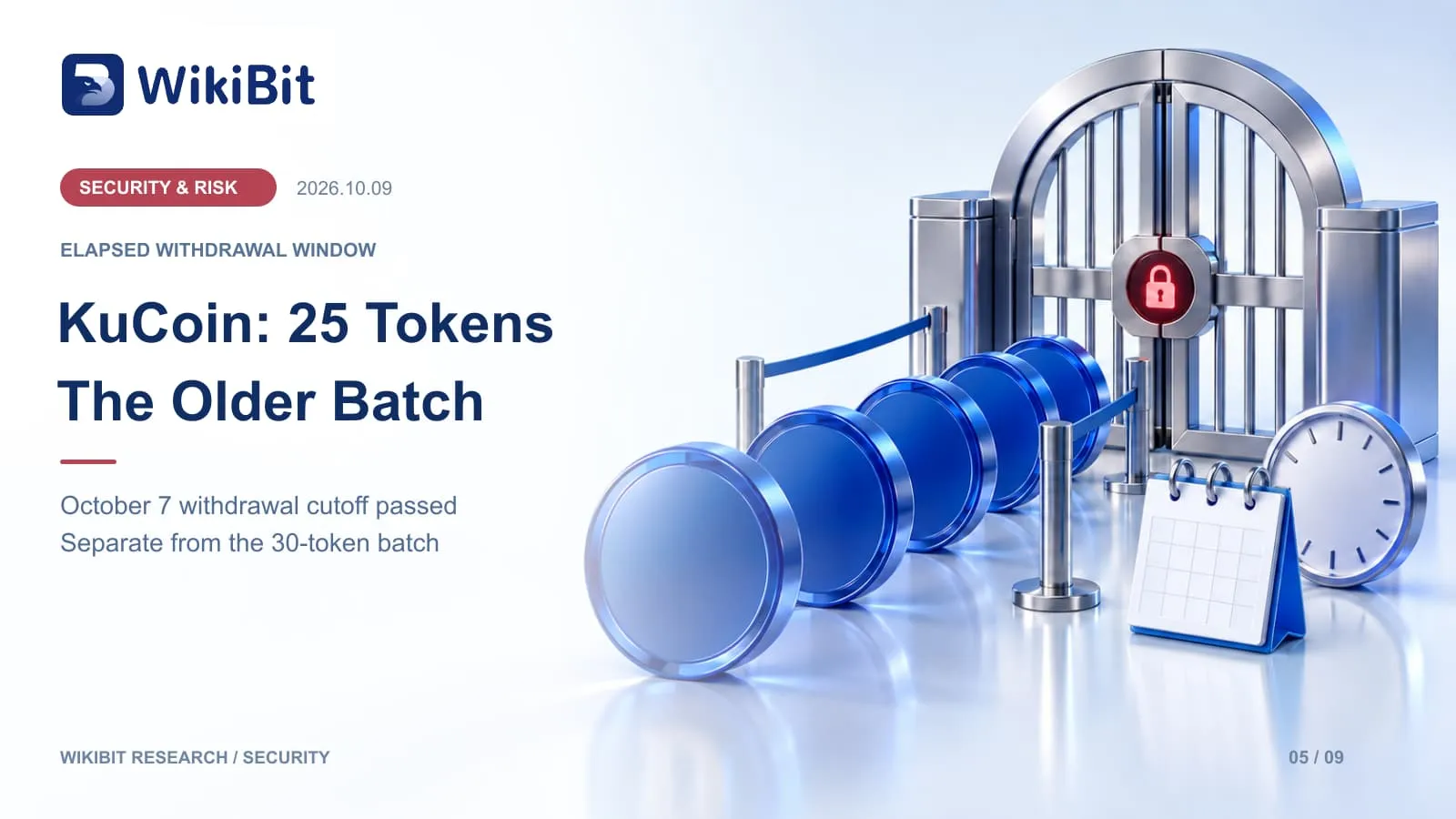
KuCoin’s Older 25-Token Delisting: Withdrawal Window Has Closed—Do Not Confuse It With the October 30-Token Batch

KuCoin users face two different delisting batches whose withdrawal dates must not be confused. The older batch covered 25 tokens, with trading already removed on September 7, 2026. KuCoins original September 3 announcement set the final normal withdrawal cutoff at October 7 at 08:00 UTC. That deadline has passed at the October 9 reporting cutoff.  This is a distinct event from KuCoins newer 30-token batch, which left spot markets on October 8 and has a November 9 scheduled withdrawal deadline. A user holding AUDIO, ACX, WAXP or REEF should not assume the newer November window applies.The 25 affected tokens  The official older batch includes ACX (Across), HYDRA, KARRAT, PORTALS, GAFI, SCOR, AUDIO (Audius), BLUM, HONEY, SN3, NOBODY, TSTBSC, HPOS10I, LVVA, MTRG (Meter Governance), EMYC, DUCK, J (Jambo), MOVA, BFC, WEN, FWOG, GAIN, WAXP and REEF.  A substantial part of this list consists of thin-liquidity tokens, but recognizable projects such as Across, Audius, WAX and Reef are also present. Being delisted from KuCoin is not proof that each underlying network or protocol has stopped operating.The three official dates  September 4 at 08:00 UTC: deposits were disabled. September 7 at 08:00 UTC: spot trading ceased and related orders were cancelled. October 7 at 08:00 UTC: the

10-09انڈسٹری ریسرچ

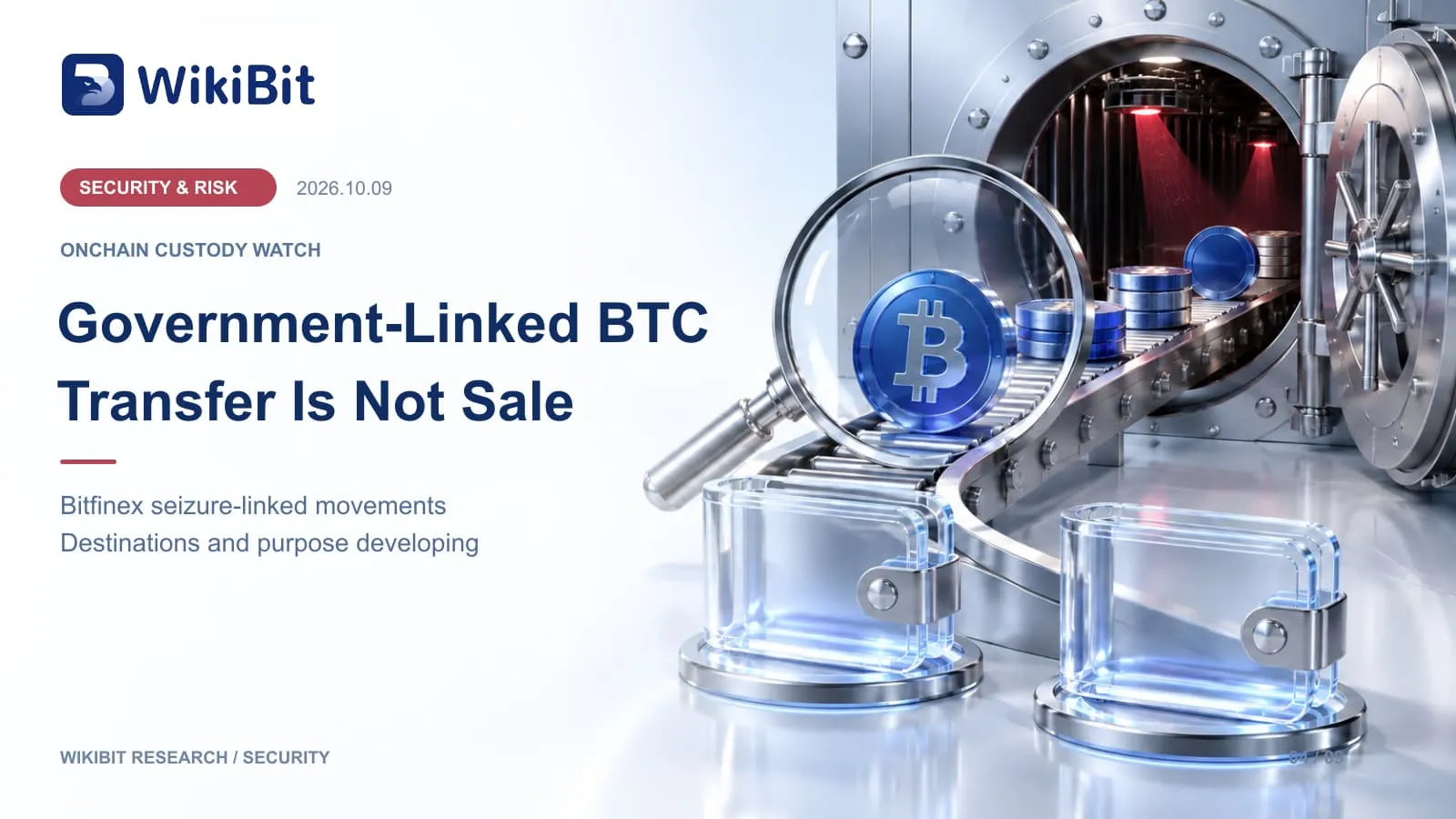
U.S. Government Moves $1 Billion in Bitfinex-Linked BTC: Transfer, Custody and Sale Are Different

On October 8, 2026, blockchain monitoring attributed an unusually large Bitcoin transfer to wallets associated with U.S. government seizures from the 2016 Bitfinex hack. Arkham-based reporting counted roughly 12,267 BTC, worth about $1.01 billion at the contemporaneous market price, sent to new, unlabeled Bitcoin addresses. The size makes the movement market-sensitive; the destination makes interpretation critical. A transfer is not proof that the government sold Bitcoin.What was observed on October 8  CoinDesk and Decrypt both reported the 12,267 BTC transfer and emphasized that the destination addresses were not identified as exchange deposit wallets. A government-associated source label is an analytics inference about wallet attribution; a new unlabeled destination provides no public confirmation of its ultimate owner or purpose. Neither the Justice Department nor the U.S. Marshals Service had supplied an explanation in the reporting reviewed for this briefing.Coinbase Prime movements are a separate observation  Galaxy Research and Cointelegraph described approximately 9,261 BTC, then worth about $770 million, moving to Coinbase Prime over the preceding two days. Part originated from known seizures, including some Bitfinex-related funds, while an additional 2,456 BTC was described as coming from previously unidentified holdings. This is an analyst classification and cannot be rewritten as the government officially announced

10-09انڈسٹری ریسرچ

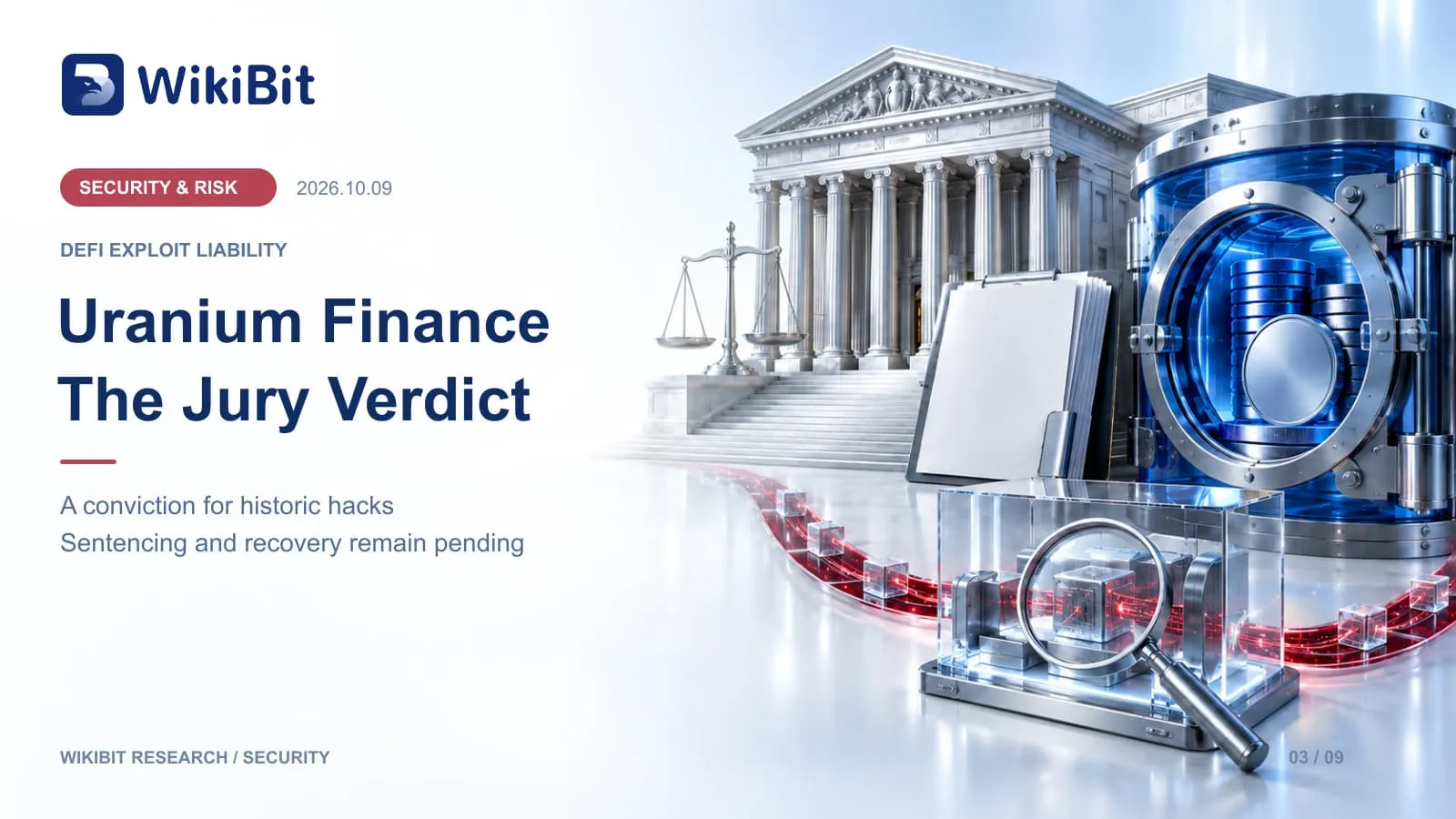
Uranium Finance 2026 Verdict: Spalletta Convicted Over $50M

A federal jury in Manhattan convicted cybersecurity consultant Jonathan Spalletta, also known as “Cthulhon” and “Jspalletta,” of computer fraud and money laundering related to two attacks against the decentralized exchange Uranium Finance in April 2021. The U.S. Attorneys Office for the Southern District of New York announced the decision on October 7, 2026, after a six-day trial before Judge Jed S. Rakoff.  The conviction is a new legal milestone for a years-old exploit, not a fresh October 2026 smart-contract theft. It also has a stronger evidentiary status than an indictment: jurors convicted Spalletta on every count charged.Two distinct exploits, not one rounded headline  April 8, 2021: prosecutors proved Spalletta repeatedly manipulated Uraniums reward-claim behavior, obtaining about $1.4 million of reward tokens from a liquidity pool. April 28: he exploited a separate liquidity-pool withdrawal-accounting flaw across multiple pools, obtaining about $53.3 million and leaving the platform unable to continue operating. Some publications round the aggregate to about $55 million; the court announcement provides the two-stage amounts and should control the timeline.How the first attack became a sham bounty  The DOJ recounts a written admission by Spalletta about exploiting a smart-contract bug and taking roughly $1.5 million. After the first attack, he pressured Uranium into

10-09انڈسٹری ریسرچ

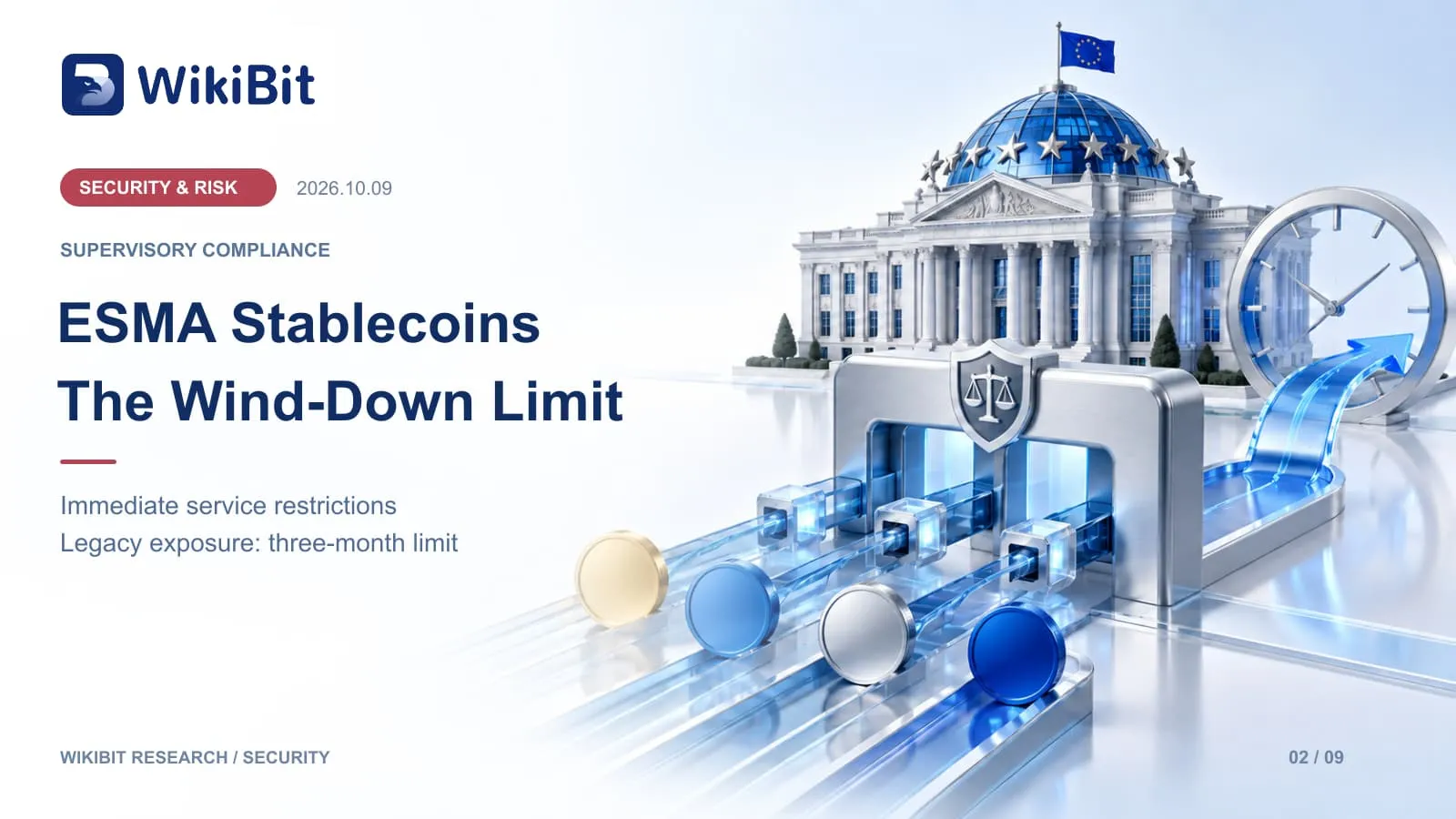
ESMA Stablecoin Opinion 2026: MiCA CASPs Face Three-Month Wind-Down

The European Securities and Markets Authority (ESMA) issued an opinion on October 8, 2026 telling national supervisors how MiCA-authorised crypto-asset service providers (CASPs) should handle stablecoins that do not satisfy the regulation. This is a current supervisory opinion, not the proposed future MiCA review amendments covered in WikiBits earlier report.  The central distinction is immediate restrictions on making non-compliant tokens available versus a supervised, time-limited wind-down of pre-existing customer exposures. ESMA says existing holdings should be remediated as soon as possible and no later than three months after publication, making January 8, 2027 the outside date implied by its October 8 publication. That is not permission for venues to keep growing such business until January.What ESMA issued—and who must act  ESMA document ESMA75-113276571-1742 concerns asset-referenced tokens (ARTs) and e-money tokens (EMTs) that are not MiCA-compliant. It instructs national competent authorities (NCAs) to ensure MiCA-authorised CASPs neither maintain, introduce nor facilitate EU clients access to such tokens through services. The regulated intermediary is the immediate supervisory target: exchange, broker, custody provider or portfolio manager, not every private individual holding tokens independently.The service perimeter is deliberately broad  The opinion names trading platforms, exchange of crypto-assets, execution and transmission of orders, placing, advice, transfers, custody and

10-09انڈسٹری ریسرچ

Abstracts shutdown exposes the gap between owning assets and being able to move them

Abstract, an Ethereum layer-2 network, says it will shut down on Dec. 15, 2026. In its Oct. 6 announcement, @AbstractChain told users to migrate their assets before that date or lose access to their funds.  The deadline tests a distinction that can disappear behind the phrase self-custody. A holder can retain ownership and the authority to approve transactions while losing the infrastructure needed to execute them. Cube, Inc., the company providing Abstracts services, makes that separation explicit in its updated terms: wind-down does not transfer assets to Cube or the other parties covered by its terms, but the end of normal processing ends transfer access through discontinued services.  A completed exit requires a supported asset route, access to the authorizing wallet, a controlled destination and every required processing or claim step.  Related Asset Ethereum ETH · $2,481.24 24-hour change: down 3.76%  A shutdown date is not every routes deadline  @AbstractChains announcement directs users to the Migration Hub at migrate.abs.xyz or the native bridge at native-bridge.abs.xyz. The public Migration Hub repeats the Dec. 15 notice and lists Native Bridge, Stargate, Relay, Jumper and project-specific instructions.  The general terms identify migration.abs.xyz as the official Hub and bridge.abs.xyz as the existing bridge interface. The Hub at that address also

10-09انڈسٹری

Bitcoin monthly ‘new money’ inflows near $5B as BTC price rally stalls

Bitcoin (BTC) price gains do not yet reflect enough new capital entering the market, analysis warns.  Key points:Rolling 30-day cumulative inflows of “new money” to Bitcoin reached $4.9 billion on Oct. 5, per Glassnode data.Existing investors still accounted for three-fifths of the $12.8 billion growth in realized cap in that period.Short-term holders accounted for more than 80% of profit-taking above $85,000.  Bitcoin capital inflows not responsible for realized cap growth  In the latest edition of its regular newsletter, The Week Onchain, crypto research platform Glassnode revealed that existing holders were behind much of Bitcoins recent upside.  “New money” inflows into Bitcoin — purchases by corporate treasuries, “stablecoin growth” and inflows to the US spot Bitcoin exchange-traded funds (ETFs) — totaled around $4.9 billion in the 30 days to Oct. 5.  Bitcoins realized cap, which values each coin at the price it last moved onchain, grew by $12.8 billion, more than twice as much over the same period.  “New money therefore covers less than two fifths of that rise. The rest is coins changing hands at higher prices among money already in the market,” Glassnode commented.  Bitcoin new money inflows vs. realized cap (screenshot). Source: GlassnodeBitcoin new money inflows vs. realized cap (screenshot). Source: Glassnode  Accompanying data shows that

10-09انڈسٹری

Cantor Fitzgerald faces Senate Democrats questions over Tether ties

US investment bank Cantor Fitzgerald is facing scrutiny from a Senate Democrat over its ties to Tether, with Senator Richard Blumenthal demanding records on the firm‘s partnership with the stablecoin issuer and how much Commerce Secretary Howard Lutnick’s family has made from the arrangement.  In a letter on Thursday, Blumenthal, the ranking Democrat on the Senate‘s Permanent Subcommittee on Investigations, asked Cantor chairman Brandon Lutnick to explain how it monitors Tether’s compliance with banking and sanctions laws, along with all communications involving Howard Lutnick about Tether, including after he left Cantor.  “Disturbingly, Cantor Fitzgerald‘s lucrative business arrangements with Tether come at the expense of America’s national security,” Blumenthal wrote.  The inquiry puts Cantor‘s lucrative partnership with Tether under scrutiny. Cantor Fitzgerald acquired rights to a 5% stake in Tether in 2024 and reportedly custodies tens of billions of Tether’s US Treasury bill reserves. Blumenthal alleges that Cantors stake in Tether increased in estimated value from $600 million to $10 billion since Trump returned to office, and that Howard Lutnick received more than $250 million in that period, including a $192 million distribution from Cantor Fitzgerald.  The letter follows a report by the Democratic investigators on the Senate Permanent Subcommittee on Investigations last month alleging

10-09انڈسٹری

Cantor Fitzgerald faces Senate Democrats probe over Tether ties

US investment bank Cantor Fitzgerald is facing scrutiny from a Senate Democrat over its ties to Tether, with Senator Richard Blumenthal demanding records on the firm‘s partnership with the stablecoin issuer and how much Commerce Secretary Howard Lutnick’s family has made from the arrangement.  In a letter on Thursday, Blumenthal, the ranking Democrat on the Senate‘s Permanent Subcommittee on Investigations, asked Cantor chairman Brandon Lutnick to explain how it monitors Tether’s compliance with banking and sanctions laws, along with all communications involving Howard Lutnick about Tether, including after he left Cantor.  “Disturbingly, Cantor Fitzgerald‘s lucrative business arrangements with Tether come at the expense of America’s national security,” Blumenthal wrote.  The inquiry puts Cantor‘s lucrative partnership with Tether under scrutiny. Cantor Fitzgerald acquired rights to a 5% stake in Tether in 2024 and reportedly custodies tens of billions of Tether’s US Treasury bill reserves. Blumenthal alleges that Cantors stake in Tether increased in estimated value from $600 million to $10 billion since Trump returned to office, and that Howard Lutnick received more than $250 million in that period, including a $192 million distribution from Cantor Fitzgerald.  The letter follows a report by the Democratic investigators on the Senate Permanent Subcommittee on Investigations last month alleging

10-09انڈسٹری

XRPL’s $1.34 billion stablecoin base doesn’t tell us how much XRP users need

Tracked stablecoins on the XRP Ledger totaled $1.338 billion on Oct. 7. For XRP holders, the critical question is how much activity uses the token as principal, and how long users or intermediaries need to hold it.  Related Asset XRP #5 XRP · $1.39 24-hour change: down 2.43% Loading price history… 24H Down 2.43% 7D Down 7.13% 30D Down 2.25%  Fees and account reserves require XRP, the ledgers native token. Stablecoins, tokenized funds and securities records can keep their principal in other assets. Bridge routes and XRP-funded liquidity pools create a separate reason to hold XRP: inventory available to fill trades or payments.  DefiLlamas XRPL dashboard showed Ripples dollar stablecoin RLUSD accounting for 93.17% of tracked stablecoins. The same snapshot reported $43.44 million in value locked in decentralized finance, $3.91 million in 24-hour decentralized-exchange volume and $528 in 24-hour chain fees.  Related Company Ripple Financial technology and enterprise blockchain company  Each reading measures a different part of the ecosystem. Stablecoin supply is a balance, trading volume is turnover, and fees are a cost. Adding them together would mix those units and could count the same assets more than once.  Related Asset Ripple USD RLUSD · Stablecoin  Ripples Oct. 1 transparency figures put total RLUSD circulation at $2,509.8

10-09انڈسٹری
1
...
255257
...
1000